RS Aggarwal Class 9 Solutions Chapter 14 Statistics Ex 14H

RS Aggarwal Class 9 Solutions Chapter 14 Statistics Ex 14H

These Solutions are part of RS Aggarwal Solutions Class 9. Here we have given RS Aggarwal Solutions Class 9 Chapter 14 Statistics Ex 14H.

Other Exercises

Question 1.
Solution:
Arranging the given data in ascending order :
0, 0, 1, 2, 3, 4, 5, 5, 6, 6, 6, 6
We see that 6 occurs in maximum times.
Mode = 6 Ans.

Question 2.
Solution:
Arranging in ascending order, we get:
15, 20, 22, 23, 25, 25, 25, 27, 40
We see that 25 occurs in maximum times.
Mode = 25 Ans.

Question 3.
Solution:
Arranging in ascending order we get:
1, 1, 2, 3, 3, 4, 5, 5, 6, 6, 7, 8, 9, 9, 9, 9, 9
Here, we see that 9 occurs in maximum times.
Mode = 9 Ans.

Question 4.
Solution:
Arranging in ascending order, we get:
9, 19, 27, 28, 30, 32, 35, 50, 50, 50, 50, 60
Here, we see that 50 occurs in maximum times.
Modal score = 50 scores Ans.

Question 5.
Solution:
Arranging in ascending order, we get:
10, 10, 11, 11, 12, 12, 13, 14,15, 17
Here, number of terms is 10, which is even
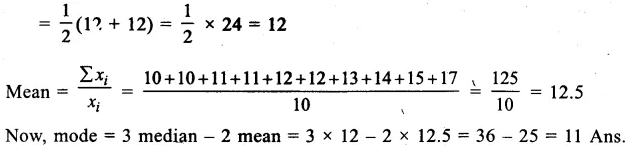
∴ Median = \(\frac { 1 }{ 2 } \left[ \frac { 10 }{ 2 } th\quad term+\left( \frac { 10 }{ 2 } +1 \right) th\quad term \right]\)
= \(\frac { 1 }{ 2 } \) (5th term + 6th term)
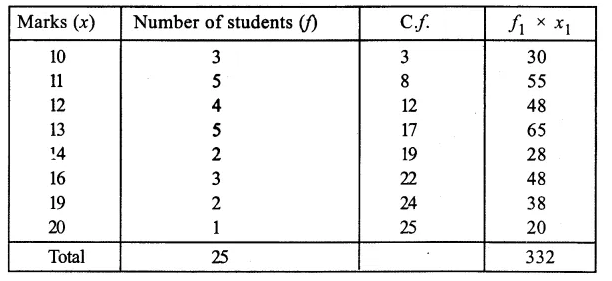
RS Aggarwal Class 9 Solutions Chapter 14 Statistics Ex 14H Q5.1

Question 6.
Solution:
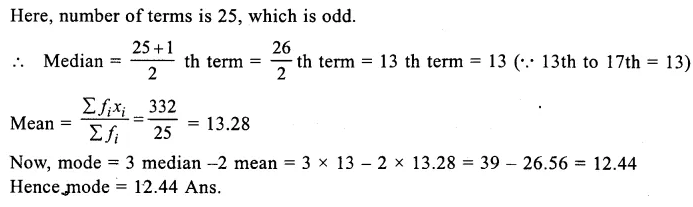
RS Aggarwal Class 9 Solutions Chapter 14 Statistics Ex 14H Q6.1
RS Aggarwal Class 9 Solutions Chapter 14 Statistics Ex 14H Q6.2

Question 7.
Solution:
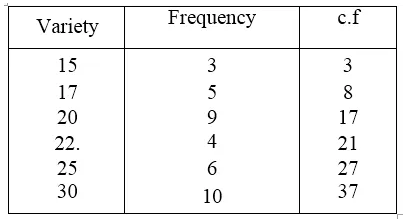
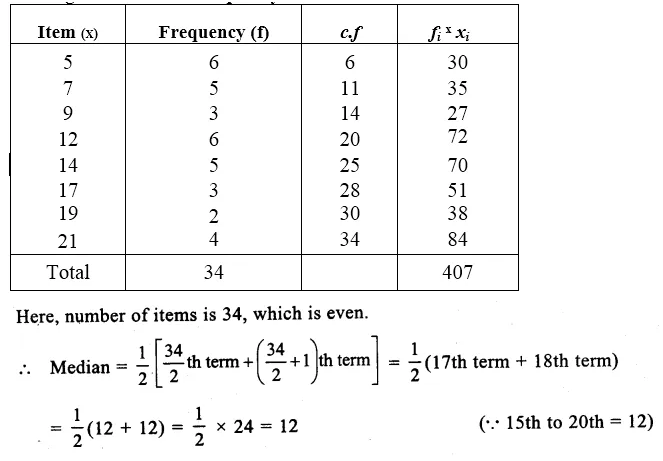
Writing its cumulative frequency table
RS Aggarwal Class 9 Solutions Chapter 14 Statistics Ex 14H Q7.1
RS Aggarwal Class 9 Solutions Chapter 14 Statistics Ex 14H Q7.2

Question 8.
Solution:
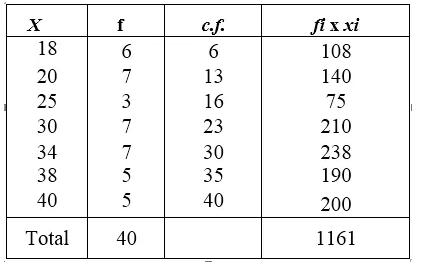
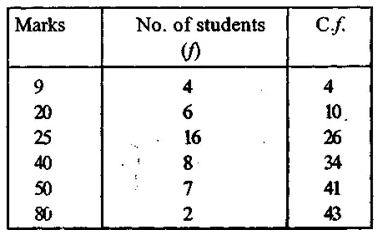
Writing its cumulative frequency table

RS Aggarwal Class 9 Solutions Chapter 14 Statistics Ex 14H Q8.1
Here, number of items is 40 which is even.
∴ Median = \(\frac { 1 }{ 2 } \left[ \frac { 40 }{ 2 } th\quad term+\left( \frac { 40 }{ 2 } +1 \right) th\quad term \right]\)
= \(\frac { 1 }{ 2 } \) (20th term + 21th term)
= \(\frac { 1 }{ 2 } \) (30 + 30) = \(\frac { 1 }{ 2 } \) x 60 = 30
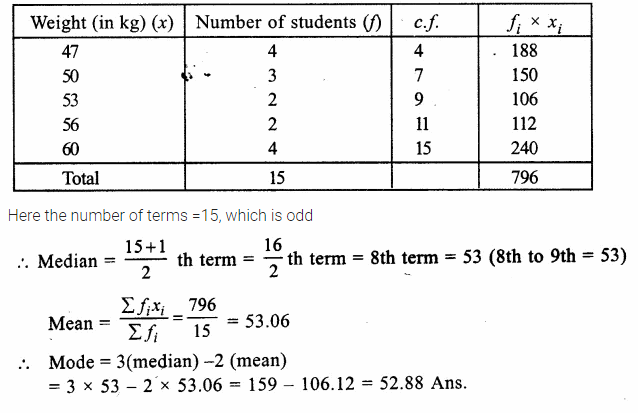
Mean= \(\frac { \sum { { f }_{ i }{ x }_{ i } } }{ \sum { { f }_{ i } } } \) = \(\frac { 1161 }{ 40 } \) = 29.025
∴Mode = 3 median – 2 mean = 3 x 30 – 2 x 29.025 = 90 – 58.05 = 31.95

Question 9.
Solution:
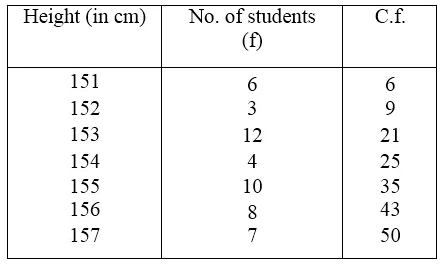
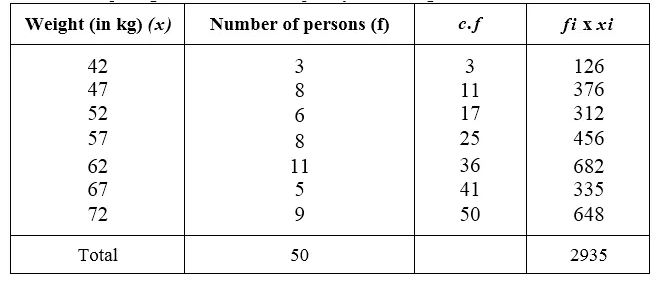
Preparing its cumulative frequency table we get:
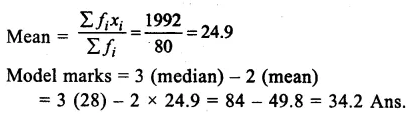
RS Aggarwal Class 9 Solutions Chapter 14 Statistics Ex 14H Q9.1
Here number of terms is 50, which is even
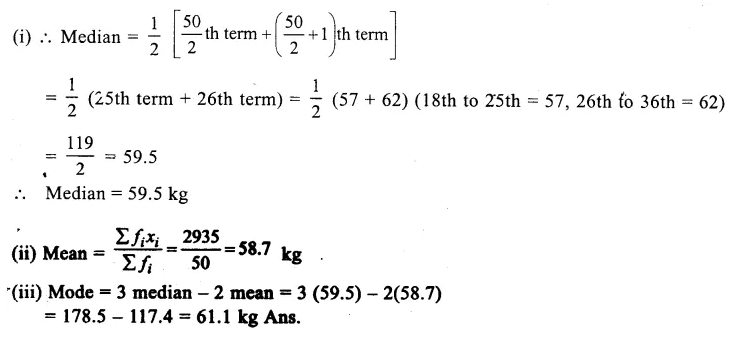
RS Aggarwal Class 9 Solutions Chapter 14 Statistics Ex 14H Q9.2

Question 10.
Solution:
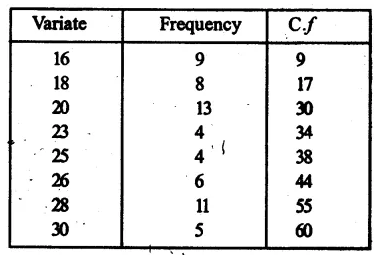
Preparing its cumulative frequency table :
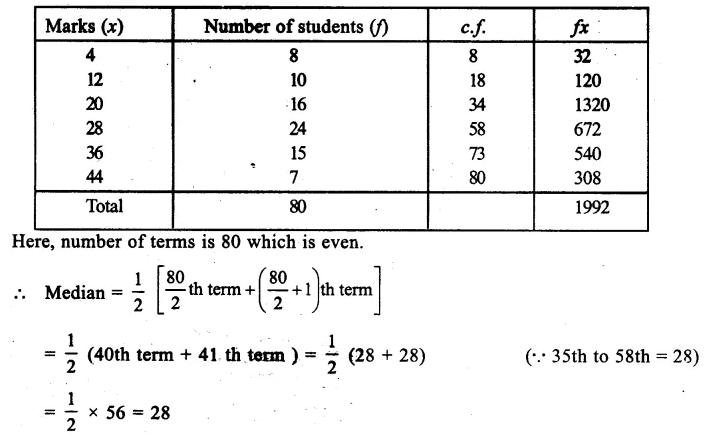
RS Aggarwal Class 9 Solutions Chapter 14 Statistics Ex 14H Q10.1
RS Aggarwal Class 9 Solutions Chapter 14 Statistics Ex 14H Q10.2

Question 11.
Solution:
Preparing its cumulative frequency table we have,
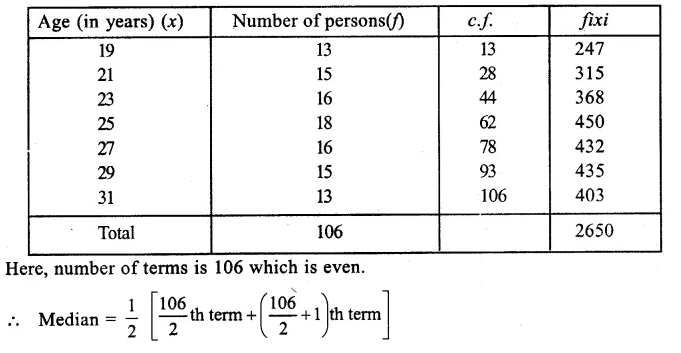
RS Aggarwal Class 9 Solutions Chapter 14 Statistics Ex 14H Q11.1
RS Aggarwal Class 9 Solutions Chapter 14 Statistics Ex 14H Q11.2

Question 12.
Solution:
Preparing its cumulative frequency table we have,
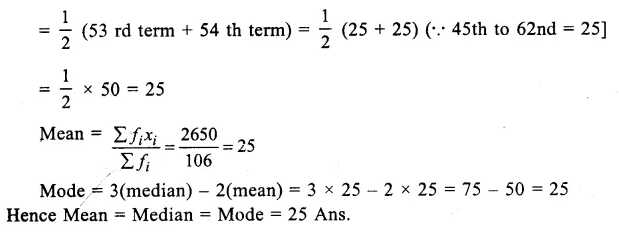
RS Aggarwal Class 9 Solutions Chapter 14 Statistics Ex 14H Q12.1
Hope given RS Aggarwal Solutions Class 9 Chapter 14 Statistics Ex 14H are helpful to complete your math homework.

If you have any doubts, please comment below. Learn Insta try to provide online math tutoring for you.

RD Sharma Class 9 Solutions Chapter 25 Probability VSAQS

RD Sharma Class 9 Solutions Chapter 25 Probability VSAQS

These Solutions are part of RD Sharma Class 9 Solutions. Here we have given RD Sharma Class 9 Solutions Chapter 25 Probability VSAQS

Other Exercises

Question 1.
Define a trial.
Solution:
When we perform an experiment, it is called a trial of the experiment.

Question 2.
Define an elementary event.
Solution:
An outcome of a trial of an experiment is called an elementary event.

Question 3.
Define an event.
Solution:
An event association to a random experiment is said to occur in a trial.

Question 4.
Define probability of an event.
Solution:
In n trials of a random experiment if an event A happens m times, then probability of happening
of A is given by P(A) = \(\frac { m }{ n } \)

Question 5.
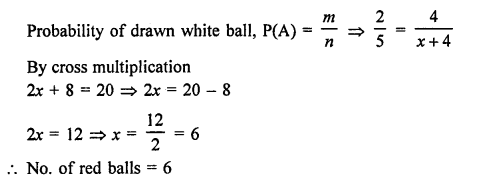
A bag contains 4 white balls and some red balls. If the probability of drawing a white ball from the bag is \(\frac { 2 }{ 5 } \), find the number of red balls in the bag
Solution:
No. of white balls = 4
Let number of red balls = x
Then total number of balls (n) = 4 white + x red = (4 + x) balls
RD Sharma Class 9 Solutions Chapter 25 Probability VSAQS 5.1

Question 6.
A die is thrown 100 times. If the probability of getting an even number is \(\frac { 2 }{ 5 } \). How many times an odd number is obtained?
Solution:
Total number of a die is thrown = 100
Let an even number comes x times, then probability of an even number = \(\frac { x }{ 100 } \)
RD Sharma Class 9 Solutions Chapter 25 Probability VSAQS 6.1

Question 7.
Three coins are tossed simultaneously 200 times with the following frequencies of different outcomes
RD Sharma Class 9 Solutions Chapter 25 Probability VSAQS 7.1
Find the probability of getting at most two heads.
Solution:
Total number of three coins are tossed (n) = 200
Getting at the most 2 heads (m) = 72 + 77 + 28 = 177
Probability P(A) = \(\frac { m }{ n } \) = \(\frac { 177 }{ 200 } \)

Question 8.
In the Q. No. 7, what is the probability of getting at least two heads?
Solution:
Total number of possible events = 200
No. of events getting at the least = 2 heads (m) = 23 + 72 = 95
Probability P(A) = \(\frac { m }{ n } \) = \(\frac { 95 }{ 200 } \) = \(\frac { 19 }{ 40 } \)

Hope given RD Sharma Class 9 Solutions Chapter 25 Probability VSAQS are helpful to complete your math homework.

If you have any doubts, please comment below. Learn Insta try to provide online math tutoring for you.

RD Sharma Class 9 Solutions Chapter 10 Congruent Triangles MCQS

RD Sharma Class 9 Solutions Chapter 10 Congruent Triangles MCQS

These Solutions are part of RD Sharma Class 9 Solutions. Here we have given RD Sharma Class 9 Solutions Chapter 10 Congruent Triangles MCQS

Other Exercises

Mark the correct alternative in each of the following:
Question 1.
One angle is equal to three times its supplement. The measure of the angle is
(a) 130°
(b) 135°
(c) 90°
(d) 120°
Solution:
Let required angle = x
Then its supplement = (180° – x)
x = 3(180° – x) = 540° – 3x
⇒ x + 3x = 540°
⇒ 4x = 540°
⇒ x = \(\frac { { 540 }^{ \circ } }{ 4 }\)  = 135°
∴ Required angle = 135° (b)

Question 2.
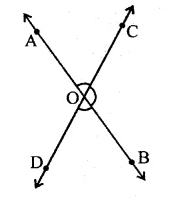
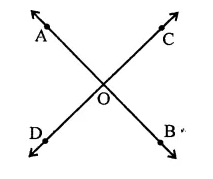
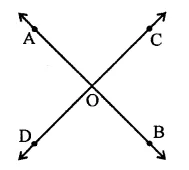
Two straight lines AB and CD intersect one another at the point O. If ∠AOC + ∠COB + ∠BOD = 274°, then ∠AOD =
(a) 86°
(b) 90°
(c) 94°
(d) 137°
Solution:
Sum of angles at a point O = 360°
Sum of three angles ∠AOC + ∠COB + ∠BOD = 274°
RD Sharma Class 9 Solutions Chapter 10 Congruent Triangles MCQS Q2.1
∴ Fourth angle ∠AOD = 360° – 274°
= 86° (a)

Question 3.
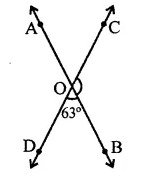
Two straight lines AB and CD cut each other at O. If ∠BOD = 63°, then ∠BOC =
(a) 63°
(b) 117°
(c) 17°
(d) 153°
Solution:
CD is a line
∴ ∠BOD + ∠BOC = 180° (Linear pair)
RD Sharma Class 9 Solutions Chapter 10 Congruent Triangles MCQS Q3.1
⇒ 63° + ∠BOC = 180°
⇒ ∠BOC = 180° – 63°
∴ ∠BOC =117° (b)

Question 4.
Consider the following statements:
When two straight lines intersect:
(i) adjacent angles are complementary
(ii) adjacent angles are supplementary
(iii) opposite angles are equal
(iv) opposite angles are supplementary Of these statements
(a) (i) and (iii) are correct
(b) (ii) and (iii) are correct
(c) (i) and (iv) are correct
(d) (ii) and (iv) are correct
Solution:
Only (ii) and (iii) arc true. (b)

Question 5.
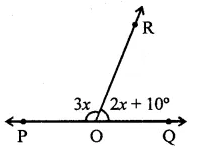
Given ∠POR = 3x and ∠QOR = 2x + 10°. If POQ is a striaght line, then the value of x is
(a) 30°
(b) 34°
(c) 36°
(d) none of these
Solution:
∵ POQ is a straight line
∴ ∠POR + ∠QOR = 180° (Linear pair)
⇒ 3x + 2x + 10° = 180°
⇒ 5x = 180 – 10° = 170°
∴ x = \(\frac { { 170 }^{ \circ } }{ 5 }\)  = 34° (b)
RD Sharma Class 9 Solutions Chapter 10 Congruent Triangles MCQS Q5.1

Question 6.
In the figure, AOB is a straight line. If ∠AOC + ∠BOD = 85°, then ∠COD =
(a) 85°
(b) 90°
(c) 95°
(d) 100°
RD Sharma Class 9 Solutions Chapter 10 Congruent Triangles MCQS Q6.1
Solution:
AOB is a straight line,
OC and OD are rays on it
and ∠AOC + ∠BOD = 85°
But ∠AOC + ∠BOD + ∠COD = 180°
⇒ 85° + ∠COD = 180°
∠COD = 180° – 85° = 95° (c)

Question 7.
In the figure, the value of y is
(a) 20°
(b) 30°
(c) 45°
(d) 60°
RD Sharma Class 9 Solutions Chapter 10 Congruent Triangles MCQS Q7.1
Solution:
In the figure,
RD Sharma Class 9 Solutions Chapter 10 Congruent Triangles MCQS Q7.2
y = x (Vertically opposite angles)
∠1 = 3x
∠2 = 3x
∴ 2(x + 3x + 2x) = 360° (Angles at a point)
2x + 6x + 4x = 360°
12x = 360° ⇒ x = \(\frac { { 360 }^{ \circ } }{ 12 }\)  = 30°
∴ y = x = 30° (b)

Question 8.
In the figure, the value of x is
(a) 12
(b) 15
(c) 20
(d) 30
RD Sharma Class 9 Solutions Chapter 10 Congruent Triangles MCQS Q8.1
Solution:
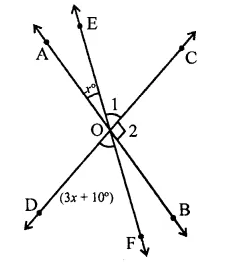
∠1 = 3x+ 10 (Vertically opposite angles)
But x + ∠1 + ∠2 = 180°
RD Sharma Class 9 Solutions Chapter 10 Congruent Triangles MCQS Q8.2
⇒ x + 3x + 10° + 90° = 180°
⇒ 4x = 180° – 10° – 90° = 80°
x = \(\frac { { 80 }^{ \circ } }{ 4 }\) = 20   (c)

Question 9.
In the figure, which of the following statements must be true?
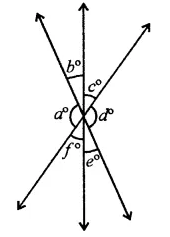
(i) a + b = d + c
(ii) a + c + e = 180°
(iii) b + f= c + e
(a) (i) only
(b) (ii) only
(c) (iii) only
(d) (ii) and (iii) only
RD Sharma Class 9 Solutions Chapter 10 Congruent Triangles MCQS Q9.1
Solution:
In the figure,
(i) a + b = d + c
a° = d°
b° = e°
c°= f°
(ii) a + b + e = 180°
a + e + c = 180°
⇒ a + c + e = 180°
(iii) b + f= e + c
∴ (ii) and (iii) are true statements (d)

Question 10.
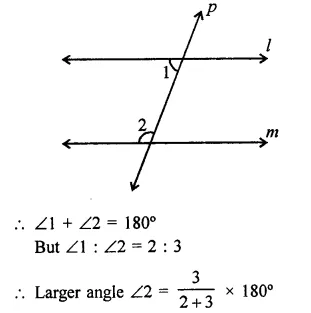
If two interior angles on the same side of a transversal intersecting two parallel lines are in the ratio 2:3, then the measure of the larger angle is
(a) 54°
(b) 120°
(c) 108°
(d) 136°
Solution:
In figure, l || m and p is transversal
RD Sharma Class 9 Solutions Chapter 10 Congruent Triangles MCQS Q10.1
= \(\frac { 3 }{ 5 }\) x 180° = 108° (c)

Question 11.
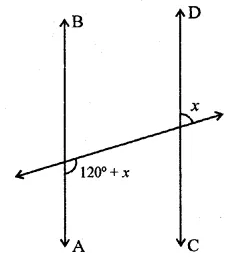
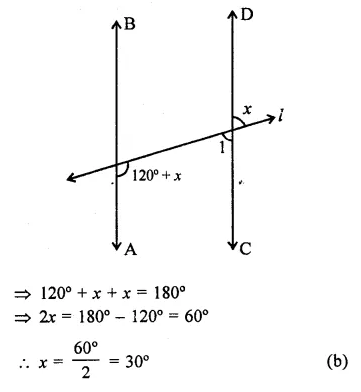
In the figure, if AB || CD, then the value of x is
(a) 20°
(b) 30°
(c) 45°
(d) 60°
RD Sharma Class 9 Solutions Chapter 10 Congruent Triangles MCQS Q11.1
Solution:
In the figure, AB || CD,
and / is transversal
∠1 = x (Vertically opposite angles)
and 120° + x + ∠1 = 180° (Co-interior angles)
RD Sharma Class 9 Solutions Chapter 10 Congruent Triangles MCQS Q11.2

Question 12.
Two lines AB and CD intersect at O. If ∠AOC + ∠COB + ∠BOD = 270°, then ∠AOC =
(a) 70°
(b) 80°
(c) 90°
(d) 180°
Solution:
Two lines AB and CD intersect at O
RD Sharma Class 9 Solutions Chapter 10 Congruent Triangles MCQS Q12.1
∠AOC + ∠COB + ∠BOD = 270° …(i)
But ∠AOC + ∠COB + ∠BOD + ∠DOA = 360° …(ii)
Subtracting (i) from (ii),
∠DOA = 360° – 270° = 90°
But ∠DOA + ∠AOC = 180°
∴ ∠AOC = 180° – 90° = 90° (c)

Question 13.
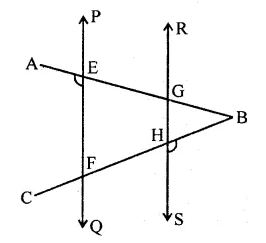
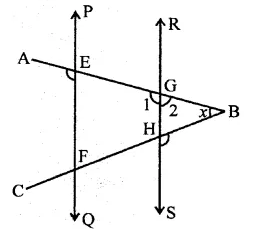
In the figure, PQ || RS, ∠AEF = 95°, ∠BHS = 110° and ∠ABC = x°. Then the value of x is
(a) 15°
(b) 25°
(c) 70°
(d) 35°
RD Sharma Class 9 Solutions Chapter 10 Congruent Triangles MCQS Q13.1
Solution:
In the figure,
RD Sharma Class 9 Solutions Chapter 10 Congruent Triangles MCQS Q13.2
PQ || RS, ∠AEF = 95°
∠BHS = 110°, ∠ABC = x
∵ PQ || RS,
∴ ∠AEF = ∠1 = 95° (Corresponding anlges)
But ∠1 + ∠2 = 180° (Linear pair)
⇒ ∠2 = 180° – ∠1 = 180° – 95° = 85°
In ∆AGH,
Ext. ∠BHS = ∠2 +x
⇒ 110° = 85° + x
⇒ x= 110°-85° = 25° (b)

Question 14.
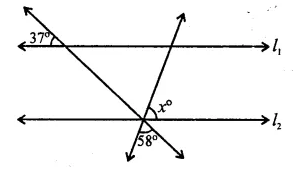
In the figure, if l1 || l2, what is the value of x?
(a) 90°
(b) 85°
(c) 75°
(d) 70°
RD Sharma Class 9 Solutions Chapter 10 Congruent Triangles MCQS Q14.1
Solution:
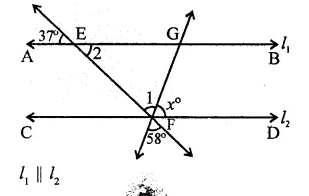
In the figure,
RD Sharma Class 9 Solutions Chapter 10 Congruent Triangles MCQS Q14.2
∠1 = 58° (Vertically opposite angles)
Similarly, ∠2 = 37°
∵ l1 || l2, EF is transversal
∠GEF + EFD = 180° (Co-interior angles)
⇒ ∠2 + ∠l +x = 180°
⇒ 37° + 58° + x = 180°
⇒ 95° + x= 180°
x = 180°-95° = 85° (b)

Question 15.
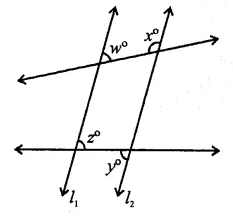
In the figure, if l1 || l2, what is x + y in terms of w and z?
(a) 180-w + z
(b) 180° + w- z
(c) 180 -w- z
(d) 180 + w + z
RD Sharma Class 9 Solutions Chapter 10 Congruent Triangles MCQS Q15.1
Solution:
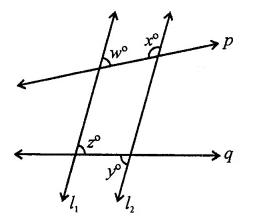
In the figure, l1 || l2
RD Sharma Class 9 Solutions Chapter 10 Congruent Triangles MCQS Q15.2
p and q are transversals
∴ w + x = 180° ⇒ x = 180° – w (Co-interior angle)
z = y (Alternate angles)
∴ x + y = 180° – w + z (a)

Question 16.
In the figure, if l1 || l2, what is the value of y?
(a) 100
(b) 120
(c) 135
(d) 150
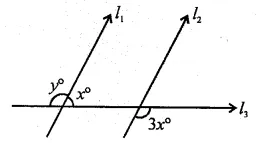
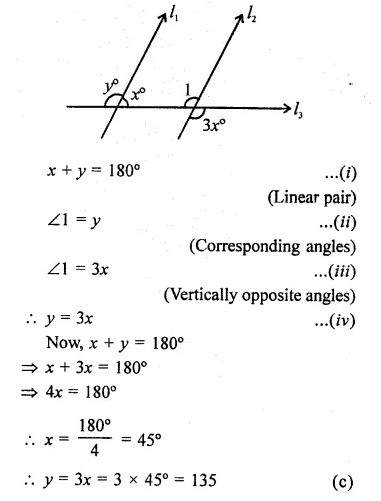
RD Sharma Class 9 Solutions Chapter 10 Congruent Triangles MCQS Q16.1
Solution:
In the figure, l1 || l2 and l3 is the transversal
RD Sharma Class 9 Solutions Chapter 10 Congruent Triangles MCQS Q16.2

Question 17.
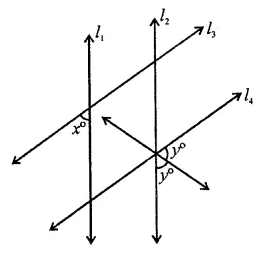
In the figure, if l1 || l2 and l3 || l4 what is y in terms of x?
(a) 90 + x
(b) 90 + 2x
(c) 90 – \(\frac { x }{ 2 }\)
(d) 90 – 2x
RD Sharma Class 9 Solutions Chapter 10 Congruent Triangles MCQS Q17.1
Solution:
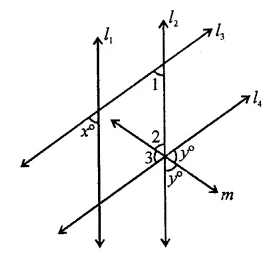
In the figure,
RD Sharma Class 9 Solutions Chapter 10 Congruent Triangles MCQS Q17.2
l1 || l2 and l3 || l4 and m is the angle bisector
∴ ∠2 = ∠3 = y
∵ l1 || l2
∠1 = x (Corresponding angles)
∵ l3 || l4
∴ ∠1 + (∠2 + ∠3) = 180° (Co-interior angles)
⇒ x + 2y= 180°
⇒ 2y= 180°-x
⇒ y = \(\frac { { 540 }^{ \circ }-x }{ 4 }\)
= 90° – \(\frac { x }{ 2 }\) (c)

Question 18.
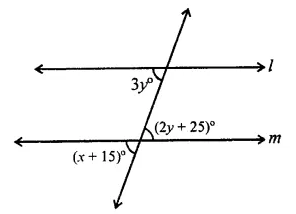
In the figure, if 11| m, what is the value of x?
(a) 60
(b) 50
(c) 45
d) 30
RD Sharma Class 9 Solutions Chapter 10 Congruent Triangles MCQS Q18.1
Solution:
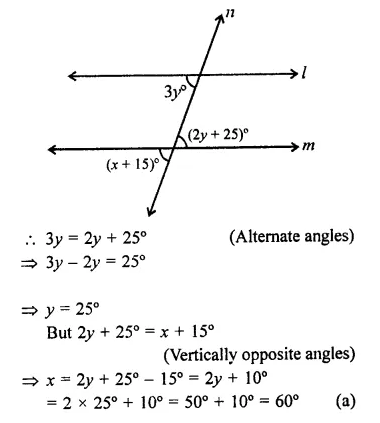
In the figure, l || m and n is the transversal
RD Sharma Class 9 Solutions Chapter 10 Congruent Triangles MCQS Q18.2
⇒ y = 25°
But 2y + 25° = x+ 15°
(Vertically opposite angles) ⇒ x = 2y + 25° – 15° = 2y+ 10°
= 2 x 25°+10° = 50°+10° = 60° (a)

Question 19.
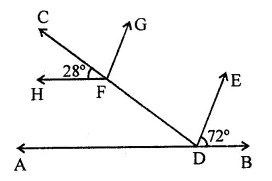
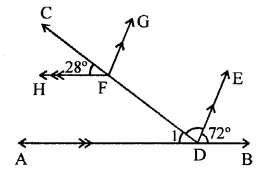
In the figure, if AB || HF and DE || FG, then the measure of ∠FDE is
(a) 108°
(b) 80°
(c) 100°
(d) 90°
RD Sharma Class 9 Solutions Chapter 10 Congruent Triangles MCQS Q19.1
Solution:
In the figure,
AB || HF, DE || FG
RD Sharma Class 9 Solutions Chapter 10 Congruent Triangles MCQS Q19.2
∴ HF || AB
∠1 =28° (Corresponding angles)
But ∠1 + ∠FDE + 72° – 180° (Angles of a straight line)
⇒ 28° + ∠FDE + 72° = 180°
⇒ ∠FDE + 100° = 180°
⇒ ∠FDE = 180° – 100 = 80° (b)

Question 20.
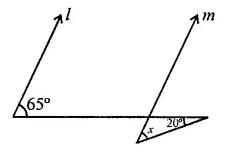
In the figure, if lines l and m are parallel, then x =
(a) 20°
(b) 45°
(c) 65°
(d) 85°
RD Sharma Class 9 Solutions Chapter 10 Congruent Triangles MCQS Q20.1
Solution:
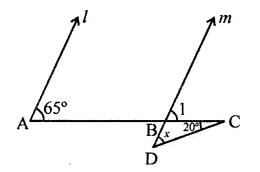
In the figure, l || m
RD Sharma Class 9 Solutions Chapter 10 Congruent Triangles MCQS Q20.2
∴ ∠1 =65° (Corresponding angles)
In ∆BCD,
Ext. ∠1 = x + 20°
⇒ 65° = x + 20°
⇒ x = 65° – 20°
⇒ x = 45° (b)

Question 21.
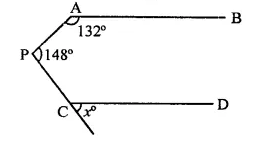
In the figure, if AB || CD, then x =
(a) 100°
(b) 105°
(c) 110°
(d) 115°
RD Sharma Class 9 Solutions Chapter 10 Congruent Triangles MCQS Q21.1
Solution:
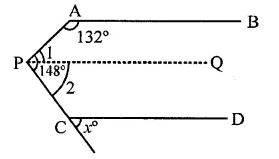
In the figure, AB || CD
Through P, draw PQ || AB or CD
RD Sharma Class 9 Solutions Chapter 10 Congruent Triangles MCQS Q21.2
∠A + ∠1 = 180° (Co-interior angles)
⇒ 132° + ∠1 = 180°
⇒ ∠1 = 180°- 132° = 48°
∴ ∠2 = 148° – ∠1 = 148° – 48° = 100°
∵ DQ || CP
∴ ∠2 = x (Corresponding angles)
∴ x = 100° (a)

Question 22.
In tlie figure, if lines l and in are parallel lines, then x =
(a) 70°
(b) 100°
(c) 40°
(d) 30°
RD Sharma Class 9 Solutions Chapter 10 Congruent Triangles MCQS Q22.1
Solution:
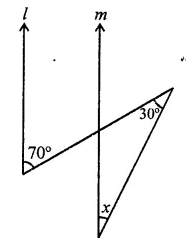
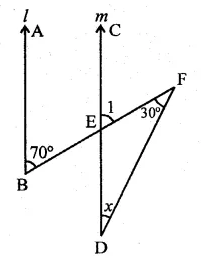
In the figure, l || m
RD Sharma Class 9 Solutions Chapter 10 Congruent Triangles MCQS Q22.2
∠l =70° (Corresponding angles)
In ∆DEF,
Ext. ∠l = x + 30°
⇒ 70° = x + 30°
⇒ x = 70° – 30° = 40° (c)

Question 23.
In the figure, if l || m, then x =
(a) 105°
(b) 65°
(c) 40°
(d) 25°
RD Sharma Class 9 Solutions Chapter 10 Congruent Triangles MCQS Q23.1
Solution:
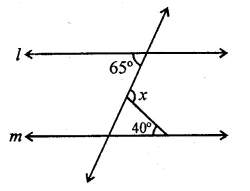
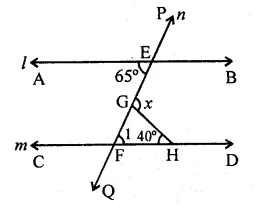
In the figure,
l || m and n is the transversal
RD Sharma Class 9 Solutions Chapter 10 Congruent Triangles MCQS Q23.2
∠1 = 65° (Alternate angles)
In ∆GHF,
Ext. x = ∠1 + 40° = 65° + 40°
⇒ x = 105°
∴ x = 105° (a)

Question 24.
In the figure, if lines l and m are parallel, then the value of x is
(a) 35°
(b) 55°
(c) 65°
(d) 75°
RD Sharma Class 9 Solutions Chapter 10 Congruent Triangles MCQS Q24.1
Solution:
In the figure, l || m
and PQ is the transversal
RD Sharma Class 9 Solutions Chapter 10 Congruent Triangles MCQS Q24.2
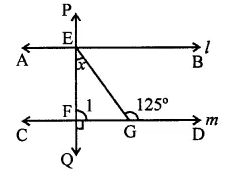
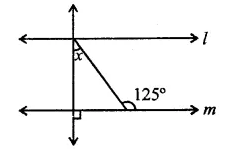
∠1 = 90°
In ∆EFG,
Ext. ∠G = ∠E + ∠F
⇒ 125° = x + ∠1 = x + 90°
⇒ x = 125° – 90° = 35° (a)

Question 25.
Two complementary angles are such that two times the measure of one is equal to three times the measure of the other. The measure of the smaller angle is
(a) 45°
(b) 30°
(c) 36°
(d) none of these
Solution:
Let first angle = x
Then its complementary angle = 90° – x
∴ 2x = 3(90° – x)
⇒ 2x = 270° – 3x
⇒ 2x + 3x = 270°
⇒ 5x = 270°
⇒ x = \(\frac { { 270 }^{ \circ } }{ 5 }\)  = 54°
∴ second angle = 90° – 54° = 36°
∴ smaller angle = 36° (c)

Question 26.
RD Sharma Class 9 Solutions Chapter 10 Congruent Triangles MCQS Q26.1
Solution:
RD Sharma Class 9 Solutions Chapter 10 Congruent Triangles MCQS Q26.2

Question 27.
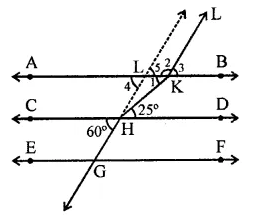
In the figure, AB || CD || EF and GH || KL.
The measure of ∠HKL is
(a) 85°
(b) 135°
(c) 145°
(d) 215°
RD Sharma Class 9 Solutions Chapter 10 Congruent Triangles MCQS Q27.1
Solution:
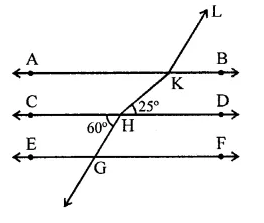
In the figure, AB || CD || EF and GH || KL and GH is product to meet AB in L.
RD Sharma Class 9 Solutions Chapter 10 Congruent Triangles MCQS Q27.2
∵ AB || CD
∴ ∠1 = 25° (Alternate angle)
and GH || KL
∴ ∠4 = 60° (Corresponding angles)
∠5 = ∠4 = 60° (Vertically opposite angle)
∠5 + ∠2 = 180° (Co-interior anlges)
∴ ⇒ 60° + ∠2 = 180°
∠2 = 180° – 60° = 120°
Now ∠HKL = ∠1 + ∠2 = 25° + 120°
= 145° (c)

Question 28.
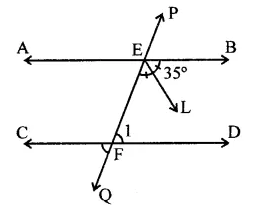
AB and CD are two parallel lines. PQ cuts AB and CD at E and F respectively. EL is the bisector of ∠FEB. If ∠LEB = 35°, then ∠CFQ will be
(a) 55°
(b) 70°
(c) 110°
(d) 130°
Solution:
AB || CD and PQ is the transversal EL is the bisector of ∠FEB and ∠LEB = 35°
RD Sharma Class 9 Solutions Chapter 10 Congruent Triangles MCQS Q28.1
∴ ∠FEB = 2 x 35° = 70°
∵ AB || CD
∴ ∠FEB + ∠EFD = 180°
(Co-interior angles)
70° + ∠EFD = 180°
∴ ∠EFD = 180°-70°= 110°
But ∠CFQ = ∠EFD
(Vertically opposite angles)
∴ ∠CFQ =110° (c)

Question 29.
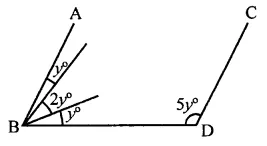
In the figure, if line segment AB is parallel to the line segment CD, what is the value of y?
(a) 12
(b) 15
(c) 18
(d) 20
RD Sharma Class 9 Solutions Chapter 10 Congruent Triangles MCQS Q29.1
Solution:
In the figure, AB || CD
BD is transversal
∴ ∠ABD + ∠BDC = 180° (Co-interior angles)
⇒y + 2y+y + 5y = 180°
⇒ 9y = 180° ⇒ y = \(\frac { { 180 }^{ \circ } }{ 9 }\)  = 20° (d)

Question 30.
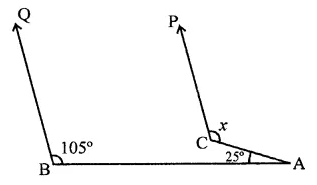
In the figure, if CP || DQ, then the measure of x is
(a) 130°
(b) 105°
(c) 175°
(d) 125°
RD Sharma Class 9 Solutions Chapter 10 Congruent Triangles MCQS Q30.1
Solution:
In the figure, CP || DQ
BA is transversal
Produce PC to meet BA at D
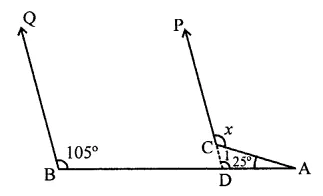
RD Sharma Class 9 Solutions Chapter 10 Congruent Triangles MCQS Q30.2
∵ QB || PD
∴ ∠D = 105° (Corresponding angles)
In ∆ADC,
Ext. ∠ACP = ∠CDA + ∠DAC
⇒ x = ∠1 + 25°
= 105° + 25° = 130° (a)

Hope given RD Sharma Class 9 Solutions Chapter 10 Congruent Triangles MCQS are helpful to complete your math homework.

If you have any doubts, please comment below. Learn Insta try to provide online math tutoring for you.
RS Aggarwal Class 9 Solutions Chapter 15 Probability Ex 15A

RS Aggarwal Class 9 Solutions Chapter 15 Probability Ex 15A

These Solutions are part of RS Aggarwal Solutions Class 9. Here we have given RS Aggarwal Class 9 Solutions Chapter 15 Probability Ex 15A.

Question 1.
Solution:
Number of trials = 500 times
Let E be the no. of events in each case, then
∴No. of heads (E1) = 285 times
and no. of tails (E2) = 215 times
∴ Probability in each case will be
∴(i)P(E1) = \(\frac { 285 }{ 500 } \) = \(\frac { 57 }{ 100 } \) = 0.57
(ii) P(E2) = \(\frac { 215 }{ 500 } \) = \(\frac { 43 }{ 100 } \) = 0.43

Question 2.
Solution:
No. of trials = 400
Let E be the no. of events in each case, then
No. of 2 heads (E1) = 112
No. of one head (E2) = 160 times
and no. of O. head (E3) = 128 times
∴ Probability in each case will be:
∴ (i)P(E1) = \(\frac { 112 }{ 400 } \) = \(\frac { 28 }{ 100 } \) = 0.28
(ii)P(E2) = \(\frac { 160 }{ 400 } \) = \(\frac { 40 }{ 100 } \)= 0.40
(iii) P(E3) = \(\frac { 128 }{ 400 } \) = \(\frac { 32 }{ 100 } \) = 0.32 Ans.

Question 3.
Solution:
Number of total trials = 200
Let E be the no. of events in each case, then
No. of three heads (E1) = 39 times
No. of two heads (E2) = 58 times
No. of one head (E3) = 67 times
and no. of no head (E4) = 36 times
∴ Probability in each case will be .
(i) P(E1) = \(\frac { 39 }{ 200 } \) = 0.195
(ii) P(E3) = \(\frac { 67 }{ 200 } \) = 0.335
(iii) P(E4) = \(\frac { 36 }{ 200 } \) = \(\frac { 18 }{ 100 } \) = 0.18
(iv) P(E2) = \(\frac { 58 }{ 200 } \) = \(\frac { 29 }{ 100 } \) = 0.29

Question 4.
Solution:
Solution No. of trials = 300 times
Let E be the no. of events in each case, then
No. of outcome of 1(E1) = 60
No. of outcome of 2(E2) = 72
No. of outcome of 3(E3) = 54
No. of outcome of 4(E4) 42
No. of outcome of 5(E5) = 39
No. of outcome of 6(E6) = 33
The probability of
(i) P(E3) = \(\frac { 54 }{ 300 } \) = \(\frac { 18 }{ 100 } \) = 0.18
(ii) P(E6) = \(\frac { 33 }{ 100 } \) = \(\frac { 11 }{ 100 } \)= 0.11
(iii) P(E5) = \(\frac { 39 }{ 300 } \) = \(\frac { 13 }{ 100 } \) = 0.13
(iv) P(E1) = \(\frac { 60 }{ 300 } \) = \(\frac { 20 }{ 100 } \)= 0.20 Ans.

Question 5.
Solution:
No. of ladies on whom survey was made = 200.
Let E be the no. of events in each case.
No. of ladies who like coffee (E1) = 142
No. of ladies who like coffee (E2) = 58
Probability of
(1) P(E1) = \(\frac { 142 }{ 200 } \) = \(\frac { 71 }{ 100 } \) = 0.71
(ii) P(E2) = \(\frac { 58 }{ 200 } \) = \(\frac { 29 }{ 100 } \) = 0.29 Ans.

Question 6.
Solution:
Total number of tests = 6
No. of test in which the students get more than 60% mark = 2
Probability will he
P(E) = \(\frac { 2 }{ 6 } \) = \(\frac { 1 }{ 3 } \)Ans.

Question 7.
Solution:
No. of vehicles of various types = 240
No. of vehicles of two wheelers = 64.
Probability will be P(E) = \(\frac { 84 }{ 240 } \) = \(\frac { 7 }{ 20 } \) = 0.35 Ans.

Question 8.
Solution:
No. of phone numbers are one page = 200
Let E be the number of events in each case,
Then (i) P(E5) = \(\frac { 24 }{ 200 } \) = \(\frac { 12 }{ 100 } \) = 0.12
(ii) P(E8) = \(\frac { 16 }{ 200 } \) = \(\frac { 8 }{ 100 } \) = 0.08 Ans.

Question 9.
Solution:
No. of students whose blood group is checked = 40
Let E be the no. of events in each case,
Then (i) P(E0) = \(\frac { 14 }{ 40 } \) = \(\frac { 7 }{ 20 } \) = 0.35
(ii) P(EAB) = \(\frac { 6 }{ 40 } \) = \(\frac { 3 }{ 20 } \) = 0.15 Ans.

Question 10.
Solution:
No. of total students = 30.
Let E be the number of elements, this probability will be of interval 21 – 30
P(E) = \(\frac { 6 }{ 30 } \) = \(\frac { 1 }{ 5 } \) = 0.2 Ans.

Question 11.
Solution:
Total number of patients of various age group getting medical treatment = 360
Let E be the number of events, then
(i) No. of patient which are 30 years or more but less than 40 years = 60.
P(E) = \(\frac { 60 }{ 360 } \) = \(\frac { 1 }{ 6 } \)
(ii) 50 years or more but less than 70 years = 50 + 30 = 80
P(E) = \(\frac { 80 }{ 360 } \) = \(\frac { 2 }{ 9 } \)
(iii) Less than 10 years = zero
P(E) = \(\frac { 0 }{ 360 } \) = 0
(iv) 10 years or more 90 + 50 + 60 + 80 + 50 + 30 = 360

Hope given RS Aggarwal Class 9 Solutions Chapter 15 Probability Ex 15A are helpful to complete your math homework.

If you have any doubts, please comment below. Learn Insta try to provide online math tutoring for you.
RS Aggarwal Class 9 Solutions Chapter 14 Statistics Ex 14F

RS Aggarwal Class 9 Solutions Chapter 14 Statistics Ex 14F

These Solutions are part of RS Aggarwal Solutions Class 9. Here we have given RS Aggarwal Solutions Class 9 Chapter 14 Statistics Ex 14F.

Other Exercises

Question 1.
Solution:
RS Aggarwal Class 9 Solutions Chapter 14 Statistics Ex 14F Q1.1

Question 2.
Solution:
RS Aggarwal Class 9 Solutions Chapter 14 Statistics Ex 14F Q2.1

Question 3.
Solution:
RS Aggarwal Class 9 Solutions Chapter 14 Statistics Ex 14F Q3.1

Question 4.
Solution:
RS Aggarwal Class 9 Solutions Chapter 14 Statistics Ex 14F Q4.1

Question 5.
Solution:
Mean = 8
RS Aggarwal Class 9 Solutions Chapter 14 Statistics Ex 14F Q5.1

Question 6.
Solution:
Mean = 28.25
RS Aggarwal Class 9 Solutions Chapter 14 Statistics Ex 14F Q6.1
RS Aggarwal Class 9 Solutions Chapter 14 Statistics Ex 14F Q6.2

Question 7.
Solution:
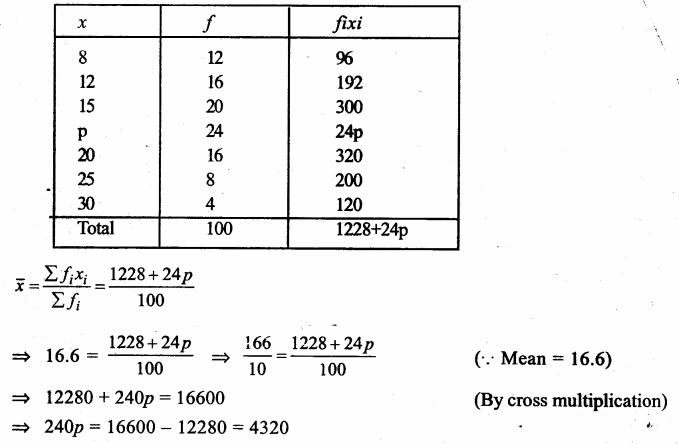
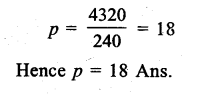
Mean = 16.6
RS Aggarwal Class 9 Solutions Chapter 14 Statistics Ex 14F Q7.1
RS Aggarwal Class 9 Solutions Chapter 14 Statistics Ex 14F Q7.2

Question 8.
Solution:
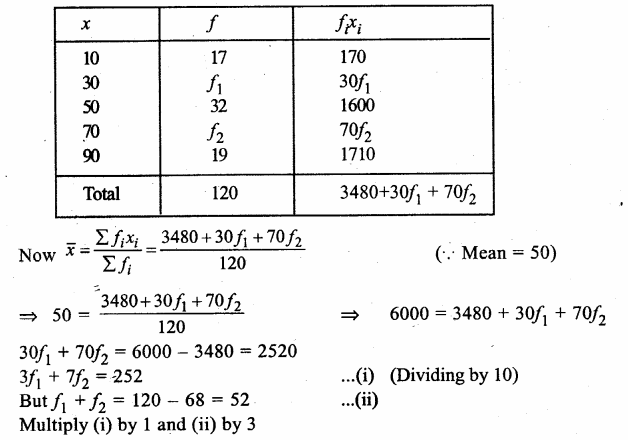
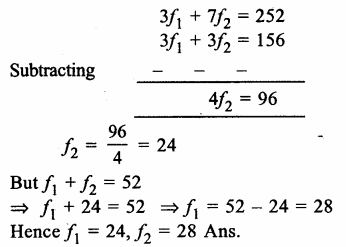
Mean = 50
RS Aggarwal Class 9 Solutions Chapter 14 Statistics Ex 14F Q8.1
RS Aggarwal Class 9 Solutions Chapter 14 Statistics Ex 14F Q8.2

Question 9.
Solution:
RS Aggarwal Class 9 Solutions Chapter 14 Statistics Ex 14F Q9.1

Question 10.
Solution:
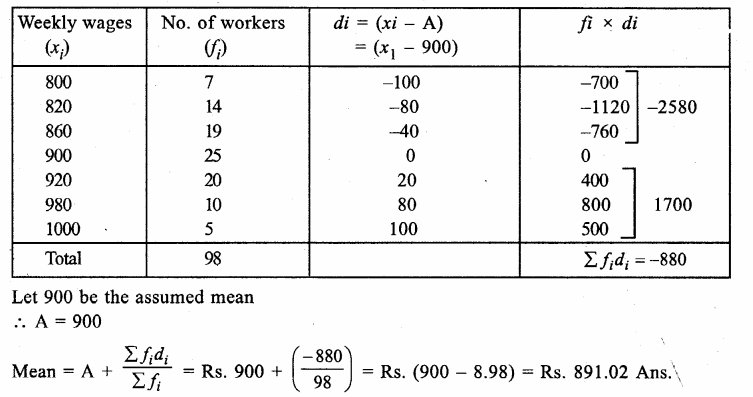
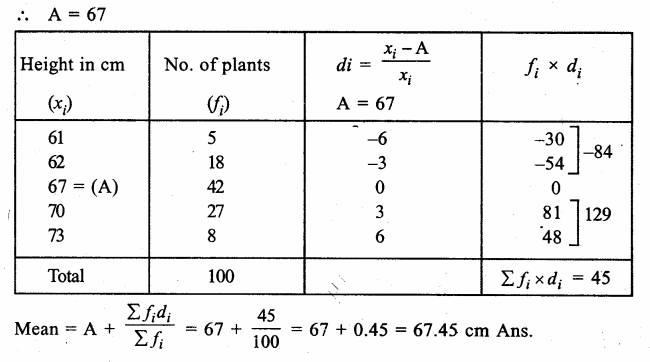
Let assumed mean = 67
RS Aggarwal Class 9 Solutions Chapter 14 Statistics Ex 14F Q10.1

Question 11.
Solution:
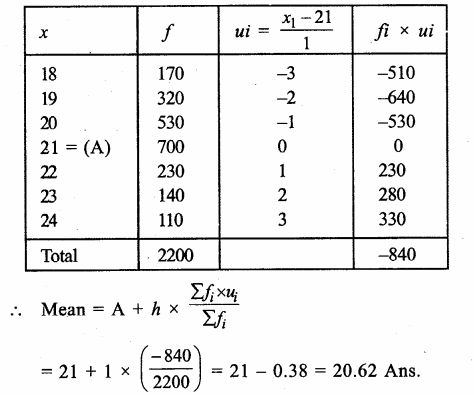
Here h = 1, Let assumed mean (A) = 21
RS Aggarwal Class 9 Solutions Chapter 14 Statistics Ex 14F Q11.1

Question 12.
Solution:
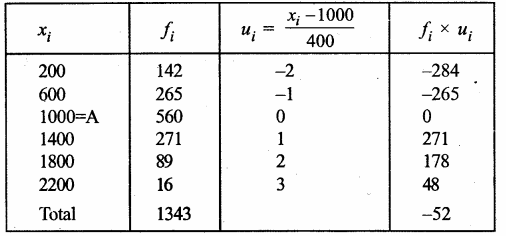
Here h = 400 and let assumed mean (A) = 1000
RS Aggarwal Class 9 Solutions Chapter 14 Statistics Ex 14F Q12.1
RS Aggarwal Class 9 Solutions Chapter 14 Statistics Ex 14F Q12.2

Hope given RS Aggarwal Solutions Class 9 Chapter 14 Statistics Ex 14F are helpful to complete your math homework.

If you have any doubts, please comment below. Learn Insta try to provide online math tutoring for you.
RD Sharma Class 9 Solutions Chapter 24 Measures of Central Tendency Ex 24.3

RD Sharma Class 9 Solutions Chapter 24 Measures of Central Tendency Ex 24.3

These Solutions are part of RD Sharma Class 9 Solutions. Here we have given RD Sharma Class 9 Solutions Chapter 24 Measures of Central Tendency Ex 24.3

Other Exercises

Find the median of the following data (1-8)

Question 1.
83, 37, 70, 29, 45, 63, 41, 70, 34, 54
Solution:
We know that median = \(\frac { 1 }{ 2 } \left[ \frac { n }{ 2 } th\quad term+\left( \frac { n }{ 2 } +1 \right) th\quad term \right] \)
(When n is even)
= \(\frac { n+1 }{ 2 } th\quad term\)
83, 37, 70, 29, 45, 63, 41, 70, 34, 54
Arranging in ascending order, 29, 34, 37, 41, 45, 54, 63, 70, 70, 83
Here n = 10 which an even
Median = \(\frac { 1 }{ 2 } \)[5th term + 6th term]
= \(\frac { 1 }{ 2 } \) (45+54) = \(\frac { 99 }{ 2 } \) = 49.5

Question 2.
133, 73, 89, 108, 94, 104, 94, 85, 100, 120
Solution:
133, 73, 89, 108, 94, 104, 94, 85, 100, 120
Arranging in ascending order, 73, 85, 89, 94, 94, 100, 104, 108, 120, 133
Here n = 10 which is an even
Median = \(\frac { 1 }{ 2 } \)[5th term + 6th term]
= \(\frac { 1 }{ 2 } \) (94+100) = \(\frac { 1 }{ 2 } \) x 194 = 97

Question 3.
31, 38, 27, 28, 36, 25, 35, 40
Solution:
31, 38, 27, 28, 36, 25, 35, 40
Arranging in ascending order, 25, 27, 28, 31, 35, 36, 38, 40
Here n = 8 which is even
Median = \(\frac { 1 }{ 2 } \)[4th term + 5th term]
= \(\frac { 1 }{ 2 } \) (31+35) = \(\frac { 1 }{ 2 } \) x 66 = 33

Question 4.
15, 6, 16, 8, 22, 21, 9, 18, 25
Solution:
15, 6, 16, 8, 22, 21, 9, 18, 25
Arranging in ascending order = 6, 8, 9, 15, 16, 18, 21, 22, 25
Here n = 9 which is odd
Median \(\frac { n+1 }{ 2 } th\quad term\) = \(\frac { 9+1 }{ 2 } th\quad term\) = \(\frac { 10 }{ 2 } th\quad \)
= 5th term = 16

Question 5.
41, 43, 127, 99, 71, 92, 71, 58, 57
Solution:
41, 43, 127, 99, 71, 92, 71, 58, 57
Arranging in ascending order = 41, 43, 57, 58, 71, 71, 92, 99, 127
Here n = 9 which is an odd
Median \(\frac { n+1 }{ 2 } th\quad term\) = \(\frac { 9+1 }{ 2 } th\quad term\) = \(\frac { 10 }{ 2 } th\quad\)
= 5th term = 71

Question 6.
25, 34, 31, 23, 22, 26, 35, 29, 20, 32
Solution:
25, 34, 31, 23, 22, 26, 35, 29, 20, 32
Arranging in ascending order = 20, 22, 23, 25, 26, 29, 31, 32, 34, 35
Here n = 10 which is even
Median = \(\frac { 1 }{ 2 } \left[ \frac { n }{ 2 } th\quad term+\left( \frac { n }{ 2 } +1 \right) th\quad term \right] \)
= \(\frac { 1 }{ 2 } \) [5th term + 6th term]
= \(\frac { 1 }{ 2 } \) (26 + 29) = \(\frac { 1 }{ 2 } \) x 55 = \(\frac { 55 }{ 2 } \) = 27.5

Question 7.
12, 17, 3, 14, 5, 8, 7, 15
Solution:
12, 17, 3, 14, 5, 8, 7, 15
Arranging in ascending order = 3, 5, 7, 8, 12, 14, 15, 17
Here n = 8 which is odd
Median = \(\frac { 1 }{ 2 } \left[ \frac { n }{ 2 } th\quad term+\left( \frac { n }{ 2 } +1 \right) th\quad term \right] \)
= \(\frac { 1 }{ 2 } \) [4th term + 5th term]
= \(\frac { 1 }{ 2 } \) (8+12) = \(\frac { 1 }{ 2 } \) x 20 = 10

Question 8.
92, 35, 67, 85, 72, 81, 56, 51, 42, 69
Solution:
92, 35, 67, 85, 72, 81, 56, 51, 42. 69
Arranging in ascending order = 35, 42, 51, 56, 67, 69, 72, 81, 85, 92
Here n = 10 which is even
Median = \(\frac { 1 }{ 2 } \left[ \frac { n }{ 2 } th\quad term+\left( \frac { n }{ 2 } +1 \right) th\quad term \right] \)
= \(\frac { 1 }{ 2 } \) [5th term + 6th term]
= \(\frac { 1 }{ 2 } \) (67+69) = \(\frac { 1 }{ 2 } \) x 136 = 68

Question 9.
Numbers 50, 42, 35, 2x + 10, 2x – 8, 12, 11, 8 are written in descending order and their median is 25, find x.
Solution:
50, 42, 35, 2x + 10, 2x – 8, 12, 11, 8 are in descending order
Here n = 8 which is even
Now Median = \(\frac { 1 }{ 2 } \left[ \frac { n }{ 2 } th\quad term+\left( \frac { n }{ 2 } +1 \right) th\quad term \right] \)
= \(\frac { 1 }{ 2 } \) [4th term + 5th term] = \(\frac { 1 }{ 2 } \)[2x + 10 + 2x – 8]
= \(\frac { 1 }{ 2 } \) [4x + 2] = 2x + 1
But median = 25
2x + 1 = 25
=> 2x = 25 – 1 = 24
=> \(\frac { 24 }{ 2 } \) = 12
Hence x = 12

Question 10.
Find the median of the following observations 46, 64, 87, 41, 58, 77, 35, 90, 55, 92, 33. If 92 is replaced by 99 and 41 by 43 in the above data, find the new median?
Solution:
46, 64, 87, 41, 58, 77, 35, 90, 55, 92, 33
Writing in ascending order = 33, 35, 41, 46, 55, 58, 64, 77, 87, 90, 92
Here n = 11 which is odd
Median = \(\frac { n+1 }{ 2 } \) th term
= \(\frac { 11+1 }{ 2 } \) = \(\frac { 12 }{ 2 } \)
= 6th term = 58
By replacing 92 by 93 and 41 by 43, then new order will be
33, 35, 43, 46, 55, 58, 64, 77, 87, 90, 99
Median = 6th term = 58

Question 11.
Find the median of the following data : 41, 43, 127, 99, 61, 92, 71, 58, 57. If 58 is replaced by 85, what will be the new median.
Solution:
41, 43, 127, 99, 61, 92, 71, 58, 57
Arranging in ascending order = 41, 43, 57, 58, 61, 71, 92, 99, 127
Here n = 9 which is odd
Median = \(\frac { n+1 }{ 2 } \) th term = \(\frac { 9+1 }{ 2 } \) th term
= \(\frac { 10 }{ 2 } \) = 5th term = 61
By change 58 by 92, we get new order = 41, 43, 57, 61, 71, 92, 92, 99, 127
Median = 5th term = 71

Question 12.
The weights (in kg) of 15 students are : 31, 35, 27, 29, 32, 43, 37, 41, 34, 28, 36, 44, 45, 42, 30. Find the median. If the weight 44 kg is replaced by 46 kg and 27 kg by 25 kg, find the new median.
Solution:
Weights of 15 students are 31, 35, 27, 29, 32, 43, 37, 41, 34, 28, 36, 44, 45, 42, 30
Writing in ascending order = 27, 28, 29, 30, 31, 32, 34, 35, 36, 37, 41, 42, 43, 44, 45
here n = 15 which is odd
n+1 15+1
Median = \(\frac { n+1 }{ 2 } \) th term = \(\frac { 15+1 }{ 2 } \)
= \(\frac { 16 }{ 2 } \)th term = 8th term = 35 kg
By replacing 44 kg by 46 kg and 27 kg by 25 kg we get new order,
25, 28, 29, 30, 31, 32, 34, 35, 36, 37, 41, 42, 43, 45, 46
Median = 8th term = 35 kg

Question 13.
The following observations have been arranged in ascending order. If the median of the data is 63, find the value of x: 29, 32, 48, 50, x, x + 2, 72, 78, 84, 95
Solution:
Median = 63
29, 32, 48, 50, x, x + 2, 72, 78, 84, 95
Here n = 10 which is even
median = \(\frac { 1 }{ 2 } \left[ \frac { n }{ 2 } th\quad term+\left( \frac { n }{ 2 } +1 \right) th\quad term \right] \)
= \(\frac { 1 }{ 2 } \left[ \frac { 10 }{ 2 } th\quad term+\left( \frac { 10 }{ 2 } +1 \right) th\quad term \right] \)
= \(\frac { 1 }{ 2 } \) [5th term + 6th term]
= \(\frac { 16 }{ 2 } \) [x+x+2] = \(\frac { 2x + 2 }{ 2 } \) = x + 1
x + 1 = 63 = x = 63 – 1 = 62
Hence x = 62

Hope given RD Sharma Class 9 Solutions Chapter 24 Measures of Central Tendency Ex 24.3 are helpful to complete your math homework.

If you have any doubts, please comment below. Learn Insta try to provide online math tutoring for you.
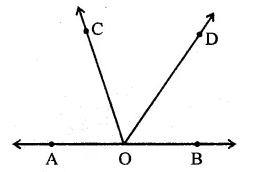
RD Sharma Class 9 Solutions Chapter 10 Congruent Triangles VSAQS

RD Sharma Class 9 Solutions Chapter 10 Congruent Triangles VSAQS

These Solutions are part of RD Sharma Class 9 Solutions. Here we have given RD Sharma Class 9 Solutions Chapter 10 Congruent Triangles VSAQS

Other Exercises

Question 1.
Define complementary angles.
Solution:
Two angles whose sum is 90°, are called complementary angles.

Question 2.
Define supplementary angles.
Solution:
Two angles whose sum is 180°, are called supplementary angles.

Question 3.
Define adjacent angles.
Solution:
Two angles which have common vertex and one arm common are called adjacent angles.

Question 4.
The complement of an acute angles is…….
Solution:
The complement of an acute angles is an acute angle.

Question 5.
The supplement of an acute angles is………
Solution:
The supplement of an acute angles is a obtuse angle.

Question 6.
The supplement of a right angle is…….
Solution:
The supplement of a right angle is a right angle.

Question 7.
Write the complement of an angle of measure x°.
Solution:
The complement of x° is (90° – x)°

Question 8.
Write the supplement of an angle of measure 2y°.
Solution:
The supplement of 2y° is (180° – 2y)°

Question 9.
If a wheel has six spokes equally spaced, then find the measure of the angle between two adjacent spokes.
Solution:
Total measure of angle around a point = 360°
Number of spokes = 6
∴ Angle between the two adjacent spokes = \(\frac { { 360 }^{ \circ } }{ 6 }\) = 60°

Question 10.
An angle is equal to its supplement. Determine its measure.
Solution:
Let required angle = x°
Then its supplement angle = 180° – x
x = 180° – x
⇒ x + x = 180°
⇒  2x = 180° ⇒  x = \(\frac { { 180 }^{ \circ } }{ 2 }\) = 90°
∴ Required angle = 90°

Question 11.
An angle is equal to five times its complement. Determine its measure.
Solution:
Let required measure of angle = x°
∴  Its complement angle = 90° – x
∴  x = 5(90° – x)
⇒  x = 450° – 5x
⇒  x + 5x = 450°
⇒  6x = 450°
⇒ x = \(\frac { { 450 }^{ \circ } }{ 6 }\) = 75°
∴ Required angle = 75°

Question 12.
How many pairs of adjacent angles are formed when two lines intersect in a point?
Solution:
If two lines AB and CD intersect at a point O, then pairs of two adjacent angles are, ∠AOC and ∠COB, ∠COB and ∠BOD, ∠BOD and DOA, ∠DOA and ∠ZAOC
i.e, 4 pairs
RD Sharma Class 9 Solutions Chapter 10 Congruent Triangles VSAQS Q12.1

Hope given RD Sharma Class 9 Solutions Chapter 10 Congruent Triangles VSAQS are helpful to complete your math homework.

If you have any doubts, please comment below. Learn Insta try to provide online math tutoring for you.
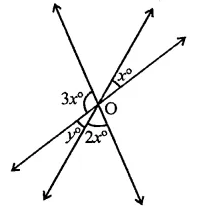
RD Sharma Class 9 Solutions Chapter 24 Measures of Central Tendency MCQS

RD Sharma Class 9 Solutions Chapter 24 Measures of Central Tendency MCQS

These Solutions are part of RD Sharma Class 9 Solutions. Here we have given RD Sharma Class 9 Solutions Chapter 24 Measures of Central Tendency MCQS

Other Exercises

Mark the correct alternative in each of the following:

Question 1.
Which one of the following is not a measure of central value?
(a) Mean
(b) Range
(c) Median
(d) Mode
Solution:
Range (b)

Question 2.
The mean of n observations is \(\overline { X } \) . If k is added to each observation, then the new mean is
(a) \(\overline { X } \)
(b) \(\overline { X } \) + k
(c) \(\overline { X } \) – k
(d) k\(\overline { X } \)
Solution:
Mean of n observation = \(\overline { X } \)
By adding k to each observation the new mean will be \(\overline { X } \) + k (b)

Question 3.
The mean of n observations is \(\overline { X } \) . If each observation is multiplied by k, the mean of new observations is
(a) k\(\overline { X } \)
(b) \(\frac { \overline { X } }{ k } \)
(c) \(\overline { X } \) + k
(d) \(\overline { X } \) – k
Solution:
Mean of n observations = \(\overline { X } \)
By multiplying each observation by k,
the new mean = k\(\overline { X } \) (a)

Question 4.
The mean of a set of seven numbers is 81. If one of the numbers is discarded, the mean of the remaining numbers is 78. The value of discarded number is
(a) 98
(b) 99
(c) 100
(d) 101
Solution:
Mean of 7 numbers = 81
Total = 7 x 81 = 567
By discarding one number, the mean of the remaining 7 – 1 = 6 numbers = 78
Total = 6 x 78 = 468
Discarded number = 567 – 468 = 99 (b)

Question 5.
For which set of numbers do the mean, median and mode all have the same value?
(a) 2, 2, 2, 2, 4
(b) 1, 3, 3, 3, 5
(c) 1, 1, 2, 5, 6
(d) 1, 1, 1, 2, 5
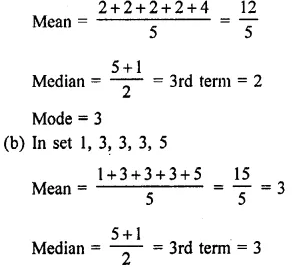
Solution:
a) In set 2, 2, 2, 2, 4
RD Sharma Class 9 Solutions Chapter 24 Measures of Central Tendency MCQS 5.1
Mode = 3 as it come in maximum times
This set has mean, median and mode same (b)

Question 6.
For the set of numbers 2, 2, 4, 5 and 12, which of the following statements is true?
(a) Mean = Median
(b) Mean > Mode
(c) Mean < Mode
(d) Mode = Median
Solution:
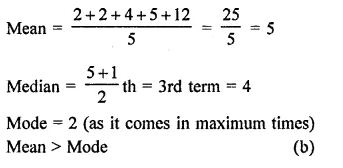
The given set is 2, 2, 4, 5, 12
RD Sharma Class 9 Solutions Chapter 24 Measures of Central Tendency MCQS 6.1

Question 7.
If the arithmetic mean of 7, 5, 13, x and 9 is 10, then the value of x is
(a) 10
(b) 12
(c) 14
(d) 16
Solution:
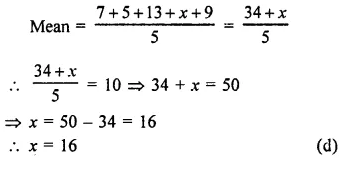
Arithmetic mean of 7, 5, 13, x, 9 is 10
RD Sharma Class 9 Solutions Chapter 24 Measures of Central Tendency MCQS 7.1

Question 8.
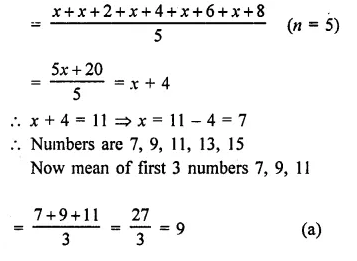
If the mean of five observations x, x + 2, x + 4, x + 6, x + 8, is 11, then the mean of first three observations is
(a) 9
(b) 11
(c) 13
(d) none of these
Solution:
Mean = 11
But mean of x, x + 2, x + 4, x+ 6, x + 8
RD Sharma Class 9 Solutions Chapter 24 Measures of Central Tendency MCQS 8.1

Question 9.
Mode is
(a) least frequent value
(b) middle most value
(c) most frequent value
(d) none of these
Solution:
Mode is most frequent value (c)

Question 10.
The following is the data of wages per day: 5, 4, 7, 5, 8, 8, 8, 5, 7, 9, 5, 7, 9, 10, 8 The mode of the data is
(a) 7
(b) 5
(c) 8
(d) 10
Solution:
Wages per day
5, 4, 7, 5, 8, 8, 8, 5, 7, 9, 5, 7, 9, 10, 8
=> 4, 5, 5, 5, 5, 7, 7, 7, 8, 8, 8, 8, 9, 9, 10
Here 8 comes in maximum times
Mode = 8 (c)

Question 11.
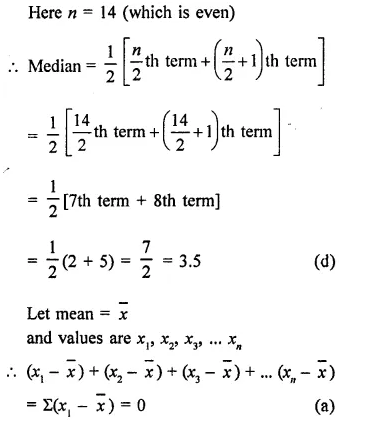
The median of the following data :
is ,
(a) 0
(b) -1.5
(c) 2
(d) 3.5
Solution:
Arranging in ascending order,
-3, -3, -1, 0, 2, 2, 2, 5, 5, 5, 5, 6, 6, 6
RD Sharma Class 9 Solutions Chapter 24 Measures of Central Tendency MCQS 11.1

Question 12.
The algebraic sum of the deviations of a set of n values from their mean is
(a) 0
(b) n – 1
(c) n
(d) n + 1
Solution:
The algebraic sum of deviation of a set of n values from that mean

Question 13.
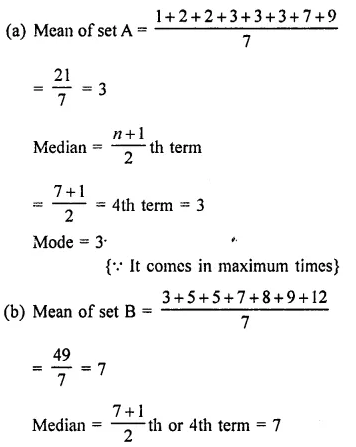
A, B, C are three sets of values of X:
A : 2, 3, 7, 1, 3, 2, 3
B: 7, 5, 9, 12, 5, 3, 8
C: 4, 4, 11, 7 ,2, 3, 4
Which one of the following statements is
correct?
(a) Mean of A = Mode of C
(b) Mean of C = Median of B
(c) Median of B = Mode of A
(d) Mean, Median and Mode of A are equal.
Solution:
Arranging the sets in ascending order
A{2, 3, 7, 1,3,2,3)
= {1, 2, 2, 3, 3, 3, 7)
B = {7, 5, 9, 12, 5, 3, 8)
= {3, 5, 5, 7, 8, 9, 12)
C = {4, 4, 11,7,2,3,4)
= {2, 3, 4, 4, 4, 7, 11)
RD Sharma Class 9 Solutions Chapter 24 Measures of Central Tendency MCQS 13.1
Mode = 5 {as it comes max times}
(c) Mean of set C = \(\\ \frac { 2+3+4+4+4+7+11 }{ 7 } \)
= \(\\ \frac { 35 }{ 7 } \) = 5
Median = \(\\ \frac { 7+1 }{ 2 } \) th =\(\\ \frac { 8 }{ 2 } \) =4th term = 4
Mode =4 {as it comes max times}
In set A,mean = median = mode = 3 (d)

Question 14.
The empirical relation between mean, mode and median is
(a) Mode = 3 Median — 2 Mean
(b) Mode 2 Median — 3 Mean
(c) Median 3 Mode — 2 Mean
(d) Mean = 3 Median —2 Mode
Solution:
The empirical relations between mean, mode
and median is
Mode = 3 Median — 2 Mean (a)

Question 15.
The mean of a, b, c, d and e is 28. If the mean of a, c, and e is 24, what is the mean of b and d?
(a) 31
(b) 32
(c) 33
(d) 34
Solution:
Mean of a, b, c, d and e = 28
Total of a, b, c, d and e = 28 x 5 = 140
Mean of a, c and e is = 24
Total of a, c, e = 24 x 3 = 72
Total of b and d = 140 – 72 = 68
Mean = \(\\ \frac { 68 }{ 2 } \) = 34 (d)

Hope given RD Sharma Class 9 Solutions Chapter 24 Measures of Central Tendency MCQS are helpful to complete your math homework.

If you have any doubts, please comment below. Learn Insta try to provide online math tutoring for you.
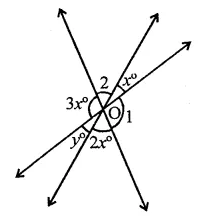
RS Aggarwal Class 9 Solutions Chapter 14 Statistics Ex 14G

RS Aggarwal Class 9 Solutions Chapter 14 Statistics Ex 14G

These Solutions are part of RS Aggarwal Solutions Class 9. Here we have given RS Aggarwal Solutions Class 9 Chapter 14 Statistics Ex 14G.

Other Exercises

Question 1.
Solution:
Arranging in ascending order, we get:
2,2,3,5,7,9,9,10,11
Here, number of terms is 9 which is odd.
∴ Median = \(\frac { n+1 }{ 2 } \) th term = \(\frac { 9+1 }{ 2 } \) th term = 5th term = 7 Ans.
(ii) Arranging in ascending order, we get: 6, 8, 9, 15, 16, 18, 21, 22, 25
Here, number of terms is 9 which is odd.
∴ Median = \(\frac { n+1 }{ 2 } \) th term = \(\frac { 9+1 }{ 2 } \) th term = 5th term = 16 Ans.
(iii) Arranging in ascending order, we get: 6, 8, 9, 13, 15, 16, 18, 20, 21, 22, 25
Here, number of terms is 11 which is odd.
∴ Median = \(\frac { 11+1 }{ 2 } \) th term = \(\frac { 12 }{ 2 } \) th term = 6th term = 16 Ans.
(iv) Arranging in ascending order, we get:
0, 1, 2, 2, 3, 4, 4, 5, 5, 7, 8, 9, 10
Here, number of terms is 13, which is odd.
Median = \(\frac { 13+1 }{ 2 } \) th term = \(\frac { 14 }{ 2 } \) th term = 7th term = 4 Ans.

Question 2.
Solution:
Arranging in ascending order, we get 9, 10, 17, 19, 21, 22, 32, 35
Here, number of terms is 8 which is even
∴Median = \(\frac { 1 }{ 2 } \left[ \frac { 8 }{ 2 } th\quad term+\left( \frac { 8 }{ 2 } +1 \right) th\quad term \right] \)
= \(\frac { 1 }{ 2 } \) [4th term + 5th term] = \(\frac { 1 }{ 2 } \) (19 + 21) = \(\frac { 1 }{ 2 } \) x 40 = 20
(ii) Arranging in ascending order, we get:
29, 35, 51, 55, 60, 63, 72, 82, 85, 91
Here number of terms is 10 which is even
∴Median = \(\frac { 1 }{ 2 } \left[ \frac { 10 }{ 2 } th\quad term+\left( \frac { 10 }{ 2 } +1 \right) th\quad term \right] \)
= \(\frac { 1 }{ 2 } \) (60 + 63) = \(\frac { 1 }{ 2 } \) x 123 = 61.5 Ans.
(iii) Arranging in ascending order we get
3, 4, 9, 10, 12, 15, 17, 27, 47, 48, 75, 81
Here number of terms is 12 which is even.
∴Median = \(\frac { 1 }{ 2 } \left[ \frac { 12 }{ 2 } th\quad term+\left( \frac { 12 }{ 2 } +1 \right) th\quad term \right] \)
= \(\frac { 1 }{ 2 } \) (6th term + 7th term) = \(\frac { 1 }{ 2 } \) (15 + 17)= \(\frac { 1 }{ 2 } \) x 32
= 16 Ans.

Question 3.
Solution:
Arranging the given data in ascending order, we get :
17, 17, 19, 19, 20, 21, 22, 23, 24, 25, 26, 29, 31, 35, 40
∴ Median = \(\frac { 15+1 }{ 2 } \) th term = \(\frac { 16 }{ 2 } \) th term = 8th term = 23
∴ Median score = 23 Ans.

Question 4.
Solution:
Arranging in ascending order, we get:
143.7, 144.2, 145, 146.5, 147.3, 148.5, 149.6, 150, 152.1
Here, number of terms is 9 which is odd.
Median = \(\frac { 9+1 }{ 2 } \) th term = \(\frac { 10 }{ 2 } \) th term = 5th term = 147.3 cm
Hence, median height = 147.3 cm Ans.

Question 5.
Solution:
Arranging in ascending order, we get:
9.8, 10.6, 12.7, 13.4, 14.3, 15, 16.5, 17.2
Here number of terms is 8 which is even
∴Median = \(\frac { 1 }{ 2 } \left[ \frac { 8 }{ 2 } th\quad term+\left( \frac { 8 }{ 2 } +1 \right) th\quad term \right] \)
= \(\frac { 1 }{ 2 } \)[4th term + 5th term]
= \(\frac { 1 }{ 2 } \) (13.4 + 14.3) = \(\frac { 1 }{ 2 } \) (27.7) = 13.85
∴ Median weight = 13.85 kg. Ans.

Question 6.
Solution:
Arranging in ascending order, we get:
32, 34, 36, 37, 40, 44, 47, 50, 53, 54
Here, number of terms is 10 which is even.
∴Median = \(\frac { 1 }{ 2 } \left[ \frac { 10 }{ 2 } th\quad term+\left( \frac { 10 }{ 2 } +1 \right) th\quad term \right] \)
= \(\frac { 1 }{ 2 } \) [5th term + 6th term ] = \(\frac { 1 }{ 2 } \) (40 + 44) = \(\frac { 1 }{ 2 } \) x 84 = 42 .
∴ Median age = 42 years.

Question 7.
Solution:
The given ten observations are 10, 13, 15, 18, x + 1, x + 3, 30, 32, 35, 41
These are even
∴Median = \(\frac { 1 }{ 2 } \left[ \frac { 10 }{ 2 } th\quad term+\left( \frac { 10 }{ 2 } +1 \right) th\quad term \right] \)
= \(\frac { 1 }{ 2 } \) [5th term + 6th term ] = \(\frac { 1 }{ 2 } \)(x + 1 + x + 3) = \(\frac { 1 }{ 2 } \)(2x + 4)
= x + 2
But median is given = 24
∴ x + 2 = 24 => x = 24 – 2 = 22
Hence x = 22.

Question 8.
Solution:
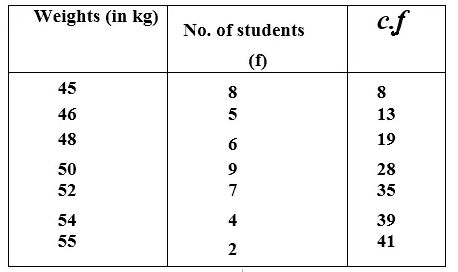
Preparing the cumulative frequency table, we have:
RS Aggarwal Class 9 Solutions Chapter 14 Statistics Ex 14G Q8.1
Here, number of terms (n) = 41, which is odd,
Median = \(\frac { 41+1 }{ 2 } \) th term = \(\frac { 42 }{ 2 } \) th term = 21st term = 50 (∵ 20th to 28th term = 50)
Hence median weight = 50 kg Ans.

Question 9.
Solution:
Arranging first in ascending order, we get:
RS Aggarwal Class 9 Solutions Chapter 14 Statistics Ex 14G Q9.1
Now preparing its cumulative frequency table
RS Aggarwal Class 9 Solutions Chapter 14 Statistics Ex 14G Q9.2
Here, number of terms is 37 which is odd.
Median = \(\frac { 37+1 }{ 2 } \) th term = \(\frac { 38 }{ 2 } \) th term = 19 th term = 22 (∵18th to 21st = 22)
Hence median – 22 Ans.

Question 10.
Solution:
first arranging in ascending order we get
RS Aggarwal Class 9 Solutions Chapter 14 Statistics Ex 14G Q10.1
Now preparing its cumulative frequency table,we find:
RS Aggarwal Class 9 Solutions Chapter 14 Statistics Ex 14G Q10.2
Here, number of terms is 43, which if odd.
Median = \(\frac { 43+1 }{ 2 } \) th term = \(\frac { 44 }{ 2 } \) th term = 22nd term = 25 25 (∵ 11th to 26th = 25)

Question 11.
Solution:
Arranging in ascending order,we get
RS Aggarwal Class 9 Solutions Chapter 14 Statistics Ex 14G Q11.1
Now preparing its cumulative frequency table, we find :
RS Aggarwal Class 9 Solutions Chapter 14 Statistics Ex 14G Q11.2
Here, number of terms = 50 which is even
∴Median = \(\frac { 1 }{ 2 } \left[ \frac { 50 }{ 2 } th\quad term+\left( \frac { 50 }{ 2 } +1 \right) th\quad term \right] \)
= \(\frac { 1 }{ 2 } \) (154 + 155) = \(\frac { 1 }{ 2 } \) (309) = 154.5 (∵ 22nd to 25th = 154, 26th to 34th= 155)

Question 12.
Solution:
Arranging in ascending order, we get:
RS Aggarwal Class 9 Solutions Chapter 14 Statistics Ex 14G Q12.1
Now, preparing its cumulative frequency table.
RS Aggarwal Class 9 Solutions Chapter 14 Statistics Ex 14G Q12.2
Here, number of terms is 60 which is even
∴Median = \(\frac { 1 }{ 2 } \left[ \frac { 60 }{ 2 } th\quad term+\left( \frac { 60 }{ 2 } +1 \right) th\quad term \right] \)
= \(\frac { 1 }{ 2 } \) (30th term + 31st term)
= \(\frac { 1 }{ 2 } \) (20 + 23) = \(\frac { 1 }{ 2 } \) x 43 = 21.5 (∵ 18th to 30th term = 20, 31st term to 34th = 23)
Hence median = 21.5 Ans.

Hope given RS Aggarwal Solutions Class 9 Chapter 14 Statistics Ex 14G are helpful to complete your math homework.

If you have any doubts, please comment below. Learn Insta try to provide online math tutoring for you.
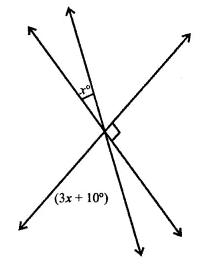
RD Sharma Class 9 Solutions Chapter 24 Measures of Central Tendency Ex 24.4

RD Sharma Class 9 Solutions Chapter 24 Measures of Central Tendency Ex 24.4

These Solutions are part of RD Sharma Class 9 Solutions. Here we have given RD Sharma Class 9 Solutions Chapter 24 Measures of Central Tendency Ex 24.4

Other Exercises

Question 1.
Find out the mode of the following marks obtained by 15 students in a class:
Marks : 4, 6, 5, 7, 9, 8, 10, 4, 7, 6, 5, 9, 8, 7, 7.
Solution:
Marks obtained are in ascending order,
4, 4, 5, 5, 6, 6, 7, 7, 7, 7, 8, 8, 9, 9, 10
Here we see that 7 is the number which is maximum times i.e. 4 times
Mode = 7

Question 2.
Find the mode for the following data:
125, 175, 225, 125, 225, 175, 325, 125, 375, 225, 125
Solution:
Arranging in ascending order,
125, 125, 125, 125, 175, 175, 225, 225, 225, 325, 375
We see that, 125 is the number which is in maximum times
Mode = 125

Question 3.
Find the mode for the following series:
7.5, 7.3, 7.2, 7.2, 7.4, 7.7, 7.7, 7.5, 7.3, 7.2, 7.6, 7.2
Solution:
Arranging in ascending order,
7.2, 7.2, 7.2, 7.2, 7.3, 7.3, 7.4, 7.5, 7.5, 7.6, 7.7, 7.7
We see that 7.2 comes in maximum times
Mode = 7.2

Question 4.
Find the mode of the following data in each case:
(i) 14, 25, 14, 28, 18, 17, 18, 14, 23, 22, 14, 18
(ii) 7, 9, 12, 13, 7, 12, 15, 7, 12, 7, 25, 18, 7
Solution:
(i) 14, 25, 14, 28, 18, 17, 18, 14, 23, 22, 14, 18
Arranging in ascending order,
14, 14, 14,. 14, 17, 18, 18, 18, 22, 23, 25, 28
Here we see that 14 comes in maximum times
Mode = 14
(ii) 7, 9, 12, 13, 7, 12, 15, 7, 12, 7, 25, 18, 7
Arranging in order,
7, 7, 7, 7, 7, 9, 12, 12, 12, 13, 15, 18, 25
Here we see that 7 comes in maximum times
Mode = 7

Question 5.
The demand of different shirt sizes, as obtained by a survey, is given below:
RD Sharma Class 9 Solutions Chapter 24 Measures of Central Tendency Ex 24.4 5.1
Find the modal shirt sizes, as observed from the survey.
Solution:
From the given data
RD Sharma Class 9 Solutions Chapter 24 Measures of Central Tendency Ex 24.4 5.2
From above, we see that
Modal size is 39 as it has maximum times persons

Hope given RD Sharma Class 9 Solutions Chapter 24 Measures of Central Tendency Ex 24.4 are helpful to complete your math homework.

If you have any doubts, please comment below. Learn Insta try to provide online math tutoring for you.
RD Sharma Class 9 Solutions Chapter 11 Co-ordinate Geometry VSAQS

RD Sharma Class 9 Solutions Chapter 11 Co-ordinate Geometry VSAQS

These Solutions are part of RD Sharma Class 9 Solutions. Here we have given RD Sharma Class 9 Solutions Chapter 11 Co-ordinate Geometry VSAQS
Other Exercises

Question 1.
Define a triangle.
Solution:
A figure bounded by three lines segments in a plane is called a triangle.

Question 2.
Write the sum of the angles of an obtuse triangle.
Solution:
The sum of angles of an obtuse triangle is 180°.

Question 3.
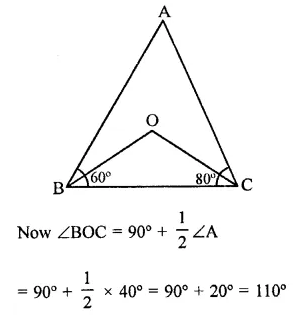
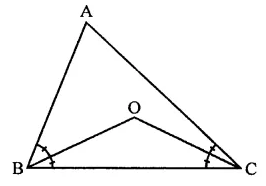
In ∆ABC, if ∠B = 60°, ∠C = 80° and the bisectors of angles ∠ABC and ∠ACB meet at a point O, then find the measure of ∠BOC.
Solution:
In ∆ABC, ∠B = 60°, ∠C = 80°
OB and OC are the bisectors of ∠B and ∠C
∵ ∠A + ∠B + ∠C = 180° (Sum of angles of a triangle)
⇒ ∠A + 60° + 80° = 180°
⇒ ∠A + 140° = 180°
∴ ∠A = 180°- 140° = 40°
RD Sharma Class 9 Solutions Chapter 11 Co-ordinate Geometry VSAQS Q3.1
= 90° + – x 40° = 90° + 20° = 110°

Question 4.
If the angles of a triangle are in the ratio 2:1:3. Then find the measure of smallest angle.
Solution:
Sum of angles of a triangle = 180°
Ratio in the angles = 2 : 1 : 3
Let first angle = 2x
Second angle = x
and third angle = 3x
∴ 2x + x + 3x = 180° ⇒ 6x = 180°
∴ x = \(\frac { { 180 }^{ \circ } }{ 6 }\)  = 30°
∴ First angle = 2x = 2 x 30° = 60°
Second angle = x = 30°
and third angle = 3x = 3 x 30° = 90°
Hence angles are 60°, 30°, 90°

Question 5.
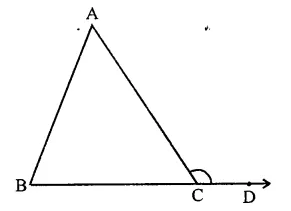
State exterior angle theorem.
Solution:
Given : In ∆ABC, side BC is produced to D
RD Sharma Class 9 Solutions Chapter 11 Co-ordinate Geometry VSAQS Q5.1
To prove : ∠ACD = ∠A + ∠B
Proof: In ∆ABC,
∠A + ∠B + ∠ACB = 180° …(i) (Sum of angles of a triangle)
and ∠ACD + ∠ACB = 180° …(ii) (Linear pair)
From (i) and (ii)
∠ACD + ∠ACB = ∠A + ∠B + ∠ACB
∠ACD = ∠A + ∠B
Hence proved.

Question 6.
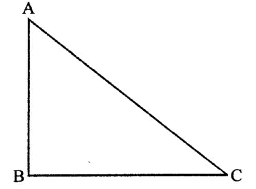
The sum of two angles of a triangle is equal to its third angle. Determine the measure of the third angle.
Solution:
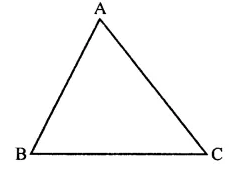
In ∆ABC,
∠A + ∠C = ∠B
RD Sharma Class 9 Solutions Chapter 11 Co-ordinate Geometry VSAQS Q6.1
But ∠A + ∠B + ∠C = 180° (Sum of angles of a triangle)
∴ ∠B + ∠A + ∠C = 180°
⇒ ∠B + ∠B = 180°
⇒ 2∠B = 180°
⇒ ∠B = \(\frac { { 180 }^{ \circ } }{ 2 }\)  = 90°
∴ Third angle = 90°

Question 7.
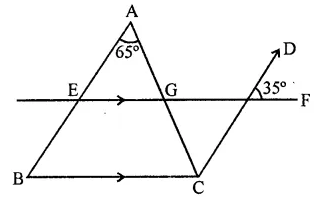
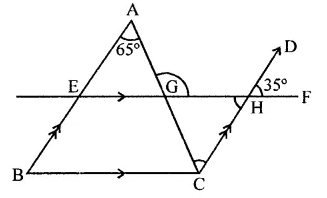
In the figure, if AB || CD, EF || BC, ∠BAC = 65° and ∠DHF = 35°, find ∠AGH.
RD Sharma Class 9 Solutions Chapter 11 Co-ordinate Geometry VSAQS Q7.1
Solution:
Given : In figure, AB || CD, EF || BC ∠BAC = 65°, ∠DHF = 35°
RD Sharma Class 9 Solutions Chapter 11 Co-ordinate Geometry VSAQS Q7.2
∵ EF || BC
∴ ∠A = ∠ACH (Alternate angle)
∴ ∠ACH = 65°
∵∠GHC = ∠DHF
(Vertically opposite angles)
∴ ∠GHC = 35°
Now in ∆GCH,
Ext. ∠AGH = ∠GCH + ∠GHC
= 65° + 35° = 100°

Question 8.
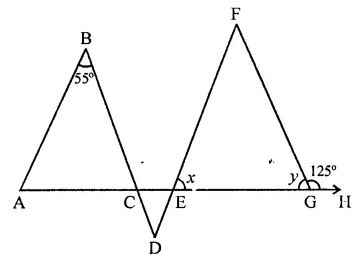
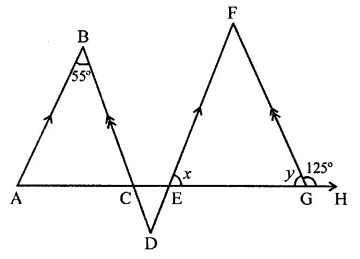
In the figure, if AB || DE and BD || FG such that ∠FGH = 125° and ∠B = 55°, find x and y.
RD Sharma Class 9 Solutions Chapter 11 Co-ordinate Geometry VSAQS Q8.1
Solution:
In the figure, AB || DF, BD || FG
RD Sharma Class 9 Solutions Chapter 11 Co-ordinate Geometry VSAQS Q8.2
∠FGH = 125° and ∠B = 55°
∠FGH + FGE = 180° (Linear pair)
⇒ 125° + y – 180°
⇒ y= 180°- 125° = 55°
∵ BA || FD and BD || FG
∠B = ∠F = 55°
Now in ∆EFG,
∠F + ∠FEG + ∠FGE = 180°
(Angles of a triangle)
⇒ 55° + x + 55° = 180°
⇒ x+ 110°= 180°
∴ x= 180°- 110° = 70°
Hence x = 70, y = 55°

Question 9.
If the angles A, B and C of ∆ABC satisfy the relation B – A = C – B, then find the measure of ∠B.
Solution:
In ∆ABC,
∠A + ∠B + ∠C= 180° …(i)
and B – A = C – B
RD Sharma Class 9 Solutions Chapter 11 Co-ordinate Geometry VSAQS Q9.1
⇒ B + B = A + C ⇒ 2B = A + C
From (i),
B + 2B = 180° ⇒ 3B = 180°
∠B = \(\frac { { 180 }^{ \circ } }{ 3 }\) = 60°
Hence ∠B = 60°

Question 10.
In ∆ABC, if bisectors of ∠ABC and ∠ACB intersect at O at angle of 120°, then find the measure of ∠A.
Solution:
In ∆ABC, bisectors of ∠B and ∠C intersect at O and ∠BOC = 120°
RD Sharma Class 9 Solutions Chapter 11 Co-ordinate Geometry VSAQS Q10.1
But ∠BOC = 90°+ \(\frac { 1 }{ 2 }\)
90°+ \(\frac { 1 }{ 2 }\) ∠A= 120°
⇒ \(\frac { 1 }{ 2 }\) ∠A= 120°-90° = 30°
∴ ∠A = 2 x 30° = 60°

Question 11.
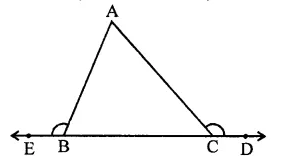
If the side BC of ∆ABC is produced on both sides, then write the difference between the sum of the exterior angles so formed and ∠A.
Solution:
In ∆ABC, side BC is produced on both sides forming exterior ∠ABE and ∠ACD
Ext. ∠ABE = ∠A + ∠ACB
and Ext. ∠ACD = ∠ABC + ∠A
RD Sharma Class 9 Solutions Chapter 11 Co-ordinate Geometry VSAQS Q11.1
Adding we get,
∠ABE + ∠ACD = ∠A + ∠ACB + ∠A + ∠ABC
⇒ ∠ABE + ∠ACD – ∠A = ∠A 4- ∠ACB + ∠A + ∠ABC – ∠A (Subtracting ∠A from both sides)
= ∠A + ∠ABC + ∠ACB = ∠A + ∠B + ∠C = 180° (Sum of angles of a triangle)

Question 12.
In a triangle ABC, if AB = AC and AB is produced to D such that BD = BC, find ∠ACD: ∠ADC.
Solution:
In ∆ABC, AB = AC
AB is produced to D such that BD = BC
DC are joined
In ∆ABC, AB = AC
∴ ∠ABC = ∠ACB
In ∆ BCD, BD = BC
∴ ∠BDC = ∠BCD
and Ext. ∠ABC = ∠BDC + ∠BCD = 2∠BDC (∵ ∠BDC = ∠BCD)
⇒ ∠ACB = 2∠BCD (∵ ∠ABC = ∠ACB)
Adding ∠BDC to both sides
⇒ ∠ACB + ∠BDC = 2∠BDC + ∠BDC
⇒ ∠ACB + ∠BCD = 3 ∠BDC (∵ ∠BDC = ∠BCD)
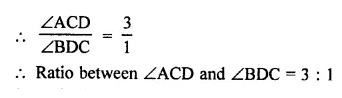
⇒ ∠ACB = 3∠BDC
RD Sharma Class 9 Solutions Chapter 11 Co-ordinate Geometry VSAQS Q12.1

Question 13.
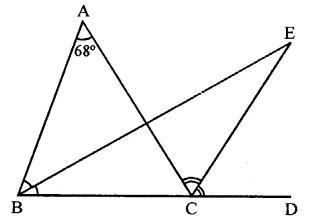
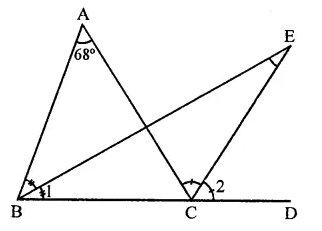
In the figure, side BC of AABC is produced to point D such that bisectors of ∠ABC and ∠ACD meet at a point E. If ∠BAC = 68°, find ∠BEC.
RD Sharma Class 9 Solutions Chapter 11 Co-ordinate Geometry VSAQS Q13.1
Solution:
In the figure,
RD Sharma Class 9 Solutions Chapter 11 Co-ordinate Geometry VSAQS Q13.2
side BC of ∆ABC is produced to D such that bisectors of ∠ABC and ∠ACD meet at E
∠BAC = 68°
In ∆ABC,
Ext. ∠ACD = ∠A + ∠B
⇒ \(\frac { 1 }{ 2 }\) ∠ACD = \(\frac { 1 }{ 2 }\) ∠A + \(\frac { 1 }{ 2 }\) ∠B
⇒ ∠2= \(\frac { 1 }{ 2 }\) ∠A + ∠1 …(i)
But in ∆BCE,
Ext. ∠2 = ∠E + ∠l
⇒ ∠E + ∠l = ∠2 = \(\frac { 1 }{ 2 }\) ∠A + ∠l [From (i)]
⇒ ∠E = \(\frac { 1 }{ 2 }\) ∠A = \(\frac { { 68 }^{ \circ } }{ 2 }\)  =34°

Hope given RD Sharma Class 9 Solutions Chapter 11 Co-ordinate Geometry VSAQS are helpful to complete your math homework.

If you have any doubts, please comment below. Learn Insta try to provide online math tutoring for you.