MCQ Questions for Class 11 Biology Chapter 12 Mineral Nutrition with Answers

Mineral Nutrition Class 11 MCQ Online Test With Answers Questions

Check the below NCERT MCQ Questions for Class 11 Biology Chapter 12 Mineral Nutrition with Answers Pdf free download. MCQ Questions for Class 11 Biology with Answers were prepared based on the latest exam pattern. We have provided Mineral Nutrition Class 11 Biology MCQs Questions with Answers to help students understand the concept very well.

Class 11 Biology Chapter 12 MCQ With Answers

Biology Class 11 Chapter 12 MCQs On Mineral Nutrition

Mineral Nutrition Class 11 MCQ Question 1.
In plants, a common symptom caused by deficiency of P, K, Ca and Mg is the
(a) bending of leaf tip
(b) formation of anthocyanins
(c) poor development of vasculature
(d) appearance of dead necrotic tissue

Answer

Answer: (d) appearance of dead necrotic tissue


Mineral Nutrition MCQ With Answers Question 2.
Function of zinc is
(a) Closing of stomata
(b) Biosynthesis of 3-IAA
(c) Synthesis of chlorophyll
(d) Oxidation of carbohydrate

Answer

Answer: (c) Synthesis of chlorophyll


Chapter 12 Biology Class 11 MCQs Question 3.
Which of the following is a group of micronutrients?
(a) Ca, Zn, B
(b) Fe, Mn, Cu
(c) Cl, C, Ca
(d) Ni, Mo, H

Answer

Answer: (b) Fe, Mn, Cu
Explanation:
Iron, mangenese and copper are micronutrients.


MCQ On Mineral Nutrition Class 11 Question 4.
The process of conversion of NO2 to N2 is called
(a) nitrification
(b) ammonification
(c) denitrification
(d) nitrogen fixation

Answer

Answer: (c) denitrification
Explanation:
The process of conversation of NO2 to N2 is called denitrification.


MCQ Questions For Class 11 Biology Chapter Wise Question 5.
The formation of first stable product of nitrogen fixation is catalysed by enzyme
(a) dehydrogenase
(b) nitrogenase
(c) isomerase
(d) none of these

Answer

Answer: (b) nitrogenase
Explanation:
The first stable product of nitrogen fixation is ammonia obtained from atmospheric nitrogen catalysed enzyme nitrogenase.


Class 11 Biology MCQ Question 6.
Manganese toxicity leads to deficiency of
(a) iron
(b) calcium
(c) magnesium
(d) all of the above

Answer

Answer: (d) all of the above
Explanation:
Manganese toxicity causes deficiency of iron, magnesium and calcium.


Mineral Nutrition Questions And Answers Question 7.
Chlorosis will occur if a plant is grown in
(a) dark
(b) shade
(c) strong light
(d) Fe – free medium

Answer

Answer: (d) Fe – free medium


MCQ Questions Class 11 Biology Question 8.
Choose the correct function of magnesium.
(a) It is a constituent of several coenzyme.
(b) It activates the enzymes of respiration and photosynthesis.
(c) It activates enzyme catalase.
(d) It helps in maintaining anion-cation balance.

Answer

Answer: (b) It activates the enzymes of respiration and photosynthesis.
Explanation:
Magnesium is absorbed by plants as Mg2+
It activates the enzymes of respiration and photosynthesis.
It is involved in the synthesis of DNA RNA.
It is the constituent of ring structure of chlorophyll.
It helps to maintain ribosome structure.


Biology Class 11 MCQ Question 9.
Mineral salts which are absorbed by the roots from soil are in the form of
(a) Dilute solution
(b) Very concentrated solution
(c) Concentrated solution
(d) Very dilute solution

Answer

Answer: (d) Very dilute solution


MCQ Questions For Class 11 Biology Question 10.
Which one of the following mineral elements plays an in biological nitrogen fixation?
(a) Copper
(b) Manganese
(c) Zinc
(d) Molybdenum

Answer

Answer: (d) Molybdenum


Question 11.
Oxygen scavangers present in root nodules of legumes is
(a) haemoglobin
(b) leg haemoglobin
(c) cyano haemoglobin
(d) none of these

Answer

Answer: (b) leg haemoglobin
Explanation:
Leg-haemoglobin is the oxygen scavanger in root nodules of legumes.


Question 12.
Which one of the following is not a micronutrient?
(a) Magnesium
(b) Molybdenum
(c) Boron
(d) Zinc

Answer

Answer: (a) Magnesium


Question 13.
Which of the following is not a macronutrient
(a) iron
(b) calcium
(c) manganese
(d) phosphorus

Answer

Answer: (c) manganese


Question 14.
Insectivorous plants grow where
(a) There is carbohydrate deficient soil
(b) There is nitrogen deficient soil
(c) Vitamin c is required
(d) Hormones are required

Answer

Answer: (b) There is nitrogen deficient soil


Question 15.
Phytotron is meant for
(a) Controlled humidity
(b) Induction of mutations
(c) Controlled irradiation
(d) Growing plants under controlled environment

Answer

Answer: (d) Growing plants under controlled environment


Question 16.
Toxicity of which element leads to the appearance of brown spots on leaves
(a) Mg
(b) Mn
(c) Fe
(d) Cu

Answer

Answer: (b) Mn
Explanation:
Toxicity of mangenese leads to the appearance of the brown spots with chlorotic veins.


Question 17.
Presence of phosphorus
(a) brings about healthy root growth
(b) promotes fruit ripening
(c) retards protein formation
(d) none

Answer

Answer: (c) retards protein formation


Question 18.
Which element is required for opening and closing of stomata?
(a) P
(b) K
(c) Ca
(d) Na

Answer

Answer: (b) K
Explanation:
Potassium plays an important role in opening and closing of stomata.


Question 19.
Exanthema is due to deficiency of
(a) B
(b) Mo
(c) Mn
(d) Cu

Answer

Answer: (d) Cu


Question 20.
NPK denotes
(a) Nitrogen, Protein, Kinetin
(b) Nitrogen, Protein, Potassium
(c) Nitrogen, Potassium, kinetin
(d) Nitrogen, Phosphorus, Potassium

Answer

Answer: (d) Nitrogen, Phosphorus, Potassium


We hope the given NCERT MCQ Questions for Class 11 Biology Chapter 12 Mineral Nutrition with Answers Pdf free download will help you. If you have any queries regarding CBSE Class 11 Biology Mineral Nutrition MCQs Multiple Choice Questions with Answers, drop a comment below and we will get back to you soon.

Class 11 Biology MCQ:

MCQ Questions for Class 11 Biology Chapter 19 Excretory Products and their Elimination with Answers

Excretory Products and their Elimination Class 11 MCQ Online Test With Answers Questions

Check the below NCERT MCQ Questions for Class 11 Biology Chapter 19 Excretory Products and their Elimination with Answers Pdf free download. MCQ Questions for Class 11 Biology with Answers were prepared based on the latest exam pattern. We have provided Excretory Products and their Elimination Class 11 Biology MCQs Questions with Answers to help students understand the concept very well.

Class 11 Biology Chapter 19 MCQ With Answers

Biology Class 11 Chapter 19 MCQs On Excretory Products and their Elimination

Excretory Products And Their Elimination MCQ Question 1.
Presence of RBCs in urine is
(a) Uremia
(b) ketonuria
(c) Glucosuria
(d) hematuria

Answer

Answer: (d) hematuria
Explanation:
Presence of blood in urine is called hematuria.
Presence of glucose in urine is called glucosuria.
Presence of ketone bodies in urine is called ketonuria.


Excretory Products And Their Elimination Class 11 MCQ Question 2.
Ornithine cycle leads to the formation of
(a) NH3
(b) ((NH2)2)CO)
(c) C5H4N4O3
(d) C5H4N4

Answer

Answer: (b) ((NH2)2)CO)
Explanation:
Ornithine cycle is the other name of urea cycle. Urea cycle is the production of urea from ammonia.
((NH2)2)CO) is the chemical formula of urea.
NH3 is ammonia.
C5H4N4 is purine.
C5H4N4O3 is uric acid.


Class 11 Biology Chapter 19 MCQ Question 3.
The yellow pigment derived from heme breakdown and excreted by kidneys is
(a) Uric acid
(b) Urochrome
(c) Cholesterol
(d) Melanin

Answer

Answer: (b) Urochrome


MCQ On Excretory Products And Their Elimination Question 4.
What happens when glomerular filteration rate falls?
(a) Activation of podocytes
(b) Release of renin
(c) Repression of juxta glomerular cells
(d) None of the above

Answer

Answer: (b) Release of renin
Explanation:
Fall in GFR activates juxta glomerular cells to release renin which stimulates glomerular blood flow and brings back the GFR to normal.


Excretory Products And Their Elimination MCQ With Answers Question 5.
Which of the following can be cured by hemodialysis?
(a) Renal calculi
(b) Glomerulonephritis
(c) Uremia
(d) All of these can be cured by hemodialysis

Answer

Answer: (c) Uremia
Explanation:
Malfunctioning of kidneys can lead to accumulation of urea in blood, this situation leads to uremia.
This can lead to kidney failure. In such patients, urea can be removed by hemodialysis.


MCQ Of Excretory Products And Their Elimination Question 6.
Kidneys are located in
(a) thoracic cavity
(b) abdominal cavity
(c) body cavity
(d) pelvic cavity

Answer

Answer: (b) abdominal cavity
Explanation:
Kidneys are present in abdominal cavity along with digestive organs.
Body cavity contains brain and spinal cord.
Thoracic cavity contains heart and lungs.
Pelvic cavity contains bladder and reproductive organs.


MCQs On Excretory Products And Their Elimination Question 7.
The muscular tubes which take the urine from the kidneys to the bladder are
(a) Urinary bladders
(b) Ureters
(c) Urethras
(d) Nephrons

Answer

Answer: (b) Ureters


Excretory Products And Their Elimination MCQs Question 8.
Most water and salts are reabsorbed in
(a) DCT
(b) Bowman s capsule
(c) PCT
(d) DCT and PCT

Answer

Answer: (c) PCT


Explanation:
Maximum absorption of water and salts occurs in proximal convulated tubule.

Excretion And Osmoregulation Class 11 MCQ Question 9.
Reabsorption of filterate occurs in
(a) renal tubules
(b) glomerular apparatus
(c) medullary pyramid
(d) juxta cells

Answer

Answer: (a) renal tubules
Explanation:
Nearly 99 per cent of the filtrate is absorbed by renal tubules.


Excretory Products And Their Elimination MCQ Questions Question 10.
JG cells release
(a) angiotensin II
(b) aldosterone
(c) renin
(d) ANF

Answer

Answer: (c) renin
Explanation:
A fall in glomerular blood flow activates JG cells to release renin.


Excretory Products And Their Elimination Ncert MCQ Question 11.
pH of human urine is
(a) 7.0
(b) 6.5
(c) 6.0
(d) 7.5

Answer

Answer: (b) 6.5
Explanation:
The average pH of human urine is 6.0.


MCQ On Excretory System Class 11 Question 12.
Average blood filtered by kidneys per minute is
(a) 1000 – 1500 mL
(b) 500 – 600 mL
(c) 200 – 300 mL
(d) 1100 – 1200 mL

Answer

Answer: (d) 1100 – 1200 mL
Explanation:
On an average kidneys filter 1100 – 1200 mL of blood per minute.


Excretory Products And Their Elimination MCQ Pdf Question 13.
Kidneys are located in
(a) thoracic cavity
(b) abdominal cavity
(c) body cavity
(d) pelvic cavity

Answer

Answer: (b) abdominal cavity
Explanation:
Kidneys are present in abdominal cavity along with digestive organs.
Body cavity contains brain and spinal cord.
Thoracic cavity contains heart and lungs.
Pelvic cavity contains bladder and reproductive organs.


Excretory Products And Their Elimination Class 11 Important Questions Question 14.
Which one of the following statements in regard to the excretion by the human kidneys is correct?
(a) Ascending limb of Loop of Henle is impermeable to electrolytes
(b) Descending limb of Loop of Henle is impermeable to water
(c) Distal convoluted tubule is incapable of reabsorbing HCO3
(d) Nearly 99 percent of the glomerular filtrate is reabsorbed by the renal tubules

Answer

Answer: (d) Nearly 99 percent of the glomerular filtrate is reabsorbed by the renal tubules


Excretory System Class 11 MCQ Question 15.
In the kidneys, osmotic pressure controls ______.
(a) Glucose absorption
(b) Sodium absorption
(c) Water absorption
(d) none of these

Answer

Answer: (c) Water absorption


Class 11 Biology Chapter 19 MCQ Questions Question 16.
Presence of __________ in urine indicates diabetes mellitus.
(a) Glucose
(b) Cholesterol
(c) Ketone bodies
(d) Both 1 and 3

Answer

Answer: (d) Both 1 and 3
Explanation:
Presence of ketone bodies and glucose in urine indicates diabetes mellitus.


Question 17.
If a man takes large amount of protein, he is likely to excrete more amount of
(a) Glucose
(b) Urea and uric acid
(c) Water
(d) Salts

Answer

Answer: (b) Urea and uric acid


Question 18.
Nerves, blood vessels and ureter enters into the kidney through
(a) calyces
(b) hilum
(c) capsule
(d) cortex

Answer

Answer: (b) hilum
Explanation:
Nerves, blood vessels and ureter enters into the kidney through hilum.


Question 19.
The principal nitrogenous excretory compound in humans is synthesised
(a) In the liver but eliminated mostly through kidneys
(b) In kidneys but eliminated mostly through liver
(c) In kidneys as well as eliminated by kidneys
(d) In liver and also eliminated by the same through bile

Answer

Answer: (a) In the liver but eliminated mostly through kidneys


Question 20.
The renal medulla consists of cone-shaped tissue masses called _______.
(a) Renal pyramid
(b) Adipose capsule
(c) Renal cortex
(d) Renal pelvis

Answer

Answer: (a) Renal pyramid


We hope the given NCERT MCQ Questions for Class 11 Biology Chapter 19 Excretory Products and their Elimination with Answers Pdf free download will help you. If you have any queries regarding CBSE Class 11 Biology Excretory Products and their Elimination MCQs Multiple Choice Questions with Answers, drop a comment below and we will get back to you soon.

Class 11 Biology MCQ:

MCQ Questions for Class 11 Biology Chapter 18 Body Fluids and Circulation with Answers

Body Fluids and Circulation Class 11 MCQ Online Test With Answers Questions

Check the below NCERT MCQ Questions for Class 11 Biology Chapter 18 Body Fluids and Circulation with Answers Pdf free download. MCQ Questions for Class 11 Biology with Answers were prepared based on the latest exam pattern. We have provided Body Fluids and Circulation Class 11 Biology MCQs Questions with Answers to help students understand the concept very well.

Class 11 Biology Chapter 18 MCQ With Answers

Biology Class 11 Chapter 18 MCQs On Body Fluids and Circulation

Body Fluids And Circulation MCQ Question 1.
In developing embryo RBCs are formed in
(a) Lymph node
(b) Bone marrow
(c) Liver
(d) Spleen

Answer

Answer: (c) Liver


Body Fluids And Circulation Class 11 MCQ Question 2.
In humans, blood passes from the post caval to the diastolic right atrium of heart due to:
(a) Pressure difference between the post caval and atrium
(b) Pushing open of the venous valves
(c) Suction pull
(d) Stimulation of the sino auricular node

Answer

Answer: (a) Pressure difference between the post caval and atrium


Class 11 Biology Chapter 18 MCQ Questions Question 3.
When body tissues are injured resulting in the loss of blood, the process of blood clot begins and the blood platelets release
(a) Fibrinogen
(b) Thrombin
(c) Prothrombin
(d) Thromboplastin

Answer

Answer: (d) Thromboplastin


Body Fluids And Circulation MCQ With Answers Question 4.
An adult human has systolic and diastolic pressures as:
(a) 80 mm Hg and 120 mm Hg
(b) 120 mm Hg and 80 mm Hg
(c) 50 mm Hg and 80 mm Hg
(d) 80 mm Hg and 80 mm Hg

Answer

Answer: (b) 120 mm Hg and 80 mm Hg


Body Fluids MCQs With Answers Question 5.
Duration of cardiac cycle is
(a) 0.7 sec
(b) 0.9 sec
(c) 0.8 sec
(d) 0.11 sec

Answer

Answer: (c) 0.8 sec
Explanation:
Duration of cardiac cycle is 0.8 seconds.


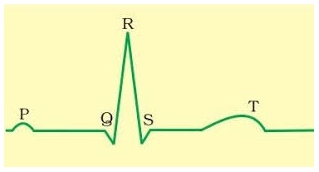
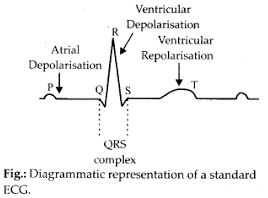
MCQ On Body Fluids And Circulation Question 6.
MCQ On Body Fluids And Circulation
In the above picture Q represents
(a) exitation of the atria
(b) depolarisation of ventricles
(c) begining of systole
(d) repolarisation

Answer

Answer: (c) begining of systole
Explanation:
Class 11 Biology Chapter 18 MCQ


Class 11 Biology Chapter 18 MCQ Question 7.
Oxygenated blood occurs in
(a) Pulmonary artery
(b) Right atrium
(c) Right ventricle
(d) Pulmonary vein

Answer

Answer: (d) Pulmonary vein


MCQ On Body Fluids And Circulation Class 11 Question 8.
The cells lining the blood vessels belong to the category of
(a) Columnar epithelium
(b) Connective tissue
(c) Smooth muscle tissue
(d) Squamous epithelium

Answer

Answer: (d) Squamous epithelium


MCQ Of Body Fluids And Circulation Question 9.
Heart failure occurs due to
(a) heart stops beating
(b) damage of heart muscles
(c) congestion of lungs
(d) all of the above

Answer

Answer: (c) congestion of lungs
Explanation:
Heart failure occurs when heart stops pumping blood effectively enough to meet the body needs.
It occurs mainly due to congestion of lungs.


Body Fluids And Circulation MCQs Question 10.
Artificial pace maker is transplanted in
(a) Inter auricular septum
(b) Below the collar bone
(c) Inter ventricular septum
(d) Right auricle

Answer

Answer: (b) Below the collar bone


MCQs On Body Fluids And Circulation Question 11.
Which of the following statement/statements can be related to erythroblastosis foetalis?
(a) Severe anemia and jaundice to the baby.
(b) Can be avoided by giving anti-Rh antibodies to mother immediately after delivery of the first child.
(c) Rh-antibodies from the Rh -ve mother destroys foetal RBCs.
(d) All of the above

Answer

Answer: (d) All of the above
Explanation:
Erythroblastosis foetalis occurs if Rh-antibodies from the Rh -ve mother destroys foetal RBCs of Rh +ve foetus.


Class 11 Biology Body Fluids And Circulation MCQ Question 12.
Among the following stem cells, which are found in the umbilical cord?
(a) Cord blood stem cells
(b) Adult stem cells
(c) Embryonic stem cells
(d) All of the above

Answer

Answer: (a) Cord blood stem cells


Body Fluids And Circulation MCQ Pdf Download Question 13.
If vagus nerve is cut the heart beat
(a) increases
(b) decreases
(c) will not be affected
(d) will stop immediately

Answer

Answer: (a) increases


MCQ On Body Fluids And Circulation Pdf Question 14.
If due to some injury the chordae tendinae of the tricuspid valve of the human heart is partially non-functional, what will be the immediate effect?
(a) The flow of blood into the pulmonary artery will be reduced
(b) The flow of blood into the aorta will be slowed down
(c) The pacemaker will stop working
(d) The blood will tend to flow back into the left atrium

Answer

Answer: (a) The flow of blood into the pulmonary artery will be reduced


MCQ Questions On Body Fluids And Circulation Question 15.
Heparin is
(a) Anti-allergic
(b) Blood diluter
(c) Anticoagulant
(d) Antiseptic

Answer

Answer: (c) Anticoagulant


Class 11 Body Fluids And Circulation MCQ Question 16.
An adult human has systolic and diastolic pressures as:
(a) 80 mm Hg and 120 mm Hg
(b) 120 mm Hg and 80 mm Hg
(c) 50 mm Hg and 80 mm Hg
(d) 80 mm Hg and 80 mm Hg

Answer

Answer: (b) 120 mm Hg and 80 mm Hg


MCQ On Circulatory System Class 11 Question 17.
Cardiac arrest is the state when
(a) heart stops beating
(b) inadequate blood supply to the heart
(c) heart not pumping enough to meet the body needs
(d) blood pressure increases

Answer

Answer: (a) heart stops beating
Explanation:
Cardiac arrest occurs when the heart stops beating.


MCQ Of Chapter 18 Class 11 Biology Question 18.
What is the normal blood pressure of human beings?
(a) 110/70
(b) 120/70
(c) 120/80
(d) 110/80

Answer

Answer: (c) 120/80
Explanation:
120/80 is the normal measurement to blood pressure.
120 mm Hg is the systolic or pumping pressure.
80 mm Hg is the diastolic or resting pressure.


Body Fluids And Circulation Class 11 MCQs Question 19.
Arteries are best defined as the vessels which
(a) Carry blood from one visceral organ to another visceral organ
(b) Supply oxygenated blood to the different organs
(c) Carry blood away from the heart to different organs
(d) Break up into capillaries which reunite to form a vein

Answer

Answer: (c) Carry blood away from the heart to different organs


Blood Fluid And Circulation MCQ Question 20.
Christmas disease is also known as
(a) Haemophilia B
(b) AIDS
(c) Haemophilia A
(d) Haemolytic jaundice

Answer

Answer: (a) Haemophilia B


We hope the given NCERT MCQ Questions for Class 11 Biology Chapter 18 Body Fluids and Circulation with Answers Pdf free download will help you. If you have any queries regarding CBSE Class 11 Biology Body Fluids and Circulation MCQs Multiple Choice Questions with Answers, drop a comment below and we will get back to you soon.

Class 11 Biology MCQ:

MCQ Questions for Class 11 Biology Chapter 22 Chemical Coordination and Integration with Answers

Chemical Coordination and Integration Class 11 MCQ Online Test With Answers Questions
Check the below NCERT MCQ Questions for Class 11 Biology Chapter 22 Chemical Coordination and Integration with Answers Pdf free download. MCQ Questions for Class 11 Biology with Answers were prepared based on the latest exam pattern. We have provided Chemical Coordination and Integration Class 11 Biology MCQs Questions with Answers to help students understand the concept very well.

Class 11 Biology Chapter 22 MCQ With Answers

Biology Class 11 Chapter 22 MCQs On Chemical Coordination and Integration

Chemical Coordination And Integration MCQ Question 1.
Which of the following is an emergency hormone?
(a) Norepinephrine
(b) Androgen
(c) Cortisol
(d) FSH

Answer

Answer: (a) Norepinephrine
Explanation:
Adrenaline (epinephrine) and noradrenaline (norepinephrine) are called as catecholamines.
These hormones are secreted in response to stress and during emergency. So these are called emergency hormones or hormones of flight and fight.


Class 11 Biology Chapter 22 MCQ Question 2.
Secretin causes stimulation of
(a) water
(b) bile juice
(c) gastric secretion
(d) pepsinogen

Answer

Answer: (a) water
Explanation:
Secretin acts on the exocrine pancreas and stimulates secretion of water and bicarbonate ions.


MCQ On Chemical Coordination And Integration Question 3.
Match the columns.
1. PRL – A. Pigmentation of skin
2. LH – B. Steriod hormones
3. ACTH – C. Formation of milk
4. MSH – D. Gonadal activity
(a) 1-C, 2-D, 3-B, 4-A
(b) 1-C, 2-D, 3A, 4-B
(c) 1-D, 2-C, 3-B, 4-A
(d) 1-B, 2-C, 3-D, 4-A

Answer

Answer: (a) 1-C, 2-D, 3-B, 4-A
Explanation:
Column I shows the names of hormones and column II shows the functions of the hormones.


Chemical Coordination And Integration Class 11 MCQ Question 4.
In adults, insufficient thyroxine can lead to ______.
(a) Goiter
(b) Tetany
(c) Cretinism
(d) Myxedema

Answer

Answer: (d) Myxedema


Chemical Control And Coordination MCQ Question 5.
In the body, both the blood sodium and potassium levels are regulated by _______.
(a) Pheromones
(b) Aldosterone
(c) Cortisol
(d) Androgens

Answer

Answer: (b) Aldosterone


Chemical Control And Coordination MCQ Questions Question 6.
Chemical name of T4 is
(a) Tetradiodothyronine
(b) Tridiodothyronine
(c) Tetraiodothyronine
(d) Triiodothyronine

Answer

Answer: (c) Tetraiodothyronine
Explanation:
Chemical name of T4 is tetraiodothyronine.
Chemicl name of T3 is triiodothyronine.


Chemical Coordination And Integration MCQ Pdf Download Question 7.
Anabolic steroids are ______ versions of testosterone.
(a) Effective
(b) Synthetic
(c) Natural
(d) Ineffective

Answer

Answer: (b) Synthetic


MCQ On Chemical Control And Coordination Question 8.
Which of the following acts on bones?
(a) Melatonin
(b) Triiodothyronine
(c) GH
(d) Parathyroid

Answer

Answer: (d) Parathyroid
Explanation:
Parathyroid hormone acts on bones and stimulates the process of bone resorption.


MCQs On Chemical Coordination And Integration Question 9.
Glucagon hormone is secreted by the ______.
(a) Thyroid gland
(b) Adrenal gland
(c) Pituitary gland
(d) Pancreas

Answer

Answer: (d) Pancreas


MCQ Of Chemical Coordination And Integration Question 10.
Which one of the followings are male sex hormones?
(a) Insulins
(b) Aldosterones
(c) Androgens
(d) Pheromones

Answer

Answer: (c) Androgens


MCQ On Integration Class 11 Question 11.
Choose the incorrect statement.
(a) Hormones are non-nutrient chemicals.
(b) Exocrine glands are ductless glands.
(c) Invertebrates have simple endocrine system.
(d) All of the above statements are incorrect.

Answer

Answer: (b) Exocrine glands are ductless glands.
Explanation:
Endocrine glands lacks ducts and are called as ductless glands.


MCQ On Chemical Coordination And Integration Class 11 Question 12.
Endemic goitre is a state of
(a) Increased thyroid function
(b) Normal thyroid function
(c) Decreased thyroid function
(d) Moderate thyroid function

Answer

Answer: (c) Decreased thyroid function


Class 11 Biology Chapter 22 Important Questions Question 13.
Match the columns.
1. PRL – A. Pigmentation of skin
2. LH – B. Steriod hormones
3. ACTH – C. Formation of milk
4. MSH – D. Gonadal activity
(a) 1-C, 2-D, 3-B, 4-A
(b) 1-C, 2-D, 3-A, 4-B
(c) 1-D, 2-C, 3-B, 4-A
(d) 1-B, 2-C, 3-D, 4-A

Answer

Answer: (a) 1-C, 2-D, 3-B, 4-A
Explanation:
Column I shows the names of hormones and column II shows the functions of the hormones.


Chemical Coordination And Integration Class 11 Important Questions Pdf Question 14.
PTH is called as hypercalcemic hormone because it leads to the
(a) absorption of CaCO3 from the digested food
(b) reabsorption of water from renal tubules
(c) increasing blood calcium levels
(d) maintainence ion balance in blood

Answer

Answer: (c) increasing blood calcium levels
Explanation:
This is called so because PTH stimulates the reabsorption of calcium by the renal tubules and increases calcium absorption from the digested food.


Class 11 Chemical Coordination And Integration MCQs Question 15.
Corpus luteum secretes
(a) progesterone
(b) estrogen
(c) glucagon
(d) vasopressin

Answer

Answer: (a) progesterone
Explanation:
After ovulation, ruptured follicle gets converted to corpus luteum which secretes progesterone.


Question 16.
In adults, insufficient thyroxine can lead to ______.
(a) Goiter
(b) Tetany
(c) Cretinism
(d) Myxedema

Answer

Answer: (d) Myxedema


Question 17.
In children, hypothyroidism (underactive thyroid gland) can lead to ______
(a) Goiter
(b) Acromegaly
(c) Cretinism
(d) Myxedema

Answer

Answer: (c) Cretinism


Question 18.
Diurnal rhythm of the body is maintained by
(a) melatonin
(b) isthmus
(c) PTH
(d) norepinephrine

Answer

Answer: (a) melatonin
Explanation:
Pineal gland secretes melatonin.
It plays a very important role in the regulation of a 24-hour (diurnal) rhythm of our body.


Question 19.
Which hormone inhibits the release of growth hormone?
(a) Insulin
(b) Gonadotrophin
(c) Somatostatin
(d) Thymosin

Answer

Answer: (c) Somatostatin
Explanation:
Hypothalamus produces two kinds of hormones: releasing hormone and inhibiting hormones.
GnRH is releasing hormone which stimulates pituitary synthesis.
Somatostatin inhibits the release of GH from the pituitary.


Question 20.
Which of the following is essential for thyroid gland?
(a) NaCl
(b) I3
(c) CaCO2
(d) H2CO3

Answer

Answer: (b) I3
Explanation:
Iodine is essential for thyroid gland.


We hope the given NCERT MCQ Questions for Class 11 Biology Chapter 22 Chemical Coordination and Integration with Answers Pdf free download will help you. If you have any queries regarding CBSE Class 11 Biology Chemical Coordination and Integration MCQs Multiple Choice Questions with Answers, drop a comment below and we will get back to you soon.

Class 11 Biology MCQ:

MCQ Questions for Class 11 Chemistry Chapter 9 Hydrogen with Answers

Hydrogen Class 11 MCQ Online Test With Answers Questions

Check the below NCERT MCQ Questions for Class 11 Chemistry Chapter 9 Hydrogen with Answers Pdf free download. MCQ Questions for Class 11 Chemistry with Answers were prepared based on the latest exam pattern. We have provided Hydrogen Class 11 Chemistry MCQs Questions with Answers to help students understand the concept very well.

Class 11 Chemistry Chapter 9 MCQ With Answers

Chemistry Class 11 Chapter 9 MCQs On Hydrogen

Hydrogen Class 11 MCQ Question 1.
Pure H2O2 is :
(a) Semi – solid
(b) Liquid
(c) Solid
(d) Gas

Answer

Answer: (b) Liquid
Explanation:
Hydrogen peroxide is the simplest kind of peroxide available (oxygen-oxygen single bond). It is a colourless liquid and is used in aqueous solution for safety reasons. It acts as a bleaching agent and is also used as a disinfectant. Concentrated hydrogen peroxide is a very reactive oxygen species and is used as a propellant in rocketry. The chemical formula for hydrogen peroxide is H2O2.


MCQ On Hydrogen Class 11 Question 2.
The freezing point of heavy water is
(a) 0°C
(b) 3.8°C
(c) 4°C
(d) 1°C

Answer

Answer: (b) 3.8°C


Hydrogen MCQ Class 11 Question 3.
H2O2 used in rocket has the concentration:
(a) 50%
(b) 90%
(c) 70%
(d) 30%

Answer

Answer: (b) 90%
Explanation:
H2O2 is used as an oxidant for rocket fuel. Usually, 90% concentration of H2O2 is used.


MCQ Of Hydrogen Class 11 Question 4.
Which of the following hydrides are generally nonstochiometric in nature?
(a) Ionic Hydrides
(b) Molecular Hydrides
(c) Interstitial Hydrides
(d) All of the Above.

Answer

Answer: (c) Interstitial Hydrides
Explanation:
Interstitial hydrides are non- stoichiometric hydrides and thus deficit in hydrogen. Transition and inner transition elements at relevant temperature absorb hydrogen into the interstices of their lattices to yield metal like hydrides.


Class 11 Hydrogen MCQ Question 5.
What is the product of the reaction of H2O2 with Cl2?
(a) O2 + HOCl
(b) HCl + O2
(c) H2O + HCl
(d) HCl + H2

Answer

Answer: (b) HCl + O2
Explanation:
H2O2 + Cl2 → 2HCl + O2


Class 11 Chemistry Hydrogen MCQ Question 6.
Water shows anomalous behavior between
(a) 0 to 4°C
(b) 0 to 5°C
(c) 0 to -4°C
(d) 4 to 0°C

Answer

Answer: (a) 0 to 4°C
Explanation:
Water show a wide range of anomalies compared to similar liquids or hydrides of other group 16 elements. One of the most talked-about anomalies is the formation of ice from liquid water and how the density changes when we cool the water.

O is a small atom and highly electronegative compared to Hydrogen. So O attracts the covalent clouds of O-H towards itself, thus making water a polar molecule. The hydrogen bonding in water molecules causes high boiling point and liquid state compared to other hydrides of group 16.

When we cool water from higher temperature, the density steadily decreases. At 4 degree C it is the highest. But below 4 degree C, The H-bonds break between the molecules and the molecules get drifted further apart, the volume increases and density decreases. The crystalline form of water is ice. At atmospheric pressure ice crystallises in the hexagonal form, but at very low temperatures it condenses to cubic form leaving gap between the structures, thus increasing the volume again.

Density of ice is less than that of water. Therefore, an ice cube floats on water. In winter season ice formed on the surface of a lake provides thermal insulation which ensures the survival of the aquatic life.


Class 11 Chemistry Chapter 9 MCQ Question 7.
Which of the following statements regarding hydrogen peroxide is/ are incorrect?
(a) As aerating agent in production of sponge rubber
(b) As an antichlor
(c) For restoring white colour of blackened lead painting
(d) All of the above

Answer

Answer: (d) All of the above
Explanation:
H2O2 show all these properties


Hydrogen Chapter Class 11 MCQ Question 8.
Atomic hydrogen is called
(a) Protium
(b) Deutrium
(c) Nascent Hydrogen
(d) Tritium

Answer

Answer: (c) Nascent Hydrogen
Explanation:
A hydrogen atom is an atom of the chemical element hydrogen. The electrically neutral atom contains a single positively charged proton and a single negatively charged electron bound to the nucleus by the Coulomb force. Atomic hydrogen constitutes about 75% of the baryonic mass of the universe.

In everyday life on Earth, isolated hydrogen atoms (called “atomic hydrogen”) are extremely rare. Instead, a hydrogen atom tends to combine with other atoms in compounds, or with another hydrogen atom to form ordinary (diatomic) hydrogen gas, H2. “Atomic hydrogen” and “hydrogen atom”


Hydrogen MCQs With Answers Question 9.
The volume strength of 1.5 NH2O2 solution is :
(a) 4.8
(b) 5.2
(c) 8.8
(d) 8.4

Answer

Answer: (d) 8.4
Explanation:
Strength =Normality ×Equivalent Weight of H2O2
= 1.5N × 1.7gL-1 = 25.5gL-1
2H2O2 → 2H2O + O2
68g 22400 mLat STP
68 g of H2O gives = 22400 mL of O2 at STP
25.5 gH2O2 gives = 2240068 × 25.5 = 8400 mL of O2 at STP
25.5g of H2O2 is present in 1000 mL of H2O2 solution
1000 mL of H2O2 gives 8400 mL of O2 at STP
1 mL of H2O2 gives 84001000 mL of O2 at STP
= 8.4mL of O2
Hence, volume strength of 1.5NH2O2 = 8.4 volume.
Or mass of H2O2 in 1.5N solution
= Equivalent Weight of H2O2 × 1.5N
= 17 × 1.5 = 25.5 g/L
Hence, volume strength of 1.5NH2O2 solution
= 22.4 × 25.568 = 8.4


Hydrogen Class 11 MCQ Pdf Question 10.
Water gas is mixture of hydrogen H2 and
(a) CO
(b) CO2
(c) Cl2
(d) SO2

Answer

Answer: (a) CO
Explanation:
Water gas is a combustion fuel containing carbon monoxide (CO) and hydrogen gas (H2). Water gas is made by passing steam over heated hydrocarbons.


MCQ Questions For Class 11 Chemistry Chapter 9 Question 11.
Hydrogen has isotopes
(a) 2
(b) 3
(c) 4
(d) 5

Answer

Answer: (c) 4
Explanation:
Hydrogen has three main isotopes; Protium (1H), deuterium (²H) and tritium (³H). These isotopes form naturally in nature. Protium and deuterium are stable. Tritium is radioactive and has a half-life of about 12 years. Scientists have created four other hydrogen isotopes (4H to 7H), but these isotopes are very unstable and do not exist naturally.
The main isotopes of hydrogen are unique because they are the only isotopes that have a name.


Hydrogen MCQs Class 11 Question 12.
The freezing point of heavy water is
(a) 0°C
(b) 3.8°C
(c) 4°C
(d) 1°C

Answer

Answer: (b) 3.8°C


Class 11 Chemistry Chapter 9 MCQ With Answers Question 13.
Pure H2O2 is:
(a) Semi – solid
(b) Liquid
(c) Solid
(d) Gas

Answer

Answer: (b) Liquid
Explanation:
Hydrogen peroxide is the simplest kind of peroxide available (oxygen-oxygen single bond). It is a colourless liquid and is used in aqueous solution for safety reasons. It acts as a bleaching agent and is also used as a disinfectant. Concentrated hydrogen peroxide is a very reactive oxygen species and is used as a propellant in rocketry. The chemical formula for hydrogen peroxide is H2O2.


MCQs On Hydrogen Class 11 Question 14.
_________________ on water decolourises H2O2
(a) O3
(b) Acidic KMnO4 solution
(c) Black Suspension of Lead Sulphide(PbS)
(d) None of these.

Answer

Answer: (c) Black Suspension of Lead Sulphide(PbS)
Explanation:
Lead sulphide (black suspension) on reaction with hydrogen peroxide forms lead sulphate and water. Lead sulphate as well as water are colourless, therefore lead sulphite decolourises on addition of hydrogen peroxide.
PbS(s) + 4H2O2 (aq) → PbSO4 (s) + 4H2O (aq)


MCQ Questions On Hydrogen Class 11 Question 15.
What is gram equivalent weight of hydrogen peroxide as reductant?
(a) 100
(b) 125
(c) 152
(d) None of the Above

Answer

Answer: (c) 152
Explanation:
As reductant hydrogen peroxide oxidises to oxygen. H2O2 → O2
​The change in oxidation number is 2
The molar mass = 34 g
Gram equivalent weight of H2O2 = (\(\frac{34}{2}\))
​= 17 g
Equivalent weight = 152


Question 16.
Hydrogen is the most abundant element on earth after______.
(a) Oxygen
(b) Carbon
(c) Sulphur
(d) None of the Above

Answer

Answer: (a) Oxygen
Explanation:
The mass-abundance of the nine most abundant elements in the Earths crust is approximately: oxygen 46%, silicon 28%, aluminium 8.2%, iron 5.6%, calcium 4.2%, sodium 2.5%, magnesium 2.4%, potassium, 2.0%, and titanium 0 .61%.
Hydrogen is 0.14% on earths crust and other elements occur at less than 0.15%.


Question 17.
Atomic hydrogen is called
(a) Protium
(b) Deutrium
(c) Nascent Hydrogen
(d) Tritium

Answer

Answer: (c) Nascent Hydrogen
Explanation:
A hydrogen atom is an atom of the chemical element hydrogen. The electrically neutral atom contains a single positively charged proton and a single negatively charged electron bound to the nucleus by the Coulomb force. Atomic hydrogen constitutes about 75% of the baryonic mass of the universe.

In everyday life on Earth, isolated hydrogen atoms (called “atomic hydrogen”) are extremely rare. Instead, a hydrogen atom tends to combine with other atoms in compounds, or with another hydrogen atom to form ordinary (diatomic) hydrogen gas, H2. “Atomic hydrogen” and “hydrogen atom”


Question 18.
Hydrogen is a good __________ agent.
(a) Oxidizing
(b) Reducing
(c) Acidic
(d) Basic

Answer

Answer: (b) Reducing
Explanation:
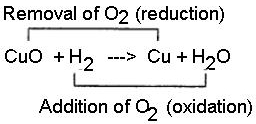
Hydrogen acts as a good reducing agent means, when hydrogen gas is passed over hot metallic oxides of copper, lead, iron, etc. it removes oxygen from them and thus reduces them to their corresponding metal. Let us consider the following example, in each of which metallic oxide react with hydrogen. Metallic oxide act as oxidizing agents and hydrogen acts as a reducing agent.
MCQ Questions for Class 11 Chemistry Chapter 9 Hydrogen with Answers 1


Question 19.
The volume of 10 volume H2O2 required to liberate 500 ml of O2 at S.T.P. is :
(a) 25 ml
(b) 50 ml
(c) 100 ml
(d) 125 ml

Answer

Answer: (b) 50 ml
Explanation:
As 10 ml of oxygen is obtained at STP from H2O2 = 1 ml
Therefore, 500 ml of O2 is obtained at STP = 50 ml


Question 20.
Hydrogen is most __________ element in the universe.
(a) Abundant
(b) None
(c) Both
(d) Consumer

Answer

Answer: (a) Abundant
Explanation:
Hydrogen is considered as the most common and abundant element. The element Hydrogen has only one proton and one electron and is the only element which has no neutrons. Therefore it is considered as the simplest element in the universe and gives a valid reason for it to be the most abundant and common element in the universe. As per estimation from the Jefferson Lab, approximately 90 percent of the visible universe is framed by Hydrogen proving that being in the simplest form, this element is the most common and abundant element in the universe.


We hope the given NCERT MCQ Questions for Class 11 Chemistry Chapter 9 Hydrogen with Answers Pdf free download will help you. If you have any queries regarding CBSE Class 11 Chemistry Hydrogen MCQs Multiple Choice Questions with Answers, drop a comment below and we will get back to you soon.

Class 11 Chemistry MCQ:

MCQ Questions for Class 11 Chemistry Chapter 12 Organic Chemistry: Some Basic Principles and Techniques with Answers

Organic Chemistry: Some Basic Principles and Techniques Class 11 MCQ Online Test With Answers Questions

Check the below NCERT MCQ Questions for Class 11 Chemistry Chapter 12 Organic Chemistry: Some Basic Principles and Techniques with Answers Pdf free download. MCQ Questions for Class 11 Chemistry with Answers were prepared based on the latest exam pattern. We have provided Organic Chemistry: Some Basic Principles and Techniques Class 11 Chemistry MCQs Questions with Answers to help students understand the concept very well.

Class 11 Chemistry Chapter 12 MCQ With Answers

Chemistry Class 11 Chapter 12 MCQs On Organic Chemistry: Some Basic Principles and Techniques

Organic Chemistry Class 11 MCQ Question 1.
If two compounds have the same empirical formula but different molecular formula they must have
(a) Different percentage composition
(b) Different molecular weight
(c) Same viscosity
(d) Same vapour density

Answer

Answer: (b) Different molecular weight


MCQ On Organic Chemistry Class 11 Question 2.
Identify the chiral molecule among the following:
(a) Isopropyl alcohol
(b) 2-pentanol
(c) 1-bromo 3-butene
(d) Isobutyl alcohol

Answer

Answer: (d) Isobutyl alcohol
Explanation:
Chirality is the condition for a molecule to be optically active and here isobutyl alcohol is the only compound is optically active and hence it is the chiral molecule.


Class 11 Organic Chemistry MCQ Question 3.
0.0833mol of carbohydrate of empirical formula CH2O contain 1g of hydrogen. The molecular formula of the carbohydrate is
(a) C5H10O5
(b) C3H4O3
(c) C12H22O11
(d) C6H12O6

Answer

Answer: (d) C6H12O6
Explanation:
As 0.0833 mole carbohydrate has hydrogen = 1g
Therefore, 1 mole carbohydrate has hydrogen = (\(\frac {1}{0.0833}\)) = 12g
Empirical Formula (CH2O) has hydrogen = 2g
Hence n = \(\frac {(12)}{(2)}\) = 6
Hence molecular formula of carbohydrate =(CH2O)6 = C6H12O6


MCQ Of Organic Chemistry Class 11 Question 4.
The displacement of electrons in a multiple bond in the presence of attacking reagent is called
(a) Inductive effect
(b) Electromeric effect
(c) Resonance
(d) Hyper conjugation.

Answer

Answer: (b) Electromeric effect
Explanation:
The electromeric effect is a temporary effect brought into play at the requirement of attacking reagent. Electromeric effect refers to a molecular polarizability effect occurring by an intra-molecular electron displacement. It is the temporary effect.


Class 11 Chemistry Chapter 12 MCQ Question 5.
Which of the following cannot be represented by resonance structures?
(a) Dimethyl ether
(b) Nitrate anion
(c) Carboxylate anion
(d) Toluene

Answer

Answer: (a) Dimethyl ether
Explanation:
Ethers due to absence of delocalized pair of electrons do not show resonance.


Organic Chemistry MCQ Class 11 Question 6.
An organic compound which produces a bluish green coloured flame on heating in presence of copper is
(a) Chlorobenzene
(b) Benzaldehyde
(c) Aniline
(d) Benzoic acid

Answer

Answer: (d) Benzoic acid
Explanation:
Halogen containing compounds, e.g.,C6H5Cl when placed in a flame, the presence of halogen is revealed by a green to blue flame.


Some Basic Concepts Of Organic Chemistry Class 11 MCQ With Answers Question 7.
Which one is strongest acid among following options?
(a) CH2FCOOH
(b) CH2ClCOOH
(c) CHCl2COOH
(d) CHF2COOH

Answer

Answer: (b) CH2ClCOOH
Explanation:
CHF2−COOH. Difluoroacetic acid is strongest because presence of two F atoms increases its acidic nature.


Organic Chemistry Class 11 MCQ Pdf Question 8.
Insulin contains 3.4% sulphur. The minimum molecular weight of insulin is
(a) 350
(b) 470
(c) 560
(d) 940

Answer

Answer: (d) 940
Explanation:
Minimum mass of sulphur = wt. of its one atom = 32
As 3.4 gms of sulphur present in 100 gms.
Therefore, 32 gms of sulphur present in = (100 × 32)/(3.4) = 940


Organic Chemistry Class 11 MCQs Question 9.
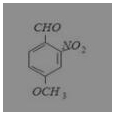
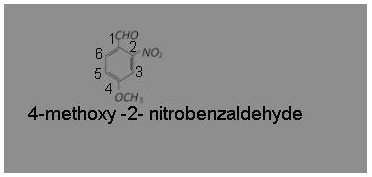
What is the correct IUPAC name of
MCQ Questions for Class 11 Chemistry Chapter 12 Organic Chemistry Some Basic Principles and Techniques with Answers 1
(a) 4-methoxy-2-nitrobenzaldehyde
(b) 4-formyl-3-nitro anisole
(c) 4-methoxy-6-nitrobenzaldehyde
(d) 2-formyl-5-methoxy nitrobenzene

Answer

Answer: (a) 4-methoxy-2-nitrobenzaldehyde
Explanation:
IUPAC name is 4-methoxy-2-nitrobenzaldehyde
MCQ Questions for Class 11 Chemistry Chapter 12 Organic Chemistry Some Basic Principles and Techniques with Answers 2


Organic Chemistry Some Basic Principles And Techniques MCQ Question 10.
59 g of an amide obtained from a carboxylic acid, RCOOH, liberated 17 g of ammonia upon heating with alkali. The acid is
(a) Formic Acid
(b) Acetic Acid
(c) Propionic Acid
(d) Benzoic Acid

Answer

Answer: (b) Acetic Acid
Explanation:
RCOOH → RCONH2 → NH3
Since, 17g of NH3 is liberated from 59 g of acid amide, the amide has molecular mass of 59, i.e., RCONH2 = 59
R + 12 + 16 + 14 + 2 = 59
R + 44 = 59
R = 15
Hence, RisCH3 group and thus acid is CH3COOH(Acetic acid)


MCQ Questions For Class 11 Chemistry Chapter 12 Question 11.
In the Dumas method, the nitrogen present in organic compound gets converted to
(a) Sodium Cyanide
(b) Gaseoue Ammonia
(c) Dinitrogen Gas
(d) Ammonium Sulphate.

Answer

Answer: (c) Dinitrogen Gas
Explanation:
Nitrogen present in the organic compound is converted into N2 gas by heating the compound with CuO.


Ch 12 Chemistry Class 11 MCQ Question 12.
0.0833mol of carbohydrate of empirical formula CH2O contain 1 g of hydrogen. The molecular formula of the carbohydrate is
(a) C5H10O5
(b) C3H4O3
(c) C12H22O11
(d) C6H12O6

Answer

Answer: (d) C6H12O6
Explanation:
As 0.0833 mole carbohydrate has hydrogen = 1 g
Therefore, 1 mole carbohydrate has hydrogen = (\(\frac {1}{0.0833}\)) = 12 g
Empirical Formula (CH2O) has hydrogen = 2 g
Hence n = \(\frac {(12)}{(2)}\) = 6
Hence molecular formula of carbohydrate = (CH2O)6 = C6H12O6


Class 11 Chemistry Ch 12 MCQ Question 13.
The compound MCQ Questions for Class 11 Chemistry Chapter 12 Organic Chemistry Some Basic Principles and Techniques with Answers 3 is known by which of the following names
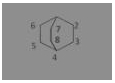
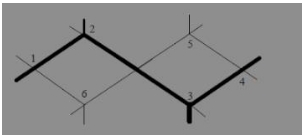
(a) Bicyclo-[2, 2, 2] octane
(b) Bicyclo-[2, 2, 1] octane
(c) Bicyclo-[1, 2, 1] octane
(d) Bicyclo-[1, 1, 1] octane

Answer

Answer: (a) Bicyclo-[2, 2, 2] octane
Explanation:
Bicyclo-[2, 2, 2] octane
MCQ Questions for Class 11 Chemistry Chapter 12 Organic Chemistry Some Basic Principles and Techniques with Answers 4


MCQ Of Chapter Organic Chemistry Class 11 Question 14.
Which one of the following conformations of cyclohexane is chiral?
(a) Twist boat
(b) Rigid
(c) Chair
(d) Boat

Answer

Answer: (a) Twist boat
Explanation:
The twist boat conformation of cyclohexane is optically active as it does not have any plane of symmetry.
MCQ Questions for Class 11 Chemistry Chapter 12 Organic Chemistry Some Basic Principles and Techniques with Answers 5


Class 11 Chemistry Chapter 12 MCQ With Answers Question 15.
If 0.228 g of silver salt of dibasic acid gave a residue of 0.162 g of silver on ignition then molecular weight of the acid is
(a) 70
(b) 80
(c) 90
(d) 100

Answer

Answer: (c) 90
Explanation:
Mass of silver salt taken = 0.228 gm
Mass of silver left = 0.162 gm
Basicity of acid = 2
Step 1- To calculate the equivalent mass of the silver salt (Eq. mass of silver salt)/(Eq. mass of silver)=(Mass of Acid taken)/(Mass of silver left)
(\(\frac {E}{108}\)) = (\(\frac {0.228}{0.162}\))
E = (\(\frac {0.228}{0.162}\)) × 108 = 152(Eq. mass of silver salt)
Step 2 – To calculate the eq. mass of acid = ( Equivalent mass of acid)
= Equivalent mass of silver salt – Equivalent mass of Ag + Basicity
= 152 – 108 + 1
= 152 – 109
= 43 (Equivalent mass of acid)
Step 3- To determine the molecular mass of acid. molecular mass of the acid = Equivalent mass of acid × basicity = 45 × 2 = 90.


Question 16.
If there is no rotation of plane polarized light by a compound in a specific solvent, thought to be chiral, it may mean that
(a) The compound may be a racemic mixture
(b) The compound is certainly a chiral
(c) The compound is certainly meso
(d) There is no compound in the solvent.

Answer

Answer: (c) The compound is certainly meso
Explanation:
Meso compound does not rotate plane polarised light. Compound which contains tetrahedral atoms with four different groups but the whole molecule is a chiral, is known as meso compound. It possesses a plane of symmetry and is optically inactive. One of the asymmetric carbon atoms turns the plane of polarised light to the right and other to the left and to the same extent so that the rotation due to upper half is compensated by the lower half, i.e., internally compensated, and finally there is no rotation of plane polarised light.


Question 17.
Which element is estimated by Carius method
(a) Carbon
(b) Hydrogen
(c) Halogen
(d) Nitrogen

Answer

Answer: (c) Halogen
Explanation:
Halogen element is estimated by Carius method


Question 18.
Inductive effect involves
(a) displacement of σ electrons
(b) delocalization of π electrons
(c) delocalization of σ-electrons
(d) displacement of π-electrons

Answer

Answer: (a) displacement of σ electrons
Explanation:
During inductive effect shifting of a electrons takes place due to which partially charges are developed on the atom.
+δ” +δ′ +δ −δ
C− C− C −Cl−


Question 19.
A crystalline solid possess which one of the following property?
(a) Irregularity
(b) Non- symmetric
(c) Perfect geometric pattern
(d) non- stability

Answer

Answer: (c) Perfect geometric pattern
Explanation:
A crystalline solid is one which possesses perfect geometry, high stability, symmetric and regularly arranged.


Question 20.
Which of the following behaves both as a nucleophile and as an electrophile?
(a) CH3C ≡ N
(b) CH3OH
(c) CH2 = CHCH3
(d) CH3NH2

Answer

Answer: (a) CH3C ≡ N
Explanation:
Due to the presence of a lone pair of electrons on N, CH3C ≡ N: acts as a nucleophile. Further due to greater electronegativity of N than C, the C atom of −C ≡ N carries a positive charge and hence behaves as an electrophile.


We hope the given NCERT MCQ Questions for Class 11 Chemistry Chapter 12 Organic Chemistry: Some Basic Principles and Techniques with Answers Pdf free download will help you. If you have any queries regarding CBSE Class 11 Chemistry Organic Chemistry: Some Basic Principles and Techniques MCQs Multiple Choice Questions with Answers, drop a comment below and we will get back to you soon.

Class 11 Chemistry MCQ:

MCQ Questions for Class 11 Chemistry Chapter 3 Classification of Elements and Periodicity in Properties with Answers

Classification of Elements and Periodicity in Properties Class 11 MCQ Online Test With Answers Questions

Check the below NCERT MCQ Questions for Class 11 Chemistry Chapter 3 Classification of Elements and Periodicity in Properties with Answers Pdf free download. MCQ Questions for Class 11 Chemistry with Answers were prepared based on the latest exam pattern. We have provided Classification of Elements and Periodicity in Properties Class 11 Chemistry MCQs Questions with Answers to help students understand the concept very well.

Class 11 Chemistry Chapter 3 MCQ With Answers

Chemistry Class 11 Chapter 3 MCQs On Classification of Elements and Periodicity in Properties

Classification Of Elements And Periodicity In Properties MCQ Question 1.
The chemistry of lithium is very similar to that of magnesium even though they are placed in different groups. Its reason is:
(a) Both are found together in nature
(b) Both have nearly the same size
(c) Both have similar electronic configuration
(d) The ratio of their charge and size (i.e. charge density) is nearly the same

Answer

Answer: (d) The ratio of their charge and size (i.e. charge density) is nearly the same
Explanation:
The chemistry of lithium is very similar to that of magnesium even though they are placed in different groups because of diagonal relationship.


Class 11 Chemistry Chapter 3 MCQ Question 2.
The element with atomic number 35 belongs to
(a) d – Block
(b) f – Block
(c) p – Block
(d) s – Block

Answer

Answer: (c) p – Block
Explanation:
The electronic configuration of element with atomic number 35 is [Ar]3d104s2 4p5. The valence electron belongs to p block. Therefore, it is a p-block element.


MCQ On Periodic Classification Of Elements Class 11 Pdf With Answers Question 3.
The correct order of first ionization potential among following elements, Be, B, C, N and O is
(a) B < Be < C < O < N
(b) B < Be < C < N < O
(c) Be < B < C < N < O
(d) Be < B < C < O < N

Answer

Answer: (a) B < Be < C < O < N
Explanation:
The energy required to remove the most loosely bound electron from an isolated gaseous atom is called the ionisation energy. The ionisation potential decreases as the size of the atom decreases. Atoms with fully or partly filled orbitals have high ionisation potential.


Class 11 Chemistry Chapter 3 MCQ With Answers Question 4.
Representative elements are those which belong to
(a) p and d – Block
(b) s and d – Block
(c) s and p – Block
(d) s and f – Block

Answer

Answer: (c) s and p – Block
Explanation:
Elements in which all the inner shells are complete but outer shell is incomplete is known as representative elements i.e. Those elements which have less than 8 electrons in outermost shell are representative.
s and p block elements except inert gas is known as representative elements.


Classification Of Elements And Periodicity In Properties Class 11 MCQ Question 5.
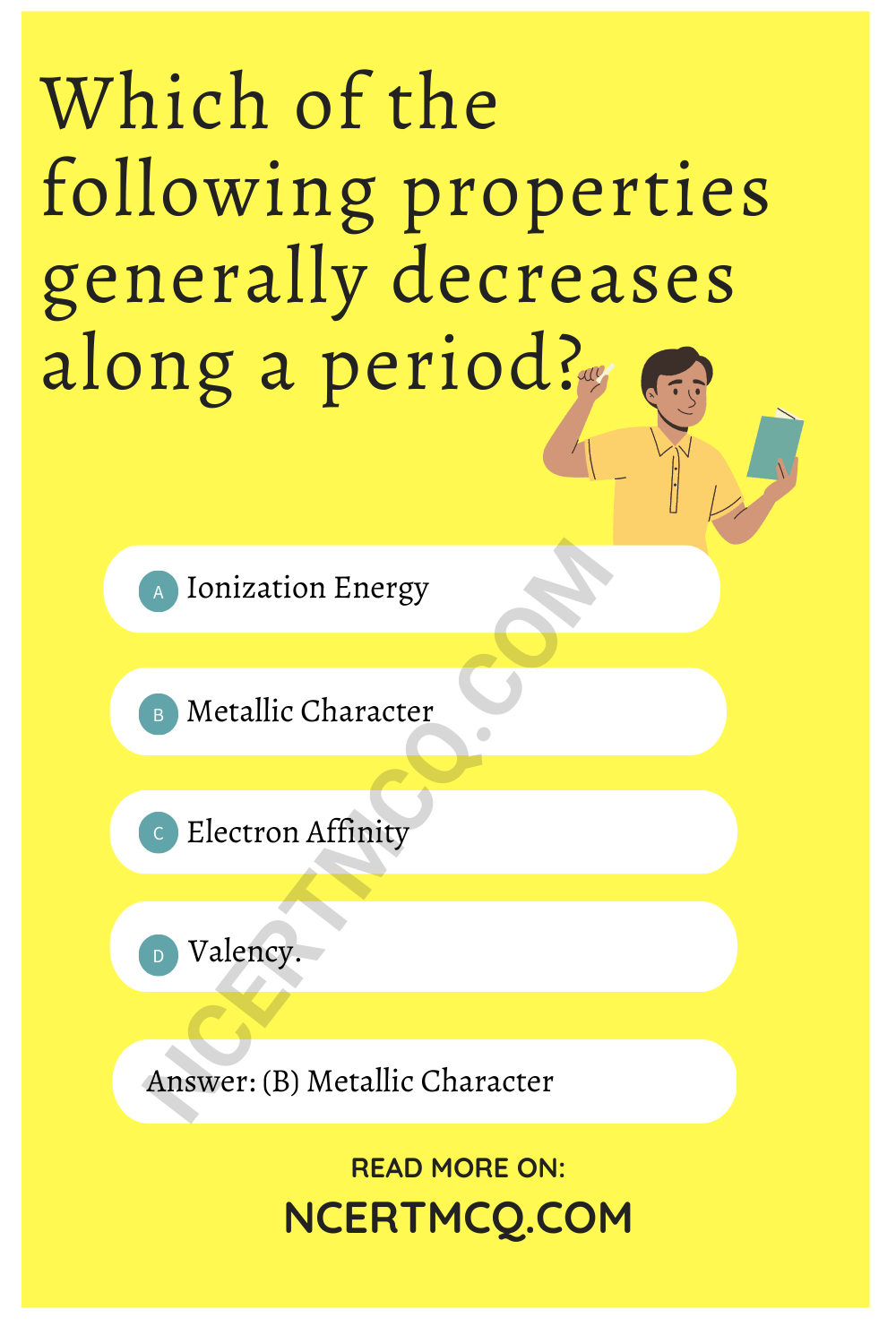
Which of the following properties generally decreases along a period?
(a) Ionization Energy
(b) Metallic Character
(c) Electron Affinity
(d) Valency.

Answer

Answer: (b) Metallic Character
Explanation:
The IE, EA increases along the period. The valency initially increases then decreases. The metallic character decreases along the period.


Which of the following properties generally decreases along a period?

MCQ Questions For Class 11 Chemistry Chapter 3 Question 6.
On the Paulings electronegativity scale the element next to F is
(a) N
(b) Cl
(c) O
(d) Ne.

Answer

Answer: (c) O
Explanation:
Pauling explained electronegativity as the power of an atom in a molecule to attract electrons towards it. When we analyse the trend in periodic table, we can see that the degree of electronegativity decreases while going down the groups, while it increases across the periods. In the case of a covalent bond, based on the bond energies, Pauling calculated the differences in electronegativity between atoms in the bond and assigned a value of 4 to fluorine, which is the most electronegative element, and others were calculated with respect to that value. Hence, on paulings scale, the element next to fluorine is Oxygen.


Periodic Classification Of Elements Class 11 MCQ Question 7.
The group number, number of valence electrons, and valency of an element with the atomic number 15, respectively, are:
(a) 16, 5 and 2
(b) 15, 5 and 3
(c) 16, 6 and 3
(d) 15, 6 and 2

Answer

Answer: (b) 15, 5 and 3
Explanation:
Atomic number (Z) =15 =P → [Ne] 3s² 3p³
Phosphorus belongs to 15th group
Number of valence electrons 3s²3p³ = 5 and valency = 3 in ground state.


Ch 3 Chemistry Class 11 MCQ Question 8.
Which of the following oxides is amphoteric in character?
(a) SnO2
(b) CO2
(c) SiO2
(d) CaO

Answer

Answer: (a) SnO2
Explanation:
CaO is basic; CO2 is acidic; SiO2 is weakly acidic. SnO2 is amphoteric.


Chapter 3 Chemistry Class 11 MCQ Question 9.
In the modern periodic table, the period indicates the value of:
(a) Atomic Number
(b) Atomic Mass
(c) Principal Quantum Number
(d) Azimuthal Quantum Number

Answer

Answer: (c) Principal Quantum Number
Explanation:
The periodic table is a tabular arrangement of the chemical elements, organized on the basis of their atomic number (number of protons in the nucleus), electron configurations, and recurring chemical properties.
The value of the principal quantum number (n) for the outermost shell or the valence shell indicates a period in the Modern periodic table.


Chemistry Class 11 Chapter 3 MCQ Question 10.
In the long form of the periodic table, the valence shell electronic configuration of 5s²5p4 corresponds to the element present in:
(a) Group 16 and period 6
(b) Group 17 and period 6
(c) Group 16 and period 5
(d) Group 17 and period 5

Answer

Answer: (c) Group 16 and period 5
Explanation:
Tellurium (Te) has 5s²5p4 valence shell configuration. It belongs to group 16 and present in period 5 of the periodic table.


Class 11 Chemistry Ch 3 MCQ Question 11.
Arrange S, O and Se in ascending order of electron affinity
(a) Se < S < O
(b) Se < O < S
(c) S < O < Se
(d) S < Se < O

Answer

Answer: (a) Se < S < O
Explanation:
Correct order of electron affinity is Se < S < O. In a group electron affinity decreases with increase in atomic number.


Periodic Classification Of Elements Class 11 MCQ With Answers Question 12.
In the modern periodic table , the period indicates the value of:
(a) Atomic Number
(b) Atomic Mass
(c) Principal Quantum Number
(d) Azimuthal Quantum Number

Answer

Answer: (c) Principal Quantum Number
Explanation:
The periodic table is a tabular arrangement of the chemical elements, organized on the basis of their atomic number (number of protons in the nucleus), electron configurations, and recurring chemical properties.
The value of the principal quantum number (n) for the outermost shell or the valence shell indicates a period in the Modern periodic table.


MCQ Questions On Periodic Classification Of Elements Class 11 Question 13.
The electronic configuration of an element is 1s², 2s² 2p6, 3s² 3p³. What is the atomic number of the element which is just below the above element in the periodic table
(a) 31
(b) 34
(c) 33
(d) 49

Answer

Answer: (c) 33
Explanation:
33−1s²2s²2p63s²3p63d104s²4p³


MCQ Of Chapter 3 Chemistry Class 11 Question 14.
The reduction in atomic size with increase in atomic number is a characteristic of elements of-
(a) d−block
(b) f−block
(c) Radioactive series
(d) High atomic masses

Answer

Answer: (b) f−block
Explanation:
The reduction in atomic size with increase in atomic number is a characteristic of elements of f- block. It is known as lanthanoid contraction and actinoid contraction. This is due to poor shielding of electrons present in f subshell.


MCQ On Classification Of Elements And Periodicity In Properties Question 15.
The number of elements in the 5th period of the periodic table is
(a) 3
(b) 9
(c) 8
(d) 18

Answer

Answer: (d) 18
Explanation:
While filling 5th shell according to Aufbau principle 5s, 5p, 4d filled so 2 + 6 + 10 = 18 electrons or elements are present in 5th shell. Further we start filling the 4d orbital which can take 10 electrons. So in the 4th principal quantum energy states, we can fill 18 electrons. Thus 5th period has 18 elements.


Class 11 Chemistry Chapter 3 MCQ Questions With Answers Question 16.
The electronic configuration of halogen is
(a) ns² np6
(b) ns² np3
(c) ns² np5
(d) ns²

Answer

Answer: (c) ns² np5
Explanation:
Halogens has 7 electrons in his valance shell (ns²np5).


MCQ Of Ch 3 Chemistry Class 11 Question 17.
Which of the following forms the most stable gaseous negative ion?
(a) F
(b) Cl
(c) Br
(d) I

Answer

Answer: (b) Cl
Explanation:
The element which forms the most stable gaseous negative ion is fluorine.


Classification Of Elements And Periodicity In Properties MCQ Pdf Question 18.
On the Paulings electro negativity scale the element next to F is
(a) N
(b) Cl
(c) O
(d) Ne.

Answer

Answer: (c) O
Explanation:
Pauling explained electro negativity as the power of an atom in a molecule to attract electrons towards it. When we analyse the trend in periodic table, we can see that the degree of electro negativity decreases while going down the groups, while it increases across the periods. In the case of a covalent bond, based on the bond energies, Pauling calculated the differences in electro negativity between atoms in the bond and assigned a value of 4 to fluorine, which is the most electro negative element, and others were calculated with respect to that value. Hence, on paulings scale, the element next to fluorine is Oxygen.


Chapter 3 Class 11 Chemistry MCQ Question 19.
The element californium belongs to a family of :
(a) Alkali metal family
(b) Actinide series
(c) Alkaline earth family
(d) Lanthanide series

Answer

Answer: (b) Actinide series
Explanation:
Atomic number of californium is 98 and its electronic configuration is
Rn86 7s² 5f10
so it is a f-block element and as it is in 7th period, it is a part of actinide series.


MCQ Of Classification Of Elements And Periodicity In Properties Question 20.
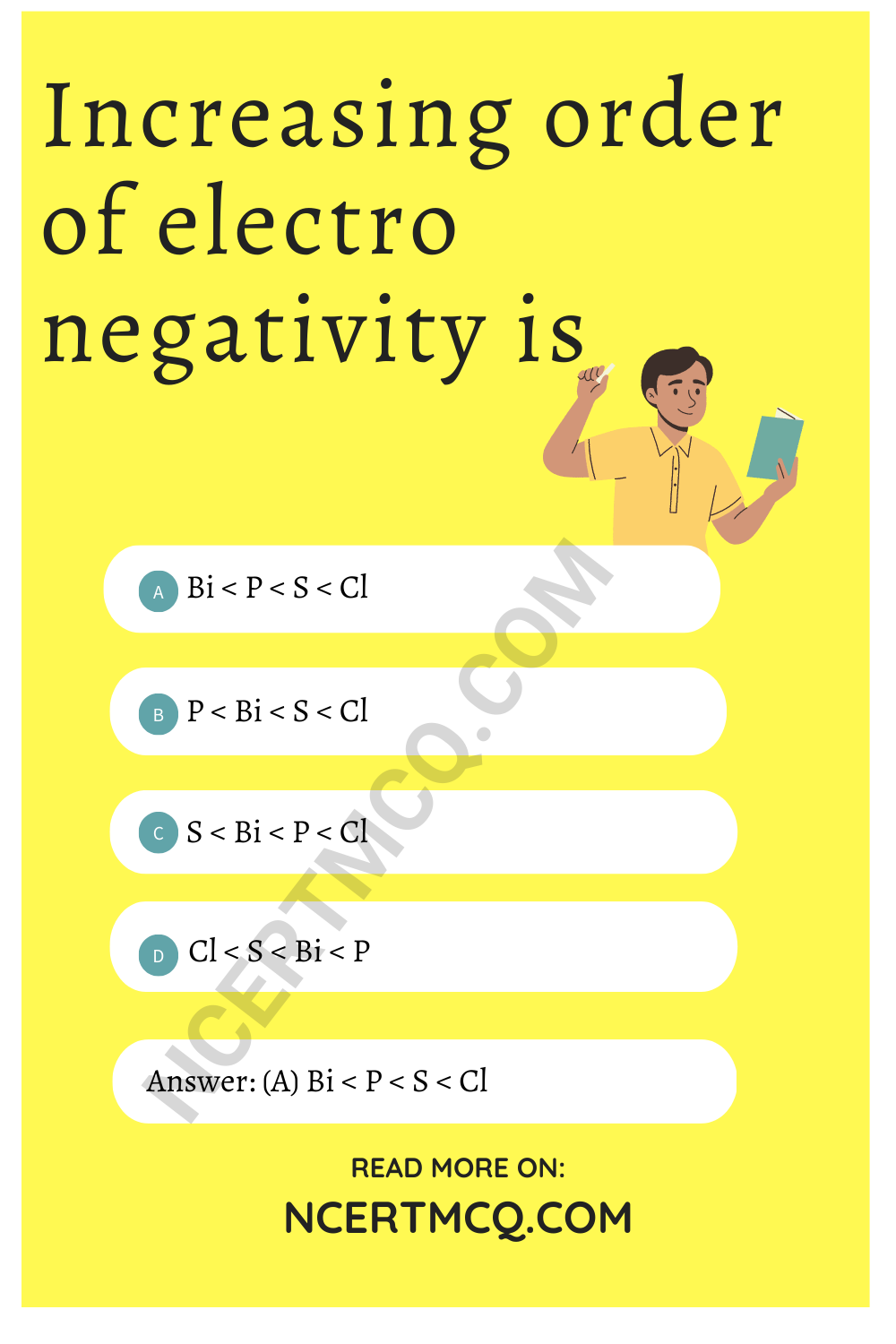
Increasing order of electro negativity is
(a) Bi < P < S < Cl
(b) P < Bi < S < Cl
(c) S < Bi < P < Cl
(d) Cl < S < Bi < P

Answer

Answer: (a) Bi < P < S < Cl
Explanation:
Increasing order of electro negativity is Bi < P < S < Cl.


Increasing order of electro negativity is

We hope the given NCERT MCQ Questions for Class 11 Chemistry Chapter 3 Classification of Elements and Periodicity in Properties with Answers Pdf free download will help you. If you have any queries regarding CBSE Class 11 Chemistry Classification of Elements and Periodicity in Properties MCQs Multiple Choice Questions with Answers, drop a comment below and we will get back to you soon.

Class 11 Chemistry MCQ:

MCQ Questions for Class 11 Chemistry Chapter 4 Chemical Bonding and Molecular Structure with Answers

Chemical Bonding and Molecular Structure Class 11 MCQ Online Test With Answers Questions

Check the below NCERT MCQ Questions for Class 11 Chemistry Chapter 4 Chemical Bonding and Molecular Structure with Answers Pdf free download. MCQ Questions for Class 11 Chemistry with Answers were prepared based on the latest exam pattern. We have provided Chemical Bonding and Molecular Structure Class 11 Chemistry MCQs Questions with Answers to help students understand the concept very well.

Class 11 Chemistry Chapter 4 MCQ With Answers

Chemistry Class 11 Chapter 4 MCQs On Chemical Bonding and Molecular Structure

Chemical Bonding Class 11 MCQ Question 1.
The bond length between hybridised carbon atom and other carbon atom is minimum in
(a) Propane
(b) Butane
(c) Propene
(d) Propyne

Answer

Answer: (d) Propyne
Explanation:
The C – C bond length = 1.54 Å, C = C bond length = 1.34 Å and C ≡ C bond length = 1.20 Å.
Since propyne has a triple bond, therefore it has minimum bond length.


Chemical Bonding And Molecular Structure MCQ Question 2.
The number of nodal planes present in s × s antibonding orbitals is
(a) 1
(b) 2
(c) 0
(d) 3

Answer

Answer: (a) 1
Explanation:
In an antibonding molecular orbital, most of the electron density is located away from the space between the nuclei, as a result of which there is a nodal plane (i.e, a plane at which the electron density is zero) between the nuclei.


Class 11 Chemistry Chapter 4 MCQ With Answers Question 3.
The hybrid state of sulphur in SO2 molecule is :
(a) sp²
(b) sp³
(c) sp
(d) sp³d

Answer

Answer: (a) sp²
Explanation:
The hybridisation of sulphur in SO2 is sp². Sulphur atom has one lone pair of electrons and two bonding domains. Bond angle is <120° and molecular geometry is V-shape, bent or angular


Class 11 Chemistry Chapter 4 MCQ Question 4.
Which one of the following does not have sp² hybridised carbon?
(a) Acetone
(b) Acetic acid
(c) Acetonitrile
(d) Acetamide

Answer

Answer: (c) Acetonitrile
Explanation:
Acetonitrile does not contain sp² hybridized carbon.


MCQ Questions For Class 11 Chemistry Chapter 4 Question 5.
Which of the following will have the lowest boiling point?
(a) 2-MethylButane
(b) 2-MethylPropane
(c) 2,2-Dimethylpropane
(d) n-Pentane

Answer

Answer: (d) n-Pentane
Explanation:
Boiling point increases with increase in molecular mass. For the compounds with the same molecular mass, boiling point decreases with an increase in branching.
The molecular mass of 2-Methylbutane: 72 g mol-1
The molecular mass of 2-Methylpropane: 58 g mol-1
The molecular mass of 2, 2-Dimethylpropane: 72 g mol-1
The molecular mass of 2-Methylbutane: 72 g mol-1
2-Methylpropane has the lowest molecular mass among all of the given compounds.
Thus, 2-Methylpropane has the lowest boiling point among the given options.


My question is that how to calculate bond order for open and closed sheel.

Chemical Bonding And Molecular Structure Class 11 MCQ Question 6.
Among the following the maximum covalent character is shown by the compound
(a) MgCl2
(b) FeCl2
(c) SnCl2
(d) AlCl3

Answer

Answer: (d) AlCl3
Explanation:
We know that, extent of polarisation ∝ covalent character in ionic bond. Fajans rule states that the polarising power of cation increases, with increase in magnitude of positive charge on the cation Therefore, polarising power ∝ charge of cation.

The polarising power of cation increases with the decrease in the size of a cation. Therefore, polarising (power) ∝ (1)/ (size of cation)
Here the AlCl3 is satisfying the above two conditions i.e., Al is in +3 oxidation state and also has small size. So it has more covalent character.


MCQ Of Chemical Bonding Class 11 Question 7.
Among the following mixtures, dipole-dipole as the major interaction, is present in
(a) benzene and ethanol
(b) acetonitrile and acetone
(c) KCl and water
(d) benzene and carbon tetrachloride

Answer

Answer: (b) acetonitrile and acetone
Explanation:
Dipole-dipole interactions occur among the polar molecules. Polar molecules have permanent dipoles. The positive pole of one molecule is thus attracted by the negative pole of the other molecule. The magnitude of dipole-dipole forces in different polar molecules is predicted on the basis of the polarity of the molecules, which in turn depends upon the electro negativities of the atoms present in the molecule and the geometry of the molecule (in case of polyatomic molecules, containing more than two atoms in a molecule).


Ch 4 Chemistry Class 11 MCQ Question 8.
The value of n in the molecular formula BenAl2Si6O18 is
(a) 3
(b) 5
(c) 7
(d) 9

Answer

Answer: (a) 3
Explanation:
BenAl2Si6O18
The oxidation states of each element
Be = +2
Al = +3
Si = +4
O = -2
(2n) + (3 × 2) + (4 + 6) + (−2 × 18) = 0
or 2n + 30 − 36 = 0
or 2n = 6
or n = 3


MCQ On Chemical Bonding Class 11 Pdf Question 9.
Which of the following types of hybridisation leads to three dimensional geometry of bonds around the carbon atom?
(a) sp
(b) sp²
(c) sp³
(d) None of these

Answer

Answer: (b) sp²
Explanation:
sp² hybrid structures have trigonal planar geometry, which is two dimensional.


Chemical Bonding MCQ Class 11 Question 10.
An atom of an element A has three electrons in its outermost orbit and that of B has six electrons in its outermost orbit. The formula of the compound between these two will be
(a) A3B6
(b) A2B3
(c) A3B2
(d) A2B

Answer

Answer: (b) A2B3
Explanation:
A has 3 electrons in outermost orbit and B has 6 electrons in its outermost orbits. So A can give three electrons to complete its octet and B needs 2 electrons to complete its octet. So 2 atoms of A will release 6 electrons and 3 atoms of B will need six electrons to complete their octet
So, the formula will be A2​B3


Class 11 Chemistry Ch 4 MCQ Question 11.
The maximum number of hydrogen bonds that a molecule of water can have is
(a) 1
(b) 2
(c) 3
(d) 4

Answer

Answer: (d) 4
Explanation:
Each water molecule can form a maximum of four hydrogen bonds with neighboring water molecules. The two hydrogens of the water molecule can form hydrogen bonds with other oxygens in ice, and the two lone pair of electrons on oxygen of the water molecule can attract other hydrogens in ice. Hence, 4 possible hydrogen bonds.


MCQ Questions On Chemical Bonding Class 11 Question 12.
The number of types of bonds between two carbon atoms in calcium carbide is
(a) Two sigma, two pi
(b) One sigma, two pi
(c) One sigma, one pi
(d) Two sigma, one pi

Answer

Answer: (b) One sigma, two pi
Explanation:
A single bond between two atoms is always considered as sigma bond.
A double bond between two atoms is always considered as one sigma and one pi bond
A triple bond between two atoms is always considered as one sigma bond and two pi bonds.
So according to the given structure CaC2 (Calcium carbide) has 1 sigma and 2 pi bonds


Class 11 Chemical Bonding MCQ Question 13.
Based on lattice enthalpy and other considerations which one the following alkali metals chlorides is expected to have the higher melting point?
(a) RbCl
(b) KCl
(c) NaCl
(d) LiCl

Answer

Answer: (c) NaCl
Explanation:
The highest melting point will be NaCl, it is because, the lattice energy decreases as the size of alkali metal increases so going down the group the melting point decreases, but due to the covalent bonding in LiCl, its melting point is lower than NaCl and so NaCl is expected to have maximum melting point in the alkali chlorides.​


MCQ Of Chapter 4 Chemistry Class 11 Question 14.
Dipole-induced dipole interactions are present in which of the following pairs?
(a) H2O and alcohol
(b) Cl2 and CCl4
(c) HCl and He atoms
(d) SiF4 and He atoms

Answer

Answer: (c) HCl and He atoms
Explanation:
HCl is polar (μ ≠ 0) and He is non-polar (μ = 0) gives dipole-induced dipole interaction.


Chemistry Class 11 Chapter 4 MCQ Question 15.
Among the following mixtures, dipole-dipole as the major interaction, is present in
(a) benzene and ethanol
(b) acetonitrile and acetone
(c) KCl and water
(d) benzene and carbon tetrachloride

Answer

Answer: (b) acetonitrile and acetone
Explanation:
Dipole-dipole interactions occur among the polar molecules. Polar molecules have permanent dipoles. The positive pole of one molecule is thus attracted by the negative pole of the other molecule. The magnitude of dipole-dipole forces in different polar molecules is predicted on the basis of the polarity of the molecules, which in turn depends upon the electro negativities of the atoms present in the molecule and the geometry of the molecule (in case of polyatomic molecules, containing more than two atoms in a molecule).


Chapter 4 Chemistry Class 11 MCQ Question 16.
The charge/size ratio of a cation determines its polarizing power. Which one of the following sequences represents the increasing order of the polarizing order of the polarizing power of the cationic species, K+, Ca++, Mg2+, Be2+?
(a) Ca2+ < Mg2+ < Be+ < K+
(b) Mg2+ < Be2+ < K+ < Ca2+
(c) Be2+ < K+ < Ca2+ < Mg2+
(d) K+ < Ca2+ < Mg2+ < Be2+

Answer

Answer: (d) K+ < Ca2+ < Mg2+ < Be2+
Explanation:
High charge and small size of the cations increases polarisation.
As the size of the given cations decreases as
K+ > Ca2+ > Mg2+ > Be2+
Hence, polarising power decreases as K+ < Ca2+ < Mg2+ < Be2+


Chapter 4 Chemistry Class 11 MCQs Question 17.
The species having pyramidal shape is
(a) SO3
(b) BrF3
(c) SiO32-
(d) OSF2

Answer

Answer: (d) OSF2
Explanation:
The species having a pyramidal shape according to VSEPR theory is OSF2. The central S atom has 3 bonding domains (one S = O double bond and two S−F single bonds) and one lone pair of electrons.

The electron pair geometry is tetrahedral and molecular geometry is pyramidal. This is similar to the ammonia molecule.


MCQ Chemical Bonding Class 11 Question 18.
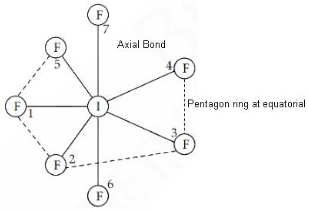
The structure of IF7 is
(a) Pentagonal bipyramid
(b) Square pyramid
(c) Trigonal bipyramid
(d) Octahedral

Answer

Answer: (a) Pentagonal bipyramid
Explanation:
IF7 Hybridization is sp³d³
Structure is Pentagonal bipyramidal.
MCQ Questions for Class 11 Chemistry Chapter 4 Chemical Bonding and Molecular Structure with Answers 1


MCQ On Chemical Bonding Class 11 Question 19.
The outer orbitals of C in ethene molecule can be considered to be hybridized to give three equivalent sp² orbitals. The total number of sigma (s) and pi (p) bonds in ethene molecule is
(a) 1 sigma (s) and 2 pi (p) bonds
(b) 3 sigma (s) and 2 pi (p) bonds
(c) 4 sigma (s) and 1 pi (p) bonds
(d) 5 sigma (s) and 1 pi (p) bonds

Answer

Answer: (d) 5 sigma (s) and 1 pi (p) bonds
Explanation:
According to valence bond theory, two atoms form a covalent bond through the overlap of individual half-filled valence atomic orbitals, each containing one unpaired electron. In ethene, each hydrogen atom has one unpaired electron and each carbon is sp² hybridized with one electron each sp² orbital. The fourth electron is in the p orbital that will form the pi bond. The bond order for ethene is simply the number of bonds between each atom: the carbon-carbon bond has a bond order of two, and each carbon-hydrogen bond has a bond order of one.


MCQ On Chemical Bonding With Answers Pdf Question 20.
Which of the following is a linear molecule?
(a) ClO2
(b) CO2
(c) NO2
(d) SO2

Answer

Answer: (b) CO2
Explanation:
The steric number of central atom of a linear molecule is two. It has two bonded atoms and zero lone pair. All the molecules have two bonded atoms. Thus, we need to work out the number of lone pairs.
In ClO2, the central atom Cl has 7 valence electrons. Four are used up to form 4 bonds with O atoms. Three are non-bonding electrons. Thus, along with an odd electron, it has a lone pair.
In CO2, the central C atom has 4 valence electrons. All are used up to form four bonds with O atoms. Thus, it has zero lone pair.
In NO2, the central N atom has 5 valence electrons. Four are used up to form bonds with oxygen atoms. Thus, one electron is left as an odd electron.
In SO2, the central S atom has 6 valence electrons. Four are used up to form bonds with oxygen atoms. Two nonbonding electrons form one lone pair.


We hope the given NCERT MCQ Questions for Class 11 Chemistry Chapter 4 Chemical Bonding and Molecular Structure with Answers Pdf free download will help you. If you have any queries regarding CBSE Class 11 Chemistry Chemical Bonding and Molecular Structure MCQs Multiple Choice Questions with Answers, drop a comment below and we will get back to you soon.

Class 11 Chemistry MCQ:

MCQ Questions for Class 11 Chemistry Chapter 11 The p-Block Elements with Answers

The p-Block Elements Class 11 MCQ Online Test With Answers Questions

Check the below NCERT MCQ Questions for Class 11 Chemistry Chapter 11 The p-Block Elements with Answers Pdf free download. MCQ Questions for Class 11 Chemistry with Answers were prepared based on the latest exam pattern. We have provided The p-Block Elements Class 11 Chemistry MCQs Questions with Answers to help students understand the concept very well.

Class 11 Chemistry Chapter 11 MCQ With Answers

Chemistry Class 11 Chapter 11 MCQs On The p-Block Elements

MCQ On P Block Elements Class 11 Question 1.
Red phosphorus is chemically less reactive because
(a) It does not contain P – P bonds
(b) It dos not contain tetrahedral P4 molecules
(c) It does not catch fire in air even upto 400°C
(d) It has a polymeric structure

Answer

Answer: (d) It has a polymeric structure
Explanation:
Red phosphorus is less reactive because of its gaint polymeric structure.


P Block Elements Class 11 MCQ Question 2.
Which of the following will not produce hydrogen gas?
(a) Reaction between Fe and dil. HCl
(b) Reaction between Zn and NaOH
(c) Reaction between Zn and conc. H2SO4
(d) Electrolysis of NaCl in Nelsons cell

Answer

Answer: (c) Reaction between Zn and conc. H2SO4
Explanation:
Concentrated sulphuric acid reacts with Zn to give SO2 and not H2


MCQ Of P Block Elements Class 11 Question 3.
Which of the following statement is correct?
(a) Copper (I) metaborate is colourless
(b) Copper (II) metaborate is colourless
(c) Copper (II) metaborate is light green
(d) Copper (I) metaborate is dark green

Answer

Answer: (a) Copper (I) metaborate is colourless
Explanation:
Copper (II) metaborate is bluish green and colour of Copper (I) metaborate is blue in colour.


P Block Elements Class 11 MCQ Pdf Question 4.
The structure of diBorane contains
(a) Four 2c – 2e bonds and two 3c – 2e bonds
(b) Two 2c – 2e bonds and two 3c – 2e bonds
(c) Two 2c – 2e bonds and two 3c – 3e bonds
(d) Four 2c – 2e bonds and four 3c – 2e bonds

Answer

Answer: (a) Four 2c – 2e bonds and two 3c – 2e bonds
Explanation:
According to molecular orbital theory, each of the two boron atoms is in sp³ hybrid state. Of the four hybrid orbitals, three have one electron each while the fourth is empty. Two of the four orbitals of each of the boron atom overlap with two terminal hydrogen atoms forming two normal B – H σ-bonds. One of the remaining hybrid orbital (either filled or empty) of one of the boron atoms, 1s orbital of hydrogen atoms (bridge atom) and one of hybrid orbitals of the other boron atom overlap to form a delocalised orbital covering the three nuclei with a pair of electrons. Such a bond is known as three centre two electron (3c – 2e) bonds
MCQ Questions for Class 11 Chemistry Chapter 11 The p-Block Elements with Answers 1


MCQ On P-Block Elements Class 11 Question 5.
Which is not the correct statement for Boron?
(a) It exhibits Allotropy
(b) It exists in both crystalline and Amorphous form
(c) It forms solid chlorides
(d) It forms volatile hydrides.

Answer

Answer: (c) It forms solid chlorides
Explanation:
Boron exists in amorphous and crystalline state and exhibit allotropy.
It forms numerous volatile hydrides which spontaneously catch fire on exposure to air and are easily hydrolysed.
The chlorides of Boron is liquid, it fumes in most air and readily hydrolysed by water.


MCQ On P-Block Elements Class 11 With Answers Question 6.
Oxygen gas can be prepared from solid KMnO4 by:
(a) Dissolving the solid in dil. HCl
(b) Dissolving the solid in conc. H2SO4
(c) Treating the solid with H2 gases
(d) Strongly heating the solid

Answer

Answer: (d) Strongly heating the solid
Explanation:
Oxygen gas can be prepared from solid KMnO4
250°C
2KMnO4 → KMnO4 + MnO2 + O2


Class 11 Chemistry Chapter 11 MCQ Question 7.
In the upper layers of atmosphere ozone is formed:
(a) By action of electric discharge on oxygen molecule
(b) By action of ultraviolet rays on oxygen molecule
(c) By action of infrared rays on oxygen molecule
(d) Due to sudden drops of pressure

Answer

Answer: (b) By action of ultraviolet rays on oxygen molecule
Explanation:
In the upper layer of atmosphere, the Ultraviolet rays (UV rays) split the molecule of oxygen (O2) into its constituent 2 atoms.
Each of the atom then combine with another oxygen (O2) molecule which gives rise to Ozone (O3).


P Block Elements MCQ Class 11 Question 8.
Among the C-X bond (where, X = Cl, Br, l) the correct decreasing order of bond energy is
(a) C−I > C−Cl > C−Br
(b) C−I > C−Br > C−Cl
(c) C−Cl > C−Br > C−I
(d) C−Br > C−Cl > C−I

Answer

Answer: (c) C−Cl > C−Br > C−I
Explanation:
Among the C-X bond (where , X = Cl, Br, I), the correct decreasing order of bond energy is
C−Cl > C−Br > C−l


P-Block Elements MCQ Class 11 Question 9.
Which of the following oxidation states are most characteristic for lead and tin respectively?
(a) 2, 2
(b) 4, 2
(c) 2, 4
(d) 4, 4

Answer

Answer: (c) 2, 4
Explanation:
Due to inert pair effect, ns² electron pair of Pb does not participate in bonding. Thus, +2 is the most characteristic oxidation state for Pb. However, for Sn, the inert pair effect is not so strong Thus, +4 is the most characteristic oxidation state for Sn.


Class 11 Chemistry P Block Elements MCQ Question 10.
When excess of Kl is added to copper sulphate solution:
(a) Cuprous iodide is formed
(b) l2 is liberated
(c) Potassium iodide is oxidized
(d) All

Answer

Answer: (d) All
Explanation:
It is an redox reaction which occurs when the iodide ion will reduce the copper (II) ion to copper(I) while iodide itself is oxidized to elemental iodine. Like most copper (I) compounds, Cul is insoluble in water.
KI + 2CuSO4 (aq) → Cu2l2(s) + l2(s) + 2K2SO4(aq)


P-Block Elements Class 11 Important Questions With Answers Pdf Question 11.
Which of the following statements regarding ozone is not correct?
(a) The oxygen-oxygen bond length in ozone is identical with that of molecular oxygen
(b) The ozone is response hybrid of two structures
(c) The ozone molecule is angular in shape
(d) Ozone is used as a germicide and disinfectant for the purification of air.

Answer

Answer: (a) The oxygen-oxygen bond length in ozone is identical with that of molecular oxygen
Explanation:
The oxygen–oxygen bond length in ozone is identical with that of molecular oxygen


MCQ Questions For Class 11 Chemistry Chapter 11 Question 12.
K2[Hgl4] detect the ion/group :
(a) NH2
(b) NO
(c) NH2+
(d) Cl

Answer

Answer: (c) NH2+
Explanation:
K2[Hgl4], Nesslers reagent detects NH+4 ion.


P Block Elements Class 11 Important Questions With Answers Question 13.
Which of the following has least covalent P−H bond?
(a) PH+4
(b) P2H+5
(c) P2H2+6
(d) PH3

Answer

Answer: (c) P2H2+6
Explanation:
The covalent charter of P−H bond depends on the formal charge distributed on each P−H bond
In PH+4 it is +1/4 = +0.25, in P2H+5 it is +1/5 = +0.2 and in P2H62+ it is +2/6 = +0.33.
The higher the formal charge the lesser the covalent character due to more polarisation. Thus the least covalent P−H bond is present in P2H2+64


P Block Elements Class 11 Questions And Answers Question 14.
If Cl2 gas is passed in to aqueous solution of Kl containing some CCl4 and the mixture is shaken then:
(a) Upper layer becomes violet
(b) Lower layer becomes violet
(c) Homogenous violet layer is formed
(d) None of these

Answer

Answer: (a) Upper layer becomes violet
Explanation:
2KI + Cl2 → 2KCl l2
I2 CCl4 → Violet Colour
But the excess of Cl2 should be avoided.
The layer may become colourless due to conversion of I2 to HIO3
I2 + 5Cl2 + 6H2O → 2HIO3 + 10HCl
In case of Br2
Br2 + 2H2O + Cl2 → 2HBrO + HCl


P Block Elements Class 11 MCQ For Neet Question 15.
MCQ Questions for Class 11 Chemistry Chapter 11 The p-Block Elements with Answers 2
Which of the statement is true for the above sequence of reactions?
(a) Z is hydrogen
(b) X is B2H6
(c) Z and Y are F2 and B2H6 respectively
(d) Z is Potassium Hydroxide

Answer

Answer: (c) Z and Y are F2 and B2H6 respectively
Explanation:
F2(Z) LiH
B(s) → BF3 → B2H6 + LiBF4
(X) (Y)


Question 16.
Ammonia gas can be dried by
(a) conc H2SO4
(b) P2O5
(c) CaCl2
(d) Quick lime

Answer

Answer: (d) Quick lime
Explanation:
Ammonia, with H2SO4 forms ammonium sulphate, with CaCl2 forms CaCl2.8NH3 and with P2O5 gives NH4PO3, hence these reagents cannot be used for drying ammonia.


Question 17.
Inert gases such as helium behave like ideal gases over a wide range of temperature .However; they condense into the solid state at very low temperatures. It indicates that at very low temperature there is a
(a) Weak attractive force between the atoms
(b) Weak repulsive force between the atoms
(c) Strong attractive force between the atoms
(d) Strong repulsive attractive between the atoms

Answer

Answer: (c) Strong attractive force between the atoms
Explanation:
Inert gases condense into the solid state at very low temperature as there is strong attractive force between the atoms.
In solid state, Van der Waals attractive forces are predominant between the atoms. The attractive force increases with the size of the atom as a result of the increase in polarizability and the decrease in ionization potential.


Question 18.
In general, the Boron Trihaides act as
(a) Strong reducing agent
(b) Lewis Acids
(c) Lewis Bases
(d) Dehydrating Agents

Answer

Answer: (b) Lewis Acids
Explanation:
The boron atom in trihaldies has only six electrons in the valence shell and hence can accept a pair of electrons in the vacant p-orbital to complete its octet. As a result, boron trihaldies act as a Lewis acids.


Question 19.
On heating ozone, its volume.
(a) Increase to 1.5 times
(b) Decreases to half
(c) Remain uncharged
(d) Becomes double

Answer

Answer: (a) Increase to 1.5 times
Explanation:
O3 → O2 + [O]
1 mole of O3 on heating produces 1 mole of O2 and 1 mole of [O], hence its volume increases to 1.5 times.


Question 20.
In the compound of type ECl3, where E = B, P, As, or Bi, the angle Cl – E – Cl for different E are ion the order:
(a) B > = P = As = Bi
(b) B > P > As > Bi
(c) B < P = As = Bi
(d) B < P < As < Bi

Answer

Answer: (b) B > P > As > Bi
Explanation:
BCl3 is trigonal planar in structure and bond angles are 120° each. PCl3, AsCl3, and BiCl3 are pyramidal in shape with sp³ hybridization.

In all of them, the bond angles are less than the normal tetrahedral angle of 109.28, and also these bond angles decrease down the group. Therefore, the correct order of bond angles is as follows:
B > P > As > Bi


We hope the given NCERT MCQ Questions for Class 11 Chemistry Chapter 11 The p-Block Elements with Answers Pdf free download will help you. If you have any queries regarding CBSE Class 11 Chemistry The p-Block Elements MCQs Multiple Choice Questions with Answers, drop a comment below and we will get back to you soon.

Class 11 Chemistry MCQ:

MCQ Questions for Class 11 Biology Chapter 9 Biomolecules with Answers

Biomolecules Class 11 MCQ Online Test With Answers Questions

Check the below NCERT MCQ Questions for Class 11 Biology Chapter 9 Biomolecules with Answers Pdf free download. MCQ Questions for Class 11 Biology with Answers were prepared based on the latest exam pattern. We have provided Biomolecules Class 11 Biology MCQs Questions with Answers to help students understand the concept very well.

Class 11 Biology Chapter 9 MCQ With Answers

Biology Class 11 Chapter 9 MCQs On Biomolecules

Biomolecules Class 11 MCQ Question 1.
Feedback inhibition of enzymes is affected by which of the following
(a) enzyme
(b) substrate
(c) end products
(d) intermediate end products

Answer

Answer: (c) end products


Biomolecules MCQs Class 11 Question 2.
An example of competitive inhibition of an enzyme is the inhibition of
(a) succinic dehydrogenase by malonic acid
(b) cytochrome oxidase by cyanide
(c) hexokinase by glucose-6-phosphate
(d) carbonic anhydrase by carbon dioxide

Answer

Answer: (a) succinic dehydrogenase by malonic acid


MCQ On Biomolecules Class 11 Question 3.
Insulin is made up of _______ and _______.
(a) glucose and fructose
(b) glucose and fructose
(c) fructose and mannose
(d) mannose and glucose

Answer

Answer: (b) glucose and fructose
Explanation:
Insulin is a polysaccharide made up of glucose and fructose.


Class 11 Biology Chapter 9 MCQ Question 4.
Enzymes increase the rate of reaction by
(a) lowering activation energy
(b) increasing activation energy
(c) increasing temperature and pH
(d) decreasing temperature and pH

Answer

Answer: (a) lowering activation energy
Explanation:
Enzymes increase the rate of reaction by decreasing the activation energy.


MCQ Of Biomolecules Class 11 Question 5.
Which of the following statements regarding enzyme inhibition is correct?
(a) Competitive inhibition is seen when a substrate competes with an enzyme for binding to an inhibitor protein
(b) Non-competitive inhibitors often bind to the enzyme irreversibly
(c) Competitive inhibition is seen when the substrate and the inhibitor compete for the active site on the enzyme
(d) Non-competitive inhibition of an enzyme can be overcome by adding large amount of substrate

Answer

Answer: (c) Competitive inhibition is seen when the substrate and the inhibitor compete for the active site on the enzyme


Class 11 Biomolecules MCQs Question 6.
Which of the following is not a pyrimidine?
(a) Uracil
(b) Cytosine
(c) Guanine
(d) Thymine

Answer

Answer: (c) Guanine
Explanation:
Guanine is a purine.


Biomolecules Class 11 MCQ With Answers Question 7.
Hydrolysis of starch occurs with the help of
(a) Peptidase
(b) Amylase
(c) Sucrose
(d) Lipase

Answer

Answer: (b) Amylase


MCQs Of Biology Class 11 Chapter 9 Question 8.
Assertion: Arachidic acid is an unsaturated fatty acid.
Reason: There are one or more double bonds between carbon atoms in unsaturated fatty acids.
(a) Both Assertion and Reason are true and Reason is the correct explanation of the Assertion.
(b) Both Assertion and Reason are true but the Reason is not the correct explanations of Assertion.
(c) Assertion is true, but Reason is false.
(d) Both Assertion and Reason are false

Answer

Answer: (d) Both Assertion and Reason are false


Biomolecules Class 11 MCQs Question 9.
Which of the following influence feedback inhibition of enzyme?
(a) End product
(b) External factors
(c) Enzyme
(d) Substrate

Answer

Answer: (a) End product


MCQ Questions For Class 11 Biology Chapter 9 Question 10.
Which of the following is not a polysaccharide?
(a) Lactose
(b) Starch
(c) Glycogen
(d) Dextrin

Answer

Answer: (a) Lactose
Explanation:
Lactose is a disaccharide made up of glucose and galactose.


Chapter 9 Biology Class 11 MCQs Question 11.
Inulin is made up of _______ and _______.
(a) glucose and fructose
(b) glucose and fructose
(c) fructose and mannose
(d) mannose and glucose

Answer

Answer: (b) glucose and fructose
Explanation:
Inulin is a polysaccharide made up of glucose and fructose.


Class 11 Biology Biomolecules MCQs Question 12.
MCQ Questions for Class 11 Biology Chapter 9 Biomolecules with Answers 1
The structure shown above is
(a) mannose
(b) fructose
(c) glucose
(d) galactose

Answer

Answer: (c) glucose
Explanation:
MCQ Questions for Class 11 Biology Chapter 9 Biomolecules with Answers 2
Glucose molecule


MCQ Biomolecules Class 11 Question 13.
A protein having both structural and enzymatic traits is
(a) Collagen
(b) Trypsin
(c) Myosin
(d) Actin

Answer

Answer: (c) Myosin


Ch 9 Bio Class 11 MCQ Question 14.
NADP contains vitamin ______.
(a) B1
(b) B2
(c) B3
(d) B12

Answer

Answer: (c) B3
Explanation:
B3 also named as niacin.


Biology Class 11 Chapter 9 MCQs Question 15.
With reference to enzymes, which one of the following statements is true?
(a) Apoenzyme = Holoenzyme + Coenzyme
(b) Holoenzyme = Apoenzyme + Coenzyme
(c) Coenzyme = Apoenzyme + Holoenzyme
(d) Holoenzyme = Coenzyme – Apoenzyme

Answer

Answer: (b) Holoenzyme = Apoenzyme + Coenzyme


Question 16.
Inhibitor binds to the active site of the enzyme. Hence blocking the reaction. This is an example of
(a) allosteric inhibition
(b) feedback inhibition
(c) uncompetitive inhibition
(d) competitive inhibition

Answer

Answer: (d) competitive inhibition
Explanation:
When substrate binds to the active site of the enzyme, it completes the reaction.
When inhibitor binds to the active site of the enzyme, it blocks the reaction.


Question 17.
The fastest enzyme known is
(a) DNA polymerase
(b) carbonic anhydrase
(c) carbonic dehydrogenase
(d) DNA ligase

Answer

Answer: (b) carbonic anhydrase
Explanation:
The fastest enzyme known is carbonic anhydrase. It converts 106 molecules of carbon dioxide molecules per second.


Question 18.
Lecithin is a
(a) polysaccharide
(b) protein
(c) nucleic acid
(d) lipid

Answer

Answer: (d) liquid
Explanation:
Lecithin is a phospholipid.


Question 19.
The minimum amount of energy required to initiate a chemical reaction is called
(a) enzymatic energy
(b) activation energy
(c) substrate energy
(d) initiation energy

Answer

Answer: (b) activation energy
Explanation:
The minimum amount of energy required to initiate a chemical reaction is called activation energy.


Question 20.
Enzymes, vitamins and hormones are common in
(a) Enhancing oxidative metabolism
(b) Being synthesised in the body of organisms
(c) Being proteinaceous
(d) Regulating metabolism

Answer

Answer: (d) Regulating metabolism


We hope the given NCERT MCQ Questions for Class 11 Biology Chapter 9 Biomolecules with Answers Pdf free download will help you. If you have any queries regarding CBSE Class 11 Biology Biomolecules MCQs Multiple Choice Questions with Answers, drop a comment below and we will get back to you soon.

Class 11 Biology MCQ:

MCQ Questions for Class 11 Chemistry Chapter 8 Redox Reactions with Answers

Redox Reactions Class 11 MCQ Online Test With Answers Questions

Check the below NCERT MCQ Questions for Class 11 Chemistry Chapter 8 Redox Reactions with Answers Pdf free download. MCQ Questions for Class 11 Chemistry with Answers were prepared based on the latest exam pattern. We have provided Redox Reactions Class 11 Chemistry MCQs Questions with Answers to help students understand the concept very well.

Class 11 Chemistry Chapter 8 MCQ With Answers

Chemistry Class 11 Chapter 8 MCQs On Redox Reactions

Redox Reaction Class 11 MCQ Question 1.
The oxidation number of Cl in Cl2O7 is
(a) + 7
(b) + 5
(c) + 3
(d) – 7

Answer

Answer: (a) + 7
Explanation:
Cl show different oxidation state as -1 to +7 due to vacant d orbital. As oxygen is more electronegative than Cl. Oxygen size is small hence its more electronegative and show -2 oxidation states.
Here Cl2O7 then equation is: 2x + 7 × (-2) = 0
x = +7 hence oxidation state of Cl is +7. I think you get your answer how to find oxidation state.


MCQ On Redox Reaction Class 11 Question 2.
What is known as Autooxidation?
(a) Formation of H2O by the oxidation of H2O2.
(b) Formation of H2O2 by the oxidation of H2O.
(c) Both (1) and (2) are true
(d) None of the above

Answer

Answer: (b) Formation of H2O2 by the oxidation of H2O.
Explanation:
Autoxidation is any oxidation that occurs in presence of oxygen. The term is usually used to describe the degradation of organic compounds in air (as a source of oxygen). Autoxidation produces hydroperoxides and cyclic organic peroxides. These species can react further to form many products. The process is relevant to many phenomena including aging, paint, and spoilage of foods, degradation of petrochemicals, and the industrial production of chemicals. Autoxidation is important because it is a useful reaction for converting compounds to oxygenated derivatives, and also because it occurs in situations where it is not desired (as in the destructive cracking of the rubber in automobile tires or in rancidification).

Water automatically gets oxidised to hydrogen peroxide.


MCQ Of Redox Reaction Class 11 Question 3.
The tendency of an electrode to lose electrons is known as
(a) Electrode Potential
(b) Reduction Potential
(c) Oxidation Potential
(d) E.M.F.

Answer

Answer: (c) Oxidation Potential
Explanation:
The magnitude of the electrode potential of a metal is a measure of its relative tendency to lose or gain electrons. i.e., it is a measure of the relative tendency to undergo oxidation (loss of electrons) or reduction (gain of electrons).
M → Mn+ + ne (oxidation potential)
Mn+ + ne → M (reduction potential)


Class 11 Chemistry Redox Reaction MCQ Question 4.
If equal volumes of 1M KMnO4 and 1M K2Cr2O7 solutions are allowed to oxidize Fe2+ in acidic medium. The amount of iron oxidized will be:
(a) More with KMnO2
(b) More with K2Cr2O7
(c) Equal with both oxidising agents
(d) Cannot be determined

Answer

Answer: (b) More with K2Cr2O7
Explanation:
The reason due to which the amount of Fe oxidised will be more with ​K2Cr2O7 is:
the change in the oxidation state (or number) or n factor is greater with KMnO4
Also, ​K2Cr2O7 is a very strong oxidising agent and holds the ability to take the electrons but ​KMnO4 is more stronger than ​K2Cr2O7.


Redox Reaction MCQ Class 11 Question 5.
Which of the following processes does not involve either oxidation or reduction?
(a) Formation of slaked lime from quick lime
(b) Heating Mercuric Oxide
(c) Formation of Manganese Chloride from Manganese oxide
(d) Formation of Zinc from Zinc blende

Answer

Answer: (a) Formation of slaked lime from quick lime
Explanation:
Here, in this reaction
CaO + H2​O →Ca(OH)2
Oxidation number doesn’t change so its not a redox reaction.


Class 11 Redox Reaction MCQ Question 6.
One mole of N2H4 loses ten moles of electrons to form a new compound A. Assuming that all the nitrogen appears in the new compound, what is the oxidation state of nitrogen in A? (There is no change in the oxidation state of hydrogen.)
(a) -1
(b) -3
(c) +3
(d) +5

Answer

Answer: (c) +3
Explanation:
First to find oxidation number of Nitrogen in N2H4
Oxidation number of H = +1
Let oxidation number of nitrogen be x
2x + 4(1) = 0
2x = -4
x = -2
Each nitrogen atom has -2 oxidation number. So taken both nitrogen atoms in account gives oxidation number -4.
Change in oxidation number of nitrogen on losing 10 mol of electrons (considering no change in oxidation number of hydrogen atoms)
-4 – (-10) = +6
Therefore, oxidation number of 2 nitrogen atoms in compound Y is +6. Hence, oxidation number of each nitrogen atom will be +3 in new compound Y.


Class 11 Chemistry Chapter 8 MCQ Question 7.
How many millilitres of 0.5 M H2SO4 are needed to dissolve 0.5 g of copper(II)carbonate?
(a) 6.01
(b) 4.5
(c) 8.1
(d) 11.1

Answer

Answer: (c) 8.1
Explanation:
The volume can be calculated :
N1V1 = N2V2
N1 = Normality of H2SO4 = 0.5 × 2 = 1 N
V1 = Volume of H2SO4
Molar mass of copper(II) carbonate = 123.5 g
N2 = Normality of copper (II) carbonate = (0.5×2)/(123.5) N
V2 = Volume of copper (II) carbonate = 1000 mL
So, after applying the formula,
1 × V1 = (0.5×2)/(123.5)×1000
Hence, V1 = 8.09 mL
= approx. 8.1 mL


Redox Reaction Class 11 MCQ Pdf Question 8.
The oxidation state of Cr in Cr (CO)6 is
(a) 0
(b) 2
(c) 2
(d) 6

Answer

Answer: (a) 0
Explanation:
CO (carbonyl) is a neutral ligand, hence oxidation state of Cr in Cr (CO)6 is zero


Redox Reactions Class 11 MCQ Question 9.
Which of the following processes does not involve oxidation of iron?
(a) Formation of Fe(CO)5 from Fe.
(b) Liberation of H2 from steam by iron at high temperature.
(c) Rusting of iron sheets.
(d) Decolourisation of blue CuSO4 solution by iron.

Answer

Answer: (a) Formation of Fe(CO)5 from Fe.
Explanation:
Oxidation number of Fe in Fe(CO)5 is zero.
In both Fe and Fe(CO)5, the oxidation state of iron is zero.
3Fe + 4H2O → Fe3O4 + 4H2
team
rusting
Fe → Fe2O3.xH2O
(+3)
CuSO4(aq) + Fe (s) → FeSO4(aq) + Cu(s)
(0) (+2)


MCQs On Redox Reaction Class 11 Question 10.
The number of moles of KMnO4 reduced by one mole of KI in alkaline medium is
(a) One
(b) Two
(c) Five
(d) One fifth.

Answer

Answer: (b) Two
Explanation:
In alkaline medium the reduction of KMnO4 with KI will takes place as
2 KMnO4 + H2O → 2 KOH + 2 MnO2
KI + 3[O] → KIO3
Hence the overall reaction is
KI + 2KMnO4 + H2O → KIO3 + 2 KOH + 2 MnO2
So, one mole of KI will reduced two moles of KMnO4


MCQ Questions For Class 11 Chemistry Chapter 8 Question 11.
Which of the following reactions does not involve either oxidation or reduction?
(a) VO2+ → V2O3
(b) Na → Na+
(c) CrO2-4 → Cr2O2-7
(d) Zn2+ →Zn

Answer

Answer: (c) CrO2-4 → Cr2O2-7
Explanation:
In VO2+ →V2​O3, V is reduced from +4 to +3 oxidation state.
In Na → Na2+, Na is oxidised from to +1 oxidation state.
In CrO4-2​ → Cr2O7-2, Cr remains in same oxidation state +6.
In Zn+2 → Zn, Zn is reduced from +2 to 0 oxidation state.


Redox Reaction Class 11 MCQs Question 12.
KMnO4​ reacts with oxalic acid according to the equation 2MnO4​ + 5C2​O42-​ + 16H+ → 2Mn2+​ +10CO2​ + 8H2​O Here 20 mL of 0.1 M KMnO4​ is equivalent to
(a) 50 mL of 0.5 M C2H2O4
(b) 20 mL of 0.1 M C2H2O4
(c) 20 mL of 0.5 M C2H2O4
(d) 50 mL of 0.1 M C2H2O4

Answer

Answer: (d) 50 mL of 0.1 M C2H2O4
Explanation:
2MnO4 + 5C2O42- + 16H+ → 2Mn2+ + 10CO2 + 8H2O
Therefore, 2 moles of MNO4 equivalent to 5 moles of C2O42-
20 mL of 0.1 M KMnO4 = 2 moles of KMnO4
Also, 50 mL of 0.1 M C2H2O4 equivalent to 5 mol of C2O42-
Therefore, these are equivalent.


Ch 8 Chemistry Class 11 MCQ Question 13.
One mole of N2H4 loses ten moles of electrons to form a new compound A. Assuming that all the nitrogen appears in the new compound, what is the oxidation state of nitrogen in A? (There is no change in the oxidation state of hydrogen.)
(a) -1
(b) -3
(c) +3
(d) +5

Answer

Answer: (c) +3
Explanation:
First to find oxidation number of Nitrogen in N2H4
Oxidation number of H = +1
Let oxidation number of nitrogen be x
2x + 4(1) = 0
2x = -4
x = -2
Each nitrogen atom has -2 oxidation number. So taken both nitrogen atoms in account gives oxidation number -4.
Change in oxidation number of nitrogen on losing 10 mol of electrons (considering no change in oxidation number of hydrogen atoms)
-4 – (-10) = +6
Therefore, oxidation number of 2 nitrogen atoms in compound Y is +6. Hence, oxidation number of each nitrogen atom will be +3 in new compound Y.


MCQs Of Redox Reaction Class 11 Question 14.
What is n-factor?
(a) Equal to product of Number of moles of electrons when Lost or gained by one mole of reductant or oxidant
(b) When Number of moles of electrons Lost or gained by one mole of reductant or oxidant is not same.
(c) Equal to Number of moles of electrons Lost or gained by one mole of reductant or oxidant
(d) None of the above

Answer

Answer: (c) Equal to Number of moles of electrons Lost or gained by one mole of reductant or oxidant.
Explanation:
For redox reaction it is considered as change in their oxidation number or change in their reduction number in both side of a chemical reaction.


Class 11 Chemistry Chapter 8 MCQ With Answers Question 15.
The oxidation number of Mn is maximum in
(a) MnO2
(b) K2MnO4
(c) Mn3O4
(d) KMnO4.

Answer

Answer: (d) KMnO4.
Explanation:
The electronic configuration of Mn is:
Mn(25) = [Ar]3d5 4s2, 4p0
In excited state, it can lose its all 7 electrons.
Hence, maximum oxidation sate exhibited by Mn is +7 which is in KMnO4.


Question 16:
The oxidation process involves
(a) Increase in oxidation number
(b) Decrease in oxidation number
(c) No change in oxidation number
(d) none of the above

Answer

Answer: (a) Increase in oxidation number
Explanation:
Oxidation process Involves:-
Addition of O2 or electronegative element
Removal of H/electropositive element
Loss of electrons
Increase in oxidation number


Question 17.
Metals generally react with dilute acids to produce hydrogen gas. Which one of the following metals does not react with dilute hydrochloric acid?
(a) Copper
(b) Magnesium
(c) Iron
(d) Silver

Answer

Answer: (b) Magnesium
Explanation:
Most of the metals such as Al, Cu, Fe etc. reacts with dilute acids to produce hydrogen gas but magnesium is an exception. Magnesium being an active metal liberates dihydrogen gas as it is allowed to react with dilute HCl. Thus all the given metals react with dilute acids.
Mg + 2HCl → MgCl2 + H2


Question 18.
The oxidation number of Xe in BaXeO6 is
(a) 8
(b) 6
(c) 4
(d) 10

Answer

Answer: (d) 10
Explanation:
Oxidation state of Ba in general = +2 and of O = −2
Applying formula, Sum of total oxidation state of all atoms = Overall charge on the compound.
Let oxidation state of Xe in BaXeO6 be x.
2 + x + 6(−2) = 0,
x = 10
But oxidation state 10 is not possible for Xe. In this case the oxidation state of Xe is equal to maximum possible oxidation state for Xe = +8.


Question 19.
The colourless solution of silver nitrate slowly turns blue on adding copper chips to it because of
(a) Dissolution of Copper
(b) Oxidation of Ag+ → Ag
(c) Reduction of Cu2+ ions
(d) Oxidation of Cu atoms.

Answer

Answer: (d) Oxidation of Cu atoms.
Explanation:
When copper turnings are added to silver nitrate solution, the solution becomes brown in color after sometime because copper is more reactive than silver so it displaces silver from silver nitrate solution and form copper nitrate solution.


Question 20.
A standard reduction electrode potentials of four metals are A = -0.250 V, B = -0.140 V, C = -0.126 V, D = -0.402 V The metal that displaces A from its aqueous solution is:
(a) A
(b) B
(c) C
(d) D

Answer

Answer: (d) D
Explanation:
Reduction potential of D is minimum i.e. −0.402 V. Thus oxidation potential of D is maximum i.e. to +0.402 V. D can oxidise itself and reduce other.
The aqueous solution A will be present in its ionic form and can be reduced by D as its reduction potential is higher than D.
Thus D can replace A from its Aqueous solution.


We hope the given NCERT MCQ Questions for Class 11 Chemistry Chapter 8 Redox Reactions with Answers Pdf free download will help you. If you have any queries regarding CBSE Class 11 Chemistry Redox Reactions MCQs Multiple Choice Questions with Answers, drop a comment below and we will get back to you soon.

Class 11 Chemistry MCQ: