MCQ Questions for Class 10 Geography Chapter 7 Lifelines of the National Economy with Answers

Lifelines of the National Economy Class 10 MCQ Online Test With Answers Questions

Students can also read MCQ Questions for Class 10 Geography Chapter 7 Lifelines of the National Economy Questions with Answers hope will definitely help for your board exams. https://ncertmcq.com/tag/lifelines-of-the-national-economy-class-10-mcqs-questions/

Class 10 Social Science Geography Chapter 7 MCQ With Answers

Geography Class 10 Chapter 7 MCQs On Lifelines of the National Economy

Lifelines Of National Economy Class 10 MCQ Question 1.
Which of the following two stations did the first train of India steam off to and when?
(a) Kolkata to Raniganj, 1874
(b) Mumbai to Thane, 1853
(c) Mumbai to Ahmedabad, 1854
(d) Chennai to Arkonam, 1856
Answer:
(b) Mumbai to Thane, 1853

Class 10 Geography Chapter 7 MCQ With Answers Question 2.
Which of the following modes of transport would one be able to find on the higher dissected terrain of mountainous regions like the Himalayas?
(a) Railways
(b) Roadways
(c) Inland waterways
(d) Airways
Answer:
(b) Roadways

Lifelines Of National Economy MCQ Question 3.
Fill in the blank by choosing the most appropriate option:
………………… is the oldest artificial port and the second most important port of the country.
(a) Mumbai port
(b) Kandla port
(c) Chennai port
(d) Ennore port
Answer:

MCQ Questions for Class 10 Geography Chapter 7 Lifelines of the National Economy with Answers

Life Lines Of National Economy Class 10 MCQ Question 4.
Which of the following networks of pipelines bring mineral oil to the refinery of Barauni and the petrochemical complex of Haldia?
(a) Pipeline from Upper Assam oilfields to Kanpur (Uttar Pradesh)
(b) Pipeline from Salaya in Gujarat to Jalandhar
(c) Hazira-Vijaipur-Jagdishpur Pipeline
(d) Pipeline from Mumbai High to Goa and then to Trombay
Answer:
(a) Pipeline from Upper Assam oilfields to Kanpur (Uttar Pradesh)

MCQ Questions For Class 10 Geography Chapter 7 Question 5.
Which one of the following groups of cities is connected by the National Highway No. 1?
(a) Delhi – Amritsar
(b) Delhi – Kolkata
(c) Delhi – Mumbai
(d) Varanasi – Kanyakumari
Answer:
(a) Delhi – Amritsar

Lifelines Of National Economy Class 10 MCQ Questions And Answers Question 6.
Which two extreme locations are connected by the North-South Corridor?
(a) Amritsar and Tuticorin
(b) Srinagar and Thiruvananthapuram
(c) Srinagar and Tuticorin
(d) Srinagar and Kanyakumari
Answer:
(d) Srinagar and Kanyakumari

Explanation: The North South Corridor is the one of the Golden Quadrilateral Super Highways that connects the mega cities of India.

MCQ Of Lifelines Of National Economy Question 7.
Which one of the following is not an advantage of pipeline transportation?
(a) Pipelines are used for transporting crude oil and gas from fields to refineries.
(b) Solids can be transported in slurry form through pipelines.
(c) Pipelines rule out trans-shipment losses or delays.
(d) Pipeline requires a lot of capital and extra maintenance.
Answer:
(d) Pipeline requires a lot of capital and extra maintenance.

Explanation: Pipelines do not need any extra maintenance. Its initial cost of laying is high.

MCQ On Lifelines Of National Economy Question 8.
……………… is considered as the First Class Mail by the Indian postal network.
(a) Cards and envelopes
(b) Registered periodicals
(c) Magazines and New Books
(d) Registered newspapers packets
Answer:
(a) Cards and envelopes

Class 10 Lifelines Of National Economy MCQ Question 9.
National Highways are constructed and maintained by
(a) NHAI
(b) CPWD
(c) SPWD
(d) BRO
Answer:
(b) CPWD

Explanation: National Highways link extreme parts of the country. These are the primary road systems.

Ncert Class 10 Social Science Objective Questions Question 10.
Which one of the following is the oldest port of the eastern coast of India?
(a) Kolkata (Haldia)
(b) Visakhapatnam
(c) Tuticorin
(d) Chennai (Madras)
Answer:

Lifelines Of National Economy Class 10 One Mark Questions Pdf Question 11.
Pawanhans Helicopters Ltd. Provides helicopter services to which of the following in its off-shore operations?
(a) Oil India Ltd.
(b) Oil and Natural Gas Commission
(c) NTPC
(d) All of these
Answer:
(b) Oil and Natural Gas Commission

MCQ Questions for Class 10 Geography Chapter 7 Lifelines of the National Economy with Answers

Class 10 Social Science MCQ Question 12.
Air travel is not within the reach of the common people. It is only in which part of the country that special provisions are made to extend the services to the common people?
(a) Northern states .
(b) North-eastern states
(c) North-western states
(d) Coastal states
Answer:

Social Science MCQ Class 10 Question 13.
Which of the following is an example of an inland riverine port in India?
(a) Chennai
(b) Kolkata
(c) Tuticorin
(d) None of these
Answer:
(b) Kolkata

Explanation: Kolkata port serves a very Large and rich hinterland of Ganga-Brahmaputra basin.

MCQ Questions For Class 10 Social Science With Answers Question 14.
Which two of the following extreme locations are connected by the east-west corridor?
(a) Mumbai and Nagpur
(b) Silchar and Porbandar
(c) Mumbai and Kolkata
(d) Nagpur and Siliguri [Diksha]
Answer:

Social MCQ Class 10 Question 15.
Which of the following is the longest National Waterway of India?
(a) The Ganga river between Allahabad and Haldia
(b) The Brahmaputra river between Sadiya and Dhubri
(c) The West-Coast Canal in Kerala
(d) None of these
Answer:

Question 16.
Which of the following ports was planned with a view to decongesting the Mumbai port?
(a) Kandla port
(b) Paradip port
(c) Tuticorin port
(d) Jawaharlal Nehru port
Answer:
(d) Jawaharlal Nehru port

Question 17.
Which one of the following is the longest National Highway?
(a) NH-7
(b) NH-8
(c) NH-1
(d) None of the above
Answer:
(a) NH-7

Explanation: National Highway-7 is the longest and traverses 2369 km between Varanasi and Kanyakumari via Jabalpur, Nagpur, Hyderabad, Bangalore and Madurai while Delhi and Mumbai are connected by National Highway-8. The historical Sher Shah Suri Marg is called National Highway No.l connects Delhi and Amritsar.

MCQ Questions for Class 10 Geography Chapter 7 Lifelines of the National Economy with Answers

Question 18.
Which one of the following places is NOT associated with oil refineries?
(a) Mathura
(b) Barauni
(c) Panipat
(d) Surat
Answer:
(d) Surat

Question 19.
Which of the following mode of transport is fuel-efficient and environment-friendly?
(a) Roadways
(b) Railways
(c) Airways
(d) Waterways
Answer:
(d) Waterways

Explanation: It’s the cheapest and most fuel-efficient type of transport as the friction of water is far less than that of land nor do they require road construction. Through waterways, heavy and bulky goods can be transported to distant lands.

Question 20.
Which of the following port is located at the entrance of a lagoon with a natural harbour?
(a) Tuticorin
(b) Kochi
(c) Marmagao
(d) None of these
Answer:
(b) Kochi

Related Theory
Kochi is the extreme south-western port of India.

Question 21.
Which of the following organisations is responsible for construction and maintenance of the strategic roads in India?
(a) CPWD
(b) SPWD
(c) NHAI
(d) BRO
Answer:
(d) BRO

Explanation: Border Road Organisation (BRO) was established in 1960.

Question 22.
Which one of the following states is NOT connected with the HVJ pipeline?
(a) Madhya Pradesh
(b) Gujarat
(c) Maharashtra
(d) Uttar Pradesh
Answer:
(c) Maharashtra

MCQ Questions for Class 10 Geography Chapter 7 Lifelines of the National Economy with Answers

Question 23.
Which one of the following major ports has been developed to decongest Kolkata port?
(a) Kandla
(b) Haldia
(c) Paradwip
(d) Marmagao
Answer:
(b) Haldia

Explanation: Haldia port was developed as a subsidiary port, in order to relieve growing pressure on the Kolkata port
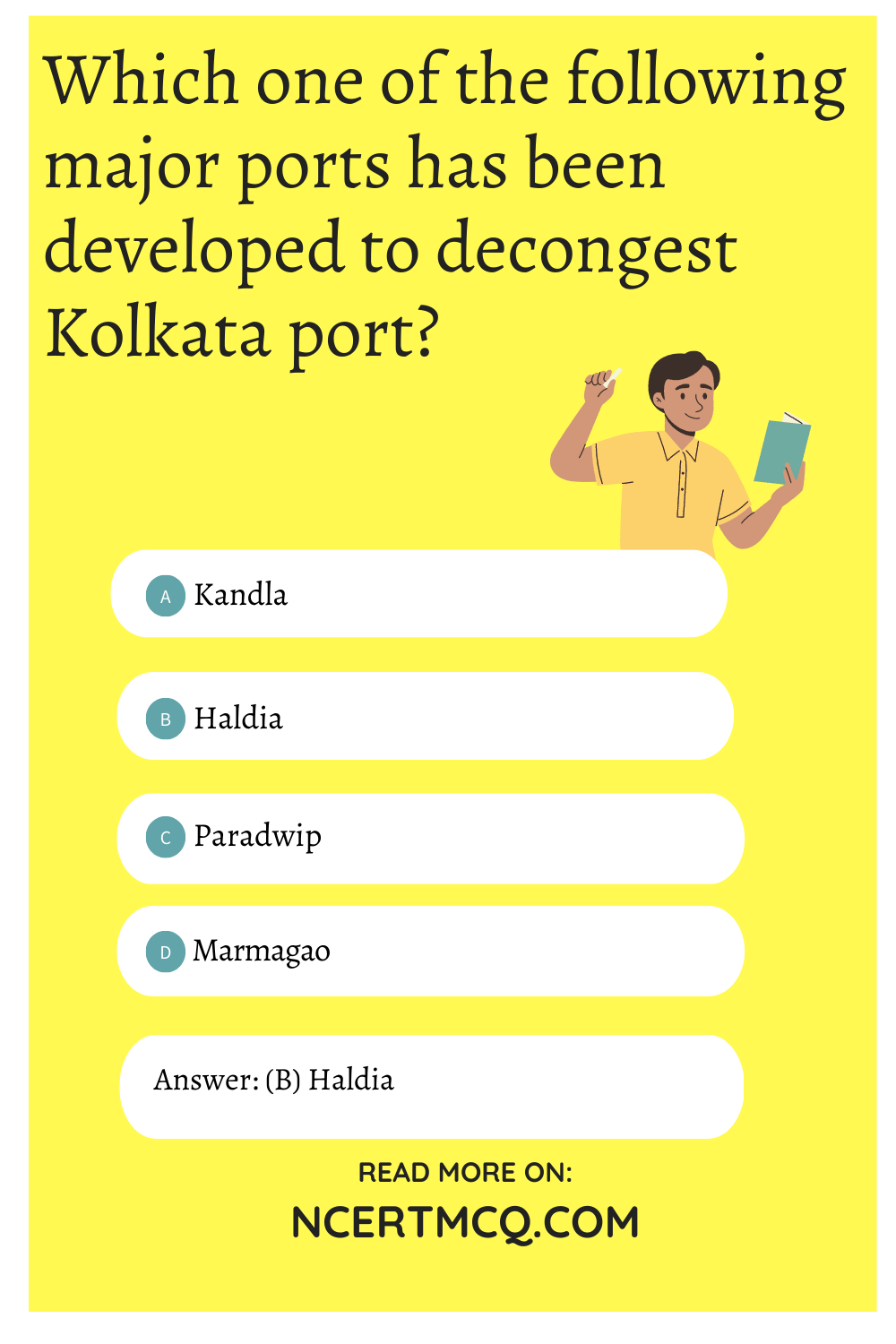
Which one of the following major ports has been developed to decongest Kolkata port?

Question 24.
Arrange the following options in the correct sequence:
(i) Science and technology helped improve transport.
(ii) Rapid moving and effiicient transport brought a change.
(iii) Transport and trade were restricted to a limited area.
(iv) Improved communication played a major role in this change.
Options:
(a) (i)—(ii)—(iii)—(iv)
(b) (i)—(iii)—(ii)—(iv)
(C) (iii)—(i)—(i0—(iv)
(d) (iv)—(iii)—(ii)—(i)

Identify the following on basis of the hints given.

Question 25.
identify the type of transport:
(1) Fastest mode of transport
(2) Can cover all dissected and undulating terrains
(3) Especially famous in the North Easterm states
Answer:
Airways

Question 26.
Identify the industry:
(1) Industry in India has grown substantially over the last three decades.
(2) 15 million people are directly engaged in the tourism industry.
(3) The industry promotes national integration, provides support to local handicrafts and cultural pursuits.
Answer:
Tourism

Question 27.
Identify the port:
(1) It is located on the Western Coast.
(2) It is the premier iron ore exporting sea port of the country.
Answer:
Marmagao Port

Correct and Rewrite/ True-False
State whether the following statements are True or False. If false, correct the statement.

Question 28.
Roadways are the principal mode of transportation for freight and passengers in India.
Answer:
False

Railways are the principal mode of transportation for freight and passengers in India.

Question 29.
India’s first train steamed off from Mumbai to Thane in 1853 covering a distance of 34 km.
Answer:
True

MCQ Questions for Class 10 Geography Chapter 7 Lifelines of the National Economy with Answers

Question 30.
Akashwani, the national television channel of India is one of the largest terrestrial networks in the world.
Answer:
False

Doordarshan.the national television channel of India is one of the largest terrestrial networks in the world.

Fill in the blanks/tables with suitable information:

Question 31.
Television is a means of …………………..
Answer:
mass communication

Question 32.
…………….. is the extreme south-western port located at the entrance of a lagoon with a natural harbour.
Answer:
Kochi

Question 33.
…………… a Government of India undertaking constructs and maintains roads in the bordering areas of the country.
Answer:

Question 34.
Complete the following table with appropriate terms in place of (a) and (b).
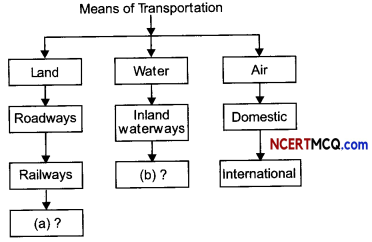
MCQ Questions for Class 10 Geography Chapter 7 Lifelines of the National Economy with Answers 1
Answer:
(a) Pipelines
(b) Overseas Waterways

Question 35.
The is the largest public sector undertaking in India.
Answer:
Indian Railways government and hence it is a public sector enterprise. Railways in India bind the economic life of the country as well as accelerate the development of industries and agriculture.

Question 36.
…………. is the deepest, land-locked and well-protected port of India.
Answer:
Vishakhapatnam

Related Theory:
Railways employ a very large number of people in the country. It is monitored and run by the

MCQ Questions for Class 10 Geography Chapter 7 Lifelines of the National Economy with Answers

Question 37.
Fill the blanks in the table with required information:
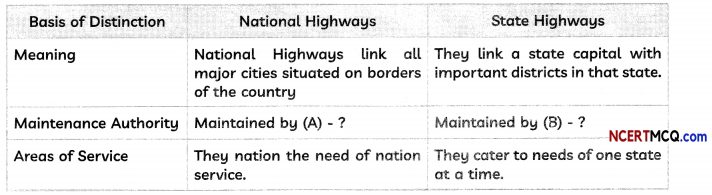
MCQ Questions for Class 10 Geography Chapter 7 Lifelines of the National Economy with Answers 2
Answer:

Match the Columns Choose the correct pairs:

Question 38.
Match the following roads from column A with the organisations responsible for their construction and maintenance from column B:

Column A (Types of Road) Column B (Organisation)
(a) Super Highways (i) Zila Parishad
(b) National Highways (ii) State Public Works Department
(c) State Highways (iii) Central Public Works Department
(d) District Roads (iv) National Highway Authority of India

Answer:

Column A (Types of Road) Column B (Organisation)
(a) Super Highways (iv) National Highway Authority of India
(b) National Highways (iii) Central Public Works Department
(c) State Highways (ii) State Public Works Department
(d) District Roads (i) Zila Parishad

Question 39.
Match the following national highways from column A with the places/cities connected by them from column B:

Column A (National Highways) Column B (Places/Cities Connected)
(a) NH-1 (i) Varanasi and Kanyakumari
(b) NH-8 (ii) Most parts of Rajasthan
(c) NH-7 (iii) Delhi and Mumbai
(d) NH-15 (iv) Delhi and Amritsar

Answer:

Assertion Reasoning questions Class 10 Geography Chapter 7

In each of following questions, a statement of Assertion (A) is given followed by a corresponding statement of Reason (R). Select the correct answers to codes (a), (b), (c) or (d) as given below:
(a) Both (A) and (R) are true and (R) is the correct explanation of (A).
(b) Both (A) and (R) are true but (R) is not the correct explanation of (A).
(c) (A) is correct but (R) is wrong.
(d) (A) is wrong but (R) is correct.

Question 40.
Assertion (A): There is a vast potential for development of tourism in all parts of the country.
Reason (R): There is a lot of scope in various fields of tourism.
Answer:

Question 41.
Assertion (A): No country can survive without international trade.
Reason (R): Resources are not space bound.
Answer:
(c) (A) is correct but (R) is wrong.

Explanation: Resources are space bound and thus a country has to import and export resources to be able to fulfill their needs.

MCQ Questions for Class 10 Geography Chapter 7 Lifelines of the National Economy with Answers

Question 42.
Assertion (A): Air travel has made access easier.
Reason (R): No other mode of transport could travel across regions in the presence of big rivers, dissected relief, dense forests and frequent floods and international frontiers, etc. in the absence of air transport.
Answer:
(a) Both (A) and (R) are true and (R) is the correct explanation of (A).

Question 43.
Assertion (A): 60 per cent of the country’s trade volume (68 per cent in terms of value) is moved by sea.
Reason (R): Seaways carry heavy loads to farther distances at very affordable rates.
Answer:

Question 44.
Assertion (A): The railways have become more important in our national economy than all other means of transport put together.
Reason (R): It carries the most loads and maximum number of people across the country.
Answer:
(a) Both (A) and (R) are true and (R) is the correct explanation of (A).

(Competency Based Questions (CBQs))

Question 1.
Read the source given below and answer the questions that follow:
Goods and services do not move from supply locales to demand locales on their own. The movement of these goods and services from their supply locations to demand locations necessitates the need for transport. Some people are engaged in facilitating these movements. These are known to be traders who make the products come to the consumers by transportation. Thus, the pace of development of a country depends upon the production of goods and services as well as their movement over space. Therefore, efficient means of transport are prerequisites for fast development.

Movement of these goods and services can be over three important domains of our earth i.e. land, water and air. Based on these, transport can also be classified into land, water and air transport expanded far and wide. Today, the world has been converted into a large village with the help of efficient and fast moving transport. Transport has been able to achieve this with the help of equally developed communication systems. Therefore, transport, communication and trade are complementary to each other.

Answer the following MCQs by choosing the most appropriate option:
(A) Which of the following groups are involved in transport of goods and services from one nation to another?
(a) Entrepreneurs
(b) Labourers
(c) Traders
(d) Farmers
Answer:
(c) Traders
Explanation: Traders contribute to movement and transfer of goods from one place to another.

(B) Which of the following does not decide the pace of development of the country?
(a) Production of goods
(b) Production of Services
(c) Economy of the country
(d) Number of castes in a country
Answer:
(d) Number of castes in a country

(C) Which of the following supports the statement, “transport, communication and trade are complementary to each other”?
(a) World has been converted into a large village.
(b) There is fast moving transport.
(c) Transport and communication together help the trade to flourish.
(d) Transport cannot exist without trade.
Answer:
(c) Transport and communication together help the trade to flourish.

(D) Which of the following necessitates the need of transport?
(a) Communication
(b) Trade
(c) Education
(d) Lifestyle
Answer:

MCQ Questions for Class 10 Geography Chapter 7 Lifelines of the National Economy with Answers

Question 2.
Read the source given below and answer the questions that follow:
In India, roadways have preceded railways. They still have an edge over railways in view of the ease with which they can be built and maintained. The growing importance of road transport vis-a-vis rail transport is rooted in the following reasons; construction cost of roads is much lower than that of railway lines, roads can traverse comparatively more dissected and undulating topography, roads can negotiate higher gradients of slopes and as such can traverse mountains such as the Himalayas, Road transport is economical in transportation of few persons and relatively smaller amount of goods over short distances, it also provides door-to-door service, thus the cost of loading and unloading is much lower, road transport is also used as a feeder to other modes of transport such as they provide a Link between railway stations, air and sea ports.
In India, roads are classified in the following six classes according to their capacity.

Answer the following MCQs by choosing the most appropriate option:
(A) Which of the following types of roads received special impetus under the Pradhan Mantri Grameen SadakYojana?
(a) National Highways
(b) State Highways
(c) Rural Roads
(d) District Roads
Answer:
(c) Rural Roads

(B) Roads linking a state capital with different district headquarters are known as:
(a) National highways
(b) District roads
(c) State highways
(d) Other roads
Answer:
(b) District roads

(C) Which of the following features about Roadways makes it most popular?
(I) Roads can traverse comparatively more dissected and undulating topography.
(II) Roads can negotiate higher gradients of slopes.
(III) Road transport is economical in transportation of few persons.
(IV) Road transport is also used as a feeder to other modes of transport.
(a) (I) only
(b) (II) only
(c) (II) & (III) only
(d) (I), (II), (III) & (IV)
Answer:

(D) In India, has preceded over railways.
(a) Waterways
(b) Airways
(c) Roadways
(d) Both (b) and (c)
Answer:
(c) Roadways

Question 3.
Read the source given below and answer the questions that follow:
Since the ancient period, India was one of the seafaring countries. Its seamen sailed far and near, thus, carrying and spreading Indian commerce and culture. Waterways are the cheapest means of transport. They are most suitable for carrying heavy and bulky goods. It is a fuel-efficient and environment friendly mode of transport. India has inland navigation waterways of 14,500 km in length. Out of these only 5685 km are navigable by mechanised vessels.

The following waterways have been declared as the National Waterways by the Government The Ganga river between Allahabad and Haldia (1620 km)-N.W. No.1

  • The Brahmaputra river between Sadiya and Dhubri (891 km)-N.W. No.2
  • The West-Coast Canal in Kerala (Kottapuram-Kollam, Udyogamandal and Champakkara canals-205 km) – N.W. No.3
  • Specified stretches of Godavari and Krishna rivers along with Kakinada Puducherry stretch of canals (1078 km) – N.W. No.4

Answer the following MCQs by choosing the most appropriate option:
(A) The National Waterway No. 1 is navigable between which of the following places?
(a) Between Sadiya and Dhubri
(b) Between Allahabad and Haldia
(c) Between Kottapuram and Komman
(d) Between Udyogamandal and Champakkara
Answer:
(b) Between Allahabad and Haldia

(B) Which of the following is the cheapest mode of transportation?
(a) Airways
(b) Waterways
(c) Roadways
(d) Railways
Answer:
(c) Waterways

(C) Fill in the blank with an appropriate option:
………………….. channel covers Kerala.
(a) West Coast Canal
(b) East Coast Canal
(c) North Coast Canal
(d) South Coast Canal
Answer:
(a) West Coast Canal

(D) Which of the following National Waterways is the longest waterway?
(a) The Ganga river between Allahabad and Haldia
(b) The Brahmaputra river between Sadiya and Dhubri
(c) The West-Coast Canal
(d) Specified stretches of Godavari and Krishna rivers along with Kakinada Puducherry stretch of canals.
Answer:
(a) The Ganga river between Allahabad and Haldia

Explanation: The Ganga river between Allahabad and Haldia (1620 km)-N.W. No.1

Related Theory

  • The Brahmaputra river between Sadiya and Dhubri (891 km)-N.W. No.2
  • The West-Coast Canal in Kerala (Kottapurma-Kollam, Udyogamandal and Champakkara canals-205 km) – N.W. No.3
  • Specified stretches of Godavari and Krishna rivers along with Kakinada Puducherry stretch of canals (1078 km) – N.W. No.4

MCQ Questions for Class 10 Geography Chapter 7 Lifelines of the National Economy with Answers

Question 4.
Read the source given below and answer the questions that follow:
With a long coastline of 7,516.6 km, India is dotted with 12 major and 200 notified non¬majors (minor/intermediate) ports. These major ports handle 95 per cent of India’s foreign trade. Kandla in Kuchchh was the first port developed soon after Independence to ease the volume of trade on the Mumbai port, in the wake of loss of Karachi port to Pakistan after the Partition. Kandla also known as the Deendayal Port, is a tidal port. It caters to the convenient handling of exports and imports of highly productive granary and industrial belt stretching across the states of Jammu and Kashmir, Himachal Pradesh, Punjab, Haryana, Rajasthan and Gujarat.

Answer the following MCQs by choosing the most appropriate option:
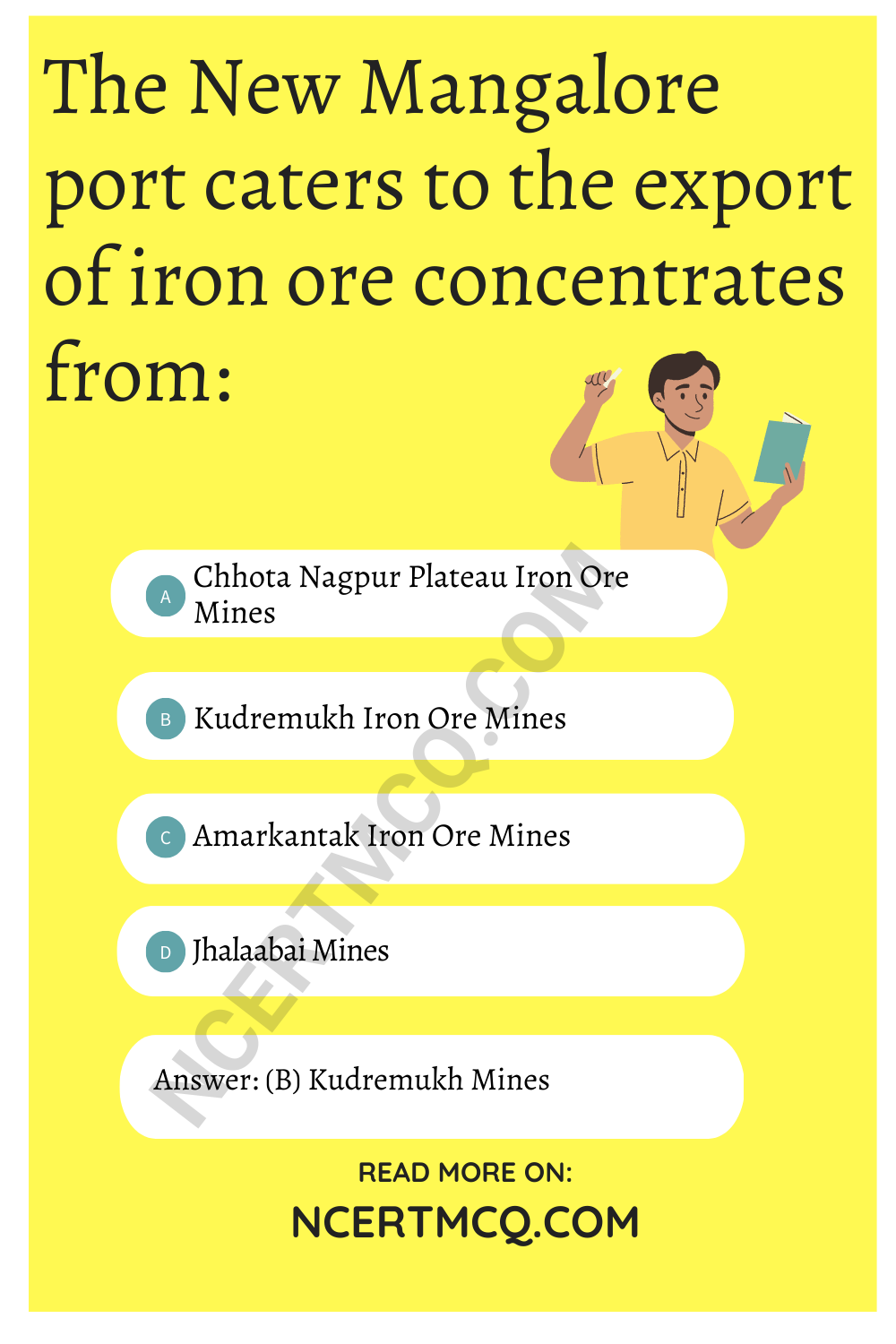
(A) The New Mangalore port caters to the export of iron ore concentrates from:
(a) Chhota Nagpur Plateau Iron Ore Mines
(b) Kudremukh Iron Ore Mines
(c) Amarkantak Iron Ore Mines
(d) Jhalaabai Mines
Answer:
(b) Kudremukh Mines
Explanation: New Mangalore port. Located in Karnataka caters to the export of iron ore concentrates from Kudremukh mines.
The New Mangalore port caters to the export of iron ore concentrates from:

(B) Which of the following ports did India lose to Pakistan after partition?
(a) Kandla
(b) Karachi
(c) Mumbai
(d) Haldia
Answer:

(C) Which of the following statements defines a tidal port?
(a) Tidal ports are the ports in which the water level within the port is subject to change with the ocean tides.
(b) Tidal ports are the ports in which the water level within the port is subject to change with floods.
(c) Tidal ports are the ports in which ocean water changes with sea breeze and land breeze.
(d) Tidal ports are the ports where ravines are formed on the beach.
Answer:

(D) Which of the following ports specialises in the Iron Ore exports?
(a) Tuticorin Port
(b) Chennai Port
(c) Paradip Port
(d) Kandla Port
Answer:
(c) Paradip Port

Very Short Answer Type Questions

Question 1.
Which authority maintains and lays National Highways?
Answer:
The Central Public Works Department (CPWD) maintains and Lays National Highways.

Question 2.
What is the new arrival on the transportation map of India?
Answer:

Question 3.
What is the major objective to develop superhighways?
Answer:
One major objective of developing superhighways is to connect the megacities of India with each other.

MCQ Questions for Class 10 Geography Chapter 7 Lifelines of the National Economy with Answers

Question 4.
Why was Jawaharlal Nehru port developed?
Answer:
Jawaharlal Nehru port was developed to decongest the Mumbai Port.

Question 5.
Why was the Haldia port set up?
Answer:
Haldia port was established to help decongest the Kolkata Seaport.

Question 6.
Suggest any one way to improve the postal system in India?
Answer:
A robust feedback system can be put in place to ensure a better customer satisfaction.

Question 7.
Name the oldest artificial sea port of India.
Answer:

Question 8.
Name the organisation which undertakes construction and maintenance of border roads.
Answer:
‘Border Roads Organisation (BRO)’ undertakes construction and maintenance of ‘border roads’.

Related Theory
Border roads are the roads constructed along the northern and north-eastern borders of our country. Border Roads Organisation (BRO) was set up in 1960 by the government of India. BRO is regarded as a symbol of nation building, national integration and an inseparable component in maintaining the security of the country.

Question 9.
Name the deepest, landlocked and well protected sea port of India.
Answer:
Vishakhapatnam is the deepest, landlocked and well protected port of India.

Related Theory
Vishakhapatnam port was originally conceived as an outlet for iron are exports.

MCQ Questions for Class 10 Geography Chapter 7 Lifelines of the National Economy with Answers

Question 10.
Name the state related to National Waterways No. 3.
Answer:
Kerala is the state related to NationaL Waterways No. 3.

Related Theory
Waterways are the cheapest means of transport. They are most suitable for carrying heavy and bulky goods. It is a fuel-efficient and environment-friendly mode of transport. India has inland navigation waterways of 14,500 km in length.

Question 11.
Suggest any one way to improve pilgrimage tourism through Indian Railways.
Answer:

Question 12.
Name the river which is related to National Waterway No. 1.
Answer:
The Ganga river between Allahabad and Haldia (1620 km) is related to National Waterways No. 1.

Question 13.
Name the new port that was developed to relieve the growing pressure on the Mumbai port.
Answer:
Kandla Seaport was developed to relieve growing pressure on the Mumbai port.

Question 14.
Name the largest public sector undertaking in India.
Answer:
The Indian Railways

Question 15.
Name the sea port that was developed to relive the growing pressure on the Kolkata port.
Answer:
Haldia Seaport was developed to relive the growing pressure on the KoLkata port.

MCQ Questions for Class 10 Geography Chapter 7 Lifelines of the National Economy with Answers

Question 16.
Name any two terminal cities connected with National Highway No.7.
Answer:

Question 17.
Name one inland riverine port.
Answer:
Kolkata Port is an inland riverine port.

MCQ Questions for Class 10 Social Science with Answers

Class 10 Social Science Geography MCQ:
MCQ Questions for Class 10 Geography Chapter 4 Agriculture with Answers

Agriculture Class 10 MCQ Online Test With Answers Questions

Students can also read Online Education MCQ Questions for Class 10 Geography Chapter 4 Agriculture Questions with Answers hope will definitely help for your board exams. https://ncertmcq.com/mcq-questions-for-class-10-social-science-with-answers/

Class 10 Social Science Geography Chapter 4 MCQ With Answers

Geography Class 10 Chapter 4 MCQs On Agriculture

Agriculture Class 10 MCQ Question 1.
Fill in the blank by choosing the most appropriate option:
Muskmelon grows in ………
(a) Rabi season
(b) Kharif season
(c) Zaid season
(d) They are grown in both Zaid and Rabi seasons.
Answer:
(c) Zaid season

Explanation: Muskmelon is grown in the Zaid Season. Zaid season comes between Kharif and Rabi season.

Agriculture MCQ Class 10 Question 2.
Which of the following pulses do not help in restoring soil fertility?
(a) Moong
(b) Gram
(c) Peas
(d) Arhar
Answer:
(d) Arhar

Explanation: Pulses need less moisture and survive even in dry conditions. All leguminous crops or pulses except arhar help in restoring soil fertility by fixing nitrogen from the air. Therefore, these are mostly grown in rotation with other crops.

Class 10 Agriculture MCQ Question 3.
Coffee cultivation was first introduced in:
(a) Himalayas
(b) Aravalli Hills
(c) Garo Hills
(d) Baba Budan Hill
Answer:

MCQ Of Agriculture Class 10 Question 4.
What percentage of our cropped area is covered by oilseeds?
(a) 21%
(b) 12%
(c) 2%
(d) 40%
Answer:
(b) 12%

MCQ Questions for Class 10 Geography Chapter 4 Agriculture with Answers

MCQ On Agriculture Class 10 Question 5.
Which one of the following is not true for pulses?
(a) Pulses are grown in both Kharif and Rabi Seasons.
(b) Pulses require intensive and excessive irrigation facilities
(c) They are grown in rotation to replenish fertility of the soil.
(d) Pulses are leguminous crops.
Answer:
(b) Pulses require intensive and excessive irrigation facilities

Explanation: Pulses need less moisture and survive even in dry conditions.

Class 10 Geography Chapter 4 MCQ With Answers Question 6.
If rice is a commercial crop in Haryana and Punjab, in which state is it a subsistence crop?
(a) Odisha
(b) Maharashtra
(c) Uttar Pradesh
(d) Rajasthan
Answer:
(a) Odisha

Class 10 Geography Chapter 4 MCQ Question 7.
From which of the following countries was the Arabica variety of coffee initially brought to India?
(a) Yemen
(b) Nepal
(c) Britain
(d) China
Answer:
(a) Yemen

MCQ Agriculture Class 10 Question 8.
Which of the following is an equatorial crop but is also grown as a subtropical and tropical crop?
(a) Jute
(b) Wheat
(c) Rubber
(d) Cotton
Answer:
(c) Rubber

Class 10 Geography Agriculture MCQ Question 9.
The state of is a major producer of Jute.
(a) Andhra Pradesh
(b) Maharashtra
(c) Madhya Pradesh
(d) West Bengal
Answer:
(d) West Bengal

Ch 4 Geo Class 10 MCQ Question 10.
Ragi has high nutritional value and is rich in
(a) Iron, calcium
(b) Magnesium
(c) Phosphate
(d) Vitamin C
Answer:

Class 10 Geography Agriculture MCQ Question 11.
Why is there enormous pressure on agricultural land in India? Choose the correct option:
(a) Landholding size is very small.
(b) High density of population.
(c) Small scale farmers do not have the technology to have a lot of produce.
(d) Farmers of less land holdings are not able to afford the right techniques of farming.
Answer:

MCQs On Agriculture Class 10 Question 12.
Fill in the blank by choosing the most appropriate option:
Intensive Subsistence Farming- Labour intensive and Machine based; Primitive Farming-
(a) Machine based
(b) Traditional methods based
(c) Labour intensive
(d) Modern
Answer:
(b) Traditional methods based

MCQ Questions for Class 10 Geography Chapter 4 Agriculture with Answers

MCQs Of Agriculture Class 10 Question 13.
Which group of crops can be classified under the classification of millets?
(a) Maize and Wheat
(b) Sesamum and Groundnut
(c) Urad and Arhar
(d) Bajra and Ragi
Answer:
(d) Bajra and Ragi

Geography Class 10 Chapter 4 MCQ Question 14.
Match the items of Column A with that of Column B.

Column A (Fruits) Column B (Significant Areas of Growth)
(A) Guava (I) Jammu and Kashmir
(B) Orange (II) Kerala
(C) Apple (III) Uttar Pradesh
(D) Banana (IV) Maharashtra (Nagpur)

Answer:
(a) (A)-(II), (B)-(IV), (C)-(I), (D)-(III)
(b) (A)-(IV), (B)-(III), (C)-(II), (D)-(I)
(c) (A)-(III), (B)-(IV), (C)-(I), (D)-(II)
(d) (A) -(I), (B) – (III), (C) -(II), (D) -(I)

Class 10 Geo Ch 4 MCQ Question 15.
Which type of farming has the use of higher doses of modern inputs, e.g. high yielding variety (HYV) seeds, chemical fertilisers, insecticides and pesticides?
(a) Primitive subsistence
(b) Plantation farming
(c) Small Farming or Zero Based Farming
(d) Commercial Farming
Answer:
(d) Commercial Farming

Agriculture Class 10 MCQs Question 16.
Read the table and fill in the blank by choosing the most appropriate option:
Agriculture Class 10 MCQs
(a) (A) More than 500 cm, (B) Below 20 degrees
(b) (A) More than 100 cm, (B) Above 40 degrees
(c) (A) More than 200 cm, (B) Above 25 degrees
(d) (A) less than 100 cm, (B) Above 20 degrees
Answer:
(c) (A) More than 200 cm, (B) Above 25 degrees Explanation: Rubber requires a moist and humid climate with rainfall of more than 200 cm and a temperature above 25°C.

Rice is a kharif crop which requires high temperature, (above 25°C) and high humidity with annual rainfall above 100 cm. In areas of less rainfall, it grows with the help of irrigation.

Question 17.
Which of the following is a rabi crop?
(a) Rice
(b) Gram
(c) Millets
(d) Cotton
Answer:
(b) Gram

Explanation: Rice, millets and cotton are kharif crops grown with the onset of monsoon in parts of the country and harvested in September- October.

Related Theory
Rabi crops are sown in winter from October to December and harvested in summer from April to June. Some of the important rabi crops are wheat, barley, peas, gram and mustard while in between the rabi and the kharif season, a short season is known as the Zaid season. Crops grown in this short season are watermelon, muskmelon, cucumber, vegetables and fodder crops.

Question 18.
Which of the following is an age-old economic activity in our country?
(a) Mining
(b) Agriculture
(c) Sericulture
(d) All of these
Answer:
(b)Agriculture

Which of the following is an age-old economic activity in our country?

Explanation: India is an agriculturally important country. Two-third of its population is engaged in agricultural activities.

MCQ Questions for Class 10 Geography Chapter 4 Agriculture with Answers

Question 19.
Which of the following price is announced by the government in support of a crop?
(a) Minimum Subsidised Prices
(b) Maximum Support Prices
(c) Minimum Support Prices
(d) Maximum Subsidised Prices
Answer:
(c) Minimum Support Prices

Question 20.
Given below are some geographical conditions required for the growth of tea crops in India except one. Find it out:
(a) Tea is a labour intensive industry
(b) It requires warm and moist frost-free climate all through the year
(c) It grows well in tropical and sub-tropical climates
(d) It is a beverage crop introduced by the British in India.
Answer:
(d) It is a beverage crop introduced by the British in India.

Explanation: Tea is plantation agriculture and was introduced by the British in India.

Related Theory
India is the leading producer as well as exporter of tea in the world. Major tea-producing states are Assam, I/Vest Bengal, Tamil Nadu and Kerala.

Question 21.
Which of the following is a leguminous crop?
(a) Pulses
(b) Jowar
(c) Millets
(d) Sesamum
Answer:
(a) Pulses

Explanation: India is the largest producer as well as the consumer of pulses in the world.

Related Theory
Pulses are the major source of protein in a vegetarian diet. Major pulses grown in India are tur (arhar), urad, moong, masur, peas, and gram.

Question 22.
The ‘slash and burn’ agriculture is known as ‘Milpa’ in which country?
(a) Indonesia
(b) Vietnam
(c) Brazil
(d) Mexico
Answer:

Question 23.
Barley, peas, gram, wheat, and mustard are grown in which cropping season?
(a) Kharif season
(b) Rabi season
(c) Zaid season
(d) All of these
Answer:
(b) Rabi season

Question 24.
Being leguminous crops, pulses help in restoring soil fertility by fixing nitrogen from the air except:
(a) Urad
(b) Arhar
(c) Moong
(d) Masur
Answer:
(b) Arhar

Explanation: Arhar is also known as tur.

Question 25.
Which of the following right leads to the division of land among upcoming generations in India?
(a) The right to property
(b) The right of inheritance
(c) The right of successor
(d) None of these
Answer:
(b) The right of inheritance

MCQ Questions for Class 10 Geography Chapter 4 Agriculture with Answers

Question 26.
Arrange the following in the correct sequence:
(i) Sugar
(ii) Transport
(iii) Grocery Item
(iv) Sugarcane
Options:
(a) (i)—(iv)—(iii)—(ii)
(b) (iii)—(iv)—(i)—(iO
(c) (iv)—(i)—(ii)—(iii)
(d) (iii)—(iv)—00—0)

Identify the following on basis of the hints given.

Question 27.
Identify the following product:
(1) The Arabica variety initially brought from Yemen is produced in the country.
(2) Its cultivation was introduced on the Baba Budan Hills
(3) Today it is cultivated in Nilgiri in Karnataka, Kerala and Tamil Nadu.
Answer:
Coffee

Question 28.
Identify the following crop:
(1) It requires a moist and humid climate with rainfall of more than 200 cm and temperature above 25°C.
(2) It is an important industrial raw material.
(3) It is mainly grown in Kerala, Tamil Nadu, Karnataka dnd Andaman and Nicobar islands and Garo hills of Meghalaya.
Answer:

Correct & Re-write / True-False
State whether the following statements are True or False. If false, correct the statement.

Question 29.
The Arabica variety initially brought from Saudi Arabia is produced in the country.
Correct statement is as follows:
Answer:
The Arabica variety initially brought from Yemen is produced in the country.

Question 30.
Cotton requires high temperature, 220 frost- free days and heavy rainfall for its growth.
Correct statement is as follows:
Answer:
Cotton requires high temperature, 210 frost- free days and light rainfall for its growth.

Question 31.
The ‘right of inheritance’ leading to the division of land among successive generations has rendered land-holding size economical.
Correct statement is as follows:
Answer:
The ‘right of inheritance’ leading to the division of land among successive generations has rendered Land-holding size uneconomical

MCQ Questions for Class 10 Geography Chapter 4 Agriculture with Answers

Question 32.
Rice a rabi crop, is grown with the withdrawal of monsoon in different parts of India.
Answer:

Question 33.
Maize is a crop which is used both as food and fodder.
Answer:
True

Question 34.
India is the third-largest producer of Rice after China and Pakistan.
Answer:
False

India is the second-largest producer of Rice after China.

Related Theory
Rice is a kharif crop that requires high temperature, (above 25 degrees C) and high humidity with annual rainfall above 100 cm. It grows in plains of North and North-eastern India.

Fill in the blanks/tables with suitable information:

Question 35.
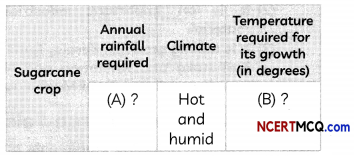
Complete the following table with correct information for A and B:
MCQ Questions for Class 10 Geography Chapter 2 Agriculture with Answers 2
Answer:
(A) 75-100 cms
(B) 21°C to 27°C

Explanation: Sugarcane grows well in a hot and humid climate with temperature of about 21-27°C.

Brazil is the largest producer of Sugarcane in the world.

Question 36.
………….. is a ‘slash and burn’ agriculture. Farmers clear a patch of land and produce cereals and other food crops to sustain their family.
Answer:
Primitive Subsistence Farming

Explanation: Primitive subsistence farming is known as Jhumming in north-eastern states like Assam. Meghalaya, Mizoram and Nagaland. Pamlou in Manipur, Dipa in Bastar district of Chhattisgarh, and in Andaman and Nicobar Islands.

Related Theory
The slash and bum agriculture is known as ‘Milpa’ in Mexico and Central America, ‘Conuco’ in Venezuela, ‘Roca’ in Brazil, ‘Masole’ in Central Africa, ‘Ladang’ in Indonesia, ‘Ray’ in Vietnam.

Question 37.
India is the …………. producer of sugarcane in the world.
Answer:

MCQ Questions for Class 10 Geography Chapter 4 Agriculture with Answers

Question 38.
Complete the following table with correct information with regard to cultivation of Rice:
MCQ Questions for Class 10 Geography Chapter 2 Agriculture with Answers 3
Answer:
(A) Kharif Cropping Season
(B) 16°C – 27°C.

Match the Columns

Question 39.
Match the following crops from column A with the states these are grown in from column B:

Column A (Crops) Column B (States)
(a) Tea (i) Uttar Pradesh
(b) Wheat (ii) Karnataka
(c) Coffee (iii) Punjab
(d) Sugarcane (iv) Assam

Answer:

Column A (Crops) Column B (States)
(a) Tea (iv) Assam
(b) Wheat (iii) Punjab
(c) Coffee (ii) Karnataka
(d) Sugarcane (i) Uttar Pradesh

Question 40.
Match the following terms from column A with their meanings from column B:

Column A (Terms) Column B (Meanings)
(a) Horticulture (i) Grown with the onset of monsoon
(b) Sericulture (ii) Grown in winter season
(c) Robi Crops (iii) Cultivation of fruits and vegetables
(d) Kharif Crops (iv) Production of silk

Answer:

Column A (Terms) Column B (Meanings)
(a) Horticulture (iii) Cultivation of fruits and vegetables
(b) Sericulture (iv) Production of silk
(c) Robi Crops (ii) Grown in winter season
(d) Kharif Crops (i) Grown with the onset of monsoon

Question 41.
Match the following crops given in Column A with the states they are found in Column B. Choose the correct answer from the options given below:

Column A Column B
(a) Cotton (i) Uttar Pradesh
(b) Jute (ii) Maharashtra
(c) Wheat (iii) Rajasthan
(d) Bajra (iv) West Bengal

Answer:

Assertion Reasoning questions Class 10 Geography Chapter 4

In each of the following questions, a statement of
Assertion (A) is given followed by a corresponding statement of Reason (R). Select the correct answer to codes (a), (b) (c) or (d) as given below:
(a) Both (A) and (R) are true and (R) is the correct explanation of (A).
(b) Both (A) and (R) are true but (R) is not the correct explanation of (A).
(c) (A) is correct but (R) is wrong.
(d) (A) is wrong but (R) is correct.

Question 42.
Assertion (A): The Government of India buys wheat and rice from farmers at a fair price.
Reason (R): The public sector contributes to economic development.
Answer:
(b) Both (A) and (R) are true but (R) is not the correct explanation of (A).

Explanation: The government announces the minimum support price and remunerative and procurement prices for important crops to avoid the exploitation of farmers by speculators and middlemen. It buys crops from farmers at a fairer price to boost their living.

Question 43.
Assertion (A): Indian agriculture finds itself at a crossroads.
Reason (R): Though the GDP growth rate is increasing over the years, it is not generating sufficient employment opportunities in the country
Answer:
(a) Both (A) and (R) are true and (R) is the correct explanation of (A).

Explanation: Indian agriculture is growing but there is a deceleration in this sector. Employment opportunities are not increasing.

MCQ Questions for Class 10 Geography Chapter 4 Agriculture with Answers

Question 44.
Assertion (A): Stagnation in agriculture will not lead to a decline in other spheres of the economy having wider implications for society.
Reason (R): All three economic sectors are dependent on each other.
Answer:
(d) (A) is wrong but (R) is correct.

Explanation: Stagnation in agriculture will lead to a decline in other spheres of the economy having wider implications for society.

Question 45.
Assertion (A): The Government of India made concerted efforts to modernize agriculture.
Reason (R): Indian farmers are facing stagnation in production due to inferior technology.
Answer:
(a) Both (A) and (R) are true and (R) is the correct explanation of (A).

Question 46.
Assertion (A): Subsidy on fertilizers is decreased leading to an increase in the cost of correct explanation of (A). production.
Reason (R): Subsidy is the discount on agricultural products.

Question 47.
Assertion (A): Under globalization, particularly after 1990, the farmers in India have been exposed to new challenges.
Reason (R): Indian products could not compete with International products due to inferior quality and expensive prices.
Answer:
(a) Both (A) and (R) are true and (R) is the correct explanation of (A).

Question 48.
Assertion (A): The Bhoodan-Gramdan movement initiated by Vinoba Bhave is also known as the Bloodless Revolution.
Reason (R): Due to this revolution, drastic land reforms occurred where lands were donated to the poor landless farmers without any violence.
Answer:
(a) Both (A) and (R) are true and (R) is the correct explanation of (A).

(Competency Based Questions (CBQs))

Question 1.
Read the given source and answer the question that follows:
In 2016 India was the second Largest producer of groundnut in the world after china. Groundnut is a kharif crop and accounts for about half of the major oilseeds produced in the country.
The second largest producer of groundnut in India is
(a) Rajasthan
(b) Andhra Pradesh
(c) Tamil Nadu
(d) Kerala
Answer:
Rajasthan

MCQ Questions for Class 10 Geography Chapter 4 Agriculture with Answers

Question 2.
Read the source given below and answer the questions that follow:
A few economists think that Indian farmers have a bleak future if they continue growing foodgrains on the holdings that grow smaller and smaller as the population rises. India’s rural population is about 833 million (2011) which depends upon 250 million (approximate) hectares of agricultural land, an average of less than half a hectare per person.
Indian farmers should diversify their cropping pattern from cereals to high-value crops. This will increase incomes and reduce environmental degradation simultaneously. Answer the following MCQs by choosing the
most appropriate option:
(A) Which of the following is a high value crop?
(a) Apple
(b) Banana
(c) Jatropha
(d) Sugarcane
Answer:

(B) Which of the following is a major problem of Indian agriculture?
(a) Indian agriculture employs most people in India.
(b) Indian agriculture takes place on small farm holdings which are not lucrative.
(c) Indian agriculture is the backbone of Indian economy.
(d) Indian agriculture produces rice, pulses, wheat and sugarcane.
Answer:
(b) Indian agriculture takes place on small farm holdings which are not lucrative.

(C) How will diversification of Indian cropping pattern help?
(I) It will save the environment.
(II) It will attract investment from people.
(III) It will increase incomes.
(IV) It will replenish fertility of soil.
(V) It will supply nitrogen to the soil.
(a) (I) & (III)
(b) (IV) & (V)
(c) (II) & (IV)
(d) (I), (II) & (III)
Answer:
(d) (I), (II) & (III)
Explanation: Diversification might or might not help with the soil’s fertility.

(D) Which of the following led to reduction of size of holdings?
(a) Right to work
(b) Right to inheritance
(c) Right to produce
(d) Right to play
Answer:
(b) Right to inheritance
Explanation: Under right to inheritance, the farm gets divided among the next generation in even parts.

Question 3.
Read the source given below and answer the questions that follow:
Globalisation is not a new phenomenon. It was there at the time of colonisation. In the nineteenth century when European traders came to India, at that time too, Indian spices were exported to different countries of the world and farmers of south India were encouraged to grow these crops. Till today it is one of the important items of export from India. During the British period cotton belts of India attracted the British and ultimately cotton was exported to Britain as a raw material for their textile industries. Cotton textile industry in Manchester and Liverpool flourished due to the availability of good quality cotton from India.
Answer the following MCQs by choosing the most appropriate option:
(A) Where was the Champaran movement held?
(a) Uttar Pradesh
(b) Jharkhand
(c) Bihar
(d) Chhattisgarh
Answer:
(c) Bihar
Explanation: Champaran Movement was held in 1917 in Bihar.

(B) Which of the following is true about Globalisation?
(a) Globalisation is a relatively new phenomenon.
(b) Globalisation has helped change the face of Indian agriculture.
(c) Indian spices were transported across the world because of Globalisation.
(d) Indian resources attracted British merchants for the barter system.
Answer:
(c) Indian spices were transported across the world because of Globalisation.

(C) Fill in the blank by choosing the most appropriate option:
The Manchester cotton industry received their raw materials from
(a) Indonesia
(b) Switzerland
(c) India
(d) France
Answer:
(c) India

(D) Why was the Champaran movement held?
(a) Peasants were being forced to plant saffron.
(b) Farmers of that region were forced to grow indigo on their Land. They could not grow food crops for their sustenance.
(c) Farmers were forced to grow jute.
(d) Farmers were forced to grow apples.
Answer:

MCQ Questions for Class 10 Geography Chapter 4 Agriculture with Answers

Question 4.
Read the source given below and answer the questions that follow:
In this type of farming, a single crop is grown on a large area. The plantation has an interface of agriculture and industry. Plantations cover large tracts of land, using capital intensive inputs, with the help of migrant labourers. All the produce is used as raw material in respective industries. In India, tea, coffee, rubber, sugarcane, banana, etc., are important plantation crops. Tea in Assam and North Bengal, coffee in Karnataka are some of the important plantation crops grown in these states. Since the production is mainly for market, a well developed network of transport and communication connecting the plantation areas, processing industries and markets plays an important role in the development of plantations.
Answer the following MCQs by choosing the most appropriate option:
(A) Which of the following types of farming can the plantation type of agriculture be classified into?
(a) Primitive Agriculture
(b) Intensive Agriculture
(c) Commercial Agriculture
(d) Slash and Burn Agriculture
Answer:
(c) Commercial Agriculture

(B) Which of the following is not a plantation crop?
(a) Silk
(b) Sugarcane
(c) Coffee
(d) Banana
Answer:
(a) Silk

Which of the following is not a plantation crop?

Explanation: Silk is not planted but reared from silkworms. This practice is called Sericulture.

(C) Which of the following statements supports the assertion, “The plantation has an interface of agriculture and industry”?
(a) It uses transportation facilities.
(b) Plantations cover large tracts of land.
(c) A single crop is grown on a large area.
(d) All the production is for the market.
Answer:
(d) All the production is for the market.
Explanation: All the production is for sale and not for consumption. This shows that plantation has an interface of an industry and agriculture together.

(D) Where of the following states is coffee grown the most?
(a) Kerala
(b) Maharashtra
(c) Goa
(d) Karnataka
Answer:
(d) Karnataka

Question 5.
Read the source given below and answer the questions that follow:
Jowar is the third most important food crop with respect to area and production. It is a rain-fed crop mostly grown in the moist areas which hardly needs irrigation. Major Jowar producing States are Maharashtra, Karnataka, Andhra Pradesh and Madhya Pradesh.

Bajra grows well on sandy soils and shallow black soil. Major Bajra producing States are Rajasthan, Uttar Pradesh, Maharashtra, Gujarat and Haryana. Ragi is a crop of dry regions and grows well on red, black, sandy, loamy and shallow black soils. Major ragi producing states are: Karnataka, Tamil Nadu, Himachal Pradesh, Uttarakhand, Sikkim, Jharkhand and Arunachal Pradesh.

Answer the following MCQs by choosing the most appropriate option:
(A) Which of the following types of crops does bajra beLong to?
(a) Fibre Crop
(b) Horticulture Crops
(c) Non food Crops
(d) Food Crops
Answer:

(B) Which of the following is the rain-fed crops?
(a) Wheat
(b) Ragi
(c) Jowar
(d) Cotton
Answer:

(C) Ragi is not grown in
(a) Goa
(b) Sikkim
(c) Jharkhand
(d) Arunachal Pradesh
Answer:
(a) Goa

(D) Which of the following soils supports the crop of bajra?
(a) Red Soil
(b) Alluvial Soil
(c) Black Soil
(d) Yellow Soil
Answer:
(c) Black Soil

Question 6.
Read the sources given below and answer the questions that follow:
Source A: Types Of Farming
This type of farming is still practiced in few pockets of India. It is practiced on small patches of land with the help of primitive tools like hoe, dao and digging sticks, and family community labour. This type of farming depends upon monsoon, natural fertility of the soil and suitability of other environmental conditions to the crops grown.

Source B: Commercial Farming In India, tea, coffee, rubber, sugarcane, banana, etc., are important plantation crops. Tea in Assam and North Bengal coffee in Karnataka are some of the important plantation crops grown in these states. Since the production is mainly for market, a well-developed network of transport and communication connecting the plantation areas, processing industries and markets plays an important role in the development of plantations.

Source C: Cropping Pattern In states like Assam, West Bengal and Odisha, three crops of paddy are grown in a year. These are Aus, Aman and Boro. In between the rabi and the kharif seasons, there Is a short season during the summer months known as the Zaid season. Some of the crops produced during ‘zaid’are watermelon and muskmelon. Source A: Types of Farming
(A) Identify the tyoe of Farming through its description in the source.
Source B: Commercial Farming
Answer:
This type of farming is Primitive Subsistence Farming. This type of farming is only used for consumption and subsistence purposes.

(B) What do you mean by Plantation Crops? Source C: Cropping Pattern
Answer:
A plantation crop is a crop which is cultivated on large scale farms called plantations for export purposes. Plantation farming is a kind of commercial farming and is mainly done for trade. Coffee is a plantation crop.

(C) Name One Zaid Crop.
Answer:
Another example of Zaid Crop is Cucumber.

Very Short Answer Type Questions

Question 1.
Which crop is a kharif crop in north and rabi crop in south India?
Answer:
Sesamum

MCQ Questions for Class 10 Geography Chapter 4 Agriculture with Answers

Question 2.
By which name is the specialized cultivation of fruits and vegetables known?
Answer:
Horticulture Crops

Question 3.
Describe “Jhumming Cultivation” in one sentence.
Answer:
In Jhumming cultivation, agriculture is practiced on a big chunk of land which is then left alone after it loses its fertility. This replenishes its fertility on its own.

Question 4.
India is the largest producer as well as consumer of which agricultural product in the world? [CBSE 2014]
Answer:
Pulses

Question 5.
What soil is perfect for the growth r c cashew nuts?
Answer:
Laterite Soil

Question 6.
Which crop is the major crop of Rabi?
Answer:

Question 7.
Which factors have helped Punjab and Haryana to grow more and more rice?
Answer:
Development of Dense Canal Network and use of new fertilisers have helped Punjab and Haryana to grow more rice.

Question 8.
Wheat is grown in which crop season?
Answer:
Rabi Season

MCQ Questions for Class 10 Geography Chapter 4 Agriculture with Answers

Question 9.
Name any one kharif crop.
Answer:
Paddy

Question 10.
Define the Green Revolution.
Answer:
The Green Revolution is referred to as the process of increasing agricultural production by incorporating modern tools and techniques.

Question 11.
Define the White Revolution.
Answer:
The White Revolution is the movement which led to dairy development movement by the Government of India.

Question 12.
Name any two schemes introduced by the Government of India for the benefit of the farmers.
Answer:
Kissan Credit Card Scheme, Personal Accident Insurance Scheme.

Question 13.
Write the temperature requirement of the maize crop.
Answer:

Question 14.
Which crop is known as ‘golden fibre’?
Answer:
Jute

MCQ Questions for Class 10 Geography Chapter 4 Agriculture with Answers

Question 15.
Write the amount of annual rainfall required for the cultivation of wheat.
Answer:
50-75 cm of rainfall is the amount of rainfall required for the cultivation of wheat.

Related Theory:
Wheat is a rabi crop that requires a cool growing season and bright sunshine at the time of ripening. It requires 50-75 cm of annual rainfall evenly- distributed evenly over the growing season.

MCQ Questions for Class 10 Social Science with Answers

Class 10 Social Science Geography MCQ:
MCQ Questions for Class 10 Civics Chapter 2 Federalism with Answers

Federalism Class 10 MCQ Online Test With Answers Questions

Students can also read MCQ Questions for Class 10 Civics Chapter 2 Federalism Questions with Answers hope will definitely help for your board exams. https://ncertmcq.com/mcq-questions-for-class-10-social-science-with-answers/

Class 10 Social Science Civics Chapter 2 MCQ With Answers

Civics Class 10 Chapter 2 MCQs On Federalism

Federalism Class 10 MCQ Question 1.
Fill in the blank by choosing the most appropriate option:
……………….. is a system of government in which the power is divided between a central authority and various constituent units of the country.
(a) Dictatorship
(b) Unitary system
(c) Monarchy
(d) Federalism
Answer:
(d) Federalism

Class 10 Federalism MCQ Question 2.
Fill in the blank by choosing the most appropriate option:
In a federal system, the central government…………..order the state government to do something.
(a) Can
(b) Cannot
(c) May
(d) Should
Answer:

Federalism MCQ Class 10 Question 3.
Which subject does not come under the State List in India?
(a) Police
(b) Agriculture
(c) Banking
(d) Trade
Answer:
(c) Banking

Explanation: Banking comes under the Union List.

MCQ Questions for Class 10 Civics Chapter 2 Federalism with Answers

MCQ Of Federalism Class 10 Question 4.
On which of the following subjects can both the Union as well as the State Governments make laws?
(a) Communications
(b) Defence
(c) Trade Unions
(d) Agriculture
Answer:
(c) Trade Unions

Explanation: Trade unions is a part of a concurrent list. On a concurrent list, both the state and central governments can make laws.

Class 10 Civics Chapter 2 MCQ With Answers Question 5.
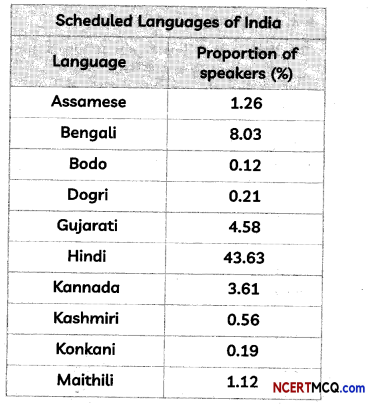
Based on the table below, answer the question that follows:
Class 10 Civics Chapter 2 MCQ With Answers
Which is the second most commonly spoken language according to the table?
(a) Hindi
(b) Bodo
(c) Gujarati
(d) Bengali
Answer:
(d) Bengali

Explanation:
Hindi: 43%
Bodo: 0.12%
Gujarati: 4.58%
Bengali: 8.03%

Class 10 Civics Chapter 2 MCQ Question 6.
States such as Assam, Nagaland, Arunachal Pradesh and Mizoram enjoy special powers under certain provisions of the Constitution of India (Article 371), under which context do they get these provisions?
(a) Their historical circumstances
(b) Protection of land rights of indigenous people
(c) Special provisions for agriculture
(d) Preferential employment in government services.
Answer:
(c) Special provisions for agriculture.

MCQ On Federalism Class 10 Question 7.
On which basis were states like Nagaland, Uttarakhand and Jharkhand created?
(a) On the basis of history
(b) On the basis of culture and ethnicity
(c) On the basis of religion
(d) On the basis of administrative efficiency
Answer:
(b) On the basis of culture and ethnicity

Ch 2 Civics Class 10 MCQ Question 8.
There are some units of the Indian Union that enjoy very little power. These are called:
(a) Cities
(b) Towns
(c) Villages
(d) Union Territories
Answer:

Federalism Class 10 MCQ With Answers Question 9.
What is true regarding sources of revenue in a federal system?
(a) States have no financial powers.
(b) States are dependent on revenue on the central government.
(c) Sources of revenue for each level of government are clearly specified in the constitution to ensure its financial autonomy.
(d) The Centre has no financial autonomy.
Answer:
(c) Sources of revenue for each level of government are clearly specified in the constitution to ensure its financial autonomy.

MCQ Questions for Class 10 Civics Chapter 2 Federalism with Answers

MCQ Federalism Class 10 Question 10.
Consider the following statements regarding language policy of Indian federation:
(1) Hindi was identified as the official language.
(2) Besides Hindi, there are 21 other languages recognised as scheduled languages.
(3) English can be used along with Hindi for official purposes.
Choose the combination that provides the correct statements) from the following :
(a) (1) and (3)
(b) (1) and (2)
(c) only (1)
(d) (1), (2) and (3)
Answer:
(d) (1), (2) and (3).

Civics Chapter 2 Class 10 MCQ Question 11.
what type of distribution of powers does the Indian Constitution provide for?
(a) Single-fold
(b) Two-fold
(c) Three-fold
(d) Four-fold
Answer:

Class 10 Civics Ch 2 MCQ Question 12.
Who presides over the meetings of Municipal Corporations?
(a) District Magistrate
(b) Mayor
(c) Deputy Mayor
(d) Governor
Answer:
(b) Mayor

Explanation: The head of the municipal corporation is called mayor.

Related Theory
The Mayor is the first citizen of the city and is elected by the members of the municipal corporation for the period of 5 year.

MCQs Of Federalism Class 10 Question 13.
How many languages are included in the Eighth Schedule of the Indian Constitution?
(a) 20
(b) 21
(c) 22
(d) 24
Answer:
(c) 22

Explanation: These 22 languages are calLed ‘Scheduled Languages.’

How many languages are included in the Eighth Schedule of the Indian Constitution?

Civics Class 10 Chapter 2 MCQ Question 14.
Which of the following pair of subjects is incorrect?
(a) Police and agriculture
(b) Banking and currency
(c) Computer software and trade unions
(d) Marriage and adoption
Answer:

Civics Ch 2 Class 10 MCQ Question 15.
Which of the following group of countries are an example of coming together federation?
(a) India, USA, Belgium
(b) USA, Switzerland, Australia
(c) India, Belgium, Spain
(d) USA, Spain, Australia
Answer:
(b) USA, Switzerland, Australia

Question 16.
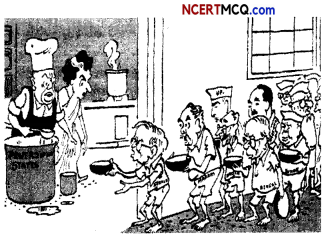
Study the given picture and identify which of the following options best signifies this cartoon?
MCQ Questions for Class 10 Civics Chapter 2 Federalism with Answers 2
(a) Sharing of responsibility between Centre and State
(b) Centre undermining the power of States
(c) States pleading from centre for more power
(d) Misuse of power by the States
Answer:

Question 17.
Which of the following pair of languages is NOT included in the Eighth Schedule of the Indian Constitution?
(a) Pali and Tulu
(b) Bodo and Maithili
(c) Nepali and Oriya
(d) Sindhi and Urdu
Answer:
(a) Pali and Tulu

MCQ Questions for Class 10 Civics Chapter 2 Federalism with Answers

Question 18.
Which of the following pairs of subjects are NOT associated with the union list?
(a) Education and Marriage
(b) Communications and currency
(c) Foreign Affairs and Currency
(d) Banking and Defence
Answer:
(a) Education and Marriage

Question 19.
Which of following language is spoken by the majority of our population?
(a) English
(b) Hindi
(c) Bengali
(d) Punjabi
Answer:
(b) Hindi

Explanation: No one language is the mother tongue of the majority of our population. Hindi is the mother tongue of only about 41 per cent Indians which is less than the 50 per cent of our total population.

Question 20.
How is Panchayat Samiti formed?
(a) By a few gram panchayats when are grouped together.
(b) By most members of the zila parishad
(c) By all MPs and MLAs in the block
(d) None of the above
Answer:
(a) By a few gram panchayats when are grouped together.

Explanation: Panchayat Samiti is also called Block or Mandal. The members of this local body are elected by all the panchayat members in that area.

Related Theory
All the Panchayat Samiti or Mandats in a district together constitute the zila Parishad. Most members of the zila parishad are elected which includes the Lok Sabha and MLAs of that district and another official of other district-level bodies. Zila parishad chairperson is the political head of the zila Parishad.

Question 21.
Which of the following is an advantage of the local government in India?
(a) It has deepened the democracy in our country
(b) It has uprooted the democracy at local level in our country
(c) It has failed in conducting the regular elections of local bodies
(d) It has given more power to the local government when compared to the centre.
Answer:
(a) It has deepened the democracy in our country

Identify the following on basis of the hints given:

Question 22.
Identify the country:
(1) The country shifted from unitary to federal form of government.
(2) The country gave regional governments constitutional powers in 1993.
(3) The country reduced the powers of the central government through an amendment.
Answer:

MCQ Questions for Class 10 Civics Chapter 2 Federalism with Answers

Question 23.
Identify the type of Government:
(1) There are two or more levels/tiers of governments.
(2) The jurisdictions of the respective levels or tiers of government are specified in the constitution.
(3) No government is subordinate to another.
Answer:
Federal Government

Explanation: Federal governments establish two or more tiers of each government and each government has its own powers and jurisdiction as given by the constitution. All levels are equal to one another.

Question 24.
Identify the institution:
(1) It resolves disputes between the states and state and centre.
(2) It interprets the constitution.
(3) It acts like an umpire and decides neutrally.
Answer:
Courts or Judiciary

Explanation: The highest court or the Supreme Court acts as an umpire if disputes arise between different levels of government in the exercise Of their respective powers. It has powers to interpret the constitution.

Correct and Rewrite/ True-False
State whether the following statements are True or False. If false, correct the statement.

Question 25.
In a federal government, different tiers of government govern the same citizens, but each tier has its own jurisdiction in specific matters of legislation, taxation and administration.
Answer:
True

Question 26.
The exact balance of power between the central and the state government is the same in every federation.
Answer:

Question 27.
The Constitution of India clearly provided a twofold distribution of legislative powers between the Union Government and the State Governments.
Answer:
False

The Constitution clearly provided a threefold distribution of legislative powers between the Union Government and the State Governments.

Explanation: It lays down subjects in form of three lists.

Question 28.
According to the constitution, the use of English for official purposes was to stop in 1956.
Answer:
According to the constitution, the use of English for official purposes was to stop in 1965.

MCQ Questions for Class 10 Civics Chapter 2 Federalism with Answers

Question 29.
At least two-third of all positions are reserved for women at Local level.
Answer:
At least one-third of all positions are reserved for women at local level.

Fill in the blanks with suitable information:

Question 30.
A ……….. has two levels of government.
Answer:
Federation

Question 31.
Indian Union is based on the principles of
Answer:
Federalism

Question 32.
Banking is included in the……………. List.
Answer:

Question 33.
……….. makes laws on Concurrent list subjects.
Answer:
Both States and the central government

Question 34.
…………. runs the Union Territories
Answer:
Central government.

MCQ Questions for Class 10 Civics Chapter 2 Federalism with Answers

Question 35.
The subjects that do not fall in any of the three lists are called……………. subjects.
Answer:
Residuary

Explanation: Subjects Like computer software that came up after the constitution was made are called residuary subjects and the union or central government has the power to legislate on these subjects.

Question 36.
The ……………. declared India as a Union of States.
Answer:
Constitution

Explanation: Indian constitution declares India as a union of states. It is an example of holding together federation where a large country decides to divide its power between the constituent states and the national or central government. In this system, generally central government is more powerful than its constituent units.

Question 37.
In 1956, an act passed by the Government in Sri Lanka recognised the Sinhala Language as the language of the state and disregard the …………… language.
Answer:

Question 38.
India, Spain and Belgium are examples of the …………….. type of federations.
Answer:
Holding Together

Explanation: There are two types of federations:

  1. The first type is ‘Coming Together Federation’ where states come together to form a bigger unit by pooling sovereignty and retaining identities. USA, Australia and Switzerland are the examples of coming together federations.
  2. The second type is where a large country decides to divide its power between the constituent states and the central government. India, Spain and Belgium are examples of this kind of‘holding together’ federations.

MCQ Questions for Class 10 Civics Chapter 2 Federalism with Answers

Question 39.
Australia is an example of type of federation.
Answer:
Coming together

Explanation: When independent States come together on their own to form a bigger unit, so that by pooling sovereignty and retaining identity they can increase their security, the type of federation is called Coming Together Type of federation. Another example is USA.

Match the Columns Choose the correct pairs:

Question 40.
Match the following subjects from column A with the lists given in column B:

Column A (Subjects)

Column B (Lists)

(a) Banking (i) State List
(b) Police (ii) Union List
(c) Computer software (iii) Concurrent List
(d) Education (iv) Residuary subject

Answer:

Column A (Subjects)

Column B (Lists)

(a) Banking (ii) Union List
(b) Police (i) State List
(c) Computer software (iv) Residuary subject
(d) Education (iii) Concurrent List

Explanation: Union List includes the subjects of national importance such as banking, defence, foreign affairs and the union government has the right to make laws on these subjects.

State list includes the subjects of state and Local importance such as police, trade, agriculture etc. and state government can make laws on these subjects.

The concurrent list includes subjects like education, forest, trade union, marriage etc. and both central and state governments can make laws on these subjects but in case if their laws conflict with each other, then the central government Law will be implemented.

On residuary subjects, central government has the power to make laws.

Related Theory
The constitution clearly provides a three-fold distribution of legislative powers between the Union Government and the State Governments via union list (97 subjects), state list (66 subjects), concurrent list (47 subjects) and the subjects which are not included in these lists are known as ‘residuary subjects.

Assertion Reasoning questions Class 10 Civics Chapter 2

In each of the following questions, a statement of Assertion (A) is given followed by a corresponding statement of Reason (R). Select the correct answers to codes (a), (b), (c) or (d) as given below:
(a) Both (A) and (R) are true and (R) is the correct explanation of (A).
(b) Both (A) and (R) are true but (R) is not the correct explanation of (A).
(c) (A) is correct but (R) is wrong.
(d) (A) is wrong but (R) is correct.

Question 41.
Assertion (A): Belgium shifted from a unitary to a federal form of government.
Reason (R): Federal Governments last longer.
Answer:
(b) Both (A) and (R) are true but (R) is not the correct explanation of (A).

Explanation: Federal governments are more stable, more participative and can handle ethnic conflicts and divisions better than unitary governments.

MCQ Questions for Class 10 Civics Chapter 2 Federalism with Answers

Question 42.
Assertion (A): Tamil leaders want Sri Lanka to become a federal system.
Reason (R): Federal systems establish a peaceful and stable environment in the country.
Answer:

Question 43.
Assertion (A): The fundamental provisions of the constitution cannot be unilaterally changed by one level of government in a federal government.
Reason (R): In a Federal government, each government has its own constitutionally laid down jurisdiction.
Answer:
(a) Both (A) and (R) are true and (R) is the correct explanation of (A).

Explanation: In a Federal government, each government has its own constitutionally laid down jurisdiction. Each government takes care of certain subjects which have been specified by the constitution. Hence all decisions have to be taken only after discussions and consensus.

Question 44.
Assertion (A): Federations that are formed by ‘holding together’ do not give equal power to its constituent units.
Reason (R): States should be treated differently to help them develop.
Answer:
(c) (A) is correct but (R) is wrong.

Explanation: In the ‘holding together’ federations, a large country divided power between its constituent units carefully to ensure peace. Hence the distribution is unequal.

(Competency Based Questions (CBQs))

Question 1.
Read the source given below and answer the question that follows:
This sharing of power between the Union Government and the State governments is basic to the structure of the Constitution. It is not easy to make changes to this power-sharing arrangement. The Parliament cannot on its own to change this arrangement.
Any change to it has to be first passed by both the Houses of Parliament with at least a majority.
(a) Half
(b) Three-fourth
(c) Two-third
(d) One-fourth
Answer:
(c) Two-third

MCQ Questions for Class 10 Civics Chapter 2 Federalism with Answers

Question 2.
Read the source given below and answer the question that follows:
A second test for Indian federation is the language policy. Our Constitution did not give the status of national language to any one language. Hindi was identified as the official language. But Hindi is the mother tongue of only about 40 percent of Indians. Therefore, there were many safeguards to protect other languages.
Which among the following is not a scheduled language of India?
(a) Santhali
(b) Sanskrit
(c) Angika
(d) Sindhi
Answer:

Question 3.
Read the source given below and answer the questions that follow:
This sharing of power between the Union Government and the State governments is basic to the structure of the Constitution. It is not easy to make changes to this power sharing arrangement. The Parliament cannot on its own change this arrangement. Any change to it has to be first passed by both the Houses of Parliament with at least two- thirds majority. Then it has to be ratified by the legislatures of at least half of the total States. The judiciary plays an important role in overseeing the implementation of constitutional provisions and procedures. In case of any dispute about the division of powers, the High Courts and the Supreme Court make a decision. The Union and State governments have the power to raise resources by levying taxes in order to carry on the government and the responsibilities assigned to each of them.
(A) Which of this can be considered a form of sharing of powers between the government?
(I) Division of Powers between Chief Minister and the Governor.
(II) Division of Powers between Central and State legislatures.
(III) Power sharing between Union and the States through lists of subjects.
(IV) Power division between Bureaucracy and Executive.
(a) (I) only
(b) (II) only
(c) (II) & (IV) only
(d) (II) & (III) only
Answer:

(B) Why was the Supreme Court given the power to resolve disputes between the states?
(a) The Supreme Court is an independent body and the best neutral judge to resolve disputes since it has no relations with working of any of the two legislatures.
(b) The Supreme Court is above the legislature.
(c) The Supreme Court has more experienced people.
(d) The Supreme Court is more representative of people’s will
Answer:
(a) The Supreme Court is an independent body and the best neutral judge to resolve disputes since it has no relations with working of any of the two legislatures.

(C) What is the prerequisite to amend the power sharing arrangement in Indian Constitution?
Answer:
A special majority (2/3rd members present and voting) in both the houses of the Parliament and ratification from the states.

(D) Assertion (A): The sharing of power between the Union Government and the State governments is basic to the structure of the Constitution.
Reason(R): Any single government can change this arrangement.
(a) Both (A) and (R) are true and (R) is the correct explanation of (A).
(b) Both (A) and (R) are true but (R) is not the correct explanation of (A).
(c) (A) is correct but (R) is wrong.
(d) (A) is wrong but (R) is correct.
Answer:
(c) (A) is correct but (R) is wrong.

Explanation: No single government can unilaterally change the power sharing arrangement. It needs ratification from the state governments and a special majority which is very tough to achieve.

The fact that our entire constitution is based on the Separation of Powers among the different organs of the government and administration makes it the very basic structure of the constitution.

Question 4.
Read the source given below and answer the questions that follow:
This new system of local government is the largest experiment in democracy conducted anywhere in the world. There are now about 36 lakh elected representatives in the panchayats and municipalities etc., all over the country. This number is bigger than the population of many countries in the world. Constitutional status for local government has helped to deepen democracy in our country. It has also increased women’s representation and voice in our democracy. At the same time, there are many diffculties.
Answer the following MCQs by choosing the most appropriate option:
(A) Which of the following is a difficulty that the local self governments face?
(a) States do not give them much power.
(b) Elections are held regularly.
(c) There is no one to contest elections.
(d) Villagers do not trust them.
Answer:
(a) States do not give them much power.
Explanation: While elections are held regularly and enthusiastically, Gram Sabhas are not held regularly. Most state governments have not transferred significant powers to the local governments. Nor have they given adequate resources. These are the basic difficulties Local self governments bodies.

(B) Which of the following has helped to deepen democracy in the country according to the source?
(a) Establishment of Local self governments.
(b) Provision of Constitutional status to Local Self-governments
(c) Establishment of Political parties
(d) Free and fair elections.
Answer:
(b) Provision of Constitutional status to Local Self governments.

(C) Match the following:

Column A (Bodies)

Column B (Details about Bodies)

(A) Gram Sabha (I) Gram Panchayats group together to form this unit.
(B) Gram Panchayat (II) It reviews the performance of the gram panchayat.
(C) Zila Parishad (III) decision-making body for the entire village.
(D) Mandals (IV) mandals in a district together constitute it.

(a) (A)-(II), (B).(III), (C)-(IV), (D)-(I)
(b) (A)-(III), (B)-(IV), (C)-(II), (D)-(I)
(c) (A)-(III), (B)-(I), (C)-(IV), (D)-(II)
(d) (A)-(IV), (B)-(III), (C)-(II), (D)-(I)
Answer:

(D) Which of the following bodies is not a local self-government body.
(a) Zila Parishad
(b) Gram Sabha
(c) State Election Commission
(d) Nagar Panchayat
Answer:
(c) State Election Commission
Explanation: It facilitates elections in Local government bodies.

MCQ Questions for Class 10 Civics Chapter 2 Federalism with Answers

Question 5.
Read the source given below and answer the questions that follow:
Constitutional provisions are necessary for the success of federalism but these are not sufficient. If the federal experiment has succeeded in India, it is not merely because of the clearly laid out constitutional provisions.
The real success of federalism in India can be attributed to the nature of democratic politics in our country. This ensured that the spirit of federalism, respect for diversity and desire for living together became shared ideals in our country.
Let us look at some of the major ways in which this happened. The creation of linguistic States was the first and a major test for democratic politics in our country. If you look at the political map of India when it began its journey as a democracy in 1947 and that of 2019, you will be surprised by the extent of the changes. Answer the following MCQs by choosing the most appropriate option:
(A) Fill in the blank by choosing the most appropriate option:
The real success of federalism in India can be attributed to ……………………..
(a) the nature of democratic politics in our country.
(b) the rules laid down by the central government
(c) the rules laid down by state governments
(d) the execution of laws by Panchayats.
Answer:
(a) the nature of democratic politics in our country.
Explanation: Rules alone cannot help in making a country federal. Its implementation has to be checked and constantly monitored.

(B) Which of the following is not a test for democratic politics in our country?
(a) Creation of linguistic states
(b) Language policy
(c) Religion policy
(d) Policy of traffic rules and policing.
Answer:

(C) Which of the following is an objective of the federal system?
(a) To safeguard and promote unity of the country
(b) To accommodate new territories
(c) To filter people belonging to one caste or ethnic groups.
(d) To reject regional diversity
Answer:
(a) To safeguard and promote unity of the country
Explanation: A federal system has a most important objective which is to work for the unity and territorial integrity of the country and keep it safe.

(D) Complete the following sentence by choosing the most appropriate option: State government has powers of its own for which………………………
(a) It is answerable to Central Government
(b) It is not answerable to Central Government
(c) It is answerable to the people
(d) It is answerable to regional and local governments.
Answer:
(c) It is answerable to the people.
Explanation: A state government is not answerable or subordinate to any other government but the people.

Question 6.
Read the source given below and answer the questions that follow.
The exact balance of power between the central and the state government varies from one federation to another. This balance depends mainly on the historical context in which the federation was formed. There are two kinds of routes through which federations have been formed. The first route involves independent States coming together on their own to form a bigger unit, so that by pooling sovereignty and retaining identity they can increase their security.

Answer the following MCQs by choosing the most appropriate option:
(A) Identify the type of Federation as mentioned in the source.
(a) Holding Together Federation
(b) Coming Together Federation
(c) Running Together Federation
(d) Walking Together Federation
Answer:
(b) Coming together Federation

(B) Which of the following can be an example of the identified type?
(a) USA
(b) Russia
(c) India
(d) Belgium
Answer:
(a) USA

(C) Which of the following is not true about this type of federation.
(a) States share equal powers
(b) States cannot go out of the federation.
(c) Centre is stronger.
(d) States do not have absolute powers.
Answer:
(c) Centre is stronger.
Explanation: Centre tends to be strong in holding together federations. Here all states and centre share equal powers.

(D) Which of the following factors does not affect the balance of powers in a federation?
(a) Its history
(b) Its culture
(c) Its neighbours
(d) Its economy
Answer:
(c) Its neighbours.
Explanation: A federation is formed and its balance of power varies due to its historical, culturaL and economical situations. Its neighbours play no role.

Which of the following factors does not affect the balance of powers in a federation?

Very Short Answer Type Questions

Question 1.
Mention two aspects of an ideal federal system?
Answer:
Two aspects are:

  1. Mutual Trust
  2. Agreement between states and people to live together.

MCQ Questions for Class 10 Civics Chapter 2 Federalism with Answers

Question 2.
What is the system of Panchayati Raj?
Answer:

Question 3.
Why was the States reorganization commission formed?
Answer:
It was formed in 1954 to recommend the creation of states in India on the basis of different languages.

Question 4.
Which is the highest institution of Panchayati Raj in India?
Answer:
Zila Parishad

Question 5.
What is decentralisation? Why do we need it?
Answer:
Decentralisation grants more autonomy or freedom to lower levels of government and increases participation of the people.

Question 6.
In which list does the subject of Education come?
Answer:
Concurrent list

Question 7.
State any one step taken in Belgium to rule out the problem of regional differences and cultural diversities.
Answer:
The Constitution of Belgium established equality by maintaining equal number of French and Dutch speaking people in the central government so that a single dominant community does not make majoritarian decisions.

Question 8.
Who presides over the meeting of the Municipal Corporation?
Answer:

Question 9.
Who has the special powers in administering the Union Territories of India?
Answer:
Central Government

MCQ Questions for Class 10 Civics Chapter 2 Federalism with Answers

Question 10.
What percentage of reservation is given to women in local administration in India?
Answer:
One third or 33% seats are reserved for women in local administration in India.

Question 11.
What do you mean by a Concurrent List? What subjects are included in this list?
Answer:
A concurrent list includes 66 subjects over which both the centre and the state possess equal powers. Both of them can make laws on these subjects and in case of a deadlock, the will of the centre prevails over that of the states, education, forest, trade unions, marriage, adoption and succession are examples of certain subjects included in this list.

Question 12.
Which institution has been created in each state of India to conduct panchayat and municipal elections?
Answer:

Question 13.
Arrange the following institutions of power according to the size of their jurisdiction in increasing order:
(i) Panchayat Samiti or Mandal
(ii) State Government
(iii) Gram Panchayat
(iv) Zila Parishad
Answer:
(iii)-(i)-(iv)-(ii)

Explanation:

  • Gram Panchayat heads a village or groups of villages.
  • Samitis head groups of gram panchayats.
  • Zila Parishad heads all panchayat samitis of a district.
  • State governments head zila parishads.

Question 14.
Who is a mayor?
Answer:
The head of municipal corporation is called mayor.

Explanation: The Mayor is the first citizen of the city and is elected by the members of the municipal corporation for the period of 5 years.

Question 15.
Define a Coalition Government.
Answer:
A coalition government is formed when none of the contesting parties get majority seats in the elections for Lok Sabha or Legislative Assemblies. In such a case, two or more parties form a government by coming together, making an alliance and adopting a common programme. NDA led by BJP under Prime Minister Narender Modi ruling presently in India is an example of a coalition government while the Congress led UPA under Manmohan Singh had been the ruling coalition government in the country for 10 years.

MCQ Questions for Class 10 Civics Chapter 2 Federalism with Answers

Question 16.
Which government has the power to legislate on ‘Residuary’ subjects in India?
Answer:
Union Government

Question 17.
Read the source given below and define what is jurisdiction?
Different tiers of government govern the same citizens, but each tier has its own JURISDICTION in specific matters of legislation, taxation and administration. The jurisdictions of the respective levels or tiers of government are specified in the constitution. So the existence and authority of each tier of government is constitutionally guaranteed.
Answer:
Jurisdiction is the area over which someone has legal authority. Jurisdiction can be defined by a geographical area or in terms of subjects.

MCQ Questions for Class 10 Social Science with Answers

Class 10 Social Science Civics MCQ:

MCQ Questions for Class 10 Civics Chapter 7 Outcomes of Democracy

Outcomes of Democracy Class 10 MCQ Online Test With Answers Questions

Students can also read Online Education MCQ Questions for Class 10 Civics Chapter 7 Outcomes of Democracy Questions with Answers hope will definitely help for your board exams. https://ncertmcq.com/mcq-questions-for-class-10-social-science-with-answers/

Class 10 Social Science Civics Chapter 7 MCQ With Answers

Civics Class 10 Chapter 7 MCQs On Outcomes of Democracy

Outcomes Of Democracy Class 10 MCQ Question 1.
Which of the following countries tops in the index of inequality of income?
(a) Hungary
(b) Russia
(c) South Africa
(d) UK
Answer:
(c) South Africa

Outcomes Of Democracy MCQ Question 2.
To measure democracies on the basis of expected outcomes, which of the following parameters should one look for?
(I) Regular, free and fair elections.
(II) Local Self Governments.
(III) Citizens’ right to information about the government.
(IV) Citizen’s non participation in the political processes.
(V) Open public debate on major policies.
(a) (I), (II) & (IV)
(b) (I), (III) & (V)
(c) (I), (II), (III) & (IV)
(d) (I), (II), (III) & (V)
Answer:
(d) (I), (II), (III) & (V)

Explanation: Citizen’s participation in the political processes is an important parameter to test successful democracies.

MCQ On Outcomes Of Democracy Class 10 Question 3.
Which of the following statements do not hold true for non-democratic regimes?
(I) These regimes do not have to bother about public opinion.
(II) These regimes take a lot of time to decide.
(III) Principle of individual dignitg has legal and moral force here.
(IV) These often suppress internal social differences.
(a) (I), (II) & (IV)
(b) (I) & (IV)
(c) (I), (II) & (III)
(d) (I), (II), (III) & (IV)

Class 10 Civics Chapter 7 MCQ With Answers Question 4.
Fill in the blank by choosing the most appropriate option:
Equal treatment of women is a necessary
ingredient of a society.
(a) Non-Democratic
(b) Monarchical
(c) Autocratic
(d) Democratic
Answer:
(d) Democratic

MCQ Questions for Class 10 Civics Chapter 7 Outcomes of Democracy

MCQ Of Outcomes Of Democracy Question 5.
Which of the following countries has half of its population living in poverty?
(a) Uzbekistan
(b) Libya
(c) Bangladesh
(d) Pakistan
Answer:
(c) Bangladesh

Outcomes Of Democracy Class 10 MCQ With Answers Question 6.
Why is there a delay in decision-making and implementation in a democratic set up?
(a) The government is afraid of taking decisions.
(b) The government is not worried about taking decisions.
(c) Democracy is based on the idea of deliberation and negotiation.
(d) A democratic government does not have a medium of taking decisions.
Answer:

Class 10 Outcomes Of Democracy MCQ Question 7.
Which one of the following is the most popular form of government in the contemporary world?
(a) Dictatorship
(b) Monarchy Rule
(c) Military Rule
(d) Democracy
Answer:
(d) Democracy

Outcomes Of Democracy MCQs Question 8.
Which one of the following is an example of outcomes of a democracy that produces an accountable government?
(a) Open to public debates on major policies and legislation.
(b) Open in promoting economic development.
(c) Open in reducing economic inequalities.
(d) Open to rulers elected by the people.
Answer:
(d) Open to rulers elected by the people.

Explanation: It produces an accountable government because the majority of the people approve of it.

MCQ Of Outcomes Of Democracy Class 10 Question 9.
Which one of the following features is common to most of the democracies?
(a) They have a formal constitution
(b) They hold regular elections
(c) They have political parties
(d) All of the above
Answer:
(d) All of the above

MCQ Of Chapter Outcomes Of Democracy Class 10 Question 10.
In the context of assessing democracy which among the following is the odd one out. Democracies needs to ensure:
(a) Free and fair election
(b) Dignity of the individual
(c) Majority rule
(d) Equal treatment before law
Answer:
(c) Majority rule

MCQ Questions for Class 10 Civics Chapter 7 Outcomes of Democracy

Outcomes Of Democracy Class 10 MCQs Question 11.
How many countries of the world today claim and practice some kind of democratic politics? Choose the correct option from the following ones:
(a) Over 80 countries
(b) Over a hundred countries
(c) Over two hundred countries
(d) Only (a) is correct option
Answer:
(b) Over a hundred countries

Explanation: These countries have formal constitutions, they hold elections, they have parties and they guarantee rights of citizens and so they claim to be a democratic country.

MCQ Outcomes Of Democracy Question 12.
Most democracies have failed on which of the following issues?
(a) Corruption
(b) Removal of poverty
(c) Political equality
(d) Both (a) and (b)
Answer:
(d) Both (a) and (b)

Most democracies have failed on which of the following issues?

MCQs On Outcomes Of Democracy Question 13.
On which of the following pair of factors, economic development does not depend?
(a) Country’s population size and global situation.
(b) Cooperation from other countries and country’s economic priorities.
(c) Global situation and resources available in the country.
(d) Both (a) and (b).
Answer:
(c) Global situation and resources available in the country.

Outcomes Of Democracy MCQ Questions Question 14.
Which of the following outcome of democracy cannot be ignored?
(a) Democracy’s ability to generate its own support.
(b) Democracy often frustrates the needs of the people.
(c) Democracy often ignores the demands of a majority of its population.
(d) All of the above.
Answer:
(a) Democracy’s ability to generate its own support.

MCQ Questions for Class 10 Civics Chapter 7 Outcomes of Democracy

Outcomes Of Democracy MCQ Class 10 Question 15.
More than half of population of which country lives in poverty?
(a) India
(b) Bangladesh
(c) Sri Lanka
(d) All of these
Answer:

Question 16.
In actual life, democracies do not appear to be very successful in:
(a) Reducing economic inequalities
(b) Maintaining dignity of each individual
(c) Ensuring equality to all
(d) All of the above
Answer:
(a) Reducing economic inequalities

Question 17.
Which of the following features is NOT associated with a democratic government?
(a) Democracy is based on the idea of deliberation and negotiation.
(b) There is transparency in decision¬making.
(c) Decisions are taken quickly and are often forced upon people.
(d) None of the above.
Answer:
(c) Decisions are taken quickly and are often forced upon people.

Explanation: Decisions are taken quickly and are often forced upon people is the feature of dictatorship while in democracy, decisions are taken slowly and it’s a time-consuming process but whatever decisions are taken, is accepted by the people.

Question 18.
Which of the following statements is against the spirit of democracy?
(a) Democracy promotes equality among citizens.
(b) It enhances the dignity of the individual.
(c) It does not allow room to correct mistakes.
(d) It provides method to resolve conflicts.
Answer:

MCQ Questions for Class 10 Civics Chapter 7 Outcomes of Democracy

Question 19.
Democracies are based on:
(a) Social equality
(b) Economic equality
(c) Political equality
(d) All of these
Answer:
(c) Political equality

Explanation: In democracy, all individuals have equal weight in electing representatives. People have the right to form their own political party, to contest election and take part in the decision-making process.

Question 20.
Study the given picture and answer the question that follows:
MCQ Questions for Class 10 Civics Chapter 7 Outcomes of Democracy 1
Which one of the following options best signifies this cartoon?
(a) Demand for separate state from Democratic Government.
(b) Democratic Government is facing territorial issues with the bordering states.
(c) Democratic Government is coping with multiple pressures through accommodation.
(d) Democratic Government accepts demands based on separate state.
Answer:
(c) Democratic Government is coping with multiple pressures through accommodation.

Question 21.
Which of the following factors is often missing from a non-democratic government?
(a) Accountability
(b) Responsibility
(c) Transparency
(d) All of these
Answer:
(d) All of these

Explanation: Democracy has the right and the means to examine the process of decision-making. This is known as transparency. Democracy takes care of the needs and expectations of its people which makes it a responsible government.

In democracy, people have the right to choose their rulers and have control over them and they participate in decision-making that affects them all. This makes democracy an accountable government.

Identify

Question 22.
Identify the type of government on basis of the hints given below:
(1) Promotes equality among citizens;
(2) Enhances the dignity of the individual;
(3) Improves the quality of decision-making
Answer:
Democratic governments

MCQ Questions for Class 10 Civics Chapter 7 Outcomes of Democracy

Correct and Rewrite /True-False
State whether the following statements are True or False. If false, correct the statement.

Question 23.
Democracies are based on social prosperity.
Answer:

Question 24.
Democratic governments have a very good record when it comes to sharing information with citizens.
Answer:
Democratic governments do not have a very good record when it comes to sharing information with citizens.

Question 25.
Dictatorships are based on political equality.
Answer:
Democracies are based on political equality.
Explanation: Democracy considers the will of the people above everything. All individuals have equal weight in electing representatives. They have right to vote or contest elections directly or indirectly through their representatives. They can participate in the decision-making process and can change the government in the next election if the government is not taking care of them. Thus, Democracies provide political equality.

Related Theory
Non-democratic governments such as monarchies, military rules, religious leaders or dictatorships do not consider the will of their people. People do not have any right to choose their representatives or change them. Nor these governments are accountable to their people.

Fill in the blanks with suitable information:

Question 26.
The passion for ………………. and ………………. are the basis of democracy.
Answer:
respect, freedom

Question 27.
Democracy transforms people from the ……………….. status of a subject into that of a
Answer:
Citizen

MCQ Questions for Class 10 Civics Chapter 7 Outcomes of Democracy

Question 28.
Ability to handle social differences, divisions and conflicts is a plus point of ……………………..
Answer:
Democratic regimes

Question 29.
Complete the following statement: Democracy remains democracy only as long as every citizen has a chance of being in ……………… at some point of time.
Answer:

Match the Columns choose the correct pairs:

Question 30.
Match the following information from column A with that given in column B:

Column A

Column B

(a) Democracy is accountable (i) Political equality in the country
(b) Democracy is responsive (ii) People’s own government
(c) Democracy is legitimate (iii) to the needs and expectations of its citizens
(d) Democracy ensures (iv) to its citizens

Answer:

Column A

Column B

(a) Democracy is accountable (iv) to its citizens
(b) Democracy is responsive (iii) to the needs and expectations of its citizens
(c) Democracy is legitimate (ii) People’s own government
(d) Democracy ensures (i) Political equality in the country

Assertion Reasoning questions Class 10 Civics Chapter 7

In each of following questions, a statemant of Assertion (A) is given followed by a corresponding statement of Reason (R). Select the correct answer to codes (a), (b) (c) or (d) as given below:
(a) Both (A) and (R) are true and (R) is the correct explanation of (A).
(b) Both (A) and (R) are true but (R) is not the correct explanation of (A).
(c) (A) is correct but (R) is wrong.
(d) (A) is wrong but (R) is correct.

Question 31.
Assertion (A): Democracy is a legitimate government.
Reason (R): Regular, free and fair elections are the spirit of democracy.
Answer:

MCQ Questions for Class 10 Civics Chapter 7 Outcomes of Democracy

Question 32.
Assertion (A): Democracies allow room to correct mistakes.
Reason (R): Democratic governments can be reelected.
Answer:
(b) Both (A) and (R) are true but (R) is not the correct explanation of (A).

Explanation: Democratic governments allow room to correct mistakes that have been done in the past through reformed social and political laws.

Question 33.
Assertion (A): A democratic government will take more time to follow procedures before arriving at a decision.
Reason (R): A Democratic government is weak.
Answer:
(c) (A) is correct but (R) is wrong.

Explanation: A democratic government will take more time to follow procedures before arriving at a decision because it is based upon deliberation and negotiation and needs the consensus of the majority before taking any decision.

Question 34.
Assertion (A):A small number of ultra rich enjoy a highly disproportionate share of wealth and incomes in various countries.
Reason (R): Due to income inequalities, poor are exploited and do not receive much.
Answer:

Question 35.
Assertion (A): Democratically elected governments do not appear to be as keen to address the question of poverty as you would expect them to.
Reason (R): They believe that if the poor remain poor they will vote for them more.
Answer:
(c) (A) is correct but (R) is wrong.

Explanation: Poor form a huge part of vote bank politics and hence one would expect governments to focus more on their interests and poverty eradication. This is not the case.

MCQ Questions for Class 10 Civics Chapter 7 Outcomes of Democracy

(Competency Based Questions (CBQs))

Question 1.
Study the data given below and answer the question that follows:
MCQ Questions for Class 10 Civics Chapter 7 Outcomes of Democracy 2
Which of the following countries promise the most support to Democracy?
(a) India
(b) Pakistan
(c) Sri Lanka
(d) Bangladesh
Answer:
(a) India

Question 2.
Read the source given below and answer the question that follows:
We felt that democracy was better because it: Promotes equality among citizens;
Enhances the dignity of the individual;
Improves the quality of decision making;
Provides a method to resolve conflicts; and Allows room to correct mistakes.
Are these expectations realised under democracies?

Considering the aims of a democracy and its realisation, which one of the following features is not common to democratic setups?
(a) They have a formal Constitution.
(b) They hold regular and fair, free elections.
(c) They do not have political parties.
(d) They have a universal adult franchise.
Answer:
(c) They do not have political parties.

MCQ Questions for Class 10 Civics Chapter 7 Outcomes of Democracy

Question 3.
Read the source given below and answer the questions that follow:
But once the principle is recognised, it becomes easier for women to wage a struggle against what is now unacceptable legally and morally. In a non-democratic set up, this unacceptability would not have legal basis because the principle of individual freedom and dignity would not have the legal and moral force there. The same is true of caste inequalities. Democracy in India has strengthened the claims of the disadvantaged and discriminated castes for equal status and equal opportunity. There are instances still of caste-based inequalities and atrocities, but these lack the moral and legal foundations. Perhaps it is the recognition that makes ordinary citizens value their democratic rights.
(A) Which of the following features of democracy has been highlighted in the source?
(a) It cures economic inequalities.
(b) It promotes dignity of individuals by recognising the importance of vulnerable groups and ensuring equality.
(c) It cures political equality.
(d) It is legitimate.
Answer:
(b) It promotes dignity of individuals by recognising the importance of vulnerable groups and ensuring equality.

(B) Which of the following countries do not enjoy a democratic government?
(a) Bhutan
(b) Nepal
(c) India
(d) China
Answer:
(d) China
Explanation: China has an authoritarian government where the president wields all the authority.

(C) Mention one way democracy avoids social conflicts.
Answer:
Democracy avoids social conflicts by accommodating social diversities.

(D) Assertion (A): Democracy establishes social equality.
Reason (R): It works for the interest of all the social groups without any prejudice or discrimination.
(a) Both (A) and (R) are true and (R) is the correct explanation of (A).
(b) Both (A) and (R) are true but (R) is not the correct explanation of (A).
(c) (A) is correct but (R) is wrong.
(d) (A) is wrong but (R) is correct.
Answer:

Question 4.
Read the source given below and answer the questions that follow:
If you consider all democracies and all dictatorships for the fifty years between 1950 and 2000, dictatorships have slightly higher rate of economic growth. The inability of democracy to achieve higher economic development worries us. But this alone cannot be a reason to reject democracy. As you have already studied in economics, economic development depends on several factors: country’s population size, global situation, cooperation from other countries, economic priorities adopted by the country, etc. However, the difference in the rates of economic development between less developed countries with dictatorships and democracies is negligible.
Answer the following MCQs by choosing the most appropriate option:
(A) Which of the following factors does affect economic growth?
(I) Country’s population size
(II) Global situation
(III) Cooperation from other countries
(IV) Economic priorities adopted by the country
(a) (II) & (III) only
(b) (I) only
(c) (111) & (IV) only
(d) (I), (II), (III) & (IV)

(B) Which of the following countries is likely to have a greater economic growth rate?
(a) India
(b) China
(c) Bangladesh
(d) Sri Lanka
Answer:
(b) China
Explanation: China is a dictatorship while the rest are democracies.

(C) How does democracy affect the economic distribution of resources in a country in reality?
(a) It equalises the distribution among classes
(b) The rich get richer.
(c) The poor get richer.
(d) The foreigners get richer.
Answer:
(c) The rich get richer.
Explanation: The rich get richer and the poor get poorer due to the unequal distribution of the resources despite the claim of democracy.

(D) Which of the following countries show a huge economic inequality?
(a) Brazil
(b) China
(c) India
(d) Denmark
Answer:
(a) Brazil

MCQ Questions for Class 10 Civics Chapter 7 Outcomes of Democracy

Question 5.
Read the source given below and answer the questions that follow:
But once the principle is recognised, it becomes easier for women to wage a struggle against what is now unacceptable legally and morally. In a non-democratic set up, this unacceptability would not have legal basis because the principle of individual freedom and dignity would not have the legal and moral force there. The same is true of caste inequalities. Democracy in India has strengthened the claims of the disadvantaged and discriminated castes for equal status and equal opportunity. There are instances still of caste-based inequalities and atrocities, but these lack the
moral and legal foundations. Perhaps it is the recognition that makes ordinary citizens value their democratic rights.
Answer the following MCQs by choosing the most appropriate option:
(A) What makes it easy to wage a struggle against a discriminating act?
(I) Legal force
(II) Recognition of a problem
(III) Moral Force
(a) (I) only
(b) (II) & (III)
(c) (I) & (II)
(d) (I), (II) & (III)
Answer:
(d) (I), (II) & (III)

(B) Which of the following governments does not lack moral and legal sanctions?
(a) Monarchy
(b) Democracy
(c) Oligarchy
(d) Aristocracy
Answer:
(b) Democracy

Which of the following governments does not lack moral and legal sanctions?

(C) Fill in the blank by choosing the most appropriate option:
Democracy in India has strengthened the claims of the …………. castes for equal status and equal opportunity.
(a) Rich classes
(b) Middle classes
(c) Disadvantaged
(d) Aristocratic
Answer:
(c) Disadvantaged

Explanation: Democracy promotes the dignity of an individual and harmony between classes and castes.

(D) Which one of the following is not the way to resolve a conflict in a democracy?
(a) Mass participation
(b) Using laws and rules
(c) Establishing justice and peace
(d) Armed revolution
Answer:
(d) Armed revolution

Question 6.
Read the source given below and answer the questions that follow:
As people get some benefits of democracy, they ask for more and want to make democracy even better.
That is why, when we ask people about the way democracy functions, they will always come up with more expectations, and many complaints. The fact that people are complaining is itself a testimony to the success of democracy: it shows that people have developed awareness and the ability to expect and to look critically at power holders and the high and the mighty. A public expression of dissatisfaction with democracy shows the success of the democratic project: it transforms people from the status of a subject into that of a citizen. Most individuals today believe that their vote makes a difference to the way the government is run and to their own self-interest.

Answer the following MCQs by choosing the most appropriate option:
(A) Why do people ask for more from democracy?
(a) Because democracy is worth it.
(b) Because democracy guarantees benefits.
(c) Because democracy is better than non democratic governments.
(d) Democracy is half developed.

(B) How do people show public dissatisfaction?
(I) Throughsocial movements
(II) By staying quiet
(III) By expecting more
(a) (I) only
(b) (III) only
(c) (II) & (III)
(d) (I) & (III)

(C) …………….. transforms people from the status of a subject into that of a citizen. Fill in the blank by choosing the most appropriate option:
(a) Democracy
(b) Monarchy
(c) Oligarchy
(d) Dictatorships

(D) Why are people complaining is itself a testimony to the success of democracy?
(a) It shows that people have developed awareness
(b) It shows people know nothing about democracy.
(c) It shows people do not enjoy democracy.
(d) It shows people want to be part of a dictatorship.

MCQ Questions for Class 10 Civics Chapter 7 Outcomes of Democracy

Question 7.
Read the source given below and answer the questions that follow:
Over a hundred countries of the world today claim and practice some kind of democratic politics: they have formal constitutions, they hold elections, they have parties and they guarantee rights of citizens. While these features are common to most of them, these democracies are very different from each other in terms of their social situations, their economic achievements and their cultures. Consequently, what may be achieved or not achieved under each of these democracies will be very different.
(A) Explain the fascination for democracy amongst various countries.
Answer:
Democracies give freedom of speech, expression and religion along with promoting dignity and freedom of human beings. It provides people with a free and dignified life and reduces possibilities of social conflicts. This is why countries are fascinated with democracy.

(B) Explain democracy on the basis of expected and actual outcome.
Answer:

Question 8.
Read the sources given below and answer the questions that follow:
Source A: Accountable, responsive and legitimate government
There are some things that democracy must provide. In a democracy, we are most concerned with ensuring that people will have the right to choose their rulers and people will have control over the rulers. Whenever possible and necessary, citizens should be able to participate in decision making, that affects them all.

Source B: Reduction of inequality and poverty
Perhaps more than development, it is reasonable to expect democracies to reduce economic disparities. Even when a country achieves economic growth, will wealth be distributed in such a way that all citizens of the country will have a share and lead a better life? Is economic growth in democracies accompanied by increased inequalities among the people? Or do democracies lead to a just distribution of goods and opportunities?

Source C: Dignity and freedom of the citizens In a non-democratic set up, this unacceptability would not have legal basis because the principle of individual freedom and dignity would not have the legal and moral force there. The same is true of caste inequalities. Democracy in India has strengthened the claims of the disadvantaged and discriminated castes for equal status and equal opportunity. Source A: Accountable, responsive and legitimate government
(A) Define democracy in a single sentence on the basis of your reading of the given extract.
Source B: Reduction of inequality and poverty
Answer:
Democracy can be defined as a political system in which people have the right of choosing or changing their rulers who are answerable to them.

(B) What are economic disparities? Has the Indian Democracy been capable of reducing them?
Source C: Dignity and freedom of the citizens
Answer:

(C) Justify the statement with an example, “Democracy in India has strengthened the claims of the disadvantaged and discriminated castes for equal status and equal opportunity.”
Answer:
It is true that democracy in India has strengthened the claims of the dis¬advantaged and discriminated castes for equal opportunity. For example, Dalits in India have been given reservations of seats in educational institutions and government jobs while 27 per cent reservation has been given to Socially and Educationally Backward Classes so that they can come up at par with the common people in the society.

MCQ Questions for Class 10 Civics Chapter 7 Outcomes of Democracy

Question 9.
Read the source and answer the questions that follow:
Democracies usually develop a procedure to conduct their competition. This reduces the possibility of these tensions becoming explosive or violent. No society can fully and permanently resolve conflicts among different groups. But we can certainly Learn to respect these differences and we can also evolve mechanisms to negotiate the differences. Democracy is best suited to produce this outcome. Non-democratic regimes often turn a blind eye to or suppress internal social differences. Ability to handle social differences, divisions and conflicts is thus a definite plus point of democratic regimes.
(A) Which is the best form of government to handle social differences?
Answer:
Democratic Governments are better suited to handle social differences than Non- democratic regimes.

(B) How does Democracy handle Social Differences?
Answer:
Democracy accepts, acknowledges social differences and gives less volatile mediums to express it without violence in the country. It develops its own method of competition.

(C) Suggest two ways to increase peace and harmony in a socially/communally divided country.
Answer:
Two ways to reduce differences and promote peace and harmony:

  1. one should try to first bring total equality among all communities or social groups. No group should be preferred for any favours.
  2. one should try to develop national unity by reminding them of shared struggles, culture and historical events.

Very Short Answer Type Questions

Question 1.
What is meant by transparency?
Answer:
Transparency means that every citizen belonging to any democratic country has the right to information, the right to examine or investigate whether the laws, plans, action, policies or decisions taken by the government are correct or are beneficial to them or not.

Question 2.
How does democracy produce an accountable development?
Answer:
Democracy produces an accountable government by giving the citizen the right to examine the process by which decisions are made.

Question 3.
Give any one example of economic development in dictatorial regimes.
Answer:
Dictatorships have higher rates of economic growth as compared to democracies. For example, China’s growth rate is higher than most of the other democracies in the world.

MCQ Questions for Class 10 Civics Chapter 7 Outcomes of Democracy

Question 4.
If you want to extract information about the functions of any government department, which right would you exercise?
Answer:
I would exercise my Right to Information (RTI) to extract information about the functions of any government department.

Related Theory
The Right to Information (RTI) Act was passed by the Parliament of India to set out rules and procedures regarding citizens’ right to information. Under the provisions of this act, any citizen of India may request information from any public authority by filing a petition in the court.

Question 5.
Mention any two common features of democratic politics.
Answer;
Features of democratic politics are:

  1. Free and fair elections are organized.
  2. The principle of one person, one vote, one value’ is followed.
  3. Major decisions are taken by elected leaders.
  4. The rule of Law prevaiLs.

Related Theory
Democracy is a form of political system in which the government of a country is elected by the citizens through free and fair elections.

Question 6.
How is democracy based on political equality in India?
Answer:
In India, every citizen above 18 years of age has the right to vote. Every citizen has the right to contest elections irrespective of his/her caste, religion, creed, economic status, etc. if he/she is 21 years of age. Hence, democracy is based on political equality in India.

Related Theory
Democracy is a form of government which is for the people, of the people and by the people, it promotes equality and discourages all forms of discrimination- social, economical or political.

MCQ Questions for Class 10 Civics Chapter 7 Outcomes of Democracy

Question 7.
Which type of government develops mechanisms for citizens to hold the government accountable?
Answer:

Question 8.
What does this image show about the outcomes of democratic politics? Explain in your own words.
Answer:
MCQ Questions for Class 10 Civics Chapter 7 Outcomes of Democracy 3

MCQ Questions for Class 10 Social Science with Answers

Class 10 Social Science Civics MCQ:

MCQ Questions for Class 10 Economics Chapter 1 Development with Answers

Development Class 10 MCQ Online Test With Answers Questions

Students can also read Online Education MCQ Questions for Class 10 Economics Chapter 1 Development Questions with Answers hope will definitely help for your board exams. https://ncertmcq.com/mcq-questions-for-class-10-social-science-with-answers/

Class 10 Social Science Economics Chapter 1 MCQ With Answers

Economics Class 10 Chapter 1 MCQs On Development

Development Class 10 MCQ Question 1.
The Literacy rate of Kerala in 2011 was ……………………….
(a) 82
(b) 94
(c) 62
(d) 50
Answer:
(b) 94

Class 10 Economics Chapter 1 MCQ With Answers Question 2.
Fill in the bLank with respect to the correct criterion of comparison by choosing the most appropriate option:
Students – Height and Weight;
Countries – …………………….
(o) Number of Cities
(b) Size of the Territory
(c) Per Capita Income
(d) Population
Answer:
(c) Per Capita Income

Class 10 Development MCQ Question 3.
In which state of India is the infant mortality rate highest?
(a) Goa
(b) Bihar
(c) Uttar Pradesh
(d) Kerala
Answer:
(b) Bihar

Development MCQ Class 10 Question 4.
Which one of the following actions enhances environmental degradation?
(a) Planting of trees along the roadsides.
(b) Prevention of sewage disposal into water bodies
(c) Ban on use of plastic bags.
(d) Allowing the level of exhaust fumes emitted by cars, buses, trucks, etc., to rise.
Answer:

Class 10 Economics Chapter 1 MCQ Question 5.
Per capita income is:
(a) Income per State
(b) Income per Earning and Non-Earning Members of a family
(c) Income of each female in a house
(d) Income per person
Answer:
(d) Income per person

MCQ Questions for Class 10 Economics Chapter 1 Development with Answers

MCQ Of Development Class 10 Question 6.
What will be the top priority in the developmental goal of jobless youth?
(a) More employment opportunities
(b) More days of work and better wages
(c) Metal roads for transportation
(d) Establishment of a high school
Answer:
(a) More employment opportunities

Class 10 Economics Chapter 1 Development MCQ Online Test Question 7.
Which one of the following is not a feature of an underdeveloped country?
(a) Agriculture as the major occupation
(b) High technological development
(c) Mass poverty
(d) Mass illiteracy
Answer:
(b) High technological development

Explanation: Any underdeveloped country does not have access to high technology because of its economic inadequacy.

Economics Class 10 Chapter 1 MCQ Question 8.
……………… will be the aspiration of a working woman.
(a) To have a garden
(b) To have a safe and secure work environment at the office.
(c) To have good job opportunities where her education can be made use of.
(d) To have better technologies that can make data storing easy.
Answer:
(b) To have a safe and secure work environment at the office.

MCQ On Development Class 10 Question 9.
For each of the sectors, that we come across we should focus on employment and:
(a) GDP
(b) GNP
(c) NNP
(d) NI
Answer:
(a) GDP

Explanation: The other quantities have been associated with the nation and not with individual sectors.

MCQ Questions for Class 10 Economics Chapter 1 Development with Answers

Economics Chapter 1 Class 10 MCQ Question 10.
Which of the following factors are important for development other than income? [Diksha]
(a) Per Capita Income
(b) Literacy
(c) Net Attendance Ratio
(d) All of the above
Answer:

Class 10 Economics Chapter 1 Development MCQ With Answers Question 11.
Which of the following neighboring country of India has a higher HDI rank than India?
(a) Sri Lanka
(b) Nepal
(c) Pakistan
(d) None of the above
Answer:
(a) Sri Lanka

MCQ Development Class 10 Question 12.
Which of the following states has the highest literacy rate according to 2018 study reports?
(a) Haryana
(b) Bihar
(c) Punjab
(d) Kerala
Answer:
(d) Kerala

Get UML full form and full name in details.

Class 10 Economics Chapter 1 One Word Questions And Answers Question 13.
What is the full form of PDS?
(a) Public Distribution System
(b) Public Development System
(c) Public Division System
(d) Public discussion System
Answer:
(a) Public Distribution System

Explanation: Public Distribution System is a scheme run by the government to provide essential food grains like rice, wheat, pulses, oil at very affordable to the disadvantaged classes to ensure their healthy development.

MCQ Questions For Class 10 Economics Chapter 1 Question 14.
…………. is an example of a renewable resource.
(a) Petroleum
(b) Crude oil
(c) Groundwater
(d) Coal resources
Answer:
(c) Groundwater

Explanation: Groundwater is a renewable resource and can be renewed through natural processes. Other renewable resources are Solar Energy, wind energy, etc.

Non-Renewable Resources, once exhausted can not be renewed naturally. For example, Coal, minerals, and petroleum.

Class 10 Eco Ch 1 MCQ Question 15.
Literacy rate measures the proportion of the Literate population in the Age group:
(a) Above 5 years
(b) Above 12 years
(c) Above 7 years
(d) Above 6 years
Answer:

MCQ Questions for Class 10 Economics Chapter 1 Development with Answers

Question 16.
The average income of a person is called:
(a) Total income
(b) Per capita income
(c) Gross income
(d) Per nation income
Answer:
(b) Per capita income

The average income of a person is called:

Explanation: The average income of a person in a country is known as per capita income. It is calculated by dividing the total income of the country by its total population.

Related Theory

  • The total income of a person is the sum of his income from all sources in a particular time period i.e. monthly or annually.
  • The value of the total goods and services produced within a country in a year is called the National income of a country.

Full form of DSLR is Digital Single-lens Reflex Camera.

Question 17.
UNDP can be expanded as:
(a) United Nations Development Programme
(b) United Nations Diversity Playground
(c) United Nations Democratic Programme
(d) None of these
Answer:
(a) United Nations Development Programme

Explanation: United Nations Development Programme is a United Nations Agency that studies, looks after the development of member countries by holding annual discussions and programs. It releases a human development report where it measures various countries on scale of a few of its indicators.

Question 18.
Based on Per capita income, India comes in the category of:
(a) Middle-income group
(b) Low-income group
(c) High-income group
(d) Low middle-income group
Answer:

Question 19.
Which of the following statement defines Sustainable Development?
(a) Sustainable use of natural resources without considering the need of the future generation.
(b) Present generation fulfills its needs while considering the needs of the future generation as well.
(c) It means utilization of natural resources by the past, present and future generation.
(d) To meet the needs of the future generations even if the needs of the present generation go unmet.
Answer:
(A) Present generation fulfils its needs while considering the needs of the future generation as well.

Identify

Question 20.
Identify the object on the basis of the hints given:
(1) The resource is renewable.
(2) Its overuse is found in the agriculturally prosperous regions of Punjab and Western U.P.
Answer:
Groundwater
Correct and Rewrite

MCQ Questions for Class 10 Economics Chapter 1 Development with Answers

Question 21.
Rewrite the statement after correcting the underlined phrase.
A country having a high standard of living and a better environment in terms of health and safety is known as a developing country.
Answer:
A country having a high standard of living and a better environment in terms of health and safety is known as a developed country.

Fill in the Blanks

Question 22.
USA has low reserves of oil and secures it through ………………………
Answer:
Economic power.

Question 23.
Observe the source given below and answer the question that follows:
MCQ Questions for Class 10 Economics Chapter 1 Development with Answers 1
Complete the following sentence based on your observation.
The idea of …………….. can be depicted from the cartoon.

Question 24.
……………. is a new-renewable resource.
Answer:
Coal or Crude Oil

Question 25.
The present Levels of development are
Answer:
not sustainable

MCQ Questions for Class 10 Economics Chapter 1 Development with Answers

Question 26.
The number of deaths of children less than one year of age per 1000 live births is referred as ………….
Answer:
Infant mortality rate (IMR).

Question 27.
One of the best ways to reduce over-usage of groundwater is …………
Answer:
Implementation of stringent policies to control misuse of water.

Question 28.
……………… is an example of renewable resource.
Answer:
Groundwater

Explanation: Renewable resource are replenished by nature as in the case of crops and plants. However even these resources may be overused. Groundwater is renewable but highly overused in states of Punjab, Haryana and Western UP.

Question 29.
Human Development Index (HDI) in India can be improved through ……………….
Answer:
(1) Provision of free educational facilities for children up to 16 years of age to improve literacy rate.
(2) Provision of better and more robust health care services.
(Mention any 1)

Match the Columns Choose the correct pairs:

Question 30.
Choose the incorrect option from Column A and Column B.

Column A (Category of person) Column B (Developmental goats/Aspirations)
(a) Landless rural Labourers (i) More days of work and better wages
(b) Prosperous farmers from Punjab (ii) Availability of other sources of irrigation
(c) Farmers who depend only on rain for growing crops (iii) Assured higher support prices for their crops
(d) A rural woman from a Land- owning family (iv) Regular job and high wages to increase her income

Answer:
(c) Farmers who depend only on rain for growing crops (iii) Assured higher support prices for their crops.

Explanation: A large amount of water is required for the cultivation of crops of the farmers, who are primarily dependent on rain. Hence, their primary need is the availability of irrigation facilities to support their crops in the absence of rain.

MCQ Questions for Class 10 Economics Chapter 1 Development with Answers

Question 31.
Match the countries given with their HDI Rank according to Human Development Report, UNDP, 2018.

Column A Column B
(a) Sri Lanka (i) 150
(b) India (ii) 149
(c) Pakistan (iii) 130
(d) Nepal (iv) 76

Answer:

Column A Column B
(a) Sri Lanka (iv) 76
(b) India (iii) 130
(c) Pakistan (i) 150
(d) Nepal (ii) 149

Explanation: Human Development Report published by UNDP annually compares countries based on the educational levels of the people their health status and per capita income. It calculates a cumulative score by measuring GNI. life expectancy at birth and mean years of schooling (literacy and accessibility to educational facilities). All member countries are compared and ranks are given according to their score. Higher rank means greater human development.

Question 32.
Choose the correctly matched option from the following:

Column I (Category of person) Column II (Development goat)
(a) Farmers who depend only on  rain for growing crops More days of work and better wages
(b) Landless rural Labourers Higher support prices for their crops
(c) Prosperous farmers from Punjab Regular wages
(d) An adivosi from Narmada volley To fulfill Livelihood

Assertion Reasoning questions Class 10 Economics Chapter 1

In each of the following questions, a statement of Assertion (A) is given followed by a corresponding statement of Reason (R). Select the correct answer to codes (a), (b) (c) or (d) as given below:
(a) Both (A) and (R) are true and (R) is the correct explanation of (A).
(b) Both (A) and (R) are true but (R) is not the correct explanation of (A).
(c) (A) is correct but (R) is wrong.
(d) (A) is wrong but (R) is correct.

Question 33.
Assertion (A): Increase in population, urbanization and industrialization lead to increased use for fossil fuels.
Reason (R): Overuse of conventional energy resources has resulted in the phenomenon of greenhouse effect.
Answer:
(b) Both (A) and (R) are true but (R) is not the correct explanation of (A).

Question 34.
Assertion (A): Groundwater is under serious threat of overuse in many parts of the country.
Reason (R): About 300 districts have reported a water level decline of over 4 meters during the past 20 years.
Answer:
(a) Both (A) and (R) are true and (R) is the correct explanation of (A).

MCQ Questions for Class 10 Economics Chapter 1 Development with Answers

Question 35.
Assertion (A): Development involves thinking about the ways in which we can work towards achieving goals of holistic growth.
Reason (R): Holistic growth is economic growth.
Answer:

Question 36.
Assertion (A): Kerala has a better net attendance ratio than Bihar.
Reason (R): Kerala has less female children than Bihar hence the attendance ratio is better.
Answer:
(c) (A) is correct but (R) is wrong.

Explanation: Kerala has better infrastructure and educational facilities for students. This makes it easier to attend school and study.

Question 37.
Assertion (A): People not only think of better income but also have goals such as security, respect for others, equal treatment, freedom, etc. in mind.
Reason (R): Money cannot buy everything.
Answer:

(Competency Based Questions (CBQs))

Question 1.
The given picture shows an overuse of which of the following resources?
MCQ Questions for Class 10 Economics Chapter 1 Development with Answers 2
(a) Soil
(b) Air
(c) Woman Power
(d) Groundwater
Answer:
(d) Groundwater

Question 2.
Read the given source and answer the question that follows:
The idea of development or progress has always been with us. We have aspirations or desires about what we would like to do and how we would like to live. Similarly, we have ideas about what a country should be like. Which of the following is the right replacement for the underlined sentence?
(a) We have community goals.
(b) We have occupational goals.
(c) We have developmental goals.
(d) We have society goals.
Answer:
(c) We have developmental goals.

Question 3.
Match the items in Column A to that of Column B and choose the right option:

Column A

Column B

(A) Girl in an urban family  (I) Regular wages and more job days
(B) A minister  (II) Equal opportunities just like her brother
(C) A laborer  (III) More profit, more projects
(D) A businessman  (IV) More votes

(a) (A)-(II),(B)-(IV),(C)-(I),(D)-(III)
(b) (A)-(III),(B)-(IV),(C)-(II),(D)-(I)
(c) (A)-(III),(B)-(I),(C)-(IV),(D)-(II)
(d) (A)-(I),(B)-(III),(C)-(II),(D)-(I)
Answer:
(a) (A)-(II),(B)-(IV),(C)-(I),(D)-(III)

MCQ Questions for Class 10 Economics Chapter 1 Development with Answers

Question 4.
Study the picture and answer the question that follows:
MCQ Questions for Class 10 Economics Chapter 1 Development with Answers 3
What could be the development goal for the shown area?
Answer:

Question 5.
Study the picture given below. Ident fy an appropriate developmental goal foe the characters.
MCQ Questions for Class 10 Economics Chapter 1 Development with Answers 4
Answer:
An appropriate developmental goal for the poor lady would be to have a stable job and affordable house for her small family. For the rich man, his developmental goal can be more opportunities for profit and investment from foreign countries, more luxurious Life or even a bigger car.

Question 6.
Study the table and answer the question tnat follows :
MCQ Questions for Class 10 Economics Chapter 1 Development with Answers 5
Sources: Economic Survey, 2017-18 VoL 2, Government of India; National Sample Survey Organisation (Report No. 575)
In comparison to Kerala, which state has the highest infant mortality rate ?
Answer:
Bihar
Explanation: As Bihar lacks health and proper education facilities, the mortality rate is highest there.

Question 7.
Study the table and answer the question that follows:
MCQ Questions for Class 10 Economics Chapter 1 Development with Answers 6
Which State has the lowest net attendance ratio at the secondary stage?
Answer:
Bihar

Explanation: The table shows the lowest statistics for net attendance ratio in Bihar.

Related Theory
Net attendance ratio is the total number of children of age group 14 and 15 years attending school as a percentage of the total number of children in the same age group.

Question 8.
Based on the data given in the following table, calculate the average income for both countries:
MCQ Questions for Class 10 Economics Chapter 1 Development with Answers 7
Which country has more equitable distribution of income?
Answer:

MCQ Questions for Class 10 Economics Chapter 1 Development with Answers

Question 9.
Study the statistics in the table and answer the question that follows:
MCQ Questions for Class 10 Economics Chapter 1 Development with Answers 8
Calculate the average income of the family.
Answer:
₹10,000

Explanation: Average Income of the family: 7,000 + 8,000 + 10,000 + 15,000 = 40,000
Sum of incomes = 40,000
MCQ Questions for Class 10 Economics Chapter 1 Development with Answers 9
Answer:

Question 10.
Read the source given below and answer the questions that follow:
A vessel dumped 500 tonnes of liquid toxic wastes into open-air dumps in a city and in the surrounding sea. This happened in a city called Abidjan in Ivory Coast, a country in Africa. The fumes from the highly toxic waste caused nausea, skin rashes, fainting, diarrhoea etc. After a month seven persons were dead, twenty in hospital and twenty six thousand treated for symptoms of poisoning. A multinational company dealing in petroleum and metals had contracted a local company of the Ivory Coast to dispose the toxic waste from its ship.
(A) Which of the following would be an ideal goal for natives of Abidjan?
(a) Free Healthcare, healthier environ-ment.
(b) More space
(c) More houses
(d) More factories and hence more jobs
Answer:
(a) Free Healthcare, healthier environment.

Which of the following would be an ideal goal for natives of Abidjan

(B) Which of the following would be an ideal goal for the multinational company?
(I) More money
(II) To get rid of its waste without having to pay for its disposal.
(III) More employees
(IV) More profit
(a) (I) only
(b) (II) only
(c) (III) only
(d) (I) (II) & (IV)
Answer:

(C) Which resource was severely affected in the given source?
Answer:
Water in the sea bodies.

(D) Assertion (A): Different people may have different and conflicting interests.
Reason (R): They belong to different continents.
(a) Both (A) and (R) are true and (R) is the correct explanation of (A).
(b) Both (A) and (R) are true but (R) is not the correct explanation of (A).
(c) (A) is correct but (R) is wrong.
(d) (A) is wrong but (R) is correct.

MCQ Questions for Class 10 Economics Chapter 1 Development with Answers

Question 11.
Read the source given below and answer the questions that follow:
Once it is realised that even though the level of income is important, yet it is an inadequate measure of the level of development, we begin to think of other criteria. There could be a long list of such criteria but then it would not be so useful. What we need is a small number of the most important things. Health and education indicators, such as the ones we used in comparison of Kerala and Haryana, are among them. Over the past decade or so, health and education indicators have come to be widely used along with income as a measure of development For instance, the Human Development Report published by UNDP compares countries based on the educational levels of the people, their health status and per capita income. It would be interesting to look at certain relevant data regarding India and its neighbours from the Human Development Report 2019.

Answer the following MCQs by choosing the most appropriate option:
(A) Which of the following countries has a better rank than India in Human Development Report for 2018?
(a) Pakistan
(b) Sri Lanka
(c) Bangladesh
(d) Nepal
Answer:
(b) Sri Lanka

Explanation: Sri Lanka is at rank 76 while India is at rank 130.

(B) Which of the following criteria is common in the assessment of development in the reports of the World Bank and UNDP?
(a) Educational levels
(b) Health Status
(c) Gold Reserves
(d) Per Capita Income
Answer:
(d) Per Capita Income

(C) Where is the UNDP headquartered?
(a) London
(b) New York
(c) Burns
(d) Geneva
Answer:
(b) New York

(D) Which of the Asian country is lower in HDI?
(a) Myanmar
(b) Pakistan
(c) India
(d) Bangladesh
Answer:
(b) Pakistan
Explanation: Pakistan is at rank 150 according to the list of 2018.

Question 12.
Read the source given below and answer the questions that follow:
Recent evidence suggests that the groundwater is under serious threat of overuse in many parts of the country. About 300 districts have reported a water level decline of over 4 metres during the past 20 years. Nearly one-third of the country is overusing their groundwater reserves. In another 25 years,
60 per cent of the country would be doing the same if the present way of using this resource continues. Groundwater overuse is particularly found in the agriculturally prosperous regions of Punjab and Western U.P., hard rock plateau areas of central and south India, some coastal areas and the rapidly growing urban settlements.

Answer the following MCQs by choosing the most appropriate option:
(A) Which of the following resources are renewable but excessively used?
(a) Solar Energy
(b) Wind Energy
(c) Air
(d) Trees
Answer:
(d) Trees
Explanation: Trees are heavily deforested and uprooted for various industrial and construction projects.

(B) What proportion of the country is over using their groundwater reserves?
(a) One-Fourth
(b) One-Third
(c) One-Tenth
(d) One-Eighth
Answer:
(b) One-Third

(C) Which of the following options is a reason for Groundwater overuse?
(I) Usage at homes
(II) Usage at Agricultural sites
(III) Watering plants
(IV) Pollution through chemicals and solid wastes
(V) Drinking
(a) (I) only
(b) (II) & (IV)
(c) (III), (IV) & (V)
(d) (I), (II) & (IV)
Answer:

(D) Which of the following is a solution to prevent Groundwater overuse?
(a) Stop drinking groundwater
(b) Stop irrigating plants and crops
(c) Rainwater harvesting
(d) Use river water for domestic usage
Answer:
(c) Rainwater harvesting

MCQ Questions for Class 10 Economics Chapter 1 Development with Answers

Question 13.
Read the source given below and answer the questions that follow:
Do all of these persons have the same notion of development or progress? Most likely not. Each one of them seeks different things. They seek things that are most important for them, i.e., that which can fulfil their aspirations or desires. In fact, at times, two persons or groups of persons may seek things which are conflicting. A girl expects as much freedom and opportunity as her brother, and that he also shares in the household work. Her brother may not like this. Similarly, to get more electricity, industrialists may want more dams. But this may submerge the land and disrupt the lives of people who are displaced – such as tribals. They might resent this and may prefer small check dams or tanks to irrigate their land. Answer the following MCQs by choosing the most appropriate option:
(A) Which one of the following is a developmental goal for labour unions?
(a) To get labour rules which benefit the labourers if implemented
(b) To get more buildings made
(c) To get more electricity
(d) To get more money
Answer:
(a) To get labour rules which benefit the labourers if implemented

(B) which of the following statements is correct about developmental goals?
(a) They are the same for all the citizens of a country.
(b) They are different and sometimes even contradictory for different groups and people.
(c) There are no developmental goals.
(d) These goals do not matter.
Answer:

(C) What will be the top priority in the developmental goal of a native craftsman?
(a) Expansion of rural banking
(b) More days of work and better wages
(c) Metal roads for transportation
(d) More demand of local and handmade goods
Answer:
(d) More demand of local and handmade goods

(D) Which two groups have conflicting interests according to the source?
(a) The girls and the boy
(b) The tribals and the industrialists
(c) Companies fighting for one project
(d) The tribals against one another
Answer:
(b) The tribals and the industrialists

Very Short Answer Type Questions

Question 1.
Suggest any one way to create employment in Semi-rural areas.
Answer:
Capacity building and establishing of food processing units in Semi Rural areas can help create employment in Semi-Rural areas.

Question 2.
State any two goals of development other than Income.
Answer:
Values like Peace and Freedom; Healthy environment.

MCQ Questions for Class 10 Economics Chapter 1 Development with Answers

Question 3.
Why does Kerala have a Low Infant Mortality Rate?
Answer:
Availability of Healthcare and medical facilities helps it have a low mortality rate.

Question 4.
What is the development goal of rural people of India as per your viewpoint?
Answer:
To have access to better resources like food, transportation and communication facilities.

Question 5.
What is the advantage of knowing per capita income? Mention any one.
Answer:
Knowing per capita income for a country helps to compare and analyze wealth of different countries and measure their,. economic development. It can be used as a measure of nation’s standard of living.

Question 6.
What is the full form of HDI?
Answer:
Human Development Index.

Question 7.
According to the World Bank (2004), which country would be classified as a low income country?
Answer:

MCQ Questions for Class 10 Economics Chapter 1 Development with Answers

Question 8.
If there are 4 families in a country with per capita income of 15,000 $. The income of 3 families is $10,000, $ 20,000 and $12,000. What is the income of the 4th family?
Answer:
Per Capita Income = Average Income = Sum of income of all units/Total units
= 10,000 + 20,000 + 12,000 + A/4 = 15,000
= 15,000 x 4 = 10,000+20,000+12,000 + A
= 60,000 – (10,000 + 20,000 + 12,000 + A)
A = 60,000 – 42,000
A = Rs. 18,000

Question 9.
“There is enough for everybody’s need but not for everybody’s greed.” Who said these words? [CBSE 2014]
Answer:
Mahatma Gandhi

Question 10.
Why do some people oppose dams? Give one reason.
Answer:
Displacement of homes, destruction of natural habitat makes adivasis in India oppose the construction of dams.

Question 11.
How can development be made sustainable? Illustrate with examples from everyday life.
Answer:
Development can be made sustainable if the existing resources are used in a planned manner. Emphasis should be developing renewable sources of energy and recycling of metals.

Question 12.
Define the term ‘literacy rate’.
Answer:

MCQ Questions for Class 10 Economics Chapter 1 Development with Answers

Question 13.
Defirle the term ‘Uteracy rate’.
Answer:

Question 14.
What may be one of the developmental goals of a girl who belongs to a rich urban family? [CBSE 2019,14,11]
Answer:
the developmental goals of a girl who belongs to a rich urban family may be getting the same freedom as her brother, pursue higher studies and a high standard of living.

Related Theory
A development goal is a target or an aim that a person wants to achieve by developing himself/ herself. Alt people have different development goals according to the situation they are in or the work they do.

Question 15.
How can two people have different developmental goals ? [CBSE 2018]
Answer:
Different people have different developmental goals because people come from different backgrounds and have different dreams and aspirations.

Related Theory
People set their goals according to the changing circumstances and the prevailing situation and may also change the goal with the change in situation which could be contradictory to the previous goal.

Question 16.
Define IMR.
Answer:
The number of children that die before the age of one year as a proportion of 1000 live children born in that particular year, is called infant mortality rate or IMR.

Question 17.
What may be one of the developmental goals of b rich farmer? [CBSE 2019,15]
Answer:
The developmental goals of a rich farmer might be gaining high profits on the produce or availability of cheap labour to work in the farm.

MCQ Questions for Class 10 Economics Chapter 1 Development with Answers

Question 18.
Define the term ‘per capita income’.
Answer:
Per capita income is calculated as the average income of a citizen of a country. Per capita Income = total income of a country/total population

Question 19.
What may be a developmental goal of farmers who depend only on rain for growing crops?
Answer:
The development goal of a farmer who is only dependent on rain for growing crop, would be a good and sufficient monsoon season so that his crops get the required irrigation and he can benefit from the good produce.

Related Theory
Developmental goal is a target or an aim that a person wants to achieve by developing himself/ herself. All people have different development goals according to the situation they are in or the work they do.

Question 20.
Mention the formula to calculate the BMI (Body Mass Index).
Answer:
BMI: (BODY MASS INDEX)
Weight of person in kg and height in metres is taken. Divide the weight by the square of the height.

Question 21.
What may be a developmental goal of the urban unemployed youth? [CBSE 2019,12]
Answer:
The development goal of an urban unemployed youth would be to find a good job and earn a decent wage with that work. He/she will aspire to maintain a good standard of living.

MCQ Questions for Class 10 Economics Chapter 1 Development with Answers

Question 22.
What criteria does UNDP compare to measure the human development index?
Answer:
UNDP compares countries based on the educational levels of the people, their health status and per capita income.

Related Theory
UNDP compares countries based on these aspects and prepares a Human Development Report.

MCQ Questions for Class 10 Social Science with Answers

Class 10 Social Science Economics MCQ:

MCQ Questions for Class 10 History Chapter 1 The Rise of Nationalism in Europe with Answers

The Rise of Nationalism in Europe Class 10 MCQ Online Test With Answers Questions

Check the below Online Education NCERT MCQ Questions for MCQ Questions for Class 10 History Chapter 1 The Rise of Nationalism in Europe with Answers Pdf free download. https://ncertmcq.com/mcq-questions-for-class-10-social-science-with-answers/

Class 10 Social Science History Chapter 1 MCQ With Answers

History Class 10 Chapter 1 MCQs On The Rise of Nationalism in Europe

Nationalism In Europe Class 10 MCQ Question 1.
Which of the following countries was not a united nation-state when Frederic Sorrieu painted “Democratic and Social Republics”?
(a) Switzerland
(b) Sicily
(c) Ireland
(d) Germany
Answer:
(d) Germany

Explanation: In Sorrieu’s painting, nations were represented through a group of citizens bearing their respective nation’s symbols. Germany was shown reaching towards the Statue of Liberty as a nation but the country was comprised of a group of divided German¬speaking principalities in 1848.

She attained the status of a united nation¬state in 1871.

Related Theory
Switzerland was already a liberal nation-state and led the procession of states along with the USA. Ireland and Sicily were behind Germany in the procession. They were united as a nation but had not attained liberty by 1848.

Rise Of Nationalism In Europe Class 10 MCQ Question 2.
Which of the following statements is true about nation-states?
(a) Citizens share a common sense of shared identity or history.
(b) Nation-state is a state ruled by one absolute ruler.
(c) Commonness is forged through linguistic factors only.
(d) Nation-States are directly ruled by people and based on the heterogenization of society.
Answer:

Class 10 History Chapter 1 MCQ Question 3.
Choose the correctly matched pair from the following:
(a) Giuseppe Garibaldi – Britain
(b) Otto Von Bismarck – Italy
(c) Friedrich Wilhelm IV – Germany
(d) Giuseppe Mazzini – Italy
Answer:
(d) Giuseppe Mazzini – Italy

Explanation: Mazzini was an Italian revolutionary who struggled to unify Italy and set up secret societies in order to achieve that His efforts were however in vain.

Related Theory
Correctly matched pairs: Giuseppe Garibaldi was one of the most celebrated of Italian freedom fighters. He led his volunteers to win several wars in order to unify Italy.

Otto Von Bismarck was the Prussian chief minister who took up the task of unifying Italy along with his bureaucracy and army.

Friedrich Wilhelm IV was the King of Prussia who opposed the elected assembly after Frankfurt Parliament.

MCQ Questions for Class 10 History Chapter 1 The Rise of Nationalism in Europe with Answers

The Rise Of Nationalism In Europe MCQ Question 4.
Fill in the blank by choosing the right answer from the options given below:
Bohemia: German, Galicia:
(a) Magyar
(b) French
(c) Polish
(d) Russian
Answer:
(c) Polish

Explanation: Eastern and Central Europe was divided into multipLe autocratic monarchies where ethnically and culturally diverse people resided. They spoke different languages and did not share a sense of collective identity.

The aristocratic class of Bohemia spoke German predominantly. The aristocratic class of Galicia was majorly Polish-speaking.

Related Theory
Magyar was spoken in Hungary.

The Rise Of Nationalism In Europe Class 10 MCQ Question 5.
Which of the following revolutions is called as the first expression of nationalism?
(a) French Revolution
(b) Russian Revolution
(c) Glorious Revolution
(d) The Revolution of Liberals
Answer:

Class 10 History Chapter 1 MCQ With Answers Question 6.
A custom union that was formed in 1834 at the initiative of Prussia and joined by most of the German states was called:
(a) Zollverein
(b) Plebiscite
(c) Utopian
(d) All of these
Answer:
(a) Zollverein

Related Theory
Plebiscite means a direct vote which gives power to the people of a region to accept or reject a proposal. Utopian means an imaginary ideal society that principally does not exist.

MCQ Questions For Class 10 History Chapter 1 Question 7.
Choose the correctly matched pair from the following:
(a) Otto Von Bismarck – Germany
(b) Napoleon – Spain
(c) Giuseppe Garibaldi – France
(d) Bourbon Kings – Italy
Answer:
(a) Otto Von Bismarck – Germany

Explanation: Otto Von Bismarck, was the Chief Minister of Prussia Germany. He was the architect of the process of unification of Germany, which was carried out with the help of the Prussian army and bureaucracy.

Related Theory

  • Corrected pairs:
  • Napoleon – France
  • Guissepe Garibaldi – Italy
  • Bourbon Kings – Spain

History Chapter 1 Class 10 MCQ Question 8.
Which one of the following claimed that true German culture was discovered among the common people-das volk?
(a) Karol Karpinski
(b) Louis Philippe
(c) CarlWelcker
(d) Johann Gottfried Herder
Answer:
(d) Johann Gottfried Herder

Explanation: Johann Gottfried Herder was a German Philosopher.

Related Theory
Louis Philippe was the constitutional monarch of France and his reign was known as July monarchy as he came in power after the July Revolution of 1830. Karol Karpinski was a polish music composer.

Carl Welcker was a liberal politician and an elected member of the Frankfurt Parliament which convened in the Church of St. Paul on 18 May 1848.

MCQ Questions for Class 10 History Chapter 1 The Rise of Nationalism in Europe with Answers

Ch 1 History Class 10 MCQ Question 9.
Which among the following best signifies the idea of liberal nationalism of nineteenth-century Europe?
(a) Emphasis on social justice
(b) State planned socio-economic system
(c) Freedom for individual and equality before law
(d) Supremacy of state oriented nationalism.
Answer:

History Class 10 Chapter 1 MCQ Question 10.
In 1789, France was a full-fledged territorial state under the rule of which of the following:
(a) A Federal Republic
(b) An Absolute Monarch
(c) A Democratic Ruler
(d) None of these
Answer:
(b) An Absolute Monarch

Explanation: Louis XVI, a Bourbon King was an absolute monarch in France in 1789.

MCQ Questions For Class 10 Icse History Chapter 1 Question 11.
“When France sneezes, the rest of Europe catches cold”. Who among the following said this popular line ?
(a) Giseppe Mazzini
(b) Metternich
(c) Otto Von Bismarck
(d) Guiseppe Garibaldi
Answer:

The Rise Of Nationalism In Europe Class 10 MCQ With Answers Pdf Question 12.
Who among the following was proclaimed as the first German Emperor in 1871?
(a) William I
(b) William II
(c) Friendrich William I
(d) Friedrich William II
Answer:
(a) William I

Explanation: In January 1871, the Prussian king, William I, was proclaimed the first German Emperor in a ceremony held at Versailles.

MCQ For Class 10 History Chapter 1 With Answers Question 13.
Study the picture and answer the question that follows:
Which of the following aspect best signifies this image of Germania?
(a) Heroism and Justice
(b) Folk and Cultural Tradition
(c) Austerity and Asceticism
(d) Revenge and Vengeance
MCQ Of Chapter 1 History Class 10 With Answers
Answer:
(a) Heroism and Justice

MCQ Of Chapter 1 History Class 10 With Answers Question 14.
Which of the following reform/s was/were introduced by Napoleon?
(a) Standardized system of weights and measures
(b) A common national currency
(c) Abolition of the feudal system
(d) All of the above
Answer:

The Rise Of Nationalism In Europe Class 10 MCQ With Answers Pdf Download Question 15.
Which one of the following attributes stands for ‘Willingness to make peace’?
(a) Breastplate with eagle
(b) Olive branch around the sword
(c) Broken chain
(d) All of the above
Answer:
(b) Olive branch around the sword

Explanation: An olive branch symbolises peace and the sword symbolises readiness to light but together an olive branch around the sword symbolises willingness to make peace.

Related Theory
Breastplate with eagle stands for ‘symbol of German empire-strength’ while broken chain refers to ‘Being freed’

MCQ Questions for Class 10 History Chapter 1 The Rise of Nationalism in Europe with Answers

Question 16.
which of the following was NOT visualized by Frederic Sorrieu in his first print of series of four prints made up of ‘Democratic and the Social Republic’?
(a) The people of America and Europe-men and women of all ages
(b) Social classes marching in a long train
(c) Offering homage to the Statue of Unity
(d) All of these
Answer:

Question 17.
He was described as ‘the most dangerous enemy of our social order’ by Metternich. Who was he?
(a) Lord Byron
(b) Giuseppe Mazzini
(c) Garibaldi
(d) Napoleon
Answer:
(b) Giuseppe Mazzini

He was described as ‘the most dangerous enemy of our social order’ by Metternich. Who was he?

Explanation: Mozzini’s relentless opposition to monarchy and his vision of democratic republics frightened the conservatives in Europe and so was described as the ‘most dangerous enemy of our social order’ by Metternich-chancellor of Austria who himself was a conservative.

Question 18.
Which one of the following was NOT among the symbols of the new Britain when a new ‘British nation’ was forged through the propagation of a dominant English culture?
(a) Union Jack
(b) God Save Our Noble King
(c) English Language
(d) Irish Language
Answer:
(d) Irish Language

Explanation: Union Jack-the British flag. God Save Our Noble King-the national anthem and the English language were actively promoted after the United Kingdom was formed. Whereas scotland and Ireland became subordinate partners of the united kingdom.

Question 19.
The French Revolution artists used the female allegory to portray which of the following ideas?
(a) Liberty
(b) Justice
(c) Republic
(d) ALL of these
Answer:
(d) All of these

Question 20.
In visual representations, who wears a crown of oak Leaves?
(a) Marianne
(b) Germania
(c) Both (a) and (b)
(d) None of these
Answer:
(b) Germania

Explanation: Germania wearing a crown of oak [earns symbolizing heroism became the allegory of the German nation white Marianne was of France.

Question 21.
A government or system of rute that has no restraints on the powers exercised is called:
(a) Absolutist
(b) Utopian
(c) Democratic
(d) Conservatist
Answer:

Question 22.
Sorrieus vision of society which is so idealistic that it is unLikeLy to exist is called
(a) Utopian
(b) Democratic
(c) AbsoLutist
(d) Conservatist
Answer:
(a) Utopian

Explanation: Utopian Vision of French Artists was so ¡deal- so perfect and unadulterated that it was impossible to find such a vision to materialise in reality.

Related Theory
Absolutism is a type of governance or system of rute that has no restraints on the power exercised.
Democracy is the supremacy of will of common people, government ¡s run by representatives chosen by common people.

Conservatism is a patitical philosophy that stressed the importance of tradition, established institutions and customs and preferred gradual development to quick change.

MCQ Questions for Class 10 History Chapter 1 The Rise of Nationalism in Europe with Answers

Question 23.
Arrange the following events of world history in increasing order of their date of occurrence
(i) Unification of Italy
(ii) Vienna Peace Settlement
(iii) Napoleonic wars begin
(iv) Unification of Germany
Options:
(a) (i)-(ii)-(iii)-(iv)
(b) (iv)-(iii)-(ii)-(i)
(c) (ii)-(i)-(iii)-(iv)
(d) (iii)-(ii)-(i)-(iv)
Answer:

Question 24.
Choose the INCORRECT option from column A and column B.

Column A Column B
(a) Frederic Sorrieu (i) A British Artist
(b) Bismarck (ii) Unification of Germany
(c) Lord Byron (iii) An English poet
(d) Karol Karpinski (iv) A Polish music composer

Answer:
(a) Frederic Sorrieu-(i) A British Artist

Explanation: Frederic Sorrieu was a French Artist.

Related Theory:
In 1848, Frederic Sameu prepared a series of four prints visualizing his dream of a world made up of Democratic and Social Republics

Question 25.
Choose the CORRECT option from column A and column B.

Column A Column B
(a) Absolutist (i) A vision of society
(b) Utopian (ii) A form of government
(c) Plebiscite (iii) A system of direct vote
(d) Suffrage (iv) A system of holding election

Answer:
(c) Plebiscite – (iii) A system of direct vote

Explanation: (a, b, and d are incorrect)
A plebiscite is a system of direct voting by which all the people of a region are asked to accept or reject a proposal.

Related Theory
Absolutist refers to a form of monarchial government or system of rule that has no restraints on the power exercised
Utopian means a vision of society that is so ideal that it is unlikely to actually exist.
Suffrage refers to the right to vote.

Question 26.
Which one of the following statements if asle regarding the Act of Union 1707 ?
(a) It was an agreement between England and Scotland.
(b) It was an agreement between England and Ireland.
(c) It resulted in the formation of the ‘United Kingdom of Gret Britain’.
(d) It gave England control over Scotland.
Answer:
(b) It was an agreement between England and Ireland.

Explanation: England was unified through an Act called the Act of Union 1707 passed by the English Parliament. This Act forged a union between England and Scotland. England gained supremacy and suppressed Scottish identity through its political, economic and diplomatic power. Ireland was joined later in 1801, after revolts from Irish Catholics.

MCQ Questions for Class 10 History Chapter 1 The Rise of Nationalism in Europe with Answers

Question 27.
Which among the following was the main reason for the weavers to revolt against contractors in Silesia, in 1845 ?
(a) Contractors reduced their payments drastically.
(b) They stopped the supply of raw materials to them.
(c) They refused to place orders for finished textiles.
(d) Condition of weavers was very pitiable.
Answer:

Question 28.
Which one of the following states was ruled by an Italian princely house before unification of Italy ?
(a) Kingdom of Two Sicilies
(b) Lombardy
(c) Venetia
(d) Sardinia-Piedmont
Answer:
(d) Sardinia-Piedmont

Explanation: Italy was divided into seven states/principalities. Sardinia-Piedmont was the only one ruled by an Italian princely house.

Related Theory
Venetia and Lombardy located in the north were under Austrian Habsburgs, the centre was ruled by the Pope and the southern regions (the two kingdoms of Sicily were under the domination of the Bourbon kings of Spain.

Question 29.
Which one of the following is not true about the female allegory of France ?
(a) She was named Marianne.
(b) She took part in the French Revolution.
(c) She was a symbol of national unity.
(d) Her characteristic were drawn from those of Liberty and the Republic.
Answer:
(b) She took part in the French Revolution.

Explanation: French Allegory Marianne was a symbolical figure which represented the country of France. She was not a human but a symbol and hence she did not take part in the French Revolution.

Identify the following on basis of the hints given in each question.

Question 30.
Identify the personalities:
(1) They were two brothers who studied law, they soon developed an interest in collecting old folktales.
(2) They spent six years traveling from village to village, talking to people and writing down fairy tales.
(3) They also published a 33-volume dictionary of the German language.
Answer:
Jacob and Wilhelm Grimm

Explanation: They were born in Germany and published Grimm’s Fairy Tales for Children.

Question 31.
Identify the personality :
(1) He was an Austrian Chancellor.
(2) He hosted the Congress of Vienna.
(3) He said “When France sneezes, the rest of Europe catches cold”.
Answer:
Duke Metternich

Explanation: He was the Austrian Chancellor and believed that conservative order was the best type of government to rule and unify the state.

Question 32.
Identify the class:
(1) They owned estates in the countryside and also town-houses.
(2) They spoke French for purposes of diplomacy and in high society.
(3) Their families were often connected by ties of marriage.
Answer:

Correct and Rewrite/True-False
State whether the statements are True or False. If false, correct the statement:

Question 33.
Germania wears red cap, the tricolour, the cockade.
Answer:
False

Germania became the allegory of the German nation and wears a crown of oak leaves, as the German oak stands for heroism.

Explanation: Artists in the eighteenth and nineteenth centuries personified nations and basic values of liberty, truth, justice through female figures. These were called female allegories. Germania was the allegory of Germany. She wears crown of German Oak leaves which stands for Heroism.

Question 34.
Napoleon abolished the feudal system in various parts of Europe.
Answer:

MCQ Questions for Class 10 History Chapter 1 The Rise of Nationalism in Europe with Answers

Question 35.
Louise Otto-Peters was a political activist who founded a women’s journal and subsequently a feminist social union.
Answer:
Louise Otto-Peters was a political activist who founded a woman’s journal and subsequently a feminist political association.

Question 36.
The Bourbon kings who had been restored to power during the conservative reaction after 1815 were now overthrown by radical conservatives.
Answer:
The Bourbon kings who had been restored to power during the conservative reaction after 1815 were now overthrown by liberal revolutionaries.

Question 37.
The 1830s were years of great political uprising in Europe.
Answer:
The 1830s were years of great economic hardship in Europe.

Fill in the blanks with suitable information:

Question 38.
The most serious source of nationalist tension in South-eastern Europe after 1871 was in the area called…………………
Answer:

Question 39.
The German philosopher ……….. claimed that true German culture was to be discovered among the common people-das volk.
Answer:
Johann Gottfried Herder

MCQ Questions for Class 10 History Chapter 1 The Rise of Nationalism in Europe with Answers

Question 40.
Name the term used for the countries to the east of the Mediterranean, usually referring to Asia.
Answer:
Orient

Explanation: Western countries see this region as pre-modern, traditional and mysterious. The name Orient also means the same.

Question 41.
Giuseppe Mazzini was a revolutionary from
Answer:
Italy

Question 42.
……………….. mobilized nationalist feelings among the educated elite across Europe.
Answer:

Question 43.
Read the source given:
The delegates drew up the Treaty of Vienna with the object of undoing most of the changes that had come about in Europe during the Napoleonic wars. The Bourbon dynasty, which had been deposed during the French Revolution, was restored to power, and France lost the territories it had annexed under Napoleon.

Answer the question.
Vienna Peace Settlement was signed in ……………………

MCQ Questions for Class 10 History Chapter 1 The Rise of Nationalism in Europe with Answers

Match the Columns Choose the correct pairs:

Question 44.
Match the following symbols from column A with their meanings from column B.

Column A (Symbols) Column B (Meanings)
(a) Broken chains (i) Heroism
(b) Sword (ii) Being freed
(c) Crown of oak leaves (iii) Symbol of the German empire strength
(d) Breastplate with eagle (iv) Readiness to fight

Answer:

Column A (Symbols) Column B (Meanings)
(a) Broken chains (ii) Being freed
(b) Sword (iv) Readiness to fight
(c) Crown of oak leaves (i) Heroism
(d) Breastplate with eagle (iii) Symbol of the German empire strength

Question 45.
Match the following famous personalities from column A with their actions from column B.

Column A (Personalities) Column B (Their Actions)
(a) Friedrich Wilhelm IV (i) Organised funds and went to fight in the war
(b) Louise Otto-Peters (ii) Proclaimed man-the stronger and woman-the weaker
(c) Carl Weicker (iii) Founded a women’s journal
(d) Lord Byron (iv) Joined other monarchs to oppose the elected assembly

Answer:

Question 46.
Match the following years from column A with important events from column B.

Column A (Years) Column B (important Events)
(a) 1707 (i) Ireland was incorporated into the UK
(b) 1801 (ii) The Act of Union
(c) 1821 (iii) William-I The Prussian King
(d) 1871 (iv) Greek struggle for independence begins

Answer:

Assertion Reasoning questions Class 10 History Chapter 1

In each of the following questions, a statemant of Assertion (A) is given followed by a corresponding statement of Reason (R). Select the correct answer to codes (a), (b) (c) or (d) as given below:
(a) Both (A) and (R) are true and (R) is the correct explanation of (A).
(b) Both (A) and (R) are true but (R) is not the correct explanation of (A).
(c) (A) is correct but (R) is wrong.
(d) (A) is wrong but (R) is correct.

Question 47.
Assertion (A): Serfdom and bonded Labour were aboLished in Habsburg dominion and Russia.
Reason (R): Monarchs had realised that revolution could be resisted only by granting concessions to liberal- nationalist rebels.
Answer:
(a) Both (A) and (R) are true and (R) is the correct explanation of (A).

Explanation: To curb repression and threats of revolution, autocratic monarchies of Europe (central and eastern) began to introduce changes and concessions to lure the rebels. Thus, both serfdom and bonded labour were abolished and they were treated better.

MCQ Questions for Class 10 History Chapter 1 The Rise of Nationalism in Europe with Answers

Question 48.
Assertion (A): The issue of extending political rights to women was a controversial one within the Liberal movement.
Reason (R): Women were considered inferior and dependent upon men by the society, despite their enthusiastic performance in Liberal Movement.
Answer:
(a) Both (A) and (R) are true and (R) is the correct explanation of (A).

Question 49.
Assertion (A): In the years after 1848, the autocratic monarchies of Central and Eastern Europe began to introduce the changes that had already taken place in Western Europe before 1815.
Reason(R): Napoleon won over Europe once again.
Answer:

Question 50.
Assertion (A): Nationalism, aligned with imperialism, led Europe to disaster in 1914.
Reason(R): Many countries in the world which had been colonized by the European powers in the nineteenth century began to oppose imperial domination.
Answer:
(b) Both (A) and (R) are true but (R) is not the correct explanation of (A).

Explanation: The aspirations of Russia, Germany, England, Austro-Hungary about extending their own control over more area led to the first World War in 1914 which was the disaster being mentioned in the assertion. Though the imperial domination of Britain was opposed, it gained momentum after the First World War ended.

Question 51.
Assertion (A): The growth of revolutionary nationalism in Europe sparked off a struggle for independence amongst the Greeks which began in 1831.
Reason(R): Greece was suffering under subjugation of the Ottoman Empire.
Answer:

(Competency Based Questions (CBQs))

Question 1.
Which of the following statements stands true about the Statue of Liberty?
(I) The Statue of Liberty holds the torch of Enlightenment and bears the Charter of Rights of Man in her hand.
(II) Frederic Sorrieu painted the statue of Liberty and Statue of Republic in his “Democratic and Social Republics.”
(III) The Statue of Liberty is situated in France.
(IV) The Statue of Liberty is allegorical representation of value of Liberty.
(a) (I) & (III) only
(b) (I) & (IV) only
(c) (II), (III) & (IV) only
(d) (I), (II), (III) & (IV)
Answer:
(b) (I) & (IV) only

Explanation: Statue of Liberty is situated in Liberty Island, USA and was painted in Sorrieu’s painting titled “Democratic and Social Republics” of 1848 as an allegorical representation of Liberty. She holds the torch of Enlightenment and the Charter of the Rights of Man in her hands.

Nations were shown marching towards it with aspirations of attaining liberty and a status of nation-state.

MCQ Questions for Class 10 History Chapter 1 The Rise of Nationalism in Europe with Answers

Question 2.
Read the source and answer the question that follows:
The members of this class were united by a common way of life that cut across regional divisions. They owned estates in the countryside and also town-houses. They spoke French for purposes of diplomacy and in high society. Their families were often connected by ties of marriage.
Identify the class mentioned in the source given above:
(a) Aristocratic Class
(b) Peasant Class
(c) Nobility
(d) Capitalist class
Answer:
(a) Aristocratic Class
Explanation: Landed aristocracy was a dominant class in Europe and were rich since they owned their fields and others cultivated these fields for them. They were numerically small.

Related Theory:
Nobility or the ruler class did not own farmlands and the peasant class cultivated the fields of aristocrats. They were tenants and did not own the lands upon which they worked hard.

Question 3.
Match the following items given in Column A with those in Column B.
Choose the correct answer from the options given below:

Column A

Column B

(A) Tready of Constantinople  (I) 1815
(B) Vienna Peace Settlement  (II) 1832
(C) Ceremony at Versailles  (III) 1707
(D) Act of Union  (IV) 1871

(a) (A)-(I), (B)-(III), (C)-(IV), (D)-(II)
(b) (A)-(III), (B)-(IV), (C)-(II), (D)-(I)
(c) (A)-(II), (B)-(I), (C)-(IV), (D) -(III)
(d) (A)-(IV), (B)-(III), (C)-(II), (D)-(I)
Answer:

Question 4.
Study the picture and answer the question that follows.
MCQ Questions for Class 10 History Chapter 1 The Rise of Nationalism in Europe with Answers 2
Explain as to what does this image of‘The courier of Rhineland’ say about Napoleon?
Answer:
This picture shows the loss of territories under Napoleon after his defeat at Battle of Leipzig in 1813.

Explanation: Napoleon in this picture is shown as a postman on his way back to France after he lost the battle of Leipzig in 1813. Each letter dropping out of his bag shows the names of the territories he lost after this battle.

MCQ Questions for Class 10 History Chapter 1 The Rise of Nationalism in Europe with Answers

Question 5.
Which of the following statements stand true for the nation of Poland?
(I) Poland was partitioned in eighteenth century.
(II) With the end of Poland, the sentiments of nationalism among the Polish people ended as well.
(III) Karl Kurpinski was a polish artist.
(IV) Poland was ruled over by Russia and Polish language was used as a weapon of struggle against Russian Dominance.
(a) (I) only
(b) (II) & (IV) only
(c) (I), (III) & (IV) only
(d) (I), (II), (III) & (IV)
Answer:
(c) (I), (III) & (IV) only

Explanation: Polish nationalism was preserved and continuously promoted through music and language by its artists and revolutionaries. Poland was given to Russia after Vienna Peace Settlement.

Question 6.
Read the source given below and answer the questions that follow:
Other Romantics such as the German philosopher Johann Gottfried Herder (1744¬1803) claimed that true German culture was to be discovered among the common people – das volt It was through folk songs, folk poetry and folk dances that the true spirit of the nation (volksgeist) was popularised. So collecting and recording these forms of folk culture was essential to the project of nation¬building. The emphasis on vernacular language and the collection of local folklore was not just to recover an ancient national spirit, but also to carry the modern nationalist message to large audiences who were mostly illiterate.
(A) Which of the following statement best describes the Romantic Movement?
(a) It was about the emotions of patriotism towards one’s state.
(b) It was a cultural movement which sought to develop nationalist sentiments.
(c) It was a literary movement to focus on vernacular languages.
(d) Both (b) and (c)
Answer:

(B) Who among the following celebrated nationalism through opera music?
(a) Garibaldi
(b) Grimm Brothers
(c) Karol Kurpinski
(d) Mazzini
Answer:
(c) Karol Kurpinski

Who among the following celebrated nationalism through opera music?

(C) Define Volksgeist.
Answer:
Volksgeist is the spirit of nation a set of intellectual, moral and cultural traits that define nations.

(D) Assertion (A): It was through folk songs, folk poetry and folk dances that the true spirit of the nation was popularised.
Reason(R): Recording these forms of foIk culture was essential to the project of nation-building.
(a) Both (A) and (R) are true and (R) is the correct explanation of (A).
(b) Both (A) and (R) are true but (R) is not the correct explanation of (A).
(c) (A) is correct but (R) is wrong.
(d) (A) is wrong but (R) is correct.
Answer:

Question 7.
Read the source given below and answer the questions that follow:
The first half of the nineteenth century saw an enormous increase in population all over Europe. In most countries there were more seekers of jobs than employment. Population from rural areas migrated to the cities to live in overcrowded slums. Small producers in towns were often faced with stiff competition from imports of cheap machine-made goods from England, where industrialisation was more advanced than on the continent.
Answer the following MCQs by choosing the most appropriate option:
(A) Which of the following revolutions were caused due to economic reasons?
(a) The Liberal Revolution
(b) Revolution of Silesian weavers
(c) Greek War of Independence
(d) Germany’s war with Austria
Answer:
(b) Revolution of Silesian weavers

Explanation: Silesian weavers in 1845, revolted against their contractors because despite ordering them and supplying them with raw materials, they had reduced their payments drastically.

(B) Who ruled France in 1830s and was forced to flee after unemployment caused workers to revolt on roads?
(a) King Emmanuel II
(b) King William I
(c) King Louis Philippe
(d) King Wilhelm (2)
Answer:
(c) King Louis Philippe

Explanation: King Louis Philippe had to flee when the revolutions started getting more frequent and violent. He ruled France up till 1848.

(C) Which right was guaranteed after the people came out on roads to revolt in France in 1830s?
(a) Right to work and vote
(b) Right to strike
(c) Right to elect their king
(d) Right to choose their profession
Answer:

(D) Why were the 1830s years of great economic hardship in Europe?
(a) Industrial Revolution had created less economic opportunities than expected.
(b) Workers were on a strike hence industries were closed.
(c) Population had risen exponentially and job opportunities were less.
(d) Aristocratic class had snatched the jobs of worker class.
Answer:

MCQ Questions for Class 10 History Chapter 1 The Rise of Nationalism in Europe with Answers

Question 8.
Read the source given below and answer the questions that follow:
The model of the nation or the nation-state, some scholars have argued, is Great Britain. In Britain the formation of the nation-state was not the result of a sudden upheaval or revolution. It was the result of a long-drawn- out process. There was no British nation prior to the eighteenth century. The primary identities of the people who inhabited the British Isles were ethnic ones – such as English, Welsh, Scot or Irish. All of these ethnic groups had their own cultural and political traditions. Answer the following MCQs by choosing the most appropriate option:
(A) Which of the following statements stands true about the process of unification of Britain:
(a) The process was a result of thirty year long war between people of different ethnicities in which only the English remained unscathed.
(b) The process was a political struggle.
(c) The unification was achieved through political and social subjugation of various ethnicities by the English.
(d) The unification was based on attack and conquer plan by the king of England.
Answer:
(c) The unification was achieved through political and social subjugation of various ethnicities by the English.

Explanation: English suppressed the Irish and Scottish ethnic identities through its political, social and territorial supremacy and forced them in a union.

(B) which of the following statements stands true for England?
(I) England was a powerful nation and its world domination was on the basis of the nation’s pride.
(II) England was economically very strong and brought Scotland under its debt.
(III) The United Kingdom of Great Britain was forged through an act in 1807 and it joined England and Scotland.
(IV) England and Scotland together suppressed Ireland to bring it under their union.
(a) (I) only
(b) (II) & (III) only
(c) 0) & (IV) only
(d) (I), (II), (III) & (IV)
Answer:

(C) England was a kingdom before the English Parliament snatched powers in 1688. Fill in the blank choosing the most appropriate answer:
(a) Republican
(b) Monarchical
(c) Democratic
(d) Directly ruled
Answer:

(D) Who was the allegory of Britain?
(a) Britannica
(b) Alexandria
(c) Britannia
(d) Melania
Answer:
(c) Britannia

Question 9.
Read the source given below and answer the questions that follow.
In 1867, Garibaldi led an army of volunteers to Rome to fight the last obstacle to the unification of Italy, the Papal States where a French garrison was stationed. The Red Shirts proved to be no match for the combined French and Papal troops. It was only in 1870 when, during the war with Prussia, France withdrew its troops from Rome that the Papal States were finally joined to Italy.

Answer the following MCQs by choosing the most appropriate option:
(A) Who was Garibaldi?
(a) Chief Minister of Italy
(b) King of Sardinia-Piedmont
(c) A Revolutionary who established Young Italy and Young Europe secret Societies.
(d) A freedom fighter who helped Cavour to unify Italy.
Answer:

(B) What was the Young Italy Movement related to?
(a) Freedom of Italy from the subjugating rule of the Ottoman rulers.
(b) A mission to educated the Youth of Italy.
(c) A mission to hold elections in Italy for the first time
(d) Unification of Italy since it was divided into various states.
Answer:
(d) Unification of Italy since it was divided into various states.

Explanation: Italy was divided into various principalities and each was ruled by a different ruler. To unify it. the Young Italy Movement was instituted by Giuseppe Mazzini and joined by Garibaldi.

(C) Match the items given in Column A to that of Column B and choose the correct option:

Column A

Column B

(A) Sardinia Piedmont  (I) Pope
(B) North Italy  (II) Spanish Rulers
(C) South Italy  (III) Italian Rulers
(D) Central Italy  (IV) Austrian Rulers

(a) (A)-(I), (B)-(III), (C)-(IV), (D)-(II)
(b) (A)-(III), (B)-(IV), (C)-(II), (D)-(I)
(c) (A)-(II), (B)-(I), (C)-(IV), (D) -(III)
(d) (A)-(IV), (B)-(III), (C)-(II), (D)-(I)
Answer:

(D) Who was proclaimed the ruler of united Italy?
(a) Cavour
(b) Kaiser William I
(c) Victor Emmanuel II
(d) King Wilhelm IV
Answer:
(c) Victor Emmanuel II

Related Theory
Camillo de Cavour was the chief minister of Sardinia- Piedmont.
Kaiser William I was proclaimed the king of united Germany in 1871.
King Frederich Wilhelm IV was the ruler of Prussia.

MCQ Questions for Class 10 History Chapter 1 The Rise of Nationalism in Europe with Answers

Question 10.
Read the source given below and answer the questions that follow:
The Bourbon kings who had been restored to power during the conservative reaction after 1815 were now overthrown by liberal revolutionaries who installed a constitutional monarchy with Louis Philippe at its head.
‘When France sneezes,’ Metternich once remarked, ‘the rest of Europe catches cold.’ The July Revolution sparked an uprising in Brussels which led to Belgium breaking away from the United Kingdom of the Netherlands.

Answer the following MCQs by choosing the most appropriate option:
(A) Why did Duke Metternich say “When France sneezes, the rest of Europe catches cold”?
(a) France was situated in a colder weather zone than the rest of Europe.
(b) French flu was highly contagious.
(c) France was the forbearer of any revolution or movement that took place in Europe.
(d) France was situated on the gateway of Europe.
Answer:

(B) Where did the Bourbon Kings belong to?
(a) Italy
(b) France
(c) Spain
(d) Austria
Answer:
(c) Spain

(C) The July Revolution took place in
(a) 1815
(b) 1845
(c) 1871
(d) 1830
Answer:
(d) 1830

(D) which of the following stands true about the conservative order?
(a) Conservatives did not accept the changed brought by Napoleon.
(b) Conservatives believed in dissent and conversation.
(c) Conservatives abolished serfdom to rule in peace.
(d) Conservatives wanted to abolish the bureaucracy.
Answer:

Question 11.
Read the source and answer the questions that follow:
The ideas of national unity in early-nineteenth- century. Europe were closely allied to the ideology of liberalism. In the economic sphere, liberalism stood for the freedom of markets and the abolition of state-imposed restrictions on the movement of goods and capital. During the nineteenth century this was a strong demand of the emerging middle classes. Napoleon had created a confederation of 39 states. Each of them had their own currency, weights and measures. A customer travelling from Hamburg to Nuremberg in 1833 to sell his goods had to pass through 11 customs barrier and pay a customs duty of about 5 percent at each one of them. Duties were often levied according to the weight or measurement of the goods. The measure of cloth, was the elle which in each region stood for a different length. An elle of textile in Frankfurt got a person 54.7 cm of cloth, in Mainz 55.1 cm, in Nuremberg 65.6 cm, in Freiburg 53.5 cm.
(A) Who was Napoleon?
Answer:
Napoleon Bonaparte was a famous French statesman and military leader who led several successful campaigns during the French Revolutionary Wars and conquered various countries in Europe. Fie incorporated Napoleonic Code establishing equality before Law.

(B) Explain what do you mean by Liberalism in your own words.
Answer:
According to me, Liberalism stands for easing of implied restrictions. The restrictions might be political, social or even economical. To be liberal means to be more accommodative of new emerging practices. In economic sphere, it stood for freedom of markets and the abolition of state imposed restrictions on the movement of goods and capital.

(C) Why was trading in nineteenth-century a tedious process?
Answer:

Very Short Answer Type Questions

Question 1.
Examine the significance of the Statue of Liberty in Frederic Sorrieu’s paintings, ‘The Dream of Worldwide Democratic and Social Republics’.
Answer:
The Statue of Liberty has been used as an allegory to signify liberty.

The painting shows independent nations marching towards the Statue of Liberty, therefore symbolising fraternity among the nations of the world.

MCQ Questions for Class 10 History Chapter 1 The Rise of Nationalism in Europe with Answers

Question 2.
Why was Otto Von Bismarck considered as the architect of the unified Germany ?
Answer:
Otto Von Bismark as the architect of the unified Germany:
He carried out unification with the help of Prussian army and bureaucracy.

Question 3.
What major issues were taken up by liberal nationalists?
Answer:
The freedom for the individual and equality of all before the Law were some of the issues taken by the liberal nationalists.

Question 4.
Name the Act which resulted in the formation of the United Kingdom of Great Britain.
Answer:
The Act Of Union 1707 resulted in the formation of the United Kingdom of Great Britain. Explanation: The Act of Union (1707) between England and Scotland resulted in the formation of the United Kingdom of Great Britain. England imposed its rule on Scotland.

Question 5.
Explain the aim to form Zollverein, a customs union, in 1834 in Germany.
Answer:

Question 6.
Who became the allegory of the German nation?
Answer:
Germania became the allegory of the German nation.

Related Theory
In visual representations, Germania wears a crown of oak leaves, as the German oak stands for heroism.

Question 7.
when did Napoleon invade Italy?
Answer:

Question 8.
Why did most ‘conservative regimes’ impose censorship laws to control printed material associated with the French Revolution in 1815?
Answer:

Question 9.
Which country did the artist Frederic Sorrieu belong?
Answer:
Frederic Sorrieu belonged to France.

MCQ Questions for Class 10 History Chapter 1 The Rise of Nationalism in Europe with Answers

Question 10.
Which nation was identifiable in the revolutionary tricolour in Sorrieu’s utopian vision?
Answer:
The French nation was identifiable in the revolutionary tricolour in Sorrieu’s utopian vision.

Related Theory
In 1848, Frederic Sorrieu, a French artist, prepared a series of four prints visualising his dream of a world made up of ‘democratic and social republics’. In Sorrieu’s utopian vision, the people of the world are grouped as distinct nations, identified through their flags and national costume, marchling towards the statue of Liberty.

Question 11.
What were the effects of revolutionary upheaval in France in 1830?
Answer:
The Bourbon dynasty that had been ruling the region was deposed.

Related Theory
In its place, constitutional monarchy was set up with Louis Philippe at its head. Belgium was freed of United Kingdom of Netherlands through an uprising.

Question 12.
Who was called as the architect of Germany’s unification?
Answer:
Otto Von Bismarck.

Question 13.
Why big European powers met in Berlin in 1885?
Answer:
European powers met in Berlin in 1885 to complete the carving up of Africa among them.

Related Theory
It was incepted with the aim of abolishing tariff and trade barriers among the German states. It helped in strengthening the nationalistic sentiments among the citizens who were already boiling with vigour and patriotism during those times.

Question 14.
Who implemented the Civil Code of 1804 in France?
Answer:
Napoleon Bonaparte implemented the Civil Code of 1804 in France.

Related Theory
The Civil Code of 1804 was also known as the ‘Napoleonic Code’. It was passed by Napoleon Bonaparte in 1804 in many parts of Europe which he had conquered after rising to power in France. It was passed by him to maintain control in his territory.

Question 15.
Name the Treaty of 1832 that recognised Greece as an independent nation.
Answer:
The Treaty of Constantinople of 1832 recognised Greece as an independent nation.

MCQ Questions for Class 10 History Chapter 1 The Rise of Nationalism in Europe with Answers

Question 16.
What was the meaning of liberalism in the early nineteenth century in Europe?
OR
Explain the meaning of ‘liberalism’.
Answer:
In the early nineteenth century in Europe, liberalism stood for freedom of the individual and equality of all before the law.

Related Theory
The term ‘liberalism’ derives from the Latin root liber, meaning free. Politically, it emphasised the concept of government by consent Nineteenth-century liberals also stressed the inviolability of private property.

Question 17.
Why did Slavic nationalist struggle in the 19th century? Give one reason.
Answer:

Question 18.
What was the main aim of the French revolutionaries?
Answer:
The main aim of French revolutionaries was:
To create a sense of collective identity amongst the French people.

Question 19.
What is the meaning of concentration camps?
Answer:
A prison where people are detained without due process of law.

MCQ Questions for Class 10 Social Science with Answers

Class 10 Social Science History MCQ:
MCQ Questions for Class 10 History Chapter 3 Nationalism in India with Answers

Nationalism in India Class 10 MCQ Online Test With Answers Questions

Students can also read Online Education MCQ Questions for Class 10 History Chapter 3 Nationalism in India Questions with Answers hope will definitely help for your board exams. https://ncertmcq.com/mcq-questions-for-class-10-social-science-with-answers/

Class 10 Social Science History Chapter 3 MCQ With Answers

History Class 10 Chapter 3 MCQs On Nationalism in India

Nationalism In India Class 10 MCQ Question 1.
The growth of modern nationalism in India is intimately connected to which of the following events:
(a) Anti-Racial Movement
(b) Religious Reform Movements
(c) Anti-Imperial Movement
(d) Secessionist movements of Sikhs
Answer:
(c) Anti-Imperial Movement

Explanation: India was facing the despotic rule of Britain and its repercussions on its economy, society and polity. Its people were struggling for independence. They were mistreated and repressed in their own country. This led to the birth of Anti-Imperial sentiments and gave birth to modern nationalism in the country.

Nationalism In India MCQ Question 2.
What was the Inland Emigration Act of 1859 related to?
(a) Peasants and agricultural workers
(b) Workers of Tea Plantation
(c) Cotton Mill Workers
(d) Civil Services Officers
Answer:
(b) Workers of Tea Plantation

Explanation: Under the Inland Emigration Act of 1859, plantation workers working on tea plantations in Assam were not permitted to leave the tea gardens without permission which was not given readily when asked.

MCQ On Nationalism In India Class 10 Question 3.
Martial law was imposed after the Rowlatt Act Hartal and took command.
(a) General Dyer
(b) Lord Irwin
(c) John Simon
(d) Lord Curzon
Answer:

MCQ Questions for Class 10 History Chapter 3 Nationalism in India with Answers

MCQ Questions For Class 10 Icse History Chapter 3 Question 4.
Which of the following leaders were two radical leaders and members of Congress?
(a) Bhagat Singh and Battukeshwar Dutta
(b) Motilal Nehru and C.R. Das
(c) Jawaharlal Nehru and Subhash Chandra Bose
(d) Purshottamdas Thakurdas and G. D. Birla
Answer:
(c) Jawaharlal Nehru and Subhash Chandra Bose

Explanation: Congress was divided among the two factions- moderates and radicals. Moderates Like C.R Das supported the reformation of British institutions through constitutional ways, they believed British were good for India’s progress. While Radicals like Nehru and Bose were of the opinion that only peaceful mass agitation and movements could drive British out of India.

Related Theory
Bhagat Singh and Battukeshwar Dutta were hardcore revolutionaries. They tried to kill British Lords and used violent methods to protest.

Purshottamdas Thakurdas and G. D. Birla were industrialists and supported the Civil Disobedience movement.

Caution
Jawaharlal Nehru was a radical leader while his father Motilal Nehru was a moderate leader. Both were members of the Indian National Congress.

MCQ Questions For Class 10 Icse History Question 5.
Fill in the blank by choosing the correct answer from the options given below:
Hind Swaraj: Gandhiji, Anand Math:
(a) Abanindranath Tagore
(b) Rabindranath Tagore
(c) Bankim Chandra Chattopadhyay
(d) Raja Ravi Varma
Answer:

Class 10 History Chapter 3 MCQ With Answers Question 6.
Identify the appropriate reason from the following options, for the non¬participation of industrial workers in the Civil Disobedience Movement.
(a) Industrialists were close to the Congress
(b) British offered them good salaries
(c) They were reluctant to boycott foreign goods
(d) Growth of socialism.

MCQ Questions For Class 10 Icse History Pdf Question 7.
Which of the following organisation/s was/ were formed by industrialists in colonial India? [Diksha]
(a) Indian Industrial and Commercial Congress in 1920
(b) Federation of the Indian Chamber of Commerce and Industries (FICCI) in 1927.
(c) Both (a) and (b)
(d) None of the above
Answer:
(c) Both (a) and (b)

Explanations: Indian merchants and industrialists like Purshotamdas Thakurdas and G.D. Birla formed the FICCI in 1927 and IICC in 1920 to organise their business interests.

Related Theory
These industrialists like Purshotamdas Thakurdas and G.D. Birla attacked colonial rule over the Indian economy and supported the Civil Disobedience Movement when it was first launched by giving financial assistance and refused to buy or sell imported goods.

Class 10 Nationalism In India MCQ Question 8.
which of the following session of Congress, the non-cooperation programmed was adopted?
(a) Calcutta Session
(b) Nagpur Session
(c) Madras Session
(d) None of the above
Answer:

MCQ Questions for Class 10 History Chapter 3 Nationalism in India with Answers

MCQ Of Nationalism In India Class 10 Question 9.
Why did the Simon Commission come to India? Identify the correct reason from the following options:
(a) To control the campaign against the British in cities
(b) To look into the functioning of the British
(c) To initiate salt law in India
(d) To suggest changes in the functioning of the constitutional system in India.
Answer:
(d) To suggest changes in the functioning of the constitutional system in India.

Related Theory
However, not a single Indian was consulted to make changes in the constitutional system of India. Both the Congress and the Muslim League demonstrated against the commission.

Nationalism In India Class 10 MCQ Pdf Question 10.
Which of the following event happened on 31 January, 1930?
(a) Gandhi ji wrote a letter to Lord Irwin.
(b) Lahore Session of Congress was concluded.
(c) The Salt March was launched by Gandhi
(d) All of the above.
Answer:
(a) Gandhi ji wrote a letter to Lord Irwin

Explanation: In his letter to Lord Irwin, Gandhi ji included 11 demands and one of them was to abolish the salt tax.

Related Theory
Lord Irwin did not negotiate with Gandhi ji and so Gandhi ji launched the Salt March on 11 March, 1930 along with his 78 volunteers from Sabarmati Ashram, covering 240 miles in 24 days Gandhi ji reached Dandi on 6 April, 1930 where he violated the salt law, manufacturing salt by boiling seawater. This marked the beginning of the Civil Disobedience Movement.

MCQ Of Nationalism In India Question 11.
Who among the following wrote ‘Vande Mata rami
(a) Rabindranath Tagore
(b) Bankim Chandra Chattopadhyay
(c) Abanindranath Tagore
(d) Dwarkanath Tagore
Answer:
(b) Bankim Chandra Chattopadhyay

Explanation: In the 1870s, he wrote ‘Vande Mataram’ as a hymn to the motherland. Later it was included in his novel ‘Anandamath’ and widely sung during the Swadeshi movement in Bengal.

Related Theory
Abanindranath Tagore painted a portrait of Bharat Mata, while Rabindranath Tagore was a great Bengali poet who wrote ‘Geetanjali.’ Dwarkanath Tagore was an industrialist.

Nationalism In India Class 10 MCQs Question 12.
Who of the following leaders headed the Oudh Khan Sabha?
(a) Gandhi ji and Baba Ramchandra
(b) Gandhi ji and Jawaharlal Nehru
(c) Jawaharlal Nehru and Baba Ramchandra
(d) Jawaharlal Nehru, Baba Ramchandra and a few others.
Answer:
(d) Jawaharlal Nehru, Baba Ramchandra and a few others.

Explanation: In October 1920 during the peasant movement in Oudh (now known as Awadh) Kisan Sabha was set up and within a month, it had over 300 branches in the villages around the region.

Related Theory
Baba Ramachandra had began a movement against landlords who demanded high rents from peasants in Oudh. The peasants had to work without payment or even permanent employment. Jawaharlal Nehru and a few others joined this movement in 1920.

MCQ Questions for Class 10 History Chapter 3 Nationalism in India with Answers

Nationalism In India MCQ Class 10 Question 13.
In which congress session the demand of ‘Purna Swaraj’ was formalized in 1929?
(a) Calcutta
(b) Bombay
(c) Lahore
(d) Nagpur
Answer:

Nationalism In India MCQs Question 14.
What were the main demands of the peasant movement led by Baba Ramchandra in Awadh?
(a) Reduction of revenue
(b) Abolition of begar
(c) Social boycott of oppressive landlords
(d) AU of the above
Answer:
(d) All of the above

Explanation: The peasants in Awadh were Landless laborers working in farms of rich Landlords. Most of the time, the Landlords would not pay the peasants demanding high rent and cess. Sometimes, the peasants were evicted without warning. The peasant movement started by Baba Ramachandra decided to resolve these problems for the peasants.

Nationalism In India Class 10 MCQ With Answers Question 15.
Read the given source and answer the following:
The most stirring of all was the demand to abolish the salt tax. Salt was something consumed by the rich and the poor alike, and it was one of the most essential items of food. The tax on salt and the government monopoly over its production, Mahatma Gandhi declared, revealed the most oppressive face of British rule.

To protest against the salt tax, Gandhiji undertook:
(a) Non-cooperation Movement
(b) Civil disobedience
(c) Dandi March
(d) Protests against Simon Commission
Answer:
(c) Dandi March

Explanation: To express his displeasure against the salt tax, Mahatma Gandhi started his famous salt march accompanied by 78 of his trusted volunteers. The march was over 240 miles, from Gandhiji’s ashram in Sabarmati to the Gujarati coastal town of Dandi. On 6 April he reached Dandi, and ceremonially violated the law, manufacturing salt by boiling seawater. This marked the beginning of the Civil Disobedience Movement.

Related Theory
Civil Disobedience Movement followed Dandi March. It openly encouraged people to break colonial laws. Thousands in different parts of the country broke the salt law, manufactured salt and demonstrated in front of government salt factories. As the movement spread, foreign cloth was boycotted, and liquor shops were picketed.

Question 16.
Which of the following incident happened on 6 January 1921?
(a) Gandhiji wrote a letter to Lord Irwin.
(b) Lahore Session of Congress was concluded.
(c) The Salt March was launched by Gandhi
(d) The police fired at peasants
Answer:

Question 17.
Which one of the following statements is not related to Gandilrwin Pact?
(a) Gandhiji agreed not to launch any further mass agitation against the British
(b) Gandhiji agreed to participate in a Round table conference
(c) Gandhiji decided to call off the Civil Disobedience movement
(d) The British agreed to release the political prisoners
Answer:
(a) Gandhiji agreed not to launch any further mass agitation against the British.

Explanation: Mahatma Gandhi called off the Civil disobedience movement and entered into a pact with Lord Irwin on 5 March 1931. Under the Gandhi-Irwin Pact, Gandhiji consented to participate in the Second Round Table Conference in London and the government agreed to release the political prisoners. Gandhiji returned from the conference disappointed and re¬launched the movement but in its second phase, it lost its momentum and came to end by 1934.

MCQ Questions for Class 10 History Chapter 3 Nationalism in India with Answers

Question 18.
Which of the following community chanted Gandhiji’s name and raised slogan demanding ‘Swatantra Bharat’ during the Non-Cooperation Movement?
(a) The tribals
(b) The Dalits
(c) The women
(d) Plantation workers
Answer:

Question 19.
Which of the following options is incorrect related to Dandi March organized by Mahatma Gandhi?
(a) Mahatma Gandhi started the Dandi March from Sabarmati Ashram
(b) Dandi March is also known as salt march
(c) Dandi March was started on 11 March 1930
(d) Mahatma Gandhi accompanied 72 of his trusted members.
Answer:
(d) Mahatma Gandhi accompanied 72 of his trusted members.

Explanation: Mahatma Gandhi demanded the abolition of the salt tax and served an ultimatum. When there was no reply from the British Government, on 11th March, Mahatma Gandhi started his famous salt march accompanied by 78 of his trusted volunteers. The march was over 240 miles, from Gandhiji’s ashram in Sabarmati to the Gujarati coastal town of Dandi.

Question 20.
Identify the appropriate reason for the formation of the Swaraj party from the options given below:
(a) Wanted members of Congress to return to Council Politics
(b) Wanted members of Congress to ask for Poorna Swaraj for Indians
(c) Wanted members of Congress to ask Dominion State for India
(d) Wanted members of Congress to oppose Simon Commission
Answer:
(a) Wanted members of Congress to return to Council Politics.

Question 21.
In which of the following places did Mahatma Gandhi organize Satyagraha for the first time in India? [CBSE 2014]
(a) Dandi
(b) Ahmedabad
(c) Kheda
(d) Champaran
Answer:
(d) Champaran

In which of the following places did Mahatma Gandhi organize Satyagraha for the first time in India? [CBSE 2014]

Explanation: He travelled to Champaran in 1916 to organise a satyagraha there with the peasants to struggle against the oppressive plantation system.

Question 22.
Who among the following was associated with the formation of ‘Swaraj Party’ within the Congress? [CBSE 2014]
(a) Subhas Chandra Bose
(b) Motilal Nehru
(c) Jawahar Lai Nehru
(d) Dadabhai Naoroji
Answer:
(b) Motilal Nehru

Explanation: Motilal Nehru and C.R. Das organized Swaraj Party within Congress to contest council elections which had been boycotted by the Indian National Congress due to the ongoing National Movement.

Question 23.
Which one of the following agreements gave reserved seats to the ‘Depressed Classes’ in Provincial and Central legislative Councils?
(a) Lucknow Pact
(b) Gandhi-Irwin Pact
(c) Poona Pact
(d) None of these
Answer:
(c) Poona Pact

Explanation: It gave the Depressed Classes (or Scheduled Castes) reserved seats in provincial and central legislative councils in return of being voted in by the general electorate.

MCQ Questions for Class 10 History Chapter 3 Nationalism in India with Answers

Question 24.
Which one of the following statements is not related to the Gandhi-Irwin Pact?
(a) Gandhiji agreed not to launch any further mas agitations against the British.
(b) Gandhiji agreed to participate in the Round Table Conference.
(c) Gandhiji decided to call off the Civil Disobedience Movement.
(d) The British agreed to release the political prisoners.
Answer:
(a) Gandhiji agreed not to launch any further mass agitations against the British. Explanation: Gandhiji did not promise anything related to future national movements. He only wanted British to give more independence and remove repressive colonial laws.

Identify the following on basis of the hints given:

Question 25.
Identify the movement:
(1) The movement was truly a mass movement which brought into its ambit thousands of ordinary people, namely students, workers and peasants. It also saw the active participation of leaders, namely,
(2) Jayprakash Narayan, Aruna Asaf Ali and Ram Manohar Lohia and many women such as Matangini Hazra in Bengal, Kanaklata Barua in Assam and Rama Devi in Odisha.
(3) The British responded with much force, yet it took more than a year to suppress the movement.
Answer:
Quit India Movement

Explanation: In Wardha on 14 July, 1942, the Congress Working Committee passed the historic ‘Quit India’ resolution demanding the immediate transfer of power to Indians and quit India. On 8 August, 1942 in Bo?v’uay, the

All India Congress Committee called for a non-violent mass struggle on the widest possible scale throughout the country.

Question 26.
Identify the leader:
(1) He served as the president of the Indian National Congress
(2) He set up the Oudh Kisan Sabha
(3) He was a radical leader.
Answer:
Jawaharlal Nehru

Explanation: Jawaharlal Nehru played a momentous role in the Indian Independence movement and supported the cause of non-violence agitations of mass wholeheartedly. He set up the Oudh Kisan Sabha in 1920 with Baba Ramchandra’s help.

Question 27.
Identify the incident:
(1) This march was a part of Civil Disobedience Movement
(2) March was accompanied by 78 of Gandhiji’s trusted volunteers.
(3) It began at his ashram in Sabarmati.
Answer:
Salt March or Dandi March

Explanation: Gandhiji began the Civil Disobedience Movement beginning with the Dandi March which was a 240 mile march from Sabarmati Ashram to Dandi, a coastal town in Gujarat, to ceremonially break the Salt Law by producing some of his own. He was accompanied by 78 of his trusted volunteers. He reached Dandi on 6th April, 1930.

Correct and Rewrite/True-False

Question 28.
Motilal Nehru and C.R. Das had formed the Swaraj Party. State whether the statement is True or False. If False, correct the Statement.
Answer:
True

Explanation: After the withdrawal of Non-Cooperation movement, some Congress Leaders felt it was important to oppose British policies within the councils, argue for reform and also to demonstrate that these councils were not truly democratic. Swaraj Party was formed for this purpose in 1923.

MCQ Questions for Class 10 History Chapter 3 Nationalism in India with Answers

Fill in the blanks with suitable information:

Question 29.
After the ………….. incident, Gandhiji was forced to halt the Non-Cooperation movement.
Answer:
Chauri Chaura

Explanation: At Chauri Chaura in Gorakhpur, a peaceful demonstration in a bazaar turned into a violent clash with the police. With this, the Non-Cooperation movement became violent and a police station was set on fire by the protesters and Gandhiji realized that India was not ready for a pan-India movement. Hence he called off the movement.

Question 30.
………… meant labour in return of no compensation.
Answer:
Begar

Explanation: Begar was a system which forced the labourers to contribute or to work at the farms of their landlords without any payments. Baba Ramchandra led the peasants in a protest against this system of begar and demanded social boycott of oppressive landlords.

Question 31.
During the ‘Swadeshi Movement’ in Bengal, a tricolour flag (red, green and yellow) was designed. It had eight lotuses, representing the eight provinces of British India. It also had a crescent moon,……………
Answer:

Question 32.
Oudh Kisan Sabha was setup and headed by…………… and
Answer:
Jawaharlal Nehru and Baba Ramchandra

Explanation: The movement in Awadh was against talukdars and landlords who demanded from peasants exorbitantly high rents and a variety of other cesses. Peasants had to do begar and work at landlords’ farms without any paymentln June 1920, Jawaharlal Nehru began going around the villages in Awadh, talking to the villagers, and trying to understand their grievances. By October, the Oudh Kisan Sabha was set up headed by Jawaharlal Nehru, Baba Ramchandra and a few others.

Match the Columns Choose the correct pairs:

Question 33.
Match the important years from Column A with related events given in column B:

Column A (Important Years) Column B (Related Events)
(a) 1918 (i) Simon Commission arrived in India
(b) 1922 (ii) First Independence Day
(c) 1928 (iii) Satyagrqha for cotton mill workers
(d) 1930 (iv) NCM was called off

Answer:

Question 34.
Match the keywords from Column A with (heir meanings given in Column B:

Column A (Keywords) Column B (Meanings)
(a) Forced recruitment (i) Labour without any payment
(b) Boycott (ii) A form of demonstration
(c) Picket (iii) A form of protest
(d) Begar (iv) A process of making people to join the army

Answer:

Column A (Keywords) Column B (Meanings)
(a) Forced recruitment (iv) A process of making people join the army
(b) Boycott (iii) A form of protest
(c) Picket (ii) A form of demonstration
(d) Begar (i) Labour without any payment

Assertion Reasoning questions Class 10 History Chapter 3

In each of the following questions, a statement of Assertion (A) is given followed by a corresponding statement of Reason (R). Select the correct answer to codes (a), (b) (c) or (d) as given below:
(a) Both (A) and (R) are true and (R) is the correct explanation of (A).
(b) Both (A) and (R) are true but (R) is not the correct explanation of (A).
(c) (A) is correct but (R) is wrong.
(d) (A) is wrong but (R) is correct.

Question 35.
Assertion (A): The non-cooperation movement was adopted in the Madras Congress session in 1919.
Reason (R): Chauri Chaura was the place where the non-cooperation movement was called off.
Answer:

Question 36.
Assertion (A): A growing anger against the colonial government was thus bringing together various groups and classes of Indians into a common struggle for freedom in the first half of the twentieth century.
Reason(R): Diverse groups were all tortured by British in one way or the other.
Answer:
(a) Both (A) and (R) are true and (R) is the correct explanation of (A).

Explanation: Industrialists, workers, farmers, cultivators, etc were all tortured due to their race and called barbaric and corrupt to justify the despotic rule over them, even though with different intensities.

MCQ Questions for Class 10 History Chapter 3 Nationalism in India with Answers

Question 37.
Assertion (A): The British saw Indians as backward and primitive, incapable of governing themselves.
Reason(R): Indians were inefficient workers.
Answer:
(c) (A) is correct but (R) is wrong.

Explanation: British believed Indians were backward and portrayed the same to justify their ill-behavior with Indians. They also beLieved this because Indian history was heavily misinterpreted by them. Indians were hard workers even in the toughest situations.

(Competency Based Questions (CBQs))

Question 1.
Arrange the following events in the correct chronoLogicaL order by choosing the correct options:
(I) Satyagraha at Kheda
(II) Hartal due to Rowtatt Act
(III) Mahatma Gandhi comes back to Indio
(IV) Congress adopts Non-Cooperation Movement
(a) (IV)-(I)-(III)-(II)
(b) (IV)-(I)-(II)-(III)
(c) (III)-(I)-(IV)-(II)
(d) (III)-(I)-(II)-(IV)
Answer:

Question 2.
Match the following items given in Column A with those in Column B. Choose the correct answer from the options given below:

Column A

Column B

(A) 1930  (I) Abanindranath Tagore painted Bharat Mata
(B) 1919  (II) All Parties Conference
(C) 1928  (III) Rowlatt Act
(D) 1905  (IV) Depressed Class Association was formed

(a) (A) – (I), (B) – (III), (C) – (IV), (D) – (II)
(b) (A) – (III), (B) – (IV), (C) – (II), (D) – (I)
(c) (A) – (II), (B) – (I), (C) – (IV), (D) – (III)
(d) (A) – (IV), (B) – (III), (C) – (II), (D) – (I)
Answer:
(d) (A) – (IV), (B) – (III), (C) – (II), (D) – (I)

Explanation: Depressed Class Association was formed by Ambedkar in 1930.
Rowlatt Act was passed by Imperial Legislative Council in 1919.
All Parties Conference took place in 1928 where M.R. Jayakar of Hindu Mahasabha clashed with Jinnah on the questions of reservation of seats of Muslims.
Image of Bharat Mata- Allegory of India was painted by Tagore in 1905.

Question 3.
Read the source and answer the question that follows:
The Non-Cooperation-Khilafat Movement began in January 1921. Various social groups participated in this movement, each with its own specific aspiration. All of them responded to the call of Swaraj, but the term meant different things to different people.
Which of the following statements stand true for the Non-cooperation Movement?
(I) Boycott of civil services, army, police, courts and legislative councils, schools, and foreign goods was a program.
(II) It showcased Hindu-Muslim Movement.
(III) It was adopted in one of the sessions of All India Conference of Parties
(IV) lt was suggested by Gandhiji.
(a) (I) & (III) only
(b) (I) & (IV) only
(c) (I), (II) & (IV) only
(d) (I), (II), (III) & (IV)
Answer:
(c) (I), (II) & (IV) only
Explanation: It was adopted at the Congress session at Nagpur in December 1920.

MCQ Questions for Class 10 History Chapter 3 Nationalism in India with Answers

Question 4.
Certain events are given below. Choose the appropriate chronological order:
(1) Coming of Simon Commission to India
(2) Demand of Purna Swaraj in Lahore Sesson of INC
(3) Government of India Act, 1919
(4) Champaran Satyagraha Choose the correct sequence:
(a) (3)-(2)-(4)-(1)
(b) (1)-(2)-(4)-(3)
(c) (2)-(3)-(1)-(4)
(d) (4)-(3)-(1)-(2)
Answer:

Question 5.
Read the source given below and answer the questions that follows:
Source: The Movement in the Towns
The movement started with the participation of the middleclass participation in the cities. Thousands of students left government- controlled schools and colleges, headmasters and teachers resigned, and lawyers gave up their legal practices. The council elections were boycotted in most provinces except Madras, where the Justice Party, the party of the non-Brahmans, felt that entering the council was one way of gaining some power something that usually only Brahmas had access to.

The effects of Non-cooperation movement on the economic front were more dramatic. Foreign goods were boycotted, liquor shops picketed, and foreign cloth burnt in huge bonfires. The import of foreign cloth halved between 1921 and 1922, its value dropping from Rs. 102 crore to Rs. 57 crore. In many places merchants and traders refused to trade in foreign goods or finance foreign trade. As the boycott movement spread, and people began discarding imported clothes and wearing only Indian ones, production of Indian textile mills and handlooms went up.
(A) Explain the role of the Justice Party in boycotting council elections.
Answer:
The Justice Party in Madras (Chennai) wanted to contest the council elections to gain power which was only available to Brahmans till then.

(B) How were the effects of ‘Non-coope-ration movement on the economic front’ dramatic?
Answer:
Merchants burnt foreign clothes in huge bonfires, refusing to buy foreign goods
completely and even picketed liquor shops. Import of foreign goods reduced to half due to their dramatic reaction.

(C) Explain the effect of the ‘boycott’ move-ment on ‘foreign textile trade’.
Answer:
The boycott movement affected foreign trade negatively. Imports of clothes were reduced to half in initial value. Businessmen refused to finance foreign trade or wear foreign goods. People began discarding imported clothes and started wearing only Indian made fabrics, from mills and handlooms.

Question 6.
Read the sources given below and answer the questions that follow.
Source A: The Rowlatt Act Emboldened with this success, Gandhiji in 1919 decided to launch a nationwide satyagraha against the proposed Rowlatt Act (1919). This Act had been hurriedly passed through the Imperial Legislative Council despite the united opposition of the Indian members. Mahatma Gandhi wanted non-violent civil disobedience against such unjust laws, which would start with a hartal on 6 April.

Rallies were organised in various cities, workers went on strike in railway workshops, and shops closed down. Alarmed by the popular upsurge, and scared that lines of communication such as the railway and telegraph would be disrupted, the British administration decided to clamp down on nationalists.
Source B: Why Non-cooperation?
In Hind Swaraj, Mahatama Gandhi declared that British rule was established in India with the cooperation of Indians, and had survived only because of this cooperation. If Indians refused to cooperate, British rule in India would collapse within a year, and swaraj would come. How could non-cooperation become a movement? Gandhiji proposed that the movement should unfold in stages.
Source C: The Salt March and The Civil Disobedience Movement On 31 January 1930, Gandhiji sent a letter to Viceroy Irwin stating eleven demands. Some of these were of general interest; others were specific demands of different classes, from industrialists to peasants. The idea was to make the demarjds wide-ranging, so that all classes within Indian society could identify with them and everyone could be brought together in a united campaign. The most stirring of all was the demand to abolish the salt tax.
Source A: The Rowlatt Act
(A) Which famous incident followed protests after the hartal on April 6th?
Source B: Why Non-cooperation?
Answer:
After the hartal against Rowlatt Act on 6th April, the infamous Jallianwala Bagh tragedy took place on 13th April where General Dyer open fired on a large crowd assembled for annual Baisakhi fair to spread terror among Satyagrahis. Hundreds of people died in this incident.

(B) List two methods that Gandhiji proposed to adopt to launch the non-cooperation movement
Source C: The Salt March and The Civil Disobedience Movement
Answer:
Gandhiji proposed that to convert non-cooperation into a movement, people should first surrender the titles, awards, rewards or any favours awarded to them by the government and boycott all services under government control such as educational, legal, political, military etc. This meant leaving schools, courts, colleges and offices.

(C) Why was Salt chosen as a symbol of national unity?
Answer:
Gandhiji chose salt to represent national unity because it was the only item used by all-rich or poor, Hindus or Muslims etc. and could be used successfully to unite them against their common enemy-the British.

MCQ Questions for Class 10 History Chapter 3 Nationalism in India with Answers

Question 7.
Read the source given below and answer the questions that follow;
It was again a tricolour (red, green and white) and had a spinning wheel in the centre, representing the Gandhian ideal of self-help. Carrying the flag, holding it aloft, during marches became a symbol of defiance. Another means of creating a feeling of nationalism was through reinterpretation of history. By the end of the nineteenth century many Indians began feeling that to instill a sense of pride in the nation, Indian history had to be thought about differently. The British saw Indians as backward and primitive, incapable of governing themselves. In response, Indians began looking into the past to discover India’s great achievements.
(A) Why was the flag mentioned in the source?
(a) The flag represented Britain as a nation.
(b) The flag wanted to spread the idea of self-help among people.
(c) The flag represented the idea and spirit of India as a nation.
(d) The flag was created to decorate the image of Bharat Mata.
Answer:
(c) The flag represented the idea and spirit of India as a nation.

Why was the flag mentioned in the source?

Explanation: The flag represented Gandhian idea of self help and was also a symbol of independence a self-rule. ^ Hence it represented Indian aspirations of nationhood, independence and self-rule. It was a manifestation of the dreams of millions of Indians.

(B) Which of the following symbols were not used to unify people?
(a) Literature
(b) Rivers and Mountains
(c) History of India
(d) FolkSongs
Answer:
(b) Rivers and Mountains

(C) Who created the flag mentioned in the source?
Answer:

(D) Assertion (A): Indian history had to be thought about differently.
Reason(R): Facts were written wrong.
(a) Both (A) and (R) are true and (R) is the correct explanation of (A).
(b) Both (A) and (R) are true but (R) is not the correct explanation of (A).
(c) (A) is correct but (R) is wrong.
(d) (A) is wrong but (R) is correct.
Answer:

Question 8.
Read the source given below and answer the N questions that follow:
If the demands were not fulfilled by 11 March, the letter stated, the Congress would launch a civil disobedience campaign. Irwin was unwilling to negotiate. So Mahatma Gandhi started his famous salt march accompanied by 78 of his trusted volunteers. The march was over 240 miles, from Gandhiji’s ashram in Sabarmati to the Gujarati coastal town of Dandi. The volunteers walked for 24 days, about 10 miles a day. Thousands came to hear Mahatma Gandhi wherever he stopped, and he told them what he meant by swaraj and urged them to peacefully defy the British. On 6 April he reached Dandi, and ceremonially violated the law, manufacturing salt by boiling sea water.

Answer the following MCQs by choosing the . most appropriate option.
(A) Which movement was Kickstarted by Dandi March?
(a) Non-Cooperation Movement
(b) Civil Disobedience Movement
(c) Quit India Movement
(d) Protest against Simon Commission
Answer:
(b) Civil Disobedience Movement

(B) Which of the following statements are true with respect to the demands as mentioned in the source?
(a) Mahatma Gandhi wrote a letter to Lord Curzon.
(b) Mahatma Gandhi stated 11 important demands for the welfare of Indians.
(c) Mahatma Gandhi was frustrated by the failure of Gandhi-lrwin Pact and hence he sent the demands.
(d) Irwin fulfilled all of those demands afterwards.
Answer:
(b) Mahatma Gandhi stated 11 important demands for the welfare of Indians. Explanation: Gandhi was frustrated by the failure of Second round table conference and hence gave an ultimatum to Lord Irwin to accept his demands regarding the welfare of Indians else a full blown Civil disobedience Movement.

(C) Where did Mahatma Gandhi go to attend a Round Table Conference before sending his 11 demands?
(a) New York
(b) Delhi
(c) London
(d) Spain
Answer:
(c) London

(D) The demands that Mahatma Gandhi sent were about ….
(a) Wide ranging demands of the general public of Indian for their welfare.
(b) Specific demands from the Non Residential Indians
(c) Demands about independence of the country
(d) Demands about abolishing custom duties.
Answer:
(a) Wide ranging demands of the general public of Indian for their welfare.

Explanation: Gandhi presented Irwin with his wide ranging demands, general to all the communities and specific demands of social groups to promote equality and welfare of all.

MCQ Questions for Class 10 History Chapter 3 Nationalism in India with Answers

Question 9.
Read the source given below and answer the questions that follow:
They wanted protection against imports of foreign goods, and a rupee-sterling foreign exchange ratio that would discourage imports. To organise business interests, they formed the Indian Industrial and Commercial Congress in 1920 and the Federation of the Indian Chamber of Commerce and Industries (FICCI) in 1927. Led by prominent industrialists like Purshottamdas Thakurdas and G. D. Birla, the industrialists attacked colonial control over the Indian economy, and supported the Civil Disobedience Movement when it was first launched. They gave financial assistance and refused to buy or sell imported goods.
Answer the following MCQs by choosing the most appropriate option:
(A) Which of the following class/social group is mentioned in the given source?
(a) Industrial workers
(b) Farmers and rich landlords
(c) Industrialists
(d) Both (a) and (b)
Answer:

(B) What was the reaction of the given class when this movement was called off?
(a) They encouraged re-launching of this movement.
(b) They were happy because they could no longer financially support the movement.
(c) They were content because they could not disrupt their business for so long.
(d) They were sad because their interests had not been achieved.
Answer:
(c) They were content because they could not disrupt their business for so long.

Explanation: Supporting the movement meant the business was stalled for days and Industrialists were worried about their profit. Hence when the movement could not achieve realisation of their interest, they were at least content that it would not disrupt business anymore.

(C) Why was the given class interested in supporting the Civil Disobedience Movement?
(a) They wanted their business to flourish which could only happen if British industries were closed
(b) They wanted to open more industries in India.
(c) They wanted to stop exporting Indian materials
(d) They wanted their business to flourish which could only happen if Indian exports were encouraged.
Answer:

(D) When was this movement adopted?
(a) 1920
(b) 1921
(c) 1930
(d) 1931
Answer:
(c) 1930
Explanation: The Civil Disobedience movement began in 1930 with the Dandi March.

Question 10.
Read the source given below and answer the questions that follow:
During his trial, Bhagat Singh stated that he did not wish to glorify ‘the cult of the bomb and pistol’ but wanted a revolution in society: ‘Revolution is the inalienable right of mankind. Freedom is the imprescriptible birth right of all. The labourer is the real sustainer of society… To the altar of this revolution we have brought our youth as incense, for no sacrifice is too great for so magnificent a cause. We are content. We await the advent of revolution.
Answer the following MCQs by choosing the most appropriate option:
(A) Which of the following leaders supported Bhagat Singh in organising this revolution?
(a) Jawaharlal Nehru
(b) Mahatma Gandhi
(c) C.R. Das
(d) Ajay Ghosh
Answer:

(B) Which organisation did Bhagat Singh organised to support the cause of his revolution?
(a) FICCI
(b) INA
(c) HSRA
(d) INC
Answer:
(c) HSRA

Explanation: In 1928, the Hindustan Socialist Republican Army (HSRA) was founded at a meeting in Feroze Shah Kotla ground in Delhi by Bhagat Singh, Jatin Das and Ajoy Ghosh.

(C) Which of the following statements was said by Bhagat Singh?
(a) Jai Jawan, Jai Kisaan
(b) Inquilab Zindabad
(c) Simon Go Back
(d) Do or Die
Answer:
(b) Inquitab Zindabad

Explanation: This translates to “Long live the revolution”. This slogan was coined by the Urdu poet, Indian freedom fighter and socialist Maulana Hasrat Mohani in 1921 and used heavily by Bhagat Singh.

Related Theory
Lai Bahadur Shastri, India’s second Prime Minister used “Jai Jawan Jai Kisan”

(D) Which of the following term clearly described the tendencies of Bhagat Singh?
(a) Moderate nationalist
(b) Radical Nationalist
(c) Internationalist
(d) Both (a) and (c)
Answer:

Question 11.
Read the source given below and answer the questions that follow:
When the Simon Commission arrived in India in 1928, it was greeted with the slogan ‘Go back Simon’. All parties, including the Congress and the Muslim League, participated in the demonstrations. In an effort to win them over, the viceroy, Lord Irwin, announced in October 1929, a vague offer of ‘dominion status’ for India in an unspecified future, and a Round Table Conference to discuss a future constitution. This did not satisfy the Congress leaders. The radicals within the Congress, led by Jawaharlal Nehru and Subhas Chandra Bose, became more assertive.

Answer the following MCQs by choosing the most appropriate option:
(A) Why did the Simon Commission arrive in India?
(a) They were to analyse the working of Indian Constitution and suggest reforms.
(b) He was elected as the viceroy and came to take charge.
(c) He wanted to change the name of Hindustan to British India.
(d) He came to arrest Mahatma Gandhi.
Answer:

(B) Which of the following leaders rejected the invitation to First Round Table Conference?
(a) Jinnah
(b) Mahatma Gandhi
(c) J. Nehru
(d) Bal Gangadhar Tilak
Answer:
(b) Mahatma Gandhi
Explanation: First Round Table Conference was rejected by Congress.

(C) What was the offer of Dominion Status for India?
(a) India was to be an independent country.
(b) India was to change its status from a colonised country to a dominated country.
(c) India was to continue to be colonised country but with more participation of Indians in the administration.
(d) India was to become part of another country called Scotland.
Answer:

(D) Who was Lord Irwin?
(a) He was the viceroy of India during 1930s.
(b) He was the Secretary of state for India.
(c) He was the King of Britain.
(d) He was the Prime Minister of Britain.
Answer:
(a) He was the viceroy of India during 1930s.

Question 12.
Read the source and answer the questions that follow:
This marked the beginning of the Civil Disobedience Movement. How was this movement different from the Non-Cooperation Movement? People were now asked not only to refuse cooperation as they had done in 1921-22, but also to break colonial laws. Thousands in different parts of country broke salt law, manufactured salt and demonstrated in front of government salt factories.
As the movement spread, foreign cloth was boycotted and liquor shops were picketed. Peasants refused to pay revenue and chaukidari taxes, village officials resigned, and in many places forest people violated forest laws, going to collect wood and graze cattle.
(A) When did the Civil Disobedience Movement start?
Answer:
Civil disobedience movement was launched in April 1930.

(B) Who launched Civil Disobedience Movement and how?
Answer:
Civil disobedience movement was launched by Gandhiji by breaking Salt law after he carried out Dandi March in March with 78 of his followers. He drove the point of breaking laws in this movement home by breaking the salt law.

(C) Was the Civil Disobedience Movement different from Non-Cooperation Movement?
Answer:

Very Short Answer Type Questions

Question 1.
What was the reason for calling off the Non-Cooperation Movement?
Answer:
The Chauri Chaura incident happened where general public violently clashed with the police in Gorakhpur, United Provinces in 1922. This made Gandhiji realise that Indians were not yet ready for a peaceful agitation and hence he called the movement off.

Question 2.
The Resolution of Poorna Swaraj was adopted at which Congress session?
Answer:
Lahore Session, 1929

MCQ Questions for Class 10 History Chapter 3 Nationalism in India with Answers

Question 3.
Who announced a vague offer of Dominion Status for India in 1929?
Answer:
Lord Irwin, the then viceroy of India.

Question 4.
Why did Mahatma Gandhi organise, Satyagraha in the Kheda district of Gujarat in 1917? Give the main reason.
Answer:
Peasants affected from crop failure and plague epidemic wanted relaxation in revenue collection. Mahatma Gandhi organised a Satyagraha with these peasants against revenue collectors for the same in 1917.

Question 5.
What happened to the workers in plantations of Assam?
Answer:

Question 6.
Who wrote the song ‘Vande Matram’?
Answer:
‘Bankim Chandra Chattopadhyay’ wrote the song Vande Matram’.

Related Theory
Bankim Chandra Chattopadhyay wrote ‘Vande Matram’ as a hymn to the motherland in, 1870s. Later it was included in his novel ‘Anandamath’ and widely sung during the Swadeshi movement in Bengal

Question 7.
Name the author of the novel ‘Anandmath’.
Answer:
Bankim Chandra Chattopadhyay is the author of ‘Anandmath’.

Related Theory
The image of Bharat Mata was first created by Bankim Chandra Chattopadhyay. In the 1870s he wrote ‘Vande Mataram’ as a hymn to the motherland which was later included in his novel ‘Anandamath’.

Question 8.
State the slogan with which Simon Commission was greeted in 1928 in India.
Answer:
Simon Commission was greeted with the slogan ‘Simon Go back’ in 1928 in India.
Related Theory
Simon Commission was constituted by the Tory government in Britain as a response to the nationalist movement. It had no Indian member and when it arrived in India, all parties like the Congress and Muslim League opposed it.

Question 9.
Why did Indians oppose the ‘Simon Commission’?
Answer:

MCQ Questions for Class 10 History Chapter 3 Nationalism in India with Answers

Question 10.
Read the source given below and name the pact of compromise signed later between Gandhiji and Dr B.R Amdbedkar on the position of Dalits in India in future.
Dr B.R. Ambedkar, who organised the dalits into the Depressed Classes Association in 1930, clashed with Mahatma Gandhi at the second Round Table Conference by demanding separate electorates for dalits. When the British government conceded Ambedkar’s demand, Gandhiji began a fast unto death. He believed that separate electorates for dalits would slow down the process of their integration into society.
Answer:
Poona Pact

Explanation: The Poona Pact signed in September 1932 between Mahatma Gandhi and B. R. Ambedkar. This pact gave the Depressed Classes (later to be known as the Schedule Castes) reserved seats in provincial and central legislative councils, but they were to be voted in by the general electorate.

Question 11.
Who was the author of ‘Hind Swaraf ?
Answer:
Mahatma Gandhi was the author of ‘Hind Sawaraj.

Question 12.
When did Jallianwala Bagh Massacre occur?
Answer:
The Jallianwala Bagh Massacre occurred on 13th April, 1919.

MCQ Questions for Class 10 Social Science with Answers

Class 10 Social Science History MCQ:
MCQ Questions for Class 10 History Chapter 5 The Age of Industrialisation with Answers

The Age of Industrialisation Class 10 MCQ Online Test With Answers Questions

Students can also read Online Education MCQ Questions for Class 10 History Chapter 5 The Age of Industrialisation Questions with Answers hope will definitely help for your board exams. https://ncertmcq.com/mcq-questions-for-class-10-social-science-with-answers/

Class 10 Social Science History Chapter 5 MCQ With Answers

History Class 10 Chapter 5 MCQs On The Age of Industrialisation

Age Of Industrialisation Class 10 MCQ Question 1.
Which of the following statements is not true about the album cover “Dawn of the century”?
(a) The painting appeared on the cover of a music book published by E.T. Pauli in 1900.
(b) The centre of the picture represents the angel of progress, bearing the flag of the new century.
(c) She is gently perched on a wheel with wings, symbolising scientific inventions.
(d) Her flight is taking her into the future.
Answer:
(c) She is gently perched on a wheel with wings, symbolising scientific inventions.

Explanation: The wheel with wings symbolises time not scientific inventions. The painting appeared as the cover of a music book by publisher E.T. Pauli in the 1900s.

The Age Of Industrialisation Class 10 MCQ Question 2.
Which of the following fictional characters was featured in the painting, Two Magicians?
(a) Popeye
(b) Romeo and Juliet
(c) Touchstone
(d) Aladdin
Answer:
(d) Aladdin

Explanation: Two Magicians, published on 26 January, 1901 appeared as a trade magazine over a hundred years ago. It featured Aladdin from the orient who built a beautiful palace with his magic lamp. The other was a modern mechanic, who with his modern tools weaves a new magic builds bridges, ships, towers and high-rise buildings. Aladdin is shown as representing the East and the past, the mechanic stands for the West and modernity.

Class 10 History Chapter 5 MCQ With Answers Question 3.
Which of the following is not a function of trade guiLds?
(a) They trained craftspeopte.
(b) They maintained control over production.
(c) They reguLated competition and prices.
(d) They produced metal goods.
Answer:
(d) They produced metaL goods.

Explanation: Trade guilds were not producers and manufacturers. They did not produce any goods, they were just professional guilds and other interest groups. They regulated competition, production and trained craftspeople.

MCQ Questions for Class 10 History Chapter 5 The Age of Industrialisation with Answers

Age Of Industrialisation Class 10 MCQs Question 4.
Who was a Stapler?
(a) He spun the final clothes.
(b) He sorts wooL according to its fibre
(c) He gathers wool by pleating
(d) He dyes clothes.
Answer:

Class 10 Age Of Industrialisation MCQ Question 5.
………………. was the textiLe finishing centre.
(a) London
(b) Shanghai
(c) Delhi
(d) New York
Answer:
(a) London

The Age Of Industrialisation MCQ Question 6.
The symbol of the new era was ………..
(a) Steel
(b) Cotton
(c) Silk
(d) Iron
Answer:
(b) Cotton

Class 10 History Chapter 5 MCQ Question 7.
Invented the Steam Engine- Newcomen:
Improved upon the steam engine and patented it: ………..
(a) James Watt
(b) Richard Arkwright
(c) James Fuller
(d) James Hargreaves
Answer:
(a) James Watt

Related Theory
Richard Arkwnght created the Cotton Mill. James Hargreaves devised the spinning Jenny.

Age Of Industrialisation MCQ Question 8.
Which of the following reasons correctly describes the probLem that the American Civil War caused for Indian weavers?
(a) Indian weavers couLd not get sufficient supply of raw cotton of good quality.
(b) The Americans stopped suppLying raw cotton to India.
(c) America decreased their prices drastically and hence Indian goods were not in demand.
(d) American oversupplied raw cotton to Britain.
Answer:
(a) Indian weavers could not get sufficient supply of raw cotton of good quality. Explanation: Weavers could not get sufficient suppLy of raw cotton of good quality.

When the American Civil War broke out, cotton supplies from the US were cut off, Britain began heavily importing from India. This led to a severe rise in the price of raw cotton. Weavers were starved of supplies and had to buy raw cotton at exorbitant prices.

MCQ Of Chapter Age Of Industrialisation Class 10 Question 9.
Which of the following was a label used by producers to advertise their products in India?
(a) Made in Delhi
(b) Made in Manchester
(c) Made in Vienna
(d) Made in London
Answer:

MCQ Questions for Class 10 History Chapter 5 The Age of Industrialisation with Answers

MCQ On The Age Of Industrialisation Class 10 Question 10.
Choose the most appropriate option:
First Jute Mill- Bengal; First Cotton Mill-
(a) Surat
(b) Bombay
(c) Bengal
(d) Madras
Answer:
(b) Bombay

Explanation: The first cotton mill was set up in Bombay (Mumbai) in 1854. Around the same time jute mills were set in Bengal.

MCQ Of The Age Of Industrialisation Question 11.
The pattern of industrial change in India was conditioned by
(a) Colonial rule of Britain
(b) Weakness of the rulers of India
(c) Rampant Poverty in India
(d) Diverse provinces and their disjointed administrations
Answer:
(a) Colonial rule of Britain

MCQ Of History Chapter The Age Of Industrialisation Class 10 Question 12.
Richard Arkwright is associated with which of the following mills:
(a) Elgin Mill
(b) Iron and Steel Factory
(c) Jute Mill
(d) Cotton Mill
Answer:
(d) Cotton Mill

Explanation: Sir Richard Arkwright was an English inventor and a leading entrepreneur during the early Industrial Revolution.

He created the Cotton Mill which revolutionised cloth production.

Class 10 The Age Of Industrialisation MCQ Question 13.
Which of the following is not a European Managing agency?
(a) Bird Heiglers & Co.
(b) Peter Mcguire & Co.
(c) Andrew Yule
(d) Jardine Skinner & Co.
Answer:
(b) Peter Mcguire & Co.

Explanation: Peter Mcguire & Co is an American company.

The Age Of Industrialization Class 10 MCQ Question 14.
The sale of sarees was not affected by famines in India.
(a) Kanjeevaram Sarees
(b) Baluchari sarees
(c) Cotton Sarees
(d) Khadi Sarees
Answer:
(b) Baluchari Sarees

Explanation: Famines affected the demand of goods made from coarser fabrics. Fine fabrics like Baluchari silk were bought by the rich who could afford to buy it at any time of the year.

Industrialisation Class 10 MCQ Question 15.
Which of the following reasons correctly explains the increased Indian industrial growth after the First World War?
(a) Britishers had begun opening new factories in India
(b) New technology was introduced
(c) India gained control of its mills and production houses
(d) There was a vast home market for Indian mills to supply since British economy was in ruins
Answer:
(d) There was a vast home market for Indian mills to supply since British economy was in ruins.

Explanation: British economy crumbled after the war. It could not recapture its position. In the meantime, Indian industries had started producing weLl and above for its home market. Local industrialists gradually consolidated their position.

Question 16.
When was the first weaving and spinning mill set up?
(a) 1878
(b) 1874
(c) 1873
(d) 1879
Answer:
(b) 1874

Question 17.
Which of the following countries could the term Occident refer to?
(a) Sri Lanka
(b) America
(c) Iran
(d) India
Answer:
(b) America

Explanation: The term Occident refers to the countries west of Mediterranean Sea. Iran, India and Sri Lanka are all located east of Mediterranean Sea.

Question 18.
In 1911, 67 percent of Indian large industries were located in which of the following areas?
(a) Bengal and Bombay
(b) Surat and Bharuch
(c) Masulipatnam and Bengal
(d) Ahmedabad and Nagpur jute mill in Kolkata?
Answer:

Question 19.
…… was the first industrialised nation in the worLd.
(a) Britain
(b) India
(c) Finland
(d) Germany
Answer:
(a) Britain

Question 20.
Who among the following set up the first jute mitt in Kotkata?
(a) J. N Tata
(b) Seth Hukumchand
(c) Dwarkanath Tagore
(d) Dinshaw Petit
Answer:
(b) Seth Hukumchand

Who among the following set up the first jute mitt in Kotkata?

Explanation: Fie was a Marwari businessman who traded with China and set up this mill in Kolkata (Calcutta) in 1917.

Question 21.
The spinning jenny was devised by
(a) TE Nicholson
(b) James Hargreaves
(c) William Bell Scott
(d) Will Thome
Answer:
(b) James Hargreaves

Explanation: Hargreaves invented the spinning jenny in 1764. This machine speeded up the spinning process and reduced labour demand.

MCQ Questions for Class 10 History Chapter 5 The Age of Industrialisation with Answers

Question 22.
Which one of the following alternatives is associated with the gomasthas?
(a) Traders
(b) Landlords
(c) Unpaid servants
(d) Paid supervisors
Answer:
(d) Paid Supervisors

Explanation: Gomasthas were paid servants employed by the British to supervise weavers, collect suppLies, and examine the quality of cloth.

Question 23.
Who among the following improved the steam engine produced by Newcomen?
(a) James Watt
(b) Matthew Boulton
(c) Henry Ford
(d) Graham Bell
Answer:

Question 24.
Which of the following groups of industries was the dynamic industries of England during its earliest phase of industrialisation?
(a) Cotton and metals
(b) Cotton and silk
(c) Silk and footwears
(d) Footwears and glass
Answer:
(a) Cotton and metals

Explanation: Cotton and metals which were developed as a result of the Industrial Revolution were the most important dynamic industries of England during its earliest phase of industrialization.

Identify the following on basis of the hints given:

Question 25.
Identify the object:
(1) It was devised by James Hargreaves
(2) It reduced labour demand
(3) It speeded up the spinning process.
Answer:
The Spinning Jenny

Explanation: The Spinning Jenny worked by turning one single wheel a worker could set in motion a number of spindles and spin several threads at the same time.

Question 26.
Identify the object:
(1) They try to shape the minds of people and create new needs.
(2) Today we live in a world where they surround us.
(3) They appear in newspapers, magazines, hoardings, street walls, television screens.
Answer:
Advertisement

Explanation: Advertisements are used by the producers to promote their product, impress the customers and lure them into buying more. Advertisements make products appear desirable and necessary.

Question 27.
Identify the personality:
(1) He was generally an old and trusted worker.
(2) He got people from his village, ensured them jobs, helped them settle in the city and provided them money in times of crisis.
(3) He therefore became a person with some authority and power.
Answer:

MCQ Questions for Class 10 History Chapter 5 The Age of Industrialisation with Answers

Correct and Rewrite/True-False
State whether the statements are true or false. If false, correct the statement.

Question 28.
The modern age appears as a wonderful time of spiritual progress.
Answer:
False
The modern age appears as a wonderful time of technological progress.

Explanation: The modern world is associated with rapid technological change and innovations, machines and factories, railways and steamships.

Question 29.
The pace of change in the ‘traditional’ industries was set by steam-powered cotton or metal industries in the 18th century.
Answer:
False.

The pace of change in the ‘traditional’ industries was not set by steam-powered cotton or metal industries.

Explanation: Despite these tremendous inventions, ordinary and small innovations were the basis of growth in many non- mechanised sectors such as food processing, building, pottery, glass work, tanning, furniture making, and production of implements.

Question 30.
The new industries replaced traditional industries easily in Britain.
Answer:

Question 31.
British in India began exporting opium to China and took tea from China to England.
Answer:
True

Question 32.
Technological changes did not spread dramatically across the industrial landscape.
Answer:
True

MCQ Questions for Class 10 History Chapter 5 The Age of Industrialisation with Answers

Fill in the blanks with suitable information:

Question 33.
The term orient refers to
Answer:
countries east to the Mediterranean Sea

Question 34.
Advertisements became a vehicle of the nationalist message of
Answer:
Swadeshi

Explanation: Indian manufacturers advertised the nationalist message of promoting the culture of the region. They wanted to imply that if an Indian cared for the nation, they should buy products that Indians produced.

Question 35.
In the 20th century, the coarser cloth was bought by the ………….. and its demand fluctuated violently.
Answer:
poor

Explanation: The demand of the cloth fluctuated because the poor people often did not have any money to buy these clothes regularly, especially during famines. They were finding it diffcult to even make their ends meet.

Question 36.
Machine-made goods were produced mainly for ………. in Victorian Britain.
Answer:
export to colonies

Explanation: The rich classes of Britain preferred handmade goods. To earn a stronghold over their colonies, the majority of the goods produced in Britain were exported to its colonies.

MCQ Questions for Class 10 History Chapter 5 The Age of Industrialisation with Answers

Question 37.
The first cotton mill in Bombay (Mumbai) came up in …………….
Answer:
1854

Question 38.
The port of ………………. lost its importance during Colonial rule in India.
Answer:

Question 39.
Surat on the coast connected India to the Gulf and Red Sea ports.
Answer:
Gujarat

Assertion Reasoning questions Class 10 History Chapter 5

In each of the following questions, a statement of Assertion (A) is given followed by a corresponding statement of Reason (R). Select the correct answers to codes (a), (b), (c) or (d) as given below:
(a) Both (A) and (R) are true and (R) is the correct explanation of (A).
(b) Both (A) and (R) are true but (R) is not the correct explanation of (A).
(c) (A) is correct but (R) is wrong.
(d) (A) is wrong but (R) is correct.

Question 40.
Assertion (A): When Manchester industrialists began selling cloth in India, they put labels on the cloth bundles.
Reason (R): The labels were used to make the customers feel positive and confident about buying these clothes. They were marks of quality.
Answer:
(a) Both (A) and (R) are true and (R) is the correct explanation of (A).

Explanation: These labels were used to make the customers familiar with the name and place of production.

Question 41.
Assertion (A): With the expansion of railways, in England from the 1840s and in the colonies from the 1860s, the demand for iron and steel increased rapidly.
Reason (R): Iron and steel were used in making various parts of the trains and trams.
Answer:

Question 42.
Assertion (A): The most dynamic industries in Britain were cotton and metals.
Reason (R): There was no other material requirement at that time.
Answer:
(c) (A) is correct but (R) is wrong.

Explanation: These were the two most important industries in Britain. There were other industries like food processing, pottery, glass work, tanning, furniture making, and production of implements as well. Hence there was material requirement for other industries as well.

MCQ Questions for Class 10 History Chapter 5 The Age of Industrialisation with Answers

Question 43.
Assertion (A): The typical worker in the mid-nineteenth century was not a machine operator but the traditional craftsperson and labourer.
Reason (R): The new technology was very expensive and was accepted very slowly.
Answer:
(a) Both (A) and (R) are true and (R) is the correct explanation of (A).

Explanation: Labour was available in abundance and it was less expensive to work with traditional tools. SeasonaL employment saved a lot of money during off season. With machines, a lot of capital had to be invested.

Question 44.
Assertion (A): Wages were low in Victorian Britain.
Reason (R): Labour was in abundance.
Answer:

Question 45.
Assertion (A): The export of Indian yarn to China declined in 1906.
Reason (R): India began exporting more to Japan.
Answer:
(c) (A) is correct but (R) is wrong.

Explanation: The export declined because Japanese goods had filled the Chinese markets.

Question 48.
Assertion (A): Advertisements make products appear less desirable and unnecessary.
Reason (R): They try to shape the minds of people and create new needs.
Answer:
(d) (A) is wrong but (R) is correct.

Explanation: Advertisements help to make the products appear more desirable and necessary among the users.

(Competency Based Questions (CBQs))

Question 1.
Read the source and answer the question that follows:
In the seventeenth and eighteenth centuries, merchants from the towns in Europe began moving to the countryside, supplying money to peasants and artisans, persuading them to produce for an international market. With the expansion of world trade and the acquisition of colonies in different parts of the world, the demand for goods began growing. But merchants could not expand production within towns.
Why could the new merchants not set up business in the towns in Europe? Choose the most appropriate option.
(a) Rules forbade them.
(b) They were restricted by the monopoly of guilds and lack of demand of products.
(c) The powerful trade guilds and urban crafts restricted their entry and made it difficult for new merchants to start business in towns.
(d) The merchants did not want to trade with towns.
Answer:
(c) The powerful trade guilds and urban crafts restricted their entry and made it difficult for new merchants to start business in towns.

Explanation: Trade guilds did not allow the new merchants to set up their businesses in towns and cities. They had monopolised the markets of the towns.

MCQ Questions for Class 10 History Chapter 5 The Age of Industrialisation with Answers

Question 2.
Which of the following statements was true about European Managing Agencies?
(I) They established tea and coffee plantations
(II) They invested in mining, indigo and jute.
(III) They produced goods primarily for export trade and not for sale in India.
(IV) Till the First World War, European Managing Agencies controlled a large sector of Indian industries.
(a) (I), (II) & (IV) only
(b) (I) only
(c) (IV) only
(d) (I), (II), (III) & (IV)
Answer:
(d) (I), (II), (III) & (IV)

Explanation: European Managing Agencies dominated Indian production and markets for a long time. Three of them were Bird Heilgers & Co., Andrew Yule, and Jardine Skinner & Co. These agencies mobilised capital, set up joint- stock companies and managed them.

Question 3.
Which of the following causes led to the decline and collapse of the weaving industry in India?
(I) Export markets collapsed, local markets shrank in 1850s
(II) Indian products could not compete with cheap, machine-produced goods of Manchester
(III) Indian weavers did not have access to enough raw cotton supply
(IV) Factories in India began mass production of machine-goods and thus weavers lost their livelihoods
(a) (I) only
(b) (IV) only
(c) (II) & (III) only
(d) (I), (II), (III) & (IV)
Answer:
(d) (I), (II), (III) & (IV)

Question 4.
Read the source and answer the question that follows:
Yet, till the First World War, industrial growth was slow. The war created a dramatically new situation. With British mills busy with war production to meet the needs of the army, Manchester imports into India declined. Suddenly, Indian mills had a vast home market to supply. As the war prolonged, Indian factories were called upon to supply war needs.
What items did Indian factories supply during the First World War?
(a) Guns and weapons
(b) Jute bags, cloth for army uniforms, tents, leather boots, horse and mule saddles
(c) Medicines for war patients
(d) Nuclear weapons
Answer:
(b) Jute bags, cloth for army uniforms, tents, leather boots, horse and mule saddles

Explanation: India was a leading textile producer during 18th and 19th centuries and hence had to fulfill textile related needs during war in Britain. Nuclear power had not been discovered by then.

Question 5.
Match the items in column A with that of Column B:

Column A

Column B

(A) Elgin Mill  (I) Madras
(B) Jute Mill  (II) Kanpur
(C) Cotton Mill  (III) Bengal
(D) Spinning and Weaving Mill  (IV) Bombay

(a) (A)-(I), (B)-(III), (C)-(IV), (D)-(II)
(b) (A)-(III), (B)-(IV), (C)-(II), (D)-(I)
(c) (A)-(II), (B)-(III), (C)-(IV), (D)-(I)
(d) (A)-(IV), (B)-(III), (C)-(II), (D)-(I)
Answer:
(c) (A)-(II),(B)-(III),(C)-(IV),(D)-(I)

Question 6.
Which of the following statements is true about the building industry?
(I) After the 1840s, building activity intensified in the cities.
(II) After the 1840s, building activity diminished in the cities.
(III) The number of workers employed in the transport industry doubled in the 1840s.
(IV) The number of workers employed in the transport industry halved in the 1840s.
(a) (I) & (IV) only
(b) (I) & (III) only
(c) (II) & (III) only
(d) II & IV only
Answer:

Question 7.
Read the source given below and answer the questions that follow:
By the turn of the nineteenth century, cotton weavers faced a new set of problems.
In 1772, Henry Patullo, a Company official, had ventured to say that the demand for Indian textiles could never reduce, since no other nation produced goods of the same quality. Yet by the beginning of the nineteenth century we see the beginning of a long decline of textile exports from India. In 1811-12 piece-goods accounted for 33 per cent of India’s exports; by 1850-51 it was no more than 3 per cent. Why did this happen? What were its implications?

As cotton industries developed in England, industrial groups began worrying about imports from other countries. They pressurised the government to impose import duties on cotton textiles so that Manchester goods could sell in Britain without facing any competition from outside.
Answer the following MCQs by choosing the most appropriate option:
(A) Which one of the following problems was not faced by cotton weavers in India?
(a) Their export market had collapsed due to high import duties levied by Britain.
(b) They did not have good quality cotton to produce goods due to civil war.
(c) Imported goods from Manchester were cheap.
(d) There were frequent strikes in Indian industries
Answer:

(B) Which of the following was appointed by British to supervise weavers?
(a) Jobber
(b) Gomastha
(c) Sepoys
(d) Munshis
Answer:

(C) …………….. was one of the main products exported by India to Britain among textiles.
(a) Silk
(b) Wool
(c) Khadi
(d) Cotton
Answer:
(d) Cotton

................. was one of the main products exported by India to Britain among textiles.

(D) What was the main reason behind the following incident?
In 1811-12 piece-goods accounted for 33 per cent of India’s exports; by 1850-51 it was no more than 3 per cent.
(a) There was a famine in India.
(b) To promote their products, British restricted the import of Indian goods.
(c) To export their own products, British stopped the mills from producing in India.
(d) Britain stopped using cotton textiles.
Answer:
(b) To promote their products, British restricted the import of Indian goods. Explanation: British imposed tariffs on Indian goods to promote their own goods. This made Indian goods very expensive.

Very Short Answer Type Questions

Question 1.
Name the two industrialists of Bombay who built huge industrial empires during the nineteenth century.
Answer:
Dinshaw Petit, Jamsetji Nusserwanji Tata

MCQ Questions for Class 10 History Chapter 5 The Age of Industrialisation with Answers

Question 2.
Define the term ‘Carding.
Answer:
Carding is the process in which fibres, such as cotton or wool, are prepared prior to spinning. This disentangles, cleans and intermixes fibres such as cotton or wool in order to produce a continuous web suitable for subsequent processing like spinning.

Question 3.
What is a ‘fly shuttle’?
Answer:

Question 4.
Why were the calendars used by Indian producers to popularise Indian products?
Answer:
Calendars were used by people of all classes regions and castes. They were even more popular than newspapers.

Question 5.
Name the four steps in production of yarn?
Answer:
Carding, twisting and spinning, and rolling

Question 6.
Why did silk and cotton goods from India dominate the international market in textiles?
Answer:
They were very fine in quality. Other countries produced coarser cotton.

MCQ Questions for Class 10 History Chapter 5 The Age of Industrialisation with Answers

Question 7.
When were the factories first established in Britain?
Answer:
1730s

Question 8.
Which Indian movement led to the boycott of foreign goods?
Answer:
Swadeshi movement

Question 9.
Why did the East India Company appoint ‘Gomasthas’?
Answer:
The East India Company appointed gomasthas to supervise weavers in India to establish a more direct control over the weavers, free of the existing traders and brokers in the cloth trade.

Related Theory
The Gomasthas were the paid servants who supervised the weavers, collected supplies and examined the quality of cloth.

MCQ Questions for Class 10 Social Science with Answers

Class 10 Social Science History MCQ:

MCQ Questions for Class 10 History Chapter 4 The Making of Global World with Answers

The Making of Global World Class 10 MCQ Online Test With Answers Questions

Students can also read Online Education MCQ Questions for Class 10 History Chapter 4 The Making of Global World Questions with Answers hope will definitely help for your board exams. https://ncertmcq.com/mcq-questions-for-class-10-social-science-with-answers/

Class 10 Social Science History Chapter 4 MCQ With Answers

History Class 10 Chapter 4 MCQs On The Making of Global World

Class 10 History Chapter 4 MCQ With Answers Question 1.
Hosay was a:
(a) Riotous Hindu festival
(b) Riotous carnival
(c) Violent blood-shedding war
(d) History and art festival
Answer:
(b) Riotous carnival

Explanation: The annual Muharram procession got transformed into a riotous carnival called

‘Hosay’ for the religious figure Imam Hussain which saw the attendance of workers of all races and religions.

MCQ Questions For Class 10 Icse History Chapter 4 Question 2.
Which country had voluntarily cut off its economic relationship with the world economy in 1949?
(a) India
(b) England
(c) America
(d) China
Answer:
(d) China

Explanation: China retreated into isolation and cut off all of its economic ties with the world in terms of trade and exports.

MCQ Questions for Class 10 History Chapter 4 The Making of Global World with Answers

The Making Of Global World MCQ Question 3.
Fill in the blank by choosing the appropriate option:
Smallpox- America; Rinderpest- …………………
(a) Asia
(b) Europe
(c) Africa
(d) Australia
Answer:
(c) Africa

Explanation: Rinderpest was a fast-spreading cattle disease in Africa which affected the local economy largely.

The Making Of A Global World MCQ Question 4.
Why did China become an attractive destination for multinational companies?
(a) Economic policies were not established.
(b) Raw material was cheap.
(c) Labour wages were low.
(d) Land was cheap.
Answer:
(c) Labour wages were low.

Explanation: Wages of factory laborers in China are very low and hence cost of production decreased massively.

Making Of Global World MCQ Question 5.
Which of the following two continents did the silk routes connect?
(a) Asia and America
(b) Europe and America
(c) Asia and Europe
(d) Europe and Southern Africa
Answer:

The Making Of Global World Class 10 MCQ Question 6.
Fill in the blank by choosing the most appropriate option:
……….. and Germany became new colonial powers by the 19th century.
(a) Australia
(b) Belgium
(c) France
(d) Italy
Answer:
(b) Belgium

Making Of Global World Class 10 MCQ Question 7.
Which of the following countries has an effective right of veto over key IMF and World Bank decisions?
(a) USA
(b) UK
(c) France
(d) India
Answer:
(a) USA

Class 10 History Chapter 4 MCQ Question 8.
Which of the following is a direct effect of the Second World War on the economy of the world?
(a) The US became the mass exporter of gold.
(b) The US emerged as the dominant economic, political and military power in the Western world.
(c) the Soviet Union collapsed.
(d) Soldiers died in larger numbers than the civilians.
Answer:

MCQ Questions for Class 10 History Chapter 4 The Making of Global World with Answers

The Making Of Global World Class 10 Extra Questions MCQ Question 9.
Who amongst the following West-Indies cricketers trace their roots to indentured labour migrants from India?
(a) Vivian Richards and Gary Sobers
(b) Chris Gayle and Dwayne Bravo
(c) Ramnaresh Sarwan and Shivnarine Chanderpaul
(d) Brian Lara and Courtney Walsh
Answer:
(c) Ramnaresh Sarwan and Shivnarine Chanderpaul

Explanation: Their families migrated during the time indentured laborers and were forced to station on plantations for work to various countries of the world.

Class 10 History Making Of Global World MCQ Question 10.
Which of the following was NOT a destination of Indian indentured migrants?
(a) China
(b) Caribbean Islands
(c) Fiji
(d) Ceylon
Answer:
(a) China

Which of the following was NOT a destination of Indian indentured migrants?

Explanation: Indentured laborers were sent to Assam, the Caribbean islands of Trinidad, Guyana and Surinam, Mauritius and Fiji. Tamil workers were sent to Ceylon (present-day Sri Lanka).

The Making Of A Global World Class 10 MCQ Question 11.
In which one of the following years Great Depression occurred in the world?
(a) 1929-30
(b) 1935-36
(c) 1939-40
(d) 1941-42
Answer:
(a) 1929-30

The Making Of Global World Class 10 MCQ Questions With Answers Question 12.
Which of the following technological breakthrough hastened industrialization in Europe in the 19th century?
(a) Pigeon messenger service
(b) Telegraph
(c) Slow transportation services
(d) Handmade goods
Answer:

Identify the following on basis of the hints given:

Making Of The Global World MCQ Question 13.
Identify the name of the institution:
(1) It is a Bretton Wood twin institution.
(2) It was created to deal with external surpluses and deficits of its member nations.
(3) Its operations began in 1947.
Answer:

The Making Of The Global World MCQ Question 14.
Identify the country:
(1) It imported opium to China.
(2) John Maynard Keynes thought that its gold exports promoted global economic recovery.
(3) It was colonized by Britain.
Answer:
India

Explanation: India was colonized by Britain for almost 2 centuries and became the major exporter of precious metals during the depression years. Indian farmers were forced to grow opium which the British traded in China.

Correct and Rewrite/True-False
State whether the following statements are True or False. If false, correct the statement.

Class 10 Making Of Global World MCQ Question 15.
As early as 3000 BCE an active coastal trade linked the Indus Valley Civilisation with the present-day East and South Asia.
Answer:
False.

As early as 3000 BCE an active coastal trade Linked the Indus Valley Civilisation with present-day West Asia.

Explanation: Indus Valley Civilisation is located in South Asia in the subcontinent of India. There was evidence of its links with West Asia and not East Asia.

MCQ Questions for Class 10 History Chapter 4 The Making of Global World with Answers

Question 16.
Foods such as potatoes, soya, groundnuts, maize, tomatoes, chilies, and sweet potatoes were introduced in Europe after the discovery of routes to India.
Answer:
False.

Foods such as potatoes, soya, groundnuts, maize, tomatoes, chilies, and sweet potatoes were introduced in Europe after the discovery of routes to the Americas.

Explanation: These foods were only introduced in Europe and Asia after Christopher Columbus accidentally discovered the Americas. The potato was a native food of the continent.

Question 17.
Chickenpox paved the way for the Portuguese and Spanish conquest and colonization of America.
Answer:

Question 18.
The Indentured Labour System was abolished in 1921 in India.
Answer:
True.

Explanation: India’s nationalist leaders opposed the system of indentured labour migration as abusive and cruel. Hence it was abolished in 1921.

Question 19.
In the nineteenth century, as you have seen, colonial India had become an importer of agricultural goods and exporter of manufactured goods.
Answer:

Question 20.
The Second World War was fought between the Axis powers (mainly Nazi Germany, Japan and Italy) and the Allies (Britain, France, the Soviet Union and the US).
Answer:
True

Explanation: The Second World War was fought (1940-1945) between the Axis and Allied powers.

MCQ Questions for Class 10 History Chapter 4 The Making of Global World with Answers

Question 21.
The First World War saw the use of machine guns, tanks, aircraft, chemical weapons, etc. on a massive scale for the first time.
Answer:
True

Explanation: The First World War was a mechanical/industrial war because all kinds of newly invented machines were used to fight a war for the first time.

Fill in the blanks with suitable information:

Question 22.
Legends spread in seventeenth-century Europe about South America’s fabled wealth. Many expeditions set off in search of
Answer:
El Dorado, the fabled city of gold.

Question 23.
………….. was carried by infected cattle imported from British Asia to feed the Italian soldiers invading Eritrea in East Africa.
Answer:
Rinderpest

Explanation: Rinderpest was a cattle plague that arrived in Africa in the late 1880s.

Question 24.
Tamil migrants went to and Malaya.
Answer:
Ceylon (Present day Sri Lanka)

Explanation: Indentured labour was sent to work overseas on different plantations, fields and farms forcefully. The main destinations of Indian indentured migrants were the Caribbean islands (mainly

Trinidad, Guyana and Surinam), Mauritius and Fiji.

Question 25.
……. was formed to demand a new international economic order (NIEO).
Answer:

Question 26.
The IMF and the World Bank commenced financial operation in
Answer:
1947

MCQ Questions for Class 10 History Chapter 4 The Making of Global World with Answers

Question 27.
…………… were needed to link the agricultural regions to the ports.
Answer:
Railways

Assertion Reasoning questions Class 10 History Chapter 4

In each of the following questions, a statement of Assertion (A) is given followed by a corresponding statement of Reason (R). Select the correct answers to codes (a), (b), (c), or (d) as given below:
(a) Both (A) and (R) are true and (R) is the correct explanation of (A).
(b) Both (A) and (R) are true but (R) is not the correct explanation of (A).
(c) (A) is correct but (R) is wrong.
(d) (A) is wrong but (R) is correct.

Question 28.
Assertion (A): The war had led to an economic boom, that is, to a large increase in demand, production and employment.
Reason (R): More and more material was needed to fulfill the requirements of the rising population in Europe.
Answer:
(b) Both (A) and (R) are true but (R) is not the correct explanation of (A).

Explanation: Economic boom happened because war needs had to be fulfilled. Soldiers required food, clothing and medical supplies.

Question 29.
Assertion (A): Nineteenth-century indenture has been described as a ‘new system of slavery’
Reason (R): New races of slaves were bought and encouraged to work far away from their homeland.
Answer:

Question 30.
Assertion (A): As the depression hit the world, India did not lose much.
Reason (R): India became an exporter of gold during the depression years.
Answer:
(b) Both (A) and (R) are true but (R) is not the correct explanation of (A).

Explanation: Indian livelihoods were destroyed when it comes to the jobs of producers and farm laborers due to drastic reductions in prices of agricultural products. Salaried professionals from the city enjoyed their lives in a better position with fixed incomes.

MCQ Questions for Class 10 History Chapter 4 The Making of Global World with Answers

Question 31.
Assertion (A): Industrialists and urban dwellers forced the abolition of the Corn Laws.
Reasons (R): Post abolition of Corn Laws, food could be imported into Britain more cheaply than it could be produced within the country.
Answer:
(a) Both (A) and (R) are true and (R) is the correct explanation of (A).

Explanation: Prices of corn and other food products rose exponentially. This led to inflation and hence the government was forced to abolish corn Laws which otherwise banned import of corn and other foreign goods.

Question 32.
Assertion (A): There are large communities of people of Indian descent in Caribbean countries.
Reason (R): Most indentured workers who were taken to work on plantations there, stayed on after their contracts ended.
Answer:
(a) Both (A) and (R) are true and (R) is the correct explanation of (A).

(Competency Based Questions (CBQs))

Question 1.
Read the source given below and answer the following question:
Food grain and raw material exports from India to Britain and the rest of the world increased.
But the value of British exports to India was much higher than the value of British imports from India. Thus Britain had a ‘trade surplus’ with India.
Which of the following is true about Britain’s trade surplus?
(I) It was used to pay Home Charges by Britain.
(II) It was used to balance its deficit with other countries.
(III) It steered the economy of the world.
(IV) It helped Britain to borrow money.
(a) (I) & (IV) only
(b) (II), (III) & (IV) only
(c) (I) & (II) only
(d) (l)f(ll), (III) & (IV)
Answer:
(c) (I) & (II) only

Explanation: Britain had trade surplus with India through economic drain of Indian resources. It was used to pay Home Charges by England and balance its deficit with other countries.

MCQ Questions for Class 10 History Chapter 4 The Making of Global World with Answers

Question 2.
Read the source given below and answer the question that follows:
For centuries before, the Indian Ocean had known a bustling trade, with goods, people, knowledge, customs, etc. crisscrossing its waters. The Indian subcontinent was central to these flows and a crucial point in their networks.
Which of the following statements is correct about the reason goods from the Indian Subcontinent began reaching European markets?
(a) European sailors found a sea route to Asia and began travelling to and fro to boost the trade.
(b) Asian markets suffered a famine that forced its merchants to venture to Europe for trade.
(c) America had not been discovered yet and hence Europe was forced to invade Asia.
(d) Asia had no traders and Europeans took over the trade in Asia.
Answer:

Question 3.
Read the source given below and answer the question that follows:
In the late nineteenth century, Europeans were attracted to Africa due to its vast resources of land and minerals. Europeans came to Africa hoping to establish plantations and mines to produce crops and minerals for export to Europe. But there was an unexpected problem – a shortage of labour willing to work for wages.
How did the Europeans push the Africans labourers to work for wages?
(I) Peasants were displaced from land through reformed inheritance laws
(II) Only one member of a family was allowed to inherit land, as a result of which the others were pushed into the labour market
(III) Their houses were burnt.
(IV) Heavy taxes were imposed.
(a) (I) & (IV) only
(b) (I), (II) & (IV) only
(c) (I) & (II) only
(d) (I), (II), (III) & (IV)
Answer:
(b) (I), (II) & (IV) only
Explanation: The Africans did not have the concept of working for a wage. The Europeans found ways to make the Africans work. They restructured their laws, imposed heavy taxes which could be paid only by working for a wage on plantations and farms and confined them within a space to make them work.

Question 4.
The IMF and the World Bank shifted their attention in the late 1950s towards the developing countries. This happened mainly because:
(I) The economy of the developing nations had greater scope.
(II) Europe and Japan had rapidly rebuilt their economies and did not need the help of IMF and World Bank.
(III) The developing countries needed their help to develop.
(a) (I) & (III) only
(b) (I) only
(c) (II) & (III) only
(d) (I), (II) & (III)
Answer:
(c) (II) & (III) only

Explanation: The World Bank and IMF was designed to build the industrial nations. They were not ready to cope with challenges of poverty and lack of development in developing countries. But Europe and Japan rapidly rebuilt their economies and were not dependent on these institutions. So these institutions shifted their attention to developing nations.

Question 5.
Choose the most appropriate option:
The reasons why the inflow of fine Indian cotton into Britain and other countries declined in the 19th century were:
(I) Industrialisation and expansion of cotton manufacture in Britain
(II) Imposition of tariff on cloth imported into Britain to protect local industries
(III) British manufacturers began to seek overseas markets for their cloth, Indians faced stiff competition in international markets.
(a) (I) only
(b) (II) & (III) only
(c) (I) & (II) only
(d) (I), (II) & (III)
Answer:

MCQ Questions for Class 10 History Chapter 4 The Making of Global World with Answers

Question 6.
Match the items in Column A with that of Column B:

Column A

Column B

(A) Ramnaresh Sarwan  (I) English Economist
(B) John Maynard Keynes  (II) Cricketer of Indo-Guyanese origin.
(C) Henry Ford  (III) Welsh-American journalist
(D) Sir Henry Morton Stanley  (IV) American Industrialist

(a) (A)-(I), (B)-(III), (C)-(IV), (D)-(II)
(b) (A)-(III), (B)-(IV), (C)-(II), (D)-(I)
(c) (A)-(II), (B)-(I), (C)-(IV), (D)-(III)
(d) (A)-(IV), (B)-(III), (C)-(II), (D)-(I)
Answer:
(c) (A)-(II),(B)-(I),(C)-(IV),(D)-(III)

Question 7.
Read the source given below and answer the questions that follow:
Economists and politicians drew two key lessons from inter-war economic experiences. First, an industrial society based on mass production cannot be sustained without mass consumption. But to ensure mass consumption, there was a need for high and stable incomes. Incomes could not be stable if employment was unstable. Thus stable incomes also required steady, full employment.

But markets alone could not guarantee full employment. Therefore governments would have to step in to minimise fluctuations of price, output and employment. Economic stability could be ensured only through the intervention of the government. The second lesson related to a country’s economic links with the outside world. The goal of full employment could only be achieved if governments had power to control flows of goods, capital and labour. Thus in brief, the main aim of the post-war international economic system was to preserve economic stability and full employment in the industrial world.
(A) Which of the following was true about the United Nations Monetary and Financial Conference?
(a) It was held at Bretton Woods in Kentucky, USA.
(b) Twin Institutions were set up in this conference.
(c) The Conference was organised in 1988.
(d) Both (b) and (c) are true.
Answer:

(B) Which of the following institutions has been renamed as the World Bank?
(a) The International Monetary Fund
(b) The United Nations Organisation
(c) The World Trade Organisation
(d) The International Bank for Reconstruction and Development
Answer:
(d) TheIntemationalBankforReconstruction and Development

(C) Name one phenomena that was a result of the lessons learnt from the inter-war economic experiences.
Answer:

(D) Assertion (A): Economic stability could be ensured only through the intervention of the government.
Reason(R): Private industrialists were focused upon their own progress.
(a) Both (A) and (R) are true and (R) is the correct explanation of (A)
(b) Both (A) and (R) are true but (R) is not the correct explanation of (A)
(c) (A) is correct but (R) is wrong
(d) (A) is wrong but (R) is correct.
Answer:
(b) Both (A) and (R) are true and (R) is not the correct explanation of (A)

Explanation: The private industrialists were themselves recovering after the two wars and required the permission and support from the governments to trade across the world. The governments were required to help and support the citizens.

Question 8.
Read the source given below and answer the questions that follow:
The IMF and the World Bank commenced financial operations in 1947. Decision-making in these institutions is controlled by the Western industrial powers. The US has an effective right of veto over key IMF and World Bank decisions. The international monetary system is the system linking national currencies and monetary systems. The Bretton Woods system was based on fixed exchange rates. In this system, national currencies, for example the Indian rupee, were pegged to the dollar at a fixed exchange rate. The dollar itself was anchored to gold at a fixed price of $35 per ounce of gold.
Answer the following MCQs by choosing the most appropriate option:
(A) The “Bretton Woods System” is associated with
(a) World economy
(b) World polity
(c) American history
(d) History of Asian development
Answer:
(a) World economy
Explanation: It was set up to finance post war reconstruction and development of bruised economies.

(B) The World Bank was also called:
(a) International Monetary Fund
(b) International Treasury Bank
(c) The International Bank for Reconstruction and Development
(d) The International council of Banking
Answer:
(c) The International Bank for Reconstruction and Development.

Related Theory
The full form of IMF is the International Monetary Fund.

(C) The Group of 77 or G – 77 was:
(a) A group formed by western nations to exploit the developing nations
(b) A group formed by the developing countries to demand a new international economic order
(c) A protest against the western economic policies
(d) A reform movement for the IMF
Answer:

(D) What was the fixed rating system?
(a) A scheme for exchanging of currencies
(b) A system to understand the value of dollar
(c) A system to establish an exchange rate among various currencies in the world to ease world trade.
(d) A system to deposit money in World Bank
Answer:

MCQ Questions for Class 10 History Chapter 4 The Making of Global World with Answers

Question 9.
Read the source given below and answer the questions that follow:
He adapted the assembly line of a Chicago slaughterhouse (in which slaughtered animals were picked apart by butchers as they came down a conveyor belt) to his new car plant in Detroit. He realised that the ‘assembly line’ method would allow a faster and cheaper way of producing vehicles. The assembly line forced workers to repeat a single task mechanically and continuously – such as fitting a particular part to the car – at a pace dictated by the conveyor belt. This was a way of increasing the output per worker by speeding up the pace of work. Standing in front of a conveyor belt no worker could afford to delay the motions, take a break, or even have a friendly word with a workmate.
Answer the following MCQs by choosing the most appropriate option:
(A) Identify the personality mentioned in the source?
(a) Henry Stanley
(b) Henry Mottle
(c) Henry Ford
(d) Henry Chremlinski
Answer:
(c) Henry Ford.

Explanation: Henry Ford was a pioneering industrialist who adapted the assembly line used in slaughterhouses to manufacturing of cars and reaped immense benefits.

(B) Which of the following turned out to be the best cost cutting decision of the personality mentioned?
(a) He doubled the daily wage to $5 in January 1914.
(b) He fired 1000 employees
(c) He fought in the Second World War
(d) He brought his main production unit to India.
Answer:

(C) The given source represents which of the following features of the US economy?
(a) Migration of Workers
(b) Mass-exports
(c) Mass imports
(d) Mass Production
Answer:

(D) The given source explains the success story of which of the following automobile giants?
(a) Ford Motors
(b) Volkswagen
(c) Tesla Motors
(d) Maruti Suzuki
Answer:
(a) Ford Motors

Explanation: Henry Ford, the famous industrialist established Ford Motors in the US in 1913-14 and adapted the assembly line method which made Ford Motors an automobile giant later.

Question 10.
Read the source given below and answer the questions that follow:
In the nineteenth century, as you have seen, colonial India had become an exporter of agricultural goods and importer of manufactures. The depression immediately affected Indian trade. India’s exports and imports nearly halved between 1928 and 1934. As international prices crashed, prices in India also plunged. Between 1928 and 1934, wheat prices in India fell by 50 per cent. Peasants and farmers suffered more than urban dwellers. Though agricultural prices fell sharply, the colonial government refused to reduce revenue demands. Peasants producing for the world market were the worst hit. Answer the following MCQs by choosing the most appropriate option:
(A) Which of the following features of the world economy can be inferred from the given description?
(a) Integration of global economy
(b) Disintegration of global economy
(c) World economy was progressing
(d) World economy was stable
Answer:
(a) Integration of Global Economy

Which of the following features of the world economy can be inferred from the given description?

Explanation: The world economy had started integrating by the time the depression hit and that is why, Indians felt the tremors of the depression even though it had not directly impacted the country.

(B) The Colonial India was an of machines.
(a) Producer
(b) Exporter
(c) Importer
(d) Assembler
Answer:

(C) Which of the following classes remained unaffected during the impact of the Great Depression?
(a) Backward Class
(b) Urban Salaried Class
(c) Manufacturing Class
(d) Worker Class
Answer:
(b) Urban Salaried Class

Explanation: Salaried classes working in the city had been least affected by the depression. This was because their income was not dependent on agricultural production- rather on their services to the administration. Town-dwelling landowners who received rents were also not as severely affected.

(D) Which of the following thought that Indian gold exports promoted global economic recovery?
(a) Ford
(b) Mahatma Gandhi
(c) Henry Motley
(d) John Keynes
Answer:

Very Short Answer Type Questions

Question 1.
Name the two hostile groups of the First World War.
Answer:
Allied Countries and Central powers

Explanation: The First World War was fought between two power blocs. On the one side were the Allies- Britain, France and Russia (later joined by the US); and on the opposite side were the Central Powers- Germany, Austria- Hungary and Ottoman Turkey. The war began in 1914 and ended in 1918.

MCQ Questions for Class 10 History Chapter 4 The Making of Global World with Answers

Question 2.
Why did most developing countries organize themselves into the Group of 77 during the 1960s?
Answer:
The developing nations organized themselves into G-77 so as to gain real control over their natural resources, to get more development assistance and fairer prices for raw materials.

Related Theory
They also wanted a better opportunity for their manufactured goods in the markets of developing nations.

Question 3.
Why did the European powers meet in Berlin in 1885?
Answer:
Big European powers met in Berlin in 1885 to carve up territories of Africa among themselves.

Question 4.
Which country was Corn Laws associated to?
Answer:
Britain

Question 5.
Define the terms ‘indentured labourer’.
Answer:
An indentured labourer was a bonded labourer under contract who worked for an employer for a specific amount of time, to pay off his passage to his choice of residence.

Question 6.
Define the term ‘tariff’.
Answer:
Tariffs are taxes and trade barriers imposed on a country’s imports from other countries.

MCQ Questions for Class 10 History Chapter 4 The Making of Global World with Answers

Question 7.
Define the term ‘Veto’.
Answer:

Question 8.
Give an example of long distance cultural exchange trade?
Answer:
Exchange of food like noodles and pasta across regions and continents is an example of long distance cultural exchange trade.

Question 9.
What was the name given to the original inhabitants of America?
Answer:
American Indians

MCQ Questions for Class 10 Social Science with Answers

Class 10 Social Science History MCQ:

MCQ Questions for Class 10 History Chapter 7 Print Culture and the Modern World with Answers

Print Culture and the Modern World Class 10 MCQ Online Test With Answers Questions

Check the below Online Education NCERT MCQ Questions for Class 10 History Chapter 7 Print Culture and the Modern World with Answers Pdf free download. https://ncertmcq.com/mcq-questions-for-class-10-social-science-with-answers/

Class 10 Social Science History Chapter 7 MCQ With Answers

History Class 10 Chapter 7 MCQs On Print Culture and the Modern World

Class 10 History Chapter 7 MCQ With Answers Question 1.
Who brought hand printing technology to Japan?
(a) The Arab travelers in the 8th century
(b) Chinese silk merchants in the 6th century
(c) The Egyptians in the AD 800
(d) Buddhist missionaries in AD 768-770
Answer:
(d) Buddhist missionaries in AD 768-770

Explanation: They brought hand printing technology to Japan from China.

Print Culture And The Modern World MCQ Question 2.
The book, “Istri Dharam Vichar”’ talked about
(a) the link between caste and class exploitation
(b) instructions on how to act as ideal women and homemakers
(c) restrictions on the vernacular press
(d) ill-treatment of widows
Answer:
(b) instructions on how to act as ideal women and homemakers

Explanation: The book was written by Ram Chaddha.

Print Culture And The Modern World Class 10 MCQ Question 3.
The term ‘calligraphy means :
(a) The art of narrating a folk tale
(b) The art of beautiful, stylized writing
(c) The art of painting
(d) The art of drawing and sketching
Answer:
(b) The art of beautiful, stylized writing

Print Culture And The Modern World MCQ With Answers Question 4.
Fill in the blank by choosing the most appropriate option:
Kitagawa Utamaro was a …….. and he was famous for
(a) famous Chinese painter; paintings of the sky
(b) well-known Japanese artist; his art form ‘Ukiyoe
(c) well known Indian sitar player; his musical notes
(d) famous sportsperson; for playing chess
Answer:
(b) well-known Japanese artist; his art form ‘Ukiyoe

Explanation: Kitagawa Utamaro, born in Edo in 1753, was widely known for his contributions to an art form called Ukiyo which basically focused on depiction of ordinary human experiences, especially urban ones.

MCQ Questions for Class 10 History Chapter 7 Print Culture and the Modern World with Answers

Print Culture And Modern World MCQ Question 5.
Choose the correctly matched pair:
(a) Diamond Sutra-Chinese book pn Jainism
(b) The Bible-lndian book on religion
(c) Tripitaka Koreana-collection of Korean Buddhist scriptures
(d) Jikji-Japanese book on the art of living
Answer:

MCQ On Print Culture And The Modern World Question 6.
Which of the following nationalists were the first to use wood-block printing in Europe?
(a) French
(b) Italians
(c) Portuguese
(d) Spaniards
Answer:
(b) Italians

Explanation: Marco Polo, the explorer, brought back to Europe from China the art of using wood block printing. Italians began using this technology and soon it spread around Europe.

Print Culture And The Modern World Class 10 MCQ With Answers Question 7.
The main function of a compositor is to:
(a) compose poems
(b) compose the text for printing
(c) compose music
(d) compose lyrics and songs for a play
Answer:
(b) compose the text for printing

Class 10 History Chapter 7 Questions And Answers Question 8.
Which of the following statements implies that print culture was not the only basis for the French Revolution?
(a) Print culture encouraged questioning, critical reasoning and rule of reason rather than tradition through the ideas that it helped spread easily.
(b) It led to the birth of a new public culture of new ideas of social revolution.
(c) It aroused hostility against monarchy and caused reformation.
(d) Print opened up the possibility of thinking differently, but it did not shape their mentalities directly. It only helped in making them consider other opinions.
Answer:
(d) Print opened up the possibility of thinking differently, but it did not shape their mentalities directly. It only helped in making them consider other opinions.

Printer Option Is Available In MCQ Question 9.
Which of the following was not an effect of the blooming of urban culture in China in 17th century:
(a) New readership was born. This included children and women.
(b) Readership grew and reached the lowest classes of the country.
(c) Reading became a leisure activity.
(d) Merchants used print in their everyday life.
Answer:

Class 7 History Chapter 10 MCQ Questions Question 10.
Who among the following invented the first printing press in Europe in the 1430s?
(a) Raja Ram Mohan Roy
(b) Kitagawa Utamaro
(c) Johann Gutenberg
(d) Marco Polo
Answer:
(c) Johann Gutenberg

Question 11.
Which of the following statements is not true about the printed copies by Gutenberg’s printing press?
(a) The printed books resembled the written manuscripts in appearance and layout.
(b) Borders were illuminated by hand with foliage and other patterns, and illustrations were painted
(c) There was no space for decoration on the printed page.
(d) The metal letters imitated the ornamental handwritten styles.
Answer:
(c) There was no space for decoration on the printed page.

Explanation: The books that were printed for the rich had a lot of space Left blank for further customised decoration.

Question 12.
The printing in Hindi began in which year? What kind of printed material was published?
(a) Hindi printing began from the 1870s, a large segment was devoted to women’s education, widow remarriage and the national movement.
(b) Hindi printing began from the 1870s and their main concern was women-related issues.
(c) Hindi printing began from 1900 and was devoted to education of women.
(d) Printing in Hindi began in the early 20th century and its main concern was religious reform.
Answer:
(a) Hindi printing began from the 1870s, a large segment was devoted to women’s education, widow remarriage and the national movement

MCQ Questions for Class 10 History Chapter 7 Print Culture and the Modern World with Answers

Question 13.
…………….. wrote about the injustices of the caste system in ‘Gulamgiri’?
(a) Raja Ram Mohan Roy
(b) Jyotiba Phule
(c) Bal Gangadhar Tilak
(d) Bankim Chandra
Answer:

Question 14.
Which of the following is an enlightened thinker whose writings are said to have created conducive conditions for a revolution in France?
(a) Einstein
(b) Rousseau
(c) Menocchio
(d) Shakespeare
Answer:

Question 15.
………….. were low priced small books printed on poor quality paper and bound in cheap blue covers called in France.
(a) Almanacs
(b) Pennybooks
(c) Bibliotheque Bleue
(d) Epics
Answer:
(c) Bibliotheque Bleue

Question 16.
The Vernacular Press Act of 1878 was modelled on
(a) American Press Laws
(b) Indian Press Laws
(c) British Press Laws
(d) Irish Press Laws
Answer:
(d) Irish Press Laws

Question 17.
In which among the following countries was the earliest kind of print technology developed?
(a) India
(b) England
(c) France
(d) China
Answer:
(d) China

Question 18.
Printing in which of the following languages had not begun until the 1870s?
(a) Urdu
(b) Hindi
(c) Bengali
(d) Maratha
Answer:
(b) Hindi

Explanation: Printing in other languages had begun much earlier.

Question 19.
Who wrote Ninety Five theses?
(a) Martin Luther
(b) Johann Gutenberg
(c) Charles Dickens
(d) L. Mercier
Answer:
(a) Martin Luther

Who wrote Ninety Five theses?

Explanation: In 1517, the religious reformer Martin Luther wrote Ninety Five Theses criticising many of the practices and rituals of the Roman Catholic Church.

Question 20.
Who were called Chapmen?
(a) Book Seller
(b) Paper Seller
(c) Workers of Printing Press
(d) Seller of Penny Chapbooks

MCQ Questions for Class 10 History Chapter 7 Print Culture and the Modern World with Answers

Question 21.
Why was reading of manuscripts not easy in India? Choose the appropriate reason from the following options.
(a) Manuscripts were highly cheap
(b) Manuscripts were widely spread out.
(c) Manuscripts were written in English and Hindi.
(d) Manuscripts were fragile.
Answer:
(d) Manuscripts were fragile.

Explanation: Manuscripts were made from palm- leaves or were handmade paper, which was very fragile.

Question 22.
Which of the following newspapers was started by Bal Gangadhar Tilak?
(a) Kesari
(b) Jansatta
(c) Statesman
(d) Amrita Bazar Patrika
Answer:
(a) Kesari

Question 23.
Who brought in the first printing press to India?
(a) Portuguese Missionaries
(b) Catholic Priests
(c) Dutch Protestants
(d) East India Company
Answer:
(a) Portuguese Missionaries

Explanation: It came to Goa with Portuguese missionaries in the mid-sixteenth century. Jesuit priests learnt Konkani and printed several tracts. By 1674, about 50 books had been printed in the Konkani and in Kanara languages.

Question 24.
Which one of the following was NOT the reason for the popularity of scientific ideas among the common people in eighteenth-century Europe?
(a) Printing ideas of Isaac Newton
(b) Development of printing press
(c) Interest of people in Science and reason
(d) Traditional aristocratic groups supported it
Answer:

Question 25.
In early nineteenth-century ‘Shamsul Akhbar’ as written in which one of the following languages ?
(a) Urdu
(b) Persian
(c) Arabic
(d) Swahili
Answer:
(b) Persian

Explanation: Two Persian newspapers- Jam- i-Jahan Nama and Shamsul Akhbar were published in 1822.

Question 26.
Which one of the following was published by Raja Ram Mohan Roy?
(a) Sambad Kaumudi
(b) Shamsul Akhbar
(c) Punjab Kesari
(d) Chandrika
Answer:
(a) Sambad Kaumudi

Explanation: Sambad Kaumudi got published in 1819 and was owned by Raja Ram Mohan Roy. It was a Bengali weekly newspaper and was noted as a pro-reformist publication which raised voice for the abolition of Sati Pratha.

MCQ Questions for Class 10 History Chapter 7 Print Culture and the Modern World with Answers

Question 27.
Which one of the following was the oldest Japanese book printed in 868 AD?
(a) Bible
(b) Diamond Sutra
(c) Kokoro
(d) Kojiki
Answer:
(b) Diamond Sutra

Explanation: The oldest Japanese book, printed in AD 868, the Buddhist Diamond Sutra, contains six sheets of text and woodcut illustrations.

Identify the following on basis of the hints given:

Question 23.
Identify the personality:
(1) He grew up on a large agricultural estate and had been surrounded by wine and olive presses.
(2) He was a master goldsmith.
(3) He revolutionized the printing industry.
(4) He printed 180 copies of the Bible.
Answer:
Johannes Gutenberg

Explanation: He invented the printing press that completely shook the entire printing industry.

Question 29.
Identify the organization:
(1) It was founded in 1867,
(2) It published thousands of fatwas instructing the way of life to Muslims
(3) It also translated and explained the meaning of some Islamic doctrine.
Answer:
The Deoband Seminary

Explanation: The seminary was founded by Muhammad Qasim Nanautavi, Rashid Ahmad Gangohi etc., in 1866.

Question 32.
The Sedition Committee Report under Rowlatt in 1919 reduced the controls that led to imposition of penalties on various newspapers.
Answer:

Question 33.
When Punjab revolutionaries were deported in 1907, Balgangadhar Tilak wrote with great sympathy about them in his Kesari.
Answer:
True

Question 34.
After the revolt of 1857, enraged Englishmen demanded a clamp down on the British press.
Answer:
False

After the revolt of 1857, enraged Englishmen demanded a clamp down on the ‘native’ press. Explanation: They considered that the revolt of 1857 was caused due to the nationalist ideas spread through native newspapers and pamphlets.

Question 35.
E.V. Ramaswamy Naicker was known as Periyar in Madras.
Answer:
True

MCQ Questions for Class 10 History Chapter 7 Print Culture and the Modern World with Answers

Question 36.
Lakshminath Bezbaruah penned the popular song of Assam, ‘O Mor Apunar Desh’ (O’ my beloved land).
Answer:
True

Question 37.
Kashibaba, a Kanpur millworker, wrote and published Sachchi Kavitaayein in 1938 to show the links between caste and class exploitation.
Answer:

Question 38.
Gutenberg developed metal types for each of the 26 characters of the Italian alphabet.
Answer:
False

Gutenberg developed metal types for each of the 26 characters of the Roman alphabet.

Question 39.
Newspapers conveyed news from one place to another, creating pan-Indian identities.
Answer:
True

Explanation: Print connected communities and people in different parts of India. It became easy for people to connect to other Indians in extreme north/south or East/west. They started recognising one another.

Fill in the blanks with suitable information:

Question 40.
This shift from hand printing to ………….. led to the print revolution.
Answer:
mechanical printing

Explanation: Mechanical Printing made printing easier, less expensive and more accessible. The books were made available more easily to all classes and sections of the society.

Question 41.
Aristocratic circles of Europe liked their manuscripts to be printed on …………….
Answer:

Question 42.
In 19th century China, the city of…………….became the hub of the new print culture, catering to the Western-style schools.
Answer:
Shanghai

Question 43.
……………… gave British government extensive rights to censor reports and editorials in the vernacular press.
Answer:
The Vernacular Press Act

Question 44.
The first printed edition of Ramcharitmanans came out in ………………..
Answer:
In 1810 in Calcutta

Question 45.
The first Malayalam book was printed by Catholic priests in
Answer:
1713

Question 46.
In Central Calcutta, at cheap editions of religious tracts and scriptures, as well as literature that was considered obscene and scandalous could be purchased.
Answer:

MCQ Questions for Class 10 History Chapter 7 Print Culture and the Modern World with Answers

Question 47.
By 1448, Gutenberg perfected the system of printing. The first book he printed was the [CBSE 2020,17]
Answer:
Bible

Explanation: Gutenberg was a son of a merchant and he mastered printing techniques by 1448. The first book that he printed was the Bible.

Related Theory
Gutenberg developed metal types for each 26 characters of the Roman alphabet and this came to be known as movable type printing machine and it remained as the basic printing technology for the next 300 years. The Gutenberg press could print 250 sheets on one side per hour.

Question 48.
Buddhist missionaries from China introduced hand-printing technology into …………… around A.D. 768-770.
Answer:
Japan

Explanation: The earliest kind of print technology was developed in China, Japan and Korea, out of which hand printing technology was introduced into Japan by Buddhist missionaries from China. The oldest Japanese book was printed in A.D. 868 named as the Buddhist Diamond Sutra which had six sheets of text and wood-cut illustrations.

Related Theory
About 180 copies of the Bible were printed and it took him years to produce them. By the standards of the time this was fast production.

Match the Columns Choose the correct pairs:

Question 49.
Match the following items given in column A with those in column B.

Column A (Authors)

Column B (Books)

(A) Rashsundari Debi (I) Chhote Aur Bade Ka Sawal
(B) Sudarshan Chakr (II) Kesari
(C) Kashibaba (III) Amar Jiban
(D) Bal Gangadhar Tilak (IV) Sacchi Kavitayen

Answer:

Column A (Authors)

Column B (Books)

(A) Rashsundari Debi (III) Amar Jiban
(B) Sudarshan Chakr (IV) Sacchi Kavitayen
(C) Kashibaba (I) Chhote Aur Bade Ka Sawal
(D) Bal Gangadhar Tilak (II) Kesari

Question 50.
Match the following items given in column A with those in column B

Column A (Pamphlets) Column B (Year of Publication)
(A) Bengal Gazette (I) 1822
(B) Statesman (II) 1780
(C) Sambad Kaumudi (III) 1877
(D) Jan-i-Jahan Nama (IV) 1821

Answer:

Assertion Reasoning questions Class 10 History Chapter 7

In each of the following questions, a statement of Assertion (A) is given followed by a corresponding statement of Reason (R). Select the correct answers to codes (a), (b), (c) or (d) as given below:,
(a) Both (A) and (R) are true and (R) is the correct explanation of (A).
(b) Both (A) and (R) are true but (R) is not the correct explanation of (A).
(c) (A) is correct but (R) is wrong.
(d) (A) is wrong but (R) is correct.

Question 51.
Assertion (A): Every page of each copy printed by Gutenberg’s press was different.
Reason (R): In each copy, the borders were carefully designed, painted, and illuminated by hand by artists.
Answer:

Question 52.
Assertion (A): With the printing press, a new reading public emerged.
Reason (R): Printing reduced the cost of books and they became easily available.
Answer:
(a) Both (A) and (R) are true and (R) is the correct explanation of (A).

MCQ Questions for Class 10 History Chapter 7 Print Culture and the Modern World with Answers

Question 53.
Assertion (A): The line that separated the oral and reading cultures became blurred, the hearing public and reading public became intermingled.
Reason (R): People became literate.

Question 54.
Assertion (A): Many were apprehensive of the effects that the easier access to the printed word and the wider circulation of books, could have on people’s minds.
Reason (R): New ideas were completely disastrous and blasphemous.
Answer:
(c) (A) is correct but (R) is wrong.

Explanation: New ideas were more rational and scientific and they strongly contrasted with the orthodox and conservative approach of the medieval ages. Hence the people were worried that these thoughts would pollute the minds and hearts of people.

Question 55.
Assertion (A): When scientists like Isaac Newton began to publish their discoveries, they could influence a much wider circle of scientifically-minded readers.
Reason (R): More people could read and form opinions on his theories, this helped the scientific temper grow.
Answer:
(a) Both (A) and (R) are true and (R) is the correct explanation of (A).

(Competency Based Questions (CBQs))

Question 1.
Read the source given below and answer the question that follows:
As the demand for books increased, booksellers all over Europe began exporting books to many different countries. Book fairs were held at different places. Production of handwritten manuscripts was also organised in new ways to meet the expanded demand. Scribes or skilled hand writers were no longer solely employed by wealthy or influential patrons but increasingly by booksellers as well. Manuscripts could be produced in Europe because:
(a) The Italians discovered paper and art of printing from where it spread to the rest of Europe.
(b) Paper reached Europe via the Arab world
(c) Paper after being discovered in China reached Europe in the 11th century via the silk route, like silk and spices
(d) Indian discovered paper and the explorers took it back with them.
Answer:
(c) Paper after being discovered in China reached Europe in the 11th century via the silk route, like silk and spices

Question 2.
What was the role of the lending libraries in England in the 19th century?
(I) They promoted the reading among the working-class people
(II) They educated the white collar workers, artisans and lower middle-class people
(III) They encouraged self-improvement, self-expression and encouraged the working class to write autobiographies.
(IV) They helped the people understand society.
(a) (I) only
(b) (II) & (III) only
(c) (I), (III) & (IV)
(d) (I), (II), (III) & (IV)
Answer:
(b) (II) & (III) only

MCQ Questions for Class 10 History Chapter 7 Print Culture and the Modern World with Answers

Question 3.
Match the items in Column A to items in Column B:

Column A (Books)

Column B (Theme)

(A) Ninety Five Theses  (I) Against Idolatry and Brahmanical priesthood
(B) Chote aur Bade ka Sawal  (II) About women and their daily lives
(C) Amar Jiban  (III) About Caste exploitation
(D) Sambad Kaumudi  (IV) About the religion of Christianity

(a) (A)-(I),(B)-(III),(C)-(IV),(D)-(II)
(b) (A)-(III),(B)-(IV),(C)-(II),(D)-(I)
(c) (A) – (II),(B) – (III),(C)- (IV),(D)- (I)
(d) (A)-(IV),(B)-(III),(C)-(II),(D)-(I)
Answer:
(d) (A)-(IV),(B)-(III),(C)-(II),(D)-(I)

Question 4.
Which of the following books reflects the plight of the Tower castes’ and poor in India?
(I) Sambad Kaumudi
(II) Chhote Aur Bade Ka Sawal
(III) Sachchi Kavitayen
(IV) Amar Jiban
(a) (I) only
(b) (II) & (III) only
(c) (I), (III) & (IV)
(d) (I), (II), (III) & (IV)
Answer:

Question 5.
Read the source given below and answer the questions that follow:
The power of the printed word is most often seen in the way governments seek to regulate and suppress print. The colonial government kept continuous track of all books and newspapers published in India and passed numerous laws to control the press. During the First World War, under the Defence of India Rules, 22 newspapers had to furnish securities. Of these, 18 shut down rather than comply with government orders. The Sedition Committee Report under Rowlatt in 1919 further strengthened controls that led to imposition of penalties on various newspapers. At the outbreak of the Second World War, the Defence of India Act was passed, allowing
censoring of reports of war-related topics. All reports about the Quit India movement came under its purview. In August 1942, about 90 newspapers were suppressed.
(A) Which of the following acts was related to suppression of the Press?
(I) Rowlatt Act
(II) Vernacular Press Act
(III) GOI act, 1935
(IV) Defence of India Act
(a) (I) only
(b) (II), (III) & (IV) only
(c) (II) & (IV) only
(d) (I), (II), (III) & (IV)
Answer:
(c) (II) & (IV) only

Explanation: Both the acts were closely related to the subject of freedom of the press. They established complete government control over the press and employed very stringent measures to control the publication of nationalist views and articles.

(B) What is sedition?
Answer:
Sedition is the practice of inciting resistance to or insurrection against lawful authority by using word or action.

(C) Which of the following Nationalist was imprisoned for writing an article about deportation of Punjab revolutionaries?
(a) Lala Lajpat Rai
(b) Bal Gangadhar Tilak
(c) Raja Ram Mohan Roy
(d) Kashibaba
Answer:

(D) Assertion (A): The colonial government kept continuous track of all books and newspapers published in India and passed numerous laws to control the press.
Reason(R): They were worried that this might affect their trade monopoly.
(a) Both (A) and (R) are true and (R) is the correct explanation of (A)
(b) Both (A) and (R) are true but (R) is not the correct explanation of (A)
(c) (A) is correct but (R) is wrong
(d) (A) is wrong but (R) is correct.
Answer:

MCQ Questions for Class 10 History Chapter 7 Print Culture and the Modern World with Answers

Question 6.
Read the source given below and answer the questions that follow:
Printing created an appetite for new kinds of writing. As more and more people could now read, they wanted to see their own lives, experiences, emotions and relationships reflected in what they read. The novel, a literary firm which had developed in Europe, ideally catered to this need. It soon acquired distinctively Indian forms and styles. For readers, it opened up new worlds of experience, and gave a vivid sense of the diversity of human lives. Other new literary forms also entered the world of reading.
Answer the following MCQs by choosing the most appropriate option:
(A) What need did the novel firm in England catered to?
(a) They produced novels based on Indian trade and history
(b) They produced novels and literature dealing with emotions and real life experiences of Indians
(c) They produced literature which presented European lives to Indians
(d) They produced literature which inter-continental culture and practices.
Answer:

(B) Which of the following literary forms were introduced as mentioned in the source?
(a) Lyrical poems
(b) Essays about women
(c) Religious epics
(d) Short stories, essays about social and political matters.
Answer:

(C) Fill in the blank by choosing the most appropriate option-
Amar Jiban: Rashsundari Debi : Ram Chaddha
(a) Sacchi Kabitaayein
(b) Kesari
(c) Istri Dharm Vichar
(d) Stri Purush Tulna
Answer:
(c) Istri Dharm Vichar

(D) What was indicated regarding the print culture by the creative new appetite of writing and reading?
(a) Print culture made people see themselves in a new light.
(b) Print culture made people aware of their own locality.
(c) Print culture gave birth to new ideas, brought people closer and made them more confident about their identity and existence..
(d) It made them wonder about how other people lived.
Answer:
(c) Print culture gave birth to new ideas, brought people closer and made them more confident about their identity and existence.

Explanation: Print culture helped people learn new ideas, concepts and emotions. It brought them closer through constant flow of information.

Question 7.
Read the source given below and answer the questions that follow:
Textbooks for this examination were printed in vast numbers under the sponsorship of the imperial state. From the sixteenth century, the number of examination candidates went up and that increased the volume of print. By the seventeenth century, as urban culture bloomed in China, the uses of print diversified. Print was no longer used just by scholar officials. Merchants used print in their everyday life, as they collected trade information. Reading increasingly became a leisure activity.
Answer the following MCQs by choosing the most appropriate option:
(A) Where was this examination mentioned in the source held?
(a) India
(b) China
(c) Korea
(d) Japan
Answer:
(b) China
Explanation: The Civil Services examination was held in China. The bureaucracy and personnel were recruited through these examinations.

(B) Which of the following was one of the groups that began reading for leisure?
(a) Children
(b) Businessmen
(c) Labourer men
(d) Rich Women and scholar wives
Answer:

(C) How did China manage to print such a large amount of books to feed the new readership?
(a) China developed a new technology of metal printing.
(b) China employed more printers.
(c) China imported western printing techniques.
(d) China used its colonies to print a lot of material.
Answer:

(D) Where was paper invented?
(a) Korea
(b) Japan
(c) India
(d) China
Answer:
(d) China

MCQ Questions for Class 10 History Chapter 7 Print Culture and the Modern World with Answers

Question 8.
Read the source given below and answer the questions that follow:
There was a virtual reading mania. People wanted books to read and printers produced books in ever-increasing numbers. New forms of popular literature appeared in print, targeting new audiences. Booksellers employed pedlars who roamed around villages, carrying little books for sale. There were almanacs or ritual calendars, along with ballads and folktales. But other forms of reading matter, largely for entertainment, began to reach ordinary readers as well. In England, penny chapbooks were carried by petty pedlars known as chapmen, and sold for a penny, so that even the poor could buy them.

Answer the following MCQs by choosing the most appropriate option:
(A) Which of the following reasons appropriately describes why there was a virtual reading mania in European countries at the end of the 18th century?
(a) Printers were able to print them quicker than before.
(b) Churches set up schools in villages carrying literacy to peasants and artisans
(c) Computers had arrived and the internet began and fueled this mania.
(d) Readers got to read more material than before.
Answer:

(B) Which of the following was not a reading material meant for entertainment?
(a) Almanac
(b) Ballads
(c) Folktales
(d) Romances
Answer:
(a) Almanac

Which of the following was not a reading material meant for entertainment?
Explanation: They were ritual calendars not made for entertainment but for information.

(C) Which of the following genres of books was sold along with romances during the 18th century?
(a) Geography related books
(b) Drama
(c) Scientific fiction
(d) Histories
Answer:

(D) How were the new audiences lured by producers?
(a) Books were sold in high prices
(b) Peddlers were made to take books to different localities and sell door to door.
(c) New genres like horror was introduced
(d) New printing technique was used
Answer:
(d) Histories

Very Short Answer Type Questions

Question 1.
Explain the meaning of the term “calligraphy”?
Answer:
Calligraphy is a visual art related to writing. It is the design and execution of lettering with a broad tip instrument, brush, or other writing instruments.

Related Theory
This word has its roots in Greek language ‘kalli’ means beautiful and ‘graphia’ is the Greek word for writing.

MCQ Questions for Class 10 History Chapter 7 Print Culture and the Modern World with Answers

Question 2.
Why was ‘Gulamgiri’ book written by Jyotiba Phule in 1871?
Answer:

Question 3.
Name the first book printed by the Gutenberg Press.
Answer:
The Bible

Question 4.
Name the oldest Japanese book.
Answer:
Diamond Sutra printed in 868 AD.

Question 5.
Who introduced hand-printing technology in Japan?
Answer:
Buddhist missionaries.

Question 6.
Who invented the printing press?
Answer;
Johann Gutenberg

Explanation: Johann Gutenberg developed the first-known printing press in the 1430s in Germany.

Question 7.
Who brought the knowledge of woodblock printing technique to Italy during the 13th century?
Answer:
Marco Polo

Question 8.
Wooden or metal frames in which types are laid and the text composed for printing was known as?
Answer:
Galley

MCQ Questions for Class 10 History Chapter 7 Print Culture and the Modern World with Answers

Question 9.
Why was the Vernacular Press Act passed in 1878?
Answer:
The Vernacular Act was passed to prevent criticism of British government by the vernacular language newspapers.

Question 10.
Who were the Ulamas?
Answer:
They were the legal scholars of Islam and law of Sharia.

Question 11.
Name the book published by Raja Ram Mohan Roy?
Answer:
Sambad Kaumudi

Related Theory
Sambad Kaumudi was published in 1821, to express and convey Rammohan Roy’s ideas against Hindu orthodoxy, Brahminicat priesthood, idolatry. As a reaction, Hindu orthodoxy published Samachar Chandrika.

Question 12.
Name the author of Amar Jiban?
Answer:
Rashsundari Debi

Related Theory
Published in 1876, Amar Jiban was the first full- length autobiography published in the Bengali language.

MCQ Questions for Class 10 History Chapter 7 Print Culture and the Modern World with Answers

Question 13.
Who wrote Chhote aur Bade ka Sawal? When was it published?
Answer:
Kashibaba, a mill worker from Kanpur

Question 14.
Why did the Roman Catholic Church impose control over publishers and booksellers?
Answer:
It imposed control over books to check the spread of different interpretations of religious texts and books which posed a threat to its position.

Question 15.
How did governor general William Bentinck react to the petition filed by editors of English and Vernacular newspapers?
Answer:
Governor-General Bentinck agreed to revise press laws after 1835.

Question 16.
Why did Martin Luther say that ‘Printing is the ultimate gift of God and the greatest one’?
Answer:

Question 17.
Why could not manuscripts satisfy the increasing demand of books in Europe during the fourteenth century?
Answer:
Manuscripts could not satisfy the increasing demand for books in Europe during the fourteenth century because they were fragile, difficult to handle and could not be carried around or read easily.

Question 18.
Who was Menocchio?
Answer:
He was a miller of the 16th century of Italy who was executed for spreading self interpreted heretical ideas about the God and the Church.

MCQ Questions for Class 10 History Chapter 7 Print Culture and the Modern World with Answers

Question 19.
Who formulated the new press laws for India after Bentinck agreed to revise press laws?
Answer:

MCQ Questions for Class 10 Social Science with Answers

Class 10 Social Science History MCQ:

MCQ Questions for Class 10 Science Chapter 11 Human Eye and Colourful World with Answers

Human Eye and Colourful World Class 10 MCQ Online Test With Answers Questions

Check the below Online Education NCERT MCQ Questions for MCQ Questions for Class 10 Science Chapter 11 Human Eye and Colourful World with Answers with Answers Pdf free download. https://ncertmcq.com/mcq-questions-for-class-10-science-with-answers/

Class 10 Science Physics Chapter 11 MCQ With Answers

Physics Class 10 Chapter 11 MCQs On Human Eye and Colourful World

Human Eye And Colourful World Class 10 MCQ Question 1.
A student traces the path of a ray of light through a glass prism for different angles of incidence. He analyses each diagram and draws the following conclusion:
(I) On entering prism, the Lightray bends towards its base.
(II) light ray suffers refraction at the point of incidence and point of emergence while passing through the prism.
(III) Emergent ray bends at a certain angle to the direction of the incident ray.
(IV) White emerging from the prism, the Lightray bends towards the vertex of the prism.
Out of the above inferences, the correct ones are:
(a) (I), (II) and (III)
(b) (I), (III) and (IV)
(c) (II), (III) and (IV)
(d) (I) and (IV)
Answer:
(a) (I), (II) and (III)

Related Theory:
In a prism, the ray of light from air into glass bends towards the normal. The ray of light from glass to air bends away from the normal. In both cases, when a ray of light passes through a prism, it bends towards the base of the prism.

Human Eye And Colourful World MCQ Question 2.
A clear sky appears blue, because:
(a) blue light gets absorbed in the atmosphere
(b) ultraviolet radiations are absorbed in the atmosphere
(c) violet and blue lights get scattered more than the lights of all other colours by the atmosphere
(d) lights of all other colours are scattered more than the violet and blue colour lights by the atmosphere
Answer:

Human Eye Class 10 MCQ Question 3.
Which of the following statements is correct regarding the propagation of light of different colours of white light in the air?
(a) Red light moves the fastest.
(b) Blue light moves faster than green light.
(c) All the colours of the white light travel at the same speed.
(d) Yellow light moves with the mean speed as that of red and violet light.
Answer:

MCQ Questions for Class 10 Science Chapter 11 Human Eye and Colourful World with Answers

Human Eye MCQ Class 10 Question 4.
In the following diagram, the correctly marked angles are:
Human Eye And Colourful World Class 10 MCQ
(a) All
(b) Only ∠i, and ∠A
(c) ∠i, ∠r and ∠A
(d) ∠i, ∠A and ∠D
Answer:

Human Eye And The Colourful World MCQ Question 5.
The bluish colour of water in the deep sea is due to:
(a) the presence of algae and other plants found in water
(b) reflection of the sky in the water
(c) scattering of light
(d) absorption of light by the sea
Answer:
(c) scattering of light

Explanation: The bluish colour of water in the deep sea is due to scattering of light. The fine particles in water scatter mainly blue light having the shortest wavelength.

Related Theory:
Water appears blue because when white light from the Sun falls on the water molecules, only blue light is reflected and scattered and reaches our eyes.
The absorption of light by a molecule depends on the wavelength and the size of the molecule. A molecule absorbs light of a wavelength either equal to or greater than the order of the size of the object.
Since red, orange and yellow have longer wavelengths, they are absorbed by the water molecules, whereas blue, having a shorter wavelength, is scattered.

Colourful World Class 10 MCQ Question 6.
During the experiment, to trace the path of ray of light through the glass prism, students reported the following observations:
(I) The ray of light from air to glass at the first refracting surface bends away from the normal after refraction.
(II) At the second refracting surface, light rays entered from air to glass.
(III) Lightray suffers two refractions on passing through a prism and in each refraction it bends towards the base of the prism.
(IV) Lightray suffers two refractions on passing through a prism. In first refraction, it bends away from the normal while in the second refraction it bends towards the normaL
The correct observation is/are:
(a) (I) and (II) only
(b) (III) only
(c) (II) and (IV) only
(d) (I) and (IV) only
Answer:

MCQ Questions for Class 10 Science Chapter 11 Human Eye and Colourful World with Answers

Class 10 Human Eye And The Colourful World MCQ Question 7.
In an experiment to trace the path of a ray of light through a triangular glass prism, a student would observe that the emergent ray
(a) is parallel to the incident ray.
(b) is along the same direction of incident ray.
(c) gets deviated and bends towards the thinner part of the prism.
(d) gets deviated and bends towards the thicker part (base) of the prism.
Answer:

Class 10 Science Chapter 11 MCQ Question 8.
In the following ray diagram the correctly marked angle are:
Human Eye And Colourful World MCQ
(a) ∠i, and ∠e
(b) ∠A and ∠D
(c) ∠i, ∠e and ∠D
(d) ∠r, ∠A and ∠D
Answer:
(d) ∠r, ∠A and ∠D

Human Eye And Colourful World Class 10 MCQ With Answers Question 9.
A person cannot see distinctly the objects kept beyond 2 m. This defect can be corrected by using a lens of power:
(a) + 0.5 D
(b) – 0.5 D
(c) + 0.2 D
(d) – 0.2 D
Answer:

MCQ Of Human Eye Class 10 Question 10.
A student sitting on the last bench can read the letters written on the blackboard but is not able to read the letters written in his textbook. Which of the following statements is correct?
(a) The near point of his eyes has receded away.
(b) The near point of his eyes has come closer to him.
(c) The far point of his eyes has come closer to him.
(d) The far point of his eyes has receded away.
Answer:
(a) The near point of his eyes has receded away.

Explanation: The student can see the object which is far from him but can’t see nearby objects. It means that the near point of his eyes has receded away. This condition is known as hypermetropia or farsightedness.

MCQ On Human Eye Class 10 Question 11.
When light rays enter the eye, most of the refraction occurs at the:
(a) crystalline lens
(b) the outer surface of the cornea
(c) iris
(d) pupil
Answer:
(b) the outer surface of the cornea

Explanation: Light enters the eye through a thin membrane called the cornea. It causes most of the bending of incident light rays, i.e. refraction, to make them converge which in turn causes image formation on the retina.

MCQ Questions for Class 10 Science Chapter 11 Human Eye and Colourful World with Answers

Ch 11 Science Class 10 MCQ Question 12.
The focal length of the eye lens increases when eye muscles:
(a) are relaxed and the lens becomes thinner
(b) contract and the lens becomes thicker
(c) are relaxed and the lens becomes thicker
(d) contract and the lens becomes thinner
Answer:

The Colourful World Class 10 MCQ Question 13.
Which of the following statements is correct?
(a) A person with myopia can see distant objects clearly.
(b) A person with hypermetropia can see nearby objects clearly.
(c) A person with myopia can see nearby objects clearly.
(d) A person with hypermetropia cannot see distant objects clearly.
Answer:
(c) A person with myopia can see nearby objects clearly.

Explanation: Myopia is also termed as short-sightedness. A person suffering from myopia can see nearby objects clearly but not the distant objects. Whereas hypermetropia is termed as long-sightedness. A person suffering from hypermetropia can see distant objects clearly but not the nearby objects.

Class 10 Science Ch 11 MCQ Question 14.
Person suffering from cataract has:
(a) elongated eyeball
(b) excessive curvature of eye lens
(c) weakened ciliary muscles
(d) opaque eye Lens
Answer:

Human Eye And The Colourful World Class 10 MCQ Question 15.
When we enter a dark room coming from outside, immediately the things inside the room do not appear clear to our eyes. This is because:
(a) pupils do not open at all in the dark.
(b) pupils take time to adjust.
(c) light travels slower in a dark room.
(d) pupils open very quickly in the dark.
Answer:

MCQ Of Colourful World Class 10 Question 16.
The phenomena of light responsible for the working of the human eye is:
(a) reflection
(b) refraction
(c) power of accommodation
(d) persistence of vision
Answer:

MCQ Questions for Class 10 Science Chapter 11 Human Eye and Colourful World with Answers

MCQs On Human Eye And Colourful World Question 17.
The sky appears dark to passengers flying at very high altitudes mainly because:
(a) Scattering of light is not enough at such heights.
(b) There is no atmosphere at great heights.
(c) The size of molecules is smaller than the wavelength of visible light.
(d) The light gets scattered towards the earth.
Answer:
(a) Scattering of light is not enough at such heights.

Explanation: At higher altitude either the atmospheric medium is very rare or there are no particles present/ no atmosphere, thus the scattering of light taking place is not enough at such heights or no scattering of sunlight takes place. Hence, the sky appears dark to the passengers flying at very high altitude.

MCQ Of Human Eye And Colourful World Question 18.
Given below are some common observations related to optics. Select the row containing incorrect observations and its reason.

Observation Reason
(a) Colour of water in deep sea Scattering of light
(b) Apparent position of stars Atmospheric refraction
(c) Fishes appear higher than their actual depth Diffraction of light
(d) Spectrum seen on soap bubbles Dispersion of light

Answer:
(c) Observation: Fishes appear higher than their actual depth, Reason: Diffraction of light

Explanation: Fishes appear higher than their actual depth due to the refraction of light as light travels from water, an optically denser medium, to air, a rarer medium. Diffraction of light refers to the phenomena of bending of light around corners.

Class 10 Physics Human Eye And The Colourful World MCQ Question 19.
The defective eye of a person has near point 0.5 m and far point 75 cm. The table below lists the type of corrective lens and its power required for reading purposes and for seeing distant objects.

Select the row containing the correct information:

For reading purpose For seeing distant objects
(a) Concave lens of  power – 0.5 D Convex lens of power + 0.75 D
(b) Convex lens of power +0.5 D A concave lens of power – 0.75 D
(c) Convex Lens of power + 0.5 D Concave Lens of power-1.33 D
(d) Convex Lens of power + 2.0 D Concave Lens of power -1.33 D

Answer:

MCQ Questions for Class 10 Science Chapter 11 Human Eye and Colourful World with Answers

MCQ Questions For Class 10 Human Eye And Colourful World Question 20.
A 55-year-old near-sighted person wears spectacles with a power of – 2.5 D for distance viewing. His doctor prescribes a correction of + 2.0 D in the near-vision section of his bifocals. This is measured relative to the main part of the lens.

Select the correct statements:
(I) The focal length of the distance-viewing part of the lens is – 40 cm.
(II) The focal length of the near-vision part of the lens is + 50 cm.
(III) The focal length of the distance-viewing part of the lens is + 50 cm.
(IV) The focal length of the near-vision part of the lens is – 40 cm.
(a) Both (I) and (II)
(b) Both (I) and (IV)
(c) Both (II) and (III)
(d) Both (III) and (IV)
Answer:

Class 10 Science Human Eye And Colourful World MCQ Question 21.
A beam of white light falling on a glass prism gets split up into seven colours marked 1 to 7 as shown in the diagram
Select the incorrect statements regarding the colours marked from 1 to 7:
(I) The colour at position marked 7 and 5 are similar to the colour of the blood and colour of gold metal respectively.
(II) The colour at position marked 1 and 3 are similar to the colour of the blood and colour of gold metal respectively.
(III) The colour at position marked 3 and 4 are similar to the colour of the sky and colour of leaves in plants respectively.
(IV) The colour at position marked 5 and 4 are similar to the colour of the sky and colour of leaves in plants respectively.
(a) Both (I) and (II)
(b) Both (I) and (III)
(c) Both (II) and (III)
(d) Both (II) and (IV)
Answer:

Question 22.
The defects of vision hypermetropia and myopia can be corrected by:
(a) Concave and a plano-convex lens
(b) Concave and convex lens
(c) Convex and concave lens
(d) Plano-concave lens for both defects.
Answer:
(c) Convex and concave lens

Explanation: Hypermetropia or farsightedness can be corrected by using convex lens of appropriate power and myopia by a concave lens of appropriate power.

MCQ Questions for Class 10 Science Chapter 11 Human Eye and Colourful World with Answers

Question 23.
The layer of atmosphere whose temperature is less than that of the hotter layer behaves as an optically
(a) denser medium
(b) rarer medium
(c) inactive medium
(d) either denser or rarer medium
Answer:
(a) denser medium

The layer of atmosphere whose temperature is less than that of the hotter layer behaves as an optically

Explanation: The layer of atmosphere whose temperature is less than that of hotter layer is more denser as compared to the hotter layer of the atmosphere. So, when light travels from a cooler layer of atmosphere to a hotter Layer, it will bend away from the normal.

Question 24.
The sun appears white at noon as:
(a) Blue colour is scattered the most
(b) Red colour is scattered the most
(c) Light is least scattered
(d) All the colours of the white light are scattered away
Answer:

Assertion Reasoning questions Class 10 Science Chapter 11

For the following questions, two statements are given-one tabled Assertion (A) and the other labeled Reason (R) select the correct answer to these questions from the codes (a), (b), (c) and (d) as given below: ,
(a) Both (A) and (R) are true and (R) is correct explanation of the (A).
(b) Both (A) and (R) are true but (R) is not correct explanation of the (A).
(c) (A) is true but (R) is false.
(d) (A) is false but (R) is true.

Question 25.
Assertion (A): Sky appears in blue colour.
Reason (R): Blue colour in sunlight travelling through atmosphere undergoes maximum scattering.
Answer:
(a) Both (A) and (R) are true and (R) is the correct explanation of the (A).

Explanation: The blue colour of the sky is due to the scattering of blue colour to the maximum extent by dust particles. The blue colour appears to be coming from the sky. Blue colour has the least wavelength. Hence, the correct option is (a).

MCQ Questions for Class 10 Science Chapter 11 Human Eye and Colourful World with Answers

Question 26.
Assertion (A): When white light passes through a glass prism, red colour has deviated the least.
Reason (R): Red colour has the minimum speed in the glass prism.
Answer:
(c) (A) is true but (R) is false.

Explanation: When white light passes through a glass prism, red colour deviates the least because red colour has maximum speed in the prism.

Question 27.
Assertion (A): When objects are observed through hot air, they appear to be moving slightly.
Reason (R): Hotter air is optically denser and the cooler air is optically rarer.
Answer:

Question 28.
Assertion (A): A rainbow is always formed in the sky after a rain shower and in the same direction as the sun.
Reason (R): Water droplets act as tiny prisms.
Answer:
(d) (A) is false but (R) is true.

Explanation: A rainbow is always formed in the sky in a direction opposite to that of the sun. The water droplets present in the sky act as tiny prisms, which refract and disperse sunlight, then reflect it internally and finally refract it again when it comes out of the raindrop.

MCQ Questions for Class 10 Science Chapter 11 Human Eye and Colourful World with Answers

Question 29.
Assertion (A): The sun’s disc appears to be flattened at sunrise and sunset.
Reason (R): The sun is near the horizon at sunrise and sunset and sunlight suffers atmospheric refraction.
Answer:

(Competency Based Questions (CBQs))

Question 1.
Ankit remarked that he has seen wavering of objects when seen through a stream of hot air rising above a tandoor or a fire. He said that the air just above the fire becomes hotter than the air further higher up. He further said that this wavering can also be seen in the earth’s atmosphere as the earth’s atmosphere is not evenly distributed and several observations can be explained on the basis of this phenomenon.
(A) Name the phenomenon about which Ankit remarked.
(B) Name two observations which can be explained by the above phenomenon.
(C) What is the total time difference on duration of day on earth?
(D) Why don’t planets twinkle?
Answer:
(B) The two observations are: twinkling of stars, advance sunrise, delayed sunset and apparent position of stars. (Any two).
(D) Planets are much closer to the earth and can be considered as extended sources or a collection of several point sources. The total variation in intensity of light entering our eyes from each of these point sources average out to zero, thereby nullifying the twinkling effect.

Question 2.
Renu was returning home after purchasing some medicines for her mother. It was noon and really very hot on that particular day. She tried to look at the sun but the sun was shining so brightly that she could hardly see it directly. She somehow managed to see its reflection on a window and noticed that the colour of sun was white.
Human Eye Class 10 MCQ
At noon, the Sun appears white as:
(a) light is least scattered
(b) all the colours of the white light are scattered away
(c) blue colour is scattered the most
(d) red colour is scattered the most
Answer:
(a) light is least scattered
Explanation: At noon, the sun is directly over head and has lesser air to travel through and thus will be reduced if the distance to be traveled in air is reduced. Less scattering leads to the Sun appearing white as only a little of the blue and violet colour is scattered.
Human Eye MCQ Class 10

Question 3.
Raman is a keen observer and loved the spectacular colours in a rainbow. He also observed the same pattern when he allowed sunlight to pass through a glass prism. He guessed that it is due to the inclined refracting surfaces of a glass prism which is responsible for showing such exciting phenomenon. Whereas, no such phenomenon was observed when light passes through a glass slab.
(A) Name the phenomenon which could explain the formation of rainbow.
Answer:
The phenomenon which could explain the formation of rainbow is dispersion or splitting of light into its component colours.

(B) What is the band of colours known as?
Answer:

(C) What is the cause of formation of band of colours?
Answer:
The cause for formation of spectrum of light is that different colours of Light bend through different angles with respect to the incident ray as light passes through a prism,

(D) Why don’t we observe similar band of colours when light passes through a glass slab?
Answer:
We don’t observe splitting of white light into its component colours when light passes through a glass slab because the refracting surfaces in a glass slab are parallel to each other whereas they are inclined at an angle in a glass prism

MCQ Questions for Class 10 Science Chapter 11 Human Eye and Colourful World with Answers

Question 4.
Sunny and his friends went to the terrace of their apartment building to watch the night sky. They noticed that all apartment buildings had red light installed at the terrace. Sunny had also seen red lights on top of tall towers such as the Pitampura TV tower and even on top of the GSM towers.
Human Eye And The Colourful World MCQ
The danger signals installed at the top of tall buildings are red in colour, These can be easily seen from a distance because among all other colours, the red light:
(a) is scattered the most by smoke or fog
(b) is scattered the least by smoke or fog
(c) is absorbed the most by smoke or fog
(d) moves the fastest in air
Answer:
(b) is scattered the Least by smoke or fog

Explanation: Among all the colours, red is scattered the Least by smoke or fog. This is because the wavelength of red colour is the largest. Thus, it can be easily seen from a distance. Since the wavelength of red light is maximum in the spectrum, it’s penetration power in the air is maximum and so we can see red colour from farther distances, thus, danger signal uses red colour.

Question 5.
Fix a sheet of white paper on a drawing board using drawing pins. Place a glass prism on it in such a way that it rests on its triangular base. Trace the outline of the prism using a pencil. Draw a straight line PE inclined to one of the refracting surfaces, say AB, of the prism. Fix two pins, say at points P and Q, on the line PE as shown in Fig. below.

Look for the images of the pins, fixed at P and Q, through the other face AC. Fix two more pins, at points R and S, such that the pins at R. and S and the images of the pins at P and Q lie on the same straight line. Remove the pins and the glass prism. The line PE meets the boundary of the prism at point E. Similarly, join and produce the points R and S. Let these lines meet the boundary of the prism at E and F, respectively. Join E and F. Draw perpendiculars to the refracting surfaces AB and AC of the prism at points E and F, respectively. Mark the angle of incidence (i), the angle of refraction (r) and the angle of emergence (e) as shown in Fig.
Colourful World Class 10 MCQ
(A) Given below are four statements regarding incident ray, refracted ray and emergent ray in the above figure.
Select the incorrect statements:
(I) PE is the incident ray.
(II) EF is the emergent ray.
(III) EF is the refracted ray and FS is the emergent ray.
(IV)PE is the incident ray and FS is the refracted ray.
(a) Both (1) and (II)
(b) Both (I) and (III)
(c) Both (II) and (IV)
(d) Both (III) and (IV)
Answer:
(c) Both (II) and (IV)

Explanation: Here PE is the incident ray, EF is the refracted ray and FS is the emergent ray. PE is the incident ray as light, is incident on the prism face AB. Light undergoes refraction in the glass prism and bends away from the normal and hence EF is the refracted ray. The ray FS is the emergent ray as light emerges out of the face AC of the prism along this direction.

(B) The angles of incidence (i), refraction (r) and emergence (e) are mentioned in the table below. Select the row containing the correct marking of angles:
Class 10 Human Eye And The Colourful World MCQ
Class 10 Science Chapter 11 MCQ
Answer:

(C) The angle of deviation is the angle between:
(a) Refracted ray and incident ray
(b) Refracted ray and emergent ray
(c) Emergent ray and face AC of the prism
(d) Emergent ray and incident ray
Answer:

(D) In a glass prism, the emergent ray is not parallel to the incident ray as:
(a) The laws of refraction do not hold in the case of glass prism.
(b) The refracting surfaces are inclined at an angle.
(c) The angle of refraction in glass is greater than the angle of incidence.
(d) The angle of refraction in glass is greater than the angle of emergence.
Answer:

(E) If n is the refractive index of glass of which the prism is made, which of the following relations is correct ?
(a) n = \(\frac{\sin \angle i}{\sin \angle r}\)
(b) n = \(\frac{\sin \angle r}{\sin \angle i}\)
(c) n = \(\frac{\sin 90^{\circ}}{\sin \angle e}\)
(d) n = \(\frac{\sin \angle r}{\sin \angle e}\)
Answer:
(a) n = \(\frac{\sin \angle i}{\sin \angle r}\)

Question 6.
While walking along the beach in Mumbai, Madhuri and her friends were amazed at the beauty of the setting sun and its reflection on the sea against the backdrop of buildings. They observed that the sun appeared reddish at sunset and even at sunrise.
Human Eye And Colourful World Class 10 MCQ With Answers
Which of the following phenomena contributes significantly to the reddish appearance of the sun at sunrise or sunset?
(a) Dispersion of light
(b) Scattering of light
(c) Total internal reflection of light
(d) Reflection of light from Earth
Answer:
(b) Scattering of light

Explanation: Scattering of light contributes to the reddish appearance of the Sun at sunrise or sunset. Near the horizon, most of the blue light and shorter wavelengths are scattered away by the particles. Therefore, the light that reaches our eyes is of longer wavelengths. The red light has the maximum wavelength. This gives rise to the reddish appearance of the Sun.

Related Theory
Light from the Sun, near the horizon, passes through thicker layers of air and a large distance in Earth’s atmosphere before reaching our eyes. Near the horizon, most of the blue light and shorter wavelengths are scattered awau by the particles. Therefore, the light that reaches our eyes is of longer wavelengths. The red light has the maximum wavelength. This gives rise to the reddish appearance of the Sun.

MCQ Questions for Class 10 Science Chapter 11 Human Eye and Colourful World with Answers

Question 7.
Place a strong source (S) of white light at the focus of a converging lens (Lj). Allow the light beam to pass through a transparent glass tank (T) containing clear water. Allow the beam of light to pass through a circular hole (c) made in a cardboard. Obtain a sharp image of the circular hole on a screen (MN) using a second converging lens (Ly), as shown in Fig. below.
Dissolve about 200 g of sodium thiosulphate (hypo) in about 2 L of clean water taken in the tank. Add about 1 to 2 mi of concentrated sulphuric acid to the water.
MCQ Of Human Eye Class 10
(A) What is the role of lenses L1 and L2 in the activity?

Role of Lens L1 Role of Lens L2
(a) Converges a beam of light placed at S  Converges a parallel beam of light
(b) Provides a parallel beam of light  Converges a parallel beam of light
(c) Provides a parallel beam of light  Provides a parallel beam of light
(d) Converges a beam of light placed at S  Provides a parallel beam of light

Answer:

(B) When about 200 g of sodium thiosulphate (hypo) is dissolved in about 2 L of clean water taken in the tank and about 1 to 2 mL of concentrated sulphuric acid is added to the water, it is observed that:
(a) A true solution is formed after 2 to 3 minutes.
(b) A suspension of sodium is formed in the tank
(c) Sulphur particles start precipitating in about 2 to 3 minutes.
(d) No change is observed.
Answer:
(c) Sulphur particles start precipitating in about 2 to 3 minutes.

Explanation: We will find fine microscopic sulphur particles precipitating in about 2 to 3 minutes due to the reaction between sulphuric acid and sodium thiosulphate.

(C) The observations regarding change in colour of light in the tank about 2 to 3 minutes after adding sulphuric acid to hypo is:
(I) Blue light can be seen from the side of the tank facing the circular hole.
(II) Blue light can be seen from the three sides of the glass tank.
(III) At first orange-red light and then red light can be seen from the side of the tank facing the circular hole.
(IV) At first orange-red light and then red light can be seen from the three sides of the glass tank.
Select the incorrect observations:
(a) Both (I) and (III)
(b) Both (II) and (III)
(c) Both (I) and (IV)
(d) Both (II) and (IV)
Answer:

(D) The observations can be explained by the phenomenon of:
(a) Scattering of light
(b) Reflection of light
(c) Refraction of light
(d) Dispersion of light
Answer:

(E) The activity above helps us in understanding:
(a) Twinkling of stars
(b) Formation of rainbow
(c) Advance sunrise and delayed sunset
(d) Reddish appearance of the Sun at the sunrise
Answer:
(d) Reddish appearance of the Sun at the sunrise

Explanation: This activity demonstrates the scattering of light that helps us to understand the bluish colour of the sky and the reddish appearance of the Sun at the sunrise or the sunset. Near the horizon, most of the blue light and shorter wavelengths are scattered away by the particles. Therefore, the light that reaches our eyes is of longer wavelengths. This gives rise to the reddish appearance of the Sun.

Question 8.
Parth noticed that his father had two sets of spectacles. So he asked him the reason for the same. His father explained that one spectacle is for viewing distant objects while the other is for reading books. It means that his father had both the defects of vision- farsightedness as well as nearsightedness.
MCQ On Human Eye Class 10
The defect of vision in which the image of nearby objects is formed behind the retina is
(a) Near sightedness
(b) Cataract
(c) Far sightedness
(d) Presbyopia
Answer:
(c) Far sightedness

Explanation: Farsightedness or hypermetropia is the defect of vision in which the image of a nearby object is formed behind the retina due to either long focal length of the eye lens or shortening of the eye ball.

MCQ Questions for Class 10 Science Chapter 11 Human Eye and Colourful World with Answers

Question 9.
We’ve all seen that part in the movie where the weary desert wanderer has been walking for hours and is dying of thirst. Then he happens upon a vast body of water on the horizon. He runs towards the water, it grows closer and closer, until he springs himself into the air only to land back down in the sand and no water in sight. Well, that is due to an optical illusion called Mirage.

Mirage is an optical phenomenon which creates an illusion of the presence of water and is a result of refraction of light from a non-uniform medium. Mirage is observed mainly during sunny days when driving on a roadway. Normally, light waves from the sun travel straight through the atmosphere to your eye. But, light travels at different speeds through hot air and cold air.

Mirages happen when the ground is very hot and the air is cool and a ray of light gets refracted more and more away from the normal. At a particular angle when a ray of light exceeds critical angle, total internal reflection takes place and ray of light gets reflected in the same medium. When the reflected ray reaches our eye, it appears as coming from tree or sky and hence the inverted image of tree creates an impression from a pond of water.
Ch 11 Science Class 10 MCQ
(A) Mirage is an example of:
(a) Reflection of tight and Refraction of Light
(b) Dispersion of Light
(c) Total internat Reflection
(d) Refraction of Ught and Total internal Reflection of Light
Answer:
(d) Refraction of light and Total Internal Reflection of Light

Explanation: As the air just above the ground is hotter than the air above it, light traveling from a distant object travels from a denser medium to a rarer medium and hence bends away from the normal. So, it undergoes refraction. Since light is travelling from a denser medium to a rarer medium, at a certain angle which is greater than the critical angle, the light undergoes total internal reflection.

(B) Mirages are more common in:
(a) rainforests
(b) dry forests
(c) deserts
(d) highlands
Answer:
(c) deserts

Mirages are more common in:

Explanation: Mirages are formed on hot sunny days in deserts or road surfaces when the air just above the ground is much hotter than the air above it.

(C) Mirage is formed because:
(I) Air above the ground is very hot and air above is cooler
(II) Air above the ground is cooL and air above is warmer.
(III) Light rays from a distant object bend towards the normal when coming towards the ground.
(IV) Light rays from a distant object bend away from the normal when coming towards the ground.
(a) Both (I) and (III)
(b) Both (I) and (IV)
(c) Both (II) and (III)
(d) Both (II) and (IV)
Answer:
(b) Both (I) and (IV)

Explanation: Mirage is formed on a hot day when the air just above the ground is hotter than the air above it. As hotter air is optically rarer than cooler air, light traveling from a distant object travels from a denser medium to a rarer medium and hence bends away from the normal. Since light is travelling from a denser medium to a rarer medium, at a certain angle which is greater than the critical angle, the light undergoes total internal reflection.

(D) Atmospheric refraction occurs because:
(a) Refractive index in medium is gradually changing
(b) Of presence of dust particles in atmosphere
(c) Large amount of moisture is present in atmosphere on a humid day
(d) Sun’s rays travel the most when sun is near the horizon
Answer:

(E) When starlight enters the earth’s atmosphere:
(a) it bends away from the normal
(b) It bends towards the normal
(c) It first bends towards the normal and then away from the normal
(d) It first bends away from the normal and then towards the normal.
Answer:

MCQ Questions for Class 10 Science Chapter 11 Human Eye and Colourful World with Answers

Question 10.
The rising sun looks so beautiful! On a trip to a hill station, Raj was overjoyed to see such a beautiful sight of the sun just rising above the horizon! But his father later told him that the sun had not risen yet and what he is actually seeing is due to an optical phenomenon!
The Colourful World Class 10 MCQ
Why is the sun visible to us 2 minutes before actual sunrise and 2 minutes after actual sunset?
Class 10 Science Ch 11 MCQ
Answer:
The sun is visible to us 2 minutes before actual sunrise and 2 minutes after actual sunset due to the phenomenon of atmospheric refraction. During this time when the sun is still below the horizon, the sun’s rays enter the earth’s atmosphere and undergo continuous refraction and bend towards the normal as the refractive index increases continuously as we reach the earth’s surface. So. the sun is visible to us.

Question 11.
The inner workings of the human eye are corn ple but at the same time, fascinating. Have you wondered how exactly they do work or what are the major parts of the eye involved in creating Vision? It helps us in visualizing objects and also helps us in light perception, color, and depth perception. Besides, these sense organs are pretty much similar to cameras, and they help us see objects when light coming from outside enters into them. The structures and functions of the eyes are complex. Each eye constantly adjusts the amount of light it lets in, focuses on objects near and far, and produces continuous images that are instantly transmitted to the brain.
Human Eye And The Colourful World Class 10 MCQ
(A) The image formed by eye tens ¡s:
(a) Real and erect
(b) Virtual and erect
(c) Real and inverted
(d) Virtual and inverted
Answer:
(c) Real and inverted

Explanation: The eye Lens forms an inverted and real image of the object on the retina as eye tens is a convex lens.

(B) Most of the refraction for the light rays entering the eye occurs at:
(a) Outer surface of the cornea.
(b) Eye Lens
(c) Pupil
(d) Vitreous humour
Answer:
(a) Outer surface of the cornea.

Explanation: Most of the refraction for the Light rays entering the eye occurs at the Outer surface of the cornea. The crystalline Lens mereLy provides the finer adjustment of focal length required to focus objects at different distances on the retina.

(C) Select the correct statements:
(I) The change in the curvature of the eye lens can change its focal length.
(II) When the citiary muscles are relaxed, the Lens becomes thin and its focal length decreases.
(III) When the ciliary muscles contract, the Lens becomes thicker and its focal length increases.
(IV)Thin tens enables us to view distant objects clearly whereas thick lens enables us to see nearby objects clearly.
(a) Both (I) and (III)
(b) Both (I) and (IV)
(c) Both (II) and (III)
(d) Both (II) and (IV)
Answer:

(D) The near point and far point of a young adult with normal vision is:
(a) Near point = 0 cm and Far point = 25cm
(b) Near point = 25 cm and far point = 50 m
(c) Near point = 0 m and far point = infinity
(d) Near point = 25 cm and far point = infinity
Answer:

(E) Select the row containing incorrect part of human eye and its function

Part of Human Eye Function
(a) Retina  Delicate membrane having Large number of Light-sensitive cells.
(b) Iris  Changes the curvature of eye Lens
(c) Cornea  A thin membrane through which Light enters the eye
(d) Pupil  An aperture that regukites and controls the amount of Light

Answer:
(b) Part of Human Eye: Iris; Function: Change the curvature of eye Lens.

Explanation: Iris is a dark muscular assembly that controls the size of the pupil. The muscle that changes the curvature of eye lens is ciliary muscles.

MCQ Questions for Class 10 Science Chapter 11 Human Eye and Colourful World with Answers

Question 12.
Shradhas parents took her grandfather to the eye speciaList as he was complaining of difficulty in seeing things. The doctor diagnosed it as cataract and said that it is quite common in old age.
MCQ Questions For Class 10 Science Chapter 11
What is cataract? How is it caused? How can it be corrected?
Answer:
The condition when there is partial or complete loss of vision in the eye of people at old age is known as cataract. It is caused when the crystalline lens of eye becomes milky andcloudy.

It can be corrected through a cataract surgery.

Question 13.
Piyush, who was a backbencher in class, started complaining of frequent headaches. His parents took him to the nearest clinic and the doctor referred him to the eye specialist. The eye specialist tested his vision and asked Piyush whether he was able to read whatever the teacher wrote on the blackboard clearly or not. He replied in the negative. The doctor told his parents about the defect of vision that Piyush was suffering from and advised corrective glasses.
After wearing the glasses, Piyush was now able to read the black board clearly and also got rid of his headaches.
MCQ Of Colourful World Class 10
(A) @Piyush was suffering from:
(a) Cataract
(b) Myopia
(c) Hypermetropic
(d) Presbyopia
Answer:

(B) Select the correct statements regarding the defect of vision Piyush was suffering from:
(I) A person with this defect has the far point nearer than infinity.
(II) A person with this defect has the near point greater than the least distance of distinct vision.
(III) A person suffering from this defect may see clearly upto a distance of a few metres.
(IV) A person suffering from this defect may not see clearly beyond the near point.
(a) Both (I) and (III)
(b) Both (II) and (III)
(c) Both (I) and (IV)
(d) Both (II) and (IV)
Answer:
(a) Both (I) and (III)

Explanation: As Piyush is suffering from myopia, a person with this defect has the far point nearer than infinity. A person suffering from this defect may see clearly upto a distance of a few metres. That is why myopia is also known as short sightedness.

(C) Which of the following is not true about the defect of vision Piyush is suffering from ?
(a) It is caused due to excessive curvature of the eye lens
(b) It may be caused due to elongation of the eyeball.
(c) The image of a distant object is formed behind the retina.
(d) It is corrected by using a concave lens of appropriate power.
Answer:

(D) The far point of a myopic person is 50 cm in front of the eyes. The nature and power of the lens required for correct the problem is:

Nature of Lens Power of Lens
(a) Concave  – 0.5 D
(b) Concave  – 2.0 D
(c) Convex  + 0.5D
(d) Convex  + 2.0D

Answer:
(b) Nature of Lens – Concave: Power of Lens – 2.0 D

Explanation: To find the focal length, we use the lens formula
\(\frac{1}{f}=\frac{1}{v}-\frac{1}{u} \Rightarrow \frac{1}{f}=-\frac{1}{50}\) ⇒ f = – 0.5 m
Power of the lens = \(-\frac{1}{0.5}\) = – 2.0 D
As focal length of the corrective lens is negative, the type of lens used is a concave lens.

(E) A person needs a lens of power – 4.5 D for correction of her vision. The nature of lens and its focal length is:

Nature of Lens Focal length
(a) Concave  – 45cm
(b) Convex – 45cm
(c) Convex  + 22.22 cm
(d) Concave  + 22.22 cm

Answer:
(d) Nature of Lens – Concave :Focal Length – 22.22 cm

Explanation: It is given that the power of the corrective lens = – 4.5 D. We know that
As the focal length is negative, the lens is a concave lens.

MCQ Questions for Class 10 Science Chapter 11 Human Eye and Colourful World with Answers

Question 14.
Pankaj noticed that while reading books or newspaper, most people keep the book neither too far nor too close to their eyes. So, he himseLf tried to find out what happens when he tried to read the book by keeping the book quite far. He immediately said that he could not read all Letters clearly. When he tried to read a book by keeping it very dose to his eyes, the letters had become blurred and his eyes started paining!
MCQ Questions On Human Eye And Colourful World
Why is a normal eye not able to see clearly the objects placed closer than 25 cm?
Answer:
The normal eye has the remarkable property to see objects when placed at any distance from the eye due to the ability of the eye lens to adjust its focal length which is called accommodation. However, the normal eye is not able to see clearly objects placed closer to 25 cmas the focal length of the eye lens cannot bedecreased below a certain minimum limit.

Question 15.
Everyone enjoys the spectacle of a rainbow glimmering against a dark stormy sky. How does sunlight falling on clear drops of rain get broken into the rainbow of colors we see? The same process causes white light to be broken into colors by a clear glass prism or a diamond. Sunlight, considered to be white, actually appears to be a bit yellow because of its mixture of wavelengths, but it does contain all visible wavelengths.
The sequence of colors in rainbows is the same sequence as the colors plotted versus wavelength in Figure below. What this implies is that white light is spread out according to wavelength in a rainbow.
(A) The phenomena that play a role in the formation of rainbow is:
(a) Reflection and refraction of light
(b) Refraction, absorption, dispersion and refraction of light
(c) Dispersion, refraction and reflection of light
(d) Refraction, dispersion, reflection and refraction of light
Answer:
(d) Refraction, dispersion, reflection and refraction of light

Explanation: Rainbow is produced after the rain, by refraction, dispersion, total internal reflection and again refraction process in droplets of water

(B) Select the colours in the correct ascending of wavelength:
(a) Blue, Green, Red
(b) Orange, Green, Red
(c) Blue, Yellow, Green
(d) Orange, Yellow, Green
Answer:

(C) Select the incorrect statements about rainbow:
(I) Rainbow is caused by scattering of sunlight by tiny water droplets, present in the atmosphere.
(II) A rainbow is always formed in a direction opposite to that of the Sun.
(III) The water droplets refract and scatter the incident sunlight, then reflect it internally, and finally refract it again when it comes out of the raindrop.
(IV) Different colours reach the observer’s eye due to the scattering of light and internal reflection.
(a) Both (I) and (II)
(b) Both (II) and (III)
(c) (I), (III) and (IV)
(d) (II), (III) and (IV)
Answer:
(c) (I), (III) and (IV)

Explanation: A rainbow is a natural spectrum appearing in the sky after a rain shower, it is caused by dispersion of sunlight by tiny water droplets, present in the atmosphere which act like small prisms. A rainbow is always formed in a direction opposite to that of the Sun. The tiny droplets of water refract and disperse the incident sunlight, then reflect it internally, and finally refract the light again when it comes out of the raindrop. Due to the dispersion of light and internal reflection, different colours reach the observer’s eye.

(D) A spectrum of light is observed when white light is directed to a prism as:
(a) The different colours in the white light bend away from the normal line at different angles on entering prism.
(b) The different colours in the white
light bend towards the normal line at different angles on entering prism.
(c) The different colours in the white light bend away from the normal at same speed to each other on entering prism.
(d) The different colours in the white light bend towards the normal at same speed to each other on entering prism.
Answer:

(E) The velocity of waves of all colours is same in:
(a) Water
(b) Oxygen
(c) Vacuum
(d) Glass
Answer:

MCQ Questions for Class 10 Science Chapter 11 Human Eye and Colourful World with Answers

Question 16.
Mike and his friends were enjoying a bonfire in their garden. One of his friends noticed that the air above the fire was wavering. He realized that this is because the physical conditions of air are notstationary because of which the apparent position of the object, as seen through the hotair, changes continuously. This phenomenon can also be used to explain several observations around us.
MCQ Questions for Class 10 Science Chapter 11 Human Eye and Colourful World with Answers 19
Why do stars appear higher than they actually are?
Answer:
Stars appear higher than they actually are due to the phenomenon of atmospheric refraction. When the starlight enters the earth’s atmosphere, it undergoes refraction continuously before it reaches the earth as the refractive index of the atmosphere changes continuously. The atmosphere bendsstarlight towards the normal due to which the apparent position of thestar is slightly different from its actual position.
MCQ Questions for Class 10 Science Chapter 11 Human Eye and Colourful World with Answers 20

Question 17.
In addition to being absorbed or transmitted, electromagnetic radiation can also be reflected or scattered by particles in the atmosphere. Scattering is the redirection of electromagnetic energy by suspended particles in the atmosphere. The Tyndall effect is light scattering by particles in a colloid or in a very fine suspension.
MCQ Questions for Class 10 Science Chapter 11 Human Eye and Colourful World with Answers 21
The type and amount of scattering that occurs depends on the size of the particles and the wavelength of the energy. Rayleigh scatter occurs when radiation (light) interacts with molecules and particles in the atmosphere that are smaller in diameter than the wavelength of the incoming radiation. Shorter wavelengths are more readily scattered tha longer wavelengths.
MCQ Questions for Class 10 Science Chapter 11 Human Eye and Colourful World with Answers 22
(A) Which of the following will not show Tyndall effect?
(a) Milk
(b) Sugar solution
(c) Smoke
(d) Emulsion
Answer:
(b) Sugar solution

Explanation: Tyndall effect is shown by colloids and suspensions but not shown by true solutions. As sugar solution is a true solution, it will not show Tyndall effect.

(B) Tyndall effect is due to
(a) Refraction of light
(b) Dispersion of light
(c) Absorption of light
(d) Scattering of light
Answer:
(d) Scattering of light

Explanation: Tyndall effect is due to scattering of light by particles present in the atmosphere, such as smoke, fine dust particles and gas molecules.

(C) Which of the following natural phenomena are not due to scattering of light in nature?
(I) Blue colour of sky
(II) Twinkling of stars
(III) Formation of rainbow
(IV) Colour of water in deep sea
(a) Both (I) and (II)
(b) Both (II) and (III)
(c) Both (II) and (IV)
(d) Both (III) and (IV)
Answer:

(D) The table below lists the colour of scattered light for different sizes of scattering particles.
Select the row containing the correct information:
MCQ Questions for Class 10 Science Chapter 11 Human Eye and Colourful World with Answers 23
Answer:

(E) The blue colour of the sky is because:
(a) Red colour is scattered more as compared to other colours
(b) Red colour is absorbed more as compared to other colours
(c) Blue colour is scattered more as compared to other colours
(d) Blue colour is absorbed more as compared to other colours
Answer:
(c) Blue colour is scattered more as compared to other colours

Explanation: The molecules of air and other fine particles in the atmosphere have sizesmaller than the wavelength of visible light and these are more effective inscattering Light of shorter wavelengths at the blue end than light of longerwa wavelengths at the red end. Thus, when sunlight passes through the atmosphere, the fine particles in air scatter the blue colour (shorter wavelengths) more strongly than red and the sky appears blue to us as the scattered blue light entersour eyes.

Very Short Answer Type Questions

Question 1.
What would have been the colour of sky if the earth had no atmosphere?
Answer:

MCQ Questions for Class 10 Science Chapter 11 Human Eye and Colourful World with Answers

Question 2.
Why do stars appear higher than their actual position?
Answer:
Stars appear higher than their actual position as starlight undergoes refraction continuously on entering earth’s atmosphere and bends towards the normal.

Question 3.
On the basis of which observation did Newton conclude that sunlight is made up of seven colours?
Answer:

Question 4.
How does the refractive index of earth’s atmosphere vary with height?
Answer:

Question 5.
Why is a small amount of sodium thiosulphate added to water in tank in the activity to understand reddish appearance of sun at sunrise and sunset?
Answer:
Sodium thiosulphate is added to water in the tank for precipitating minute colloidal sulphur particles which scatter short wavelengths of Light.

Question 6.
State one effect produced by the scattering of light by the atmosphere?
Answer:
There are two effects produced due to scattering of light in the atmosphere: Tyndall effect and appearance of the blue colour of the sky.

Related Theory
When light moves from one medium to another, the light scatters in different directions due to change in the medium. This is called scattering of light. When tiny particles of dust come in front of light and leads to its scattering, this is called Tyndall effect. We can see these tiny dust particles in the scattered light.

When the light from stars enters the atmosphere, the light with smaller wavelengths gets easily scattered, while lights with longer wavelength do not scatter much and hence travels straight. This gives red colour to the sky during sunrise and sunset.

On the other hand, the shorter wavelengths scatter in the sky and give the sky its usual blue colour.

Question 7.
An astronaut in space finds sky to be dark. Explain reason for this observation. [Diksha]
Answer:

MCQ Questions for Class 10 Science Chapter 11 Human Eye and Colourful World with Answers

Question 8.
What is a rainbow? Draw a labelled diagram to show the formation of a rainbow.
Answer:
Rainbow: A rainbow is a natural spectrum formed in the sky after a rain shower due to the dispersion of sunlight by the tiny droplets of water present in the atmosphere. The tiny droplets of water act like small prisms which refract and disperse the incident sunlight, then reflect the light internally and finally refract it again when it comes out of the raindrop. Different colours reach the observer’s eyes due to the dispersion of light and internal reflection.
MCQ Questions for Class 10 Science Chapter 11 Human Eye and Colourful World with Answers 24

Question 9.
Why does the sun appear white at noon?
Answer:

MCQ Questions for Class 10 Science with Answers

Class 10 Science Physics MCQ: