Ancient Education System of India Class 8 MCQ Questions with Answers English Chapter 11

Ancient Education System of India Class 8 MCQ Questions with Answers English Chapter 11

Check the below NCERT MCQ Questions for Class 8 English It So Happened Chapter 11 Ancient Education System of India with Answers Pdf free download. MCQ Questions for Class 8 English with Answers were prepared based on the latest exam pattern. We have provided Ancient Education System of India Class 8 English MCQs Questions with Answers to help students understand the concept very well. https://ncertmcq.com/mcq-questions-for-class-8-english-with-answers/

MCQ Questions for Class 8 English It So Happened Chapter 11 Ancient Education System of India with Answers

Education And British Rule Class 8 MCQ Question 1.
What was considered as the highest form of donation back then?
(a) Contribution towards food
(b) Contribution towards education
(c) Contribution towards children
(d) All of the Above

Answer

Answer: (b) Contribution towards education


Ancient Education System Of India Class 8 MCQ Question 2.
When did I-Qing and Xuan Zang visit Nalanda?
(a) 5 Century CE
(b) 12 Century CE
(c) 7 Century CE
(d) None of the Above

Answer

Answer: (a) 5 Century CE


Ancient Education System Of India Class 8 Question 3.
What did teachers have autonomy for?
(a) Selecting students
(b) Designing their syllabi
(c) Concluding the course
(d) All of the Above

Answer

Answer: (d) All of the Above

What did teachers have autonomy for?

MCQ On Indian Education System Question 4.
What is the other name of Chanakya?
(a) Panini
(b) Magadh
(c) Chandragupta Maurya
(d) Kautilya

Answer

Answer: (d) Kautilya


Ancient Education System Of India MCQ Question 5.
Takshashila included religious teachings of___________.
(a) Hinduism
(b) Buddhism
(c) Christianity
(d) Islam

Answer

Answer: (b) Buddhism


Education In India Was In Which Language Class 8 Question 6.
Where did monks and nuns learn?
(a) Temples
(b) Viharas
(c) Gurukuls
(d) Tols

Answer

Answer: (b) Viharas


Ancient Education System In India MCQ Question 7.
How long did children stay away for their homes?
(a) For each standard
(b) For a year
(c) For a decade
(d) Till they achieved their goals

Answer

Answer: (d) Till they achieved their goals


Question 8.
Maitreyi, Viswambhara, Apala, Gargi and Lopamudra have been called _____.
(a) Queens
(b) Woman scholars
(c) Teachers
(d) Sisters of scholars

Answer

Answer: (b) Woman scholars


Question 9.
How did students memorise what was taught in class?
(a) By writing
(b) By meditating
(c) By revising
(d) By playing

Answer

Answer: (b) By meditating


Question 10.
“_____ were the residential places of learning”
(a) Temples
(b) Gurukul
(c) Tols
(d) Viharas

Answer

Answer: (b) Gurukul


Question 11.
Besides their teachers, who helped the younger students?
(a) Advanced students
(b) Parents
(c) Society
(d) King

Answer

Answer: (a) Advanced students


Question 12.
What was taught in the name of Physical education?
(a) Krida
(b) Vyayamaprakara
(c) Yogasadhana
(d) All of the Above

Answer

Answer: (d) All of the Above


Question 13.
The education system emphasised on ______.
(a) Healthy mind
(b) Healthy body
(c) Both a and c
(d) None of the above

Answer

Answer: (c) Both a and c

The education system emphasised on ______.

Question 14.
Which balance were students taught to appreciate?
(a) Balance between animals and plants
(b) Balance between universe and the world
(c) Balance between education and personal life
(d) Balance between nature and human beings

Answer

Answer: (d) Balance between nature and human beings


Question 15.
“To them, India was a land of _____”
(a) Wealth
(b) Abundance
(c) Greenery
(d) Wonder

Answer

Answer: (d) Wonder


We hope the given NCERT MCQ Questions for Class 8 English It So Happened Chapter 11 Ancient Education System of India with Answers Pdf free download will help you. If you have any queries regarding CBSE Class 8 English Ancient Education System of India MCQs Multiple Choice Questions with Answers, drop a comment below and we will get back to you soon.
MCQ Questions for Class 6 Maths Chapter 13 Symmetry with Answers

MCQ Questions for Class 6 Maths Chapter 13 Symmetry with Answers

Check the below NCERT MCQ Questions for Class 6 Maths Chapter 13 Symmetry with Answers Pdf free download. MCQ Questions for Class 6 Maths with Answers were prepared based on the latest exam pattern. We have provided Symmetry Class 6 Maths MCQs Questions with Answers to help students understand the concept very well.

Students can also refer to NCERT Solutions for Class 6 Maths Chapter 13 Symmetry for better exam preparation and score more marks.

Symmetry Class 6 MCQs Questions with Answers

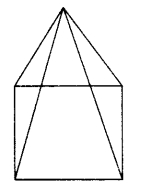
MCQ On Symmetry For Class 6 Question 1.
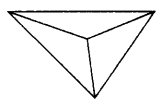
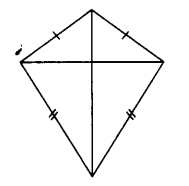
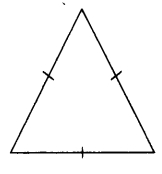
How many lines of symmetry does the figure have?
MCQ On Symmetry For Class 6
(a) 1
(b) 2
(c) 3
(d) 4

Answer

Answer: (a)


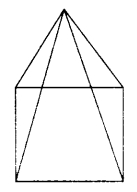
Symmetry Class 6 MCQ Question 2.
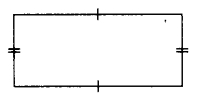
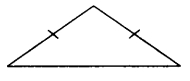
How many lines of symmetry does the figure have?
Symmetry Class 6 MCQ
(a) 1
(b) 2
(c) 3
(d) 4.

Answer

Answer: (b)


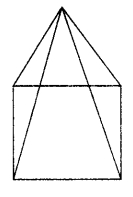
Symmetry MCQ Class 6 Question 3.
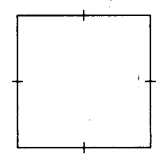
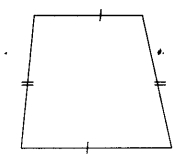
How many lines of symmetry does the figure have?
Symmetry MCQ Class 6
(a) 1
(b) 2
(c) 3
(d) 4

Answer

Answer: (d)


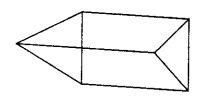
MCQ Questions On Symmetry For Class 6 Question 4.
How many lines of symmetry does the figure have?
MCQ Questions On Symmetry For Class 6
(a) 1
(b) 2
(c) 3
(d) 4

Answer

Answer: (c)


How many lines of symmetry does the figure have?

MCQ Questions For Class 6 Maths Chapter 13 Question 5.
How many lines of symmetry does the figure have ?
MCQ Questions For Class 6 Maths Chapter 13
(a) 1
(b) 2
(c) 3
(d) 4

Answer

Answer: (a)


Class 6 Maths Chapter 13 MCQ Question 6.
How many lines of symmetry does the figure have ?
Class 6 Maths Chapter 13 MCQ
(a) 1
(b) 2
(c) 3
(d) no line of symmetry

Answer

Answer: (d)


MCQ On Symmetry Class 6 Question 7.
How many lines of symmetry does the figure have?
MCQ On Symmetry Class 6
(a) 1
(b) 2
(c) 3
(d) Countless.

Answer

Answer: (d)


Class 6 Symmetry MCQ Question 8.
How many lines of symmetry does the figure have?
Class 6 Symmetry MCQ
(a) 0
(b) 1
(c) 2
(d) countless

Answer

Answer: (a)


MCQs On Symmetry For Grade 6 Question 9.
How many lines of symmetry does the figure have?
MCQs On Symmetry For Grade 6
(a) 1
(b) 2
(c) 3
(d) 4

Answer

Answer: (b)


Class 6 Maths Symmetry MCQ Question 10.
How many lines of symmetry does a regular hexagon have?
(a) 1
(b) 3
(c) 4
(d) 6

Answer

Answer: (d)


MCQ Of Symmetry Class 6 Question 11.
Which of the following letters has horizontal line of symmetry?
(a) C
(b) A
(c) J
(d) L.

Answer

Answer: (a)


Questions On Symmetry For Class 6 Question 12.
Which of the following letters has horizontal line of symmetry?
(a) Z
(b) V
(c) U
(d) E.

Answer

Answer: (d)


Class 6 Symmetry Extra Questions Question 13.
Which of the following letters has horizontal line of symmetry?
(a) S
(b) W
(c) D
(d) Y.

Answer

Answer: (c)


Class 6 Maths Chapter 13 Extra Questions Question 14.
Which of the following letters has vertical line of symmetry?
(a) R
(b) C
(c) B
(d) T.

Answer

Answer: (d)


Class 6 Symmetry MCQs Question 15.
Which of the following letters has vertical line of symmetry?
(a) N
(b) K
(c) B
(d) M.

Answer

Answer: (d)


Question 16.
Which of the following letters has vertical line of symmetry?
(a) J
(b) D
(c) E
(d) O.

AnswerWhich of the following letters has vertical line of symmetry?

Answer: (d)


Question 17.
Which of the following letters has no line of symmetry?
(a) P
(b) O
(c) H
(d) X.

Answer

Answer: (a)


Question 18.
Which of the following letters has no line of symmetry?
(a) O
(b) X
(c) I
(d) Q

Answer

Answer: (d)


We hope the given NCERT MCQ Questions for Class 6 Maths Chapter 13 Symmetry with Answers Pdf free download will help you. If you have any queries regarding Symmetry CBSE Class 6 Maths MCQs Multiple Choice Questions with Answers, drop a comment below and we will get back to you soon.
MCQ Questions for Class 8 Hindi Chapter 2 लाख की चूड़ियाँ with Answers

MCQ Questions for Class 8 Hindi Chapter 2 लाख की चूड़ियाँ with Answers

Check the below NCERT MCQ Questions for Class 8 Hindi Vasant Chapter 2 लाख की चूड़ियाँ with Answers Pdf free download. MCQ Questions for Class 8 Hindi with Answers were prepared based on the latest exam pattern. We have provided लाख की चूड़ियाँ Class 8 Hindi MCQs Questions with Answers to help students understand the concept very well. https://ncertmcq.com/mcq-questions-for-class-8-hindi-with-answers/

Students can also read NCERT Solutions for Class 8 Hindi Chapter 2 Questions and Answers at LearnInsta. Here all questions are solved with a detailed explanation, It will help to score more marks in your examinations.

लाख की चूड़ियाँ Class 8 MCQs Questions with Answers

Class 8 Hindi Chapter 2 MCQ Question 1.
लाख की चूड़ियाँ कौन बनाता था?
(a) लेखक का मामा
(b) लेखक
(c) बदलू
(d) डबलू

Answer

Answer: (c) बदलू


MCQ Questions For Class 8 Hindi Chapter 2 Question 2.
बंदलू कैसी चूड़ियाँ बनाता था?
(a) काँच की
(b) सोने की
(c) लाख की
(d) चाँदी की

Answer

Answer: (c) लाख की


बंदलू कैसी चूड़ियाँ बनाता था?

Lakh Ki Chudiyan Class 8 MCQ Question 3.
बदलू कौन था?
(a) लोहार
(b) सुनार
(c) मनिहार
(d) बढ़ई

Answer

Answer: (c) मनिहार


Class 8 Hindi Ch 2 MCQ Question 4.
लेखक अधिकतर बदलू से कब मिलता था?
(a) रात में
(b) सवेरे
(c) दोपहर में
(d) शाम में

Answer

Answer: (c) दोपहर में


Ncert Class 8 Hindi Chapter 2 MCQ Question 5.
बदलू प्रतिदिन कितनी चूड़ियाँ बना लिया करता था?
(a) तीन-चार जोड़े
(b) चार-पाँच जोड़े
(c) चार-छह जोड़े
(d) छह-सात जोड़े

Answer

Answer: (c) चार-छह जोड़े


Ch 2 Hindi Class 8 MCQ Question 6.
बेलन पर चढ़ी चूड़ियाँ बदलू को कैसी लगती थी?
(a) नई जैसी
(b) नारी की कलाइयों जैसी
(c) बहुत सुंदर
(d) नववधू की कलाई पर सजी जैसी

Answer

Answer: (d) नववधू की कलाई पर सजी जैसी


Class 8 Chapter 2 Hindi MCQ Question 7.
पिता की बदली होने का लेखक पर क्या प्रभाव पड़ा?
(a) वह उदास हो गया
(b) वह मामा के घर न जा सका
(c) उसे नए मित्र मिले
(d) मामा का घर नजदीक हो गया

Answer

Answer: (b) वह मामा के घर न जा सका


Hindi Class 8 Chapter 2 MCQ Question 8.
रज्जो कौन थी?
(a) लेखक के मामा की लड़की
(b) लेखक के पड़ोसी की लड़की
(c) बदलू की लड़की

Answer

Answer: (d) बदलू की भतीजी


(1)

वैसे तो मामा के गाँव का होने के कारण मुझे बदलू को ‘बदलू मामा’ कहना चाहिए था परंतु मैं उसे ‘बदलू मामा’ न कहकर बदलू काका कहा करता था जैसा कि गाँव के सभी बच्चे उसे कहा करते थे। बदलू का मकान कुछ ऊँचे पर बना था। मकान के सामने बड़ा-सा सहन था जिसमें एक पुराना नीम का वृक्ष लगा था। उसी के नीचे बैठकर बदलू अपना काम किया करता था। बगल में भट्ठी दहकती रहती जिसमें वह लाख पिघलाया करता। सामने एक लकड़ी की चौखट पड़ी रहती जिस पर लाख के मुलायम होने पर वह उसे सलाख के समान पतला करके चूड़ी का आकार देता। पास में चार-छह विभिन्न आकार की बेलननुमा मुँगेरियाँ रखी रहती जो आगे से कुछ पतली और पीछे से मोटी होतीं। लाख की चूड़ी का आकार देकर वह उन्हें मुंगेरियों पर चढ़ाकर गोल और चिकना बनाता और तब एक-एक कर पूरे हाथ की चूड़ियाँ बना चुकने के पश्चात वह उन पर रंग करता।

Chapter 2 Hindi Class 8 MCQ Question 1.
बदलू कहाँ का रहने वाला था?
(a) लेखक के गाँव का
(b) लेखक के पड़ोस के गाँव का
(c) लेखक के मामा के गाँव का
(d) इनमें से कोई नहीं लाख की चूड़ियाँ

Answer

Answer: (c) लेखक के मामा के गाँव का


Class 8 Hindi Chapter 2 Extra Questions Question 2.
लेखक बदलू को ‘बदलू काका’ क्यों कहता था?
(a) क्योंकि वह लेखक के गाँव का था
(b) क्योंकि गाँव के सभी बच्चे उसे बदलू काका ही कहते थे
(c) क्योंकि वह इसी नाम से खुश होता था
(d) क्योंकि वह लेखक का चाचा था।

Answer

Answer: (b) क्योंकि गाँव के सभी बच्चे उसे बदलू काका ही कहते थे


Class 8 Ch 2 Hindi MCQ Question 3.
बदलू कहाँ बैठकर अपना काम करता था?
(a) ऑफिस में
(b) अपने घर के अंदर
(c) नीम के पेड़ के नीचे
(d) एक झोपड़ी में

Answer

Answer: (c) नीम के पेड़ के नीचे


Hindi Chapter 2 Class 8 MCQ Question 4.
भट्ठी में बदलू क्या पिघलाया करता था?
(a) चूड़ी
(b) लाख
(c) तांबा
(d) मोम

Answer

Answer: (b) लाख


Class 8th Hindi Chapter 2 MCQ Question 5.
लाख की चूड़ियाँ बनाने के लिए बदलू किसका प्रयोग करता था?
(a) मोम
(b) गोलबास
(c) बोलननुमा मुंगेरियाँ
(d) लकड़ी की कटोरियाँ

Answer

Answer: (c) बोलननुमा मुंगेरियाँ


Class 8 Hindi MCQ Chapter 2 Question 6.
बदलू लाख की चूड़ियाँ कैसे बनाता था?
(a) पहले लाख को मुलायम करता था
(b) मुंगरियों पर चढ़ाकर फिर चूड़ियों को गोल आकार देता था
(c) फिर उन पर रंग करता
(d) उपर्युक्त सभी

Answer

Answer: (d) उपर्युक्त सभी


(2)

बदलू यह कार्य सदा ही एक मचिये पर बैठकर किया करता था जो बहुत ही पुरानी थी। बगल में ही उसका हुक्का रखा रहता जिसे वह बीच-बीच में पीता रहता। गाँव में मेरा दोपहर का समय अधिकतर बदलू के पास बीता। वह मुझे ‘लला’ कहा करता और मेरे पहुँचते ही मेरे लिए तुरंत एक मचिया मँगा देता। मैं घंटों बैठे-बैठे उसे इस प्रकार चूड़ियाँ बनाते देखता रहता। लगभग रोज ही वह चार-छह जोड़े चूड़ियाँ बनाता। पूरा जोड़ा बना लेने पर वह उसे बेलन पर चढ़ाकर कुछ क्षण चुपचाप देखता रहता मानो वह बेलन न होकर किसी नव-वधू की कलाई हो।

Question 1.
बदलू मचिये पर बैठकर क्या कार्य करता था?
(a) लोहे का बर्तन बनाता था
(b) जूते बनाता था
(c) लाख की चूड़ियाँ बनाता था
(d) हुक्का पीता रहता था

Answer

Answer: (c) लाख की चूड़ियाँ बनाता था


Question 2.
गाँव में लेखक का अधिकतर समय कहाँ बीतता था?
(a) मामा के घर में
(b) खेल के मैदान में
(c) मामा के बगीचे में
(d) बदलू काका के पास

Answer

Answer: (d) बदलू काका के पास


Question 3.
लेखक को बदलू क्या कहकर बुलाता था?
(a) भानजा
(b) बच्चा
(c) लला
(d) कामतानाथ

Answer

Answer: (c) लला


Question 4.
बदलू लेखक को कहाँ बिठाता था?
(a) चबूतरे पर
(b) चौकी पर
(c) कुरसी पर
(d) मचिया पर

Answer

Answer: (d) मचिया पर


Question 5.
बेलन पर चढ़ी चूड़ियाँ बदलू को कैसी लगती थी?
(a) सोने जैसे
(b) चमकदार
(c) बहुत सुंदर
(d) नव-वधू की कलाई पर सजी जैसी

Answer

Answer: (d) नव-वधू की कलाई पर सजी जैसी


(3)

बदलू मनिहार था। चूड़ियाँ बनाना उसका पैतृक पेशा था और वास्तव में वह बहुत ही सुंदर चूड़ियाँ बनाता था। उसकी बनाई हुई चूड़ियों की खपत भी बहुत थी। उस गाँव में तो सभी स्त्रियाँ उसकी बनाई हुई चूड़ियाँ पहनती ही थीं। आस-पास के गाँवों के लोग भी उससे चूड़ियाँ ले जाते थे परंतु वह कभी भी चूड़ियों को पैसों से बेचता न था। उसका अभी तक वस्तु-विनिमय का तरीका था और लोग अनाज के बदले उससे चूड़ियाँ ले जाते थे। बदलू स्वभाव से बहुत सीधा था। मैंने कभी भी उसे किसी से झगड़ते नहीं देखा। हाँ, शादी-विवाह के अवसरों पर वह अवश्य ज़िद पकड़ जाता था। जीवन भर चाहे कोई उससे मुफ्त चूड़ियाँ ले जाए परंतु विवाह के अवसर पर वह सारी कसर निकाल लेता था। आखिर सुहाग के जोड़े का महत्त्व ही और होता है।

Question 1.
बदलू क्या था?
(a) कुम्हार
(b) मनिहार
(c) मोची
(d) किसान

Answer

Answer: (b) मनिहार


Question 2.
बदलू का पैतृक पेशा क्या था?
(a) काँच की चूड़ियाँ बनाना
(b) लाख की चूड़ियाँ बनाना
(c) अनाज उपजाना
(d) सब्जी बेचना

Answer

Answer: (b) लाख की चूड़ियाँ बनाना


Question 3.
वह चूड़ियाँ कैसे बेचता था?
(a) पैसे लेकर
(b) अनाज लेकर
(c) कोई भी वस्तु लेकर

Answer

Answer: (b) अनाज लेकर


Question 4.
उसकी बनाई चूड़ियों की खपत कहाँ होती थी?
(a) शहरों में
(b) कस्बों में
(c) आस-पास के गाँवों में
(d) दूसरे शहरों में

Answer

Answer: (b) कस्बों में


Question 5.
शादी-विवाह के अवसर पर बदलू किस बात के लिए जिद पकड़ता था?
(a) चूड़ियाँ देने के लिए
(b) वस्तुएँ प्राप्त करने के लिए
(c) अधिक पैसे लेने के लिए
(d) मुफ़्त चूड़ियाँ देने के लिए

Answer

Answer: (b) वस्तुएँ प्राप्त करने के लिए


Question 6.
‘पैतृक’ शब्द में प्रयुक्त प्रत्यय कौन-सा है?
(a) क
(b) इक
(c) अक
(d) ऋक

Answer

Answer: (d) ऋक


(4)

मैं बहुधा हर गरमी की छुट्टी में अपने मामा के यहाँ चला जाता और एक-आध महीने वहाँ रहकर स्कूल खुलने के समय तक वापस आ जाता। परंतु दो-तीन बार ही मैं अपने मामा के यहाँ गया होऊँगा तभी मेरे पिता की एक दूर के शहर में बदली हो गई और एक लंबी अवधि तक मैं अपने मामा के गाँव न जा सका। तब लगभग आठ-दस वर्षों के बाद जब मैं वहाँ गया तो इतना बड़ा हो चुका था कि लाख की गोलियों में मेरी रुचि नहीं रह गई थी। अतः गाँव में होते हुए भी कई दिनों तक मुझे बदलू का ध्यान न आया।

इस बीच मैंने देखा कि गाँव में लगभग सभी स्त्रियाँ काँच की चूड़ियाँ पहने हैं। विरले ही हाथों में मैंने लाख की चूड़ियाँ देखीं। तब एक दिन सहसा मुझे बदलू का ध्यान हो आया। बात यह हुई कि बरसात में मेरे मामा की छोटी लड़की आँगन में फिसलकर गिर पड़ी और उसके हाथ की काँच की चूड़ी टूटकर उसकी कलाई में घुस गई और उससे खून बहने लगा। मेरे मामा उस समय घर पर न थे। मुझे ही उसकी मरहम-पट्टी करनी पड़ी। तभी सहसा मुझे बदलू का ध्यान हो आया और मैंने सोचा कि उससे मिल आऊँ। अतः शाम को मैं घूमते-घूमते उसके घर चला गया। बदलू वहीं चबूतरे पर नीम के नीचे एक खाट पर लेटा था।

Question 1.
लेखक लंबे अर्से तक मामा के यहाँ क्यों नहीं जा सका?
(a) क्योंकि उसे अब मामा के गाँव में मन नहीं लगता था।
(b) क्यों वह अब विदेश में रहने लगा था।
(c) क्योंकि उसका मामा अब गाँव छोड़कर बाहर चला गया था।
(d) क्योंकि लेखक के पिता का तबादला गाँव से दूर हो गया था।

Answer

Answer: (b) क्यों वह अब विदेश में रहने लगा था।


Question 2.
लेखक प्राय: गरमियों की छुट्टियों में कहाँ जाता था?
(a) दादा जी के घर
(b) अपने मामा के घर
(c) अपने मित्रों के घर
(d) कहीं नहीं

Answer

Answer: (d) कहीं नहीं


Question 3.
जब 8-10 वर्षों के बाद लेखक मामा के गाँव गया तो क्या परिवर्तन पाया?
(a) गाँव बदल गए थे
(b) बच्चों के हाथ में गोलियाँ थीं
(c) लाख की चूड़ियाँ घर-घर बनने शुरू हो गए थे
(d) औरतों ने लाख की चूड़ियाँ पहनना बंद कर दिए थे।

Answer

Answer: (d) औरतों ने लाख की चूड़ियाँ पहनना बंद कर दिए थे।


Question 4.
मामा की छोटी लड़की को क्या हो गया?
(a) वह आँगन में फिसलकर गिर गई थी
(b) काँच की चूड़ी टूटकर उसकी कलाई में घुस गई
(c) उसके हाथ से खून बहने लगा
(d) उपर्युक्त सभी।

Answer

Answer: (c) उसके हाथ से खून बहने लगा


Question 5.
लेखक को बदलू कहाँ मिला?
(a) घर में
(b) खेत में
(c) नीम के पेड़ के नीचे
(d) मामा के घर पर

Answer

Answer: (a) घर में


Question 6.
‘बहुधा’ शब्द का विलोम शब्द है-
(a) कभी-कभी
(b) यदा कदा
(c) बराबर
(d) अकसर

Answer

Answer: (c) बराबर


(5)

अच्छा, बेटी, लला को चार-पाँच आम छाँटकर दो। सिंदूरी वाले देना। देखो लला कैसे हैं? इसी साल यह पेड़ तैयार हुआ है। रज्जो ने चार-पाँच आम अंजुली में लेकर मेरी ओर बढ़ा दिए। आम लेने के लिए मैंने हाथ बढ़ाया तो मेरी निगाह एक क्षण के लिए उसके हाथों पर ठिठक गई। गोरी-गोरी कलाइयों पर लाख की चूड़ियाँ बहुत ही फब रही थीं।
बदलू ने मेरी दृष्टि देख ली और बोल पड़ा, यही आखिरी जोड़ा बनाया था जमींदार साहब की बेटी के विवाह पर। दस आने पैसे मुझकों दे रहे थे। मैंने जोड़ा नहीं दिया। कहा, शहर से ले लाओ।

Question 1.
रज्जो कौन थी?
(a) बदलू की पत्नी
(b) बदलू की बेटी
(c) बदलू की बहन
(d) बदलू की भानजी

Answer

Answer: (b) बदलू की बेटी


Question 2.
रज्जो अंजुली में कितने आम लेकर आयी?
(a) एक
(b) दो-तीन
(c) तीन-चार
(d) चार-पाँच

Answer

Answer: (d) चार-पाँच


Question 3.
रज्जो कैसी चूड़ियाँ पहन रखी थी?
(a) काँच की
(b) सोने की
(c) लाख की
(d) चाँदी की

Answer

Answer: (c) लाख की


रज्जो कैसी चूड़ियाँ पहन रखी थी?

Question 4.
बदलू ने लाख की चूड़ियों का अंतिम जोड़ा कब बनाया था?
(a) लेखक के मामा की बेटी के विवाह पर
(b) जमींदार की बेटी के विवाह पर
(c) अपनी बेटी के विवाह पर
(d) शुरुआत में।

Answer

Answer: (b) जमींदार की बेटी के विवाह पर


We hope the given NCERT MCQ Questions for Class 8 Hindi Vasant Chapter 2 लाख की चूड़ियाँ with Answers Pdf free download will help you. If you have any queries regarding CBSE Class 8 Hindi लाख की चूड़ियाँ MCQs Multiple Choice Questions with Answers, drop a comment below and we will get back to you soon.
MCQ Questions for Class 6 Maths Chapter 4 Basic Geometrical Ideas with Answers

MCQ Questions for Class 6 Maths Chapter 4 Basic Geometrical Ideas with Answers

Check the below Online Education NCERT MCQ Questions for Class 6 Maths Chapter 4 Basic Geometrical Ideas with Answers Pdf free download. MCQ Questions for Class 6 Maths with Answers were prepared based on the latest exam pattern. We have provided Basic Geometrical Ideas Class 6 Maths MCQs Questions with Answers to help students understand the concept very well.

Students can also refer to NCERT Solutions for Class 6 Maths Chapter 4 Basic Geometrical Ideas for better exam preparation and score more marks.

Basic Geometrical Ideas Class 6 MCQs Questions with Answers

Basic Geometrical Ideas Class 6 MCQ Question 1.
How many points are enough to fix a line?
(a) 1
(b) 2
(c) 3
(d) 4

Answer

Answer: (b)


Class 6 Maths Chapter 4 MCQ Question 2.
Two intersecting lines intersect in
(a) 1 point
(b) 2 points
(c) 3 points
(d) 4 points

Answer

Answer: (a)


MCQ Questions For Class 6 Maths Chapter 4 Question 3.
How many lines can pass through one given point?
(a) 1
(b) 2
(c) 4
(d) Countless

Answer

Answer: (d)


MCQ On Basic Geometrical Ideas For Class 6 Question 4.
How many lines can pass through two given points?
(a) Only one
(b) 2
(c) 4
(d) Countless

Answer

Answer: (a)


How many lines can pass through two given points?

Ncert Class 6 Maths Chapter 4 MCQ Question 5.
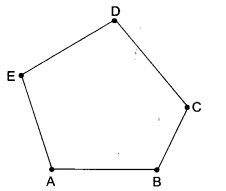
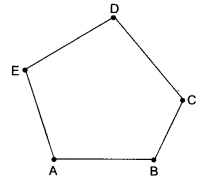
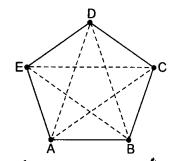
How many vertices are there in the following figure?
Ncert Class 6 Maths Chapter 4 MCQ
(a) 5
(b) 3
(c) 2
(d) 4

Answer

Answer: (a)


Basic Geometrical Ideas Class 6 MCQ Questions Question 6.
How many sides are there in the following figure?
Basic Geometrical Ideas Class 6 MCQ Questions
(a) 5
(b) 4
(c) 2
(d) 3

Answer

Answer: (a)


MCQ Class 6 Maths Chapter 4 Question 7.
How many diagonals are there in the follow-ing figure?
MCQ Class 6 Maths Chapter 4
(a) 4
(b) 5
(c) 2
(d) 3

Answer

Answer: (b)


Class 6 Maths Ch 4 MCQ Question 8.
How many vertices are there in a triangle?
(a) 1
(b) 2
(c) 3
(d) 4

Answer

Answer: (c)


Basic Geometrical Ideas Class 6 MCQ With Answers Question 9.
How many sides are there in a triangle?
(a) 1
(b) 2
(c) 3
(d) 4

Answer

Answer: (c)


MCQ Of Basic Geometrical Ideas Class 6 Question 10.
How many angles are there in a triangle?
(a) 1
(b) 2
(c) 3
(d) 4

Answer

Answer: (c)


Class 6 Maths MCQ Chapter 4 Question 11.
How many vertices are there in a quadrilat¬eral?
(a) 1
(b) 2
(c) 3
(d) 4

Answer

Answer: (d)


MCQ On Quadrilaterals Class 6 Question 12.
How many sides are there in a quadrilateral?
(a) 1
(b) 2
(c) 3
(d) 4

Answer

Answer: (d)


MCQ Questions For Class 6 Maths Basic Geometrical Ideas Question 13.
How many angles are there in a quadrilateral?
(a) 1
(b) 2
(c) 3
(d) 4

Answer

Answer: (d)


Class 6 Math Chapter 4 MCQ Question 14.
How many pairs of adjacent sides are there in a quadrilateral?
(a) 1
(b) 2
(c) 3
(d) 4

Answer

Answer: (d)


MCQ On Basic Geometrical Ideas Class 6 Question 15.
How many pairs of opposite angles are there in a quadrilateral?
(a) 1
(b) 2
(c) 3
(d) 4

Answer

Answer: (b)


Basic Geometrical Ideas MCQ Class 6 Question 16.
How many pairs of opposite sides are there in a quadrilateral?
(a) 1
(b) 2
(c) 3
(d) 4

Answer

Answer: (b)


How many pairs of opposite sides are there in a quadrilateral?

Question 17.
How many pairs of adjacent angles are there in a quadrilateral?
(a) 1
(b) 2
(c) 3
(d) 4

Answer

Answer: (d)


Question 18.
Which of the following statements is false?
(a) Two diameters of a circle will necessarily intersect.
(b) The centre of a circle is always in its interior.
(c) Every diameter of a circle is also a chord.
(d) Every chord of a circle is also a diameter.

Answer

Answer: (d)


We hope the given NCERT MCQ Questions for Class 6 Maths Chapter 4 Basic Geometrical Ideas with Answers Pdf free download will help you. If you have any queries regarding Basic Geometrical Ideas CBSE Class 6 Maths MCQs Multiple Choice Questions with Answers, drop a comment below and we will get back to you soon.
MCQ Questions for Class 8 Hindi Chapter 14 अकबरी लोटा with Answers

MCQ Questions for Class 8 Hindi Chapter 14 अकबरी लोटा with Answers

Check the below Online Education NCERT MCQ Questions for Class 8 Hindi Vasant Chapter 14 अकबरी लोटा with Answers Pdf free download. MCQ Questions for Class 8 Hindi with Answers were prepared based on the latest exam pattern. We have provided अकबरी लोटा Class 8 Hindi MCQs Questions with Answers to help students understand the concept very well. https://ncertmcq.com/mcq-questions-for-class-8-hindi-with-answers/

Students can also read NCERT Solutions for Class 8 Hindi Chapter 14 Questions and Answers at LearnInsta. Here all questions are solved with a detailed explanation, It will help to score more marks in your examinations.

अकबरी लोटा Class 8 MCQs Questions with Answers

Akbari Lota Class 8 MCQ Question 1.
लाला जी को अचानक कितने रुपयों की आवश्यकता हुई ?
(a) एक सौ रुपये की
(b) डेढ़ सौ रुपए की
(c) दो सौ रुपये की
(d) ढाई सौ रुपये की

Answer

Answer: (d) ढाई सौ रुपये की


Class 8 Hindi Chapter 14 MCQ Question 2.
लाला झाऊलाल ने रौब से पत्नी को क्या कहा?
(a) तुम्हें रुपये किसलिए चाहिए
(b) अभी रुपए नहीं हैं
(c) भाई से भी माँगने की ज़रूरत नहीं, मुझसे ले लेना
(d) कहीं से लाकर दे दूंगा

Answer

Answer: (c) भाई से भी माँगने की ज़रूरत नहीं, मुझसे ले लेना


Akbari Lota Extra Questions Question 3.
झाऊलाल ने पत्नी को रुपए देने में कितने दिन का समय लगा दिया?
(a) पाँच दिन
(b) सात दिन
(c) दो दिन
(d) चार दिन

Answer

Answer: (b) सात दिन


Akbari Lota Class 8 Extra Questions Question 4.
लोटा नीचे किससे गिरा?
(a) झाऊलाल से
(b) झाऊलाल की पत्नी से
(c) अंग्रेज़ से
(d) बिलवासी से

Answer

Answer: (a) झाऊलाल से


Ncert Class 8 Hindi Chapter 14 MCQ Question 5.
लाला झाऊलाल के हाथ से जब लोटा गिरा था तब वह कौन-सी मंजिल पर खड़े थे?
(a) दूसरी मंजिल
(b) तिनमंजिले पर
(c) चौथी मंजिल पर
(d) पाँचवीं मंजिल पर

Answer

Answer: (b) तिनमंजिले पर


लाला झाऊलाल के हाथ से जब लोटा गिरा था तब वह कौन-सी मंजिल पर खड़े थे?

Class 8 Hindi Chapter 14 Extra Questions Question 6.
पंडित बिलवासी जी क्यों आए थे?
(a) झाऊलाल से मिलने
(b) लाला झाऊलाल को ढाई सौ रुपये देने
(c) अंग्रेज़ का मित्र
(d) पुलिस

Answer

Answer: (b) लाला झाऊलाल को ढाई सौ रुपये देने


MCQ Questions For Class 8 Hindi Chapter 14 Question 7.
पं. बिलवासी ने लोटे की क्या विशेषता बताई ?
(a) पुश्तैनी
(b) ऐतिहासिक
(c) कीमती रत्न
(d) हीरे जवाहरात से जड़ा हुआ

Answer

Answer: (b) ऐतिहासिक


Akbari Lota MCQ Questions Question 8.
लोटे का नामकरण क्या हुआ?
(a) झाऊलाल लोटा
(b) मुगलकालीन लोटा
(c) अकबरी लोटा
(d) प्राचीनकालीन लोटा

Answer

Answer: (c) अकबरी लोटा


(1)

लाला झाऊलाल को खाने-पीने की कमी नहीं थी। काशी के ठठेरी बाज़ार में मकान था। नीचे की दुकानों से एक सौ रुपये मासिक के करीब किराया उतर आता था। अच्छा खाते थे, अच्छा पहनते थे, पर ढाई सौ रुपये तो एक साथ आँख सेंकने के लिए भी न मिलते थे। इसलिए जब उनकी पत्नी ने एक दिन एकाएक ढाई सौ रुपये की माँग पेश की, तब उनका जी एक बार ज़ोर से सनसनाया और फिर बैठ गया। उनकी यह दशा देखकर पत्नी ने कहा-“डरिए मत, आप देने में असमर्थ हों तो मैं अपने भाई से माँग लूँ?”

Class 8 Hindi Ch 14 MCQ Question 1.
गद्यांश के पाठ और लेखक का नाम लिखिए-
(a) बस की यात्रा – हरिशंकर परसाई
(b) कामचोर – इस्मत चुगताई
(c) जहाँ पहिया है – पी. साईनाथ
(d) अकबरी लोटा – अन्नपूर्णानंद वर्मा

Answer

Answer: (d) अकबरी लोटा – अन्नपूर्णानंद वर्मा


Class 8 Hindi Akbari Lota MCQ Question 2.
लाला झाऊलाल का मकान कहाँ था?
(a) लखनऊ में
(b) इलाहाबाद में
(c) काशी के ठठेरी बाज़ार में
(d) मथुरा में

Answer

Answer: (c) काशी के ठठेरी बाज़ार में


Akbari Lota Extra Question Answer In Hindi Question 3.
पत्नी ने झाऊलाल से कितने रुपये माँगे?
(a) दो सौ बीस रुपए
(b) ढाई सौ रुपए
(c) पाँच सौ रुपए
(d) हज़ार रुपए

Answer

Answer: (b) ढाई सौ रुपए


Question 4.
लाला झाऊलाल के मकान में नीचे थीं-
(a) दुकानें
(b) बाज़ार
(c) गलियाँ
(d) सड़कें

Answer

Answer: (a) दुकानें


Question 5.
‘सनसनाया’ शब्द का अर्थ है-
(a) सनसन की आवाज़
(b) गरमाना
(c) घबरा जाना
(d) ललचा गया

Answer

Answer: (c) घबरा जाना


(2)

लाला झाऊलाल मुश्किल से दो-एक बूंट पी पाए होंगे कि न जाने कैसे उनका हाथ हिल उठा और लोटा छूट गया। लोटे ने दाएँ देखा न बाएँ, वह नीचे गली की ओर चल पड़ा। अपने वेग में उल्का को लजाता हुआ वह आँखों से ओझल हो गया। किसी ज़माने में न्यूटन नाम के किसी खुराफाती ने पृथ्वी की आकर्षण शक्ति नाम की एक चीज़ ईजाद की थी। कहना न होगा कि यह सारी शक्ति इस समय लोटे के पक्ष में थी।

Question 1.
लाला झाऊलाल लोटे में क्या पी रहे थे?
(a) जूस
(b) पानी
(c) दूध
(d) चाय

Answer

Answer: (b) पानी


Question 2.
लोटा कहाँ से गिर रहा था?
(a) बिलवासी मिश्र के हाथ से
(b) झाऊलाल की पत्नी के हाथ से
(c) झाऊलाल के हाथ से
(d) झाऊलाल के घर से

Answer

Answer: (c) झाऊलाल के हाथ से


Question 3.
लोटे की रफ़्तार किसकी रफ्तार से भी तेज़ थी?
(a) हवा से
(b) सूर्य की रोशनी से
(c) उल्का की चाल से
(d) चंद्रमा की चाल से

Answer

Answer: (c) उल्का की चाल से


Question 4.
‘पृथ्वी के आकर्षण शक्ति’ को न्यूटन ने क्या नाम दिया?
(a) शक्तिमान
(b) गुरुत्वाकर्षण
(c) गुरुत्वाघर्षण
(d) उपर्युक्त सभी

Answer

Answer: (b) गुरुत्वाकर्षण


(3)

कुछ हुआ भी ऐसा ही। गली में ज़ोर का हल्ला उठा। लाला झाऊलाल जब तक दौड़कर नीचे उतरे तब तक एक भारी भीड़ उनके
आँगन में घुस आई।
लाला झाऊलाल ने देखा कि इस भीड़ में प्रधान पात्र एक अंग्रेज़ है जो नखशिख से भीगा हुआ है और जो अपने एक पैर को हाथ से सहलाता हुआ दूसरे पैर पर नाच रहा है। उसी के पास अपराधी लोटे को भी देखकर लाला झाऊलाल जी ने फौरन दो और दो जोड़कर स्थिति को समझ लिया।

Question 1.
गली में जोर का हल्ला क्यों हो रहा था?
(a) मारपीट होने से
(b) चोर पकड़ने जाने के कारण
(c) गली में लोटे गिरने के कारण
(d) अंग्रेज़ को देखने के लिए

Answer

Answer: (c) गली में लोटे गिरने के कारण


Question 2.
भीड़ का प्रधान पात्र कौन था?
(a) सरपंच
(b) अंग्रेज़
(c) लाला झाऊलाल
(d) पं० बिलवासी मिश्र

Answer

Answer: (b) अंग्रेज़


Question 3.
लोटा किसके पास था?
(a) पं बिलवासी मिश्र
(b) अंग्रेज के पास
(c) लाला झाऊलाल के पास
(d) लाला झाऊलाल की पत्नी के पास

Answer

Answer: (c) लाला झाऊलाल के पास


Question 4.
लोटे के लिए प्रयुक्त विशेषण कौन-सा है?
(a) अपराधी
(b) भींगा हुआ
(c) प्रधान
(d) उसी के पास

Answer

Answer: (a) अपराधी


Question 5.
लाला झाऊलाल ने किस स्थिति को समझ लिया?
(a) अंग्रेज़ के गुस्से का
(b) अंग्रेज़ के पैर में चोट लगने का
(c) लोटा अंग्रेज़ के सिर और पैर पर गिरने का
(d) अंग्रेज़ नाच रहा है।

Answer

Answer: (d) अंग्रेज़ नाच रहा है।


(4)

“जी, जनाब! सोलहवीं शताब्दी की बात है। बादशाह हुमायूँ शेरशाह से हारकर भागा था और सिंध के रेगिस्तान में मारा-मारा फिर रहा था। एक अवसर पर प्यास से उसकी जान निकल रही थी। उस समय एक ब्रह्मान ने इसी लोटे से पानी पिलाकर उसकी जान बचाई थी। हुमायूँ के बाद अकबर ने उस ब्राह्मण का पता लगाकर उससे इस लोटे को ले लिया और इसके बदले में उसे इसी प्रकार के दस सोने के लोटे प्रदान किए। यह लोटा सम्राट अकबर को बहुत प्यारा था। इसी से इसका नाम अकबरी लोटा पड़ा। वह बराबर इसी से वजू करता था। सन् 57 तक इसके शाही घराने में रहने का पता है। पर इसके बाद लापता हो गया। कलकत्ता के म्यूजियम में इसका प्लास्टर का मॉडल रखा हुआ है। पता नहीं यह लोटा इस आदमी मे पास कैसे आया? म्यूजियम वालों को पता चले तो फैंसी दाम देकर खरीद ले जाएँ।

Question 1.
इस लोटे ने किसको पानी पिलाया था?
(a) हुमायूँ को
(b) शाहजहाँ को
(c) अकबर को
(d) औरंगजेब को

Answer

Answer: (a) हुमायूँ को


Question 2.
इस लोटा का नाम पड़ा था?
(a) अकबरी लोटा
(b) बाबरी लोटा
(c) मुगल लोटा
(d) बादशाही लोटा

Answer

Answer: (a) अकबरी लोटा


Question 3.
हुमायूँ की जान कैसे बची?
(a) अच्छे भोजन खाने से
(b) इलाज कराने से
(c) ब्राह्मण द्वारा पानी पिलाने से
(d) ब्राह्मण का खाना खाने से

Answer

Answer: (c) ब्राह्मण द्वारा पानी पिलाने से


Question 4.
अकबर को वह लोटा किससे मिला?
(a) पं० बिलवासी मिश्र के पास
(b) अंग्रेज़ के पास
(c) हुमायूँ से
(d) ब्राह्मण के पास से

Answer

Answer: (b) अंग्रेज़ के पास


Question 5.
किस सम्राट के नाम से इस लोटे का नामकरण हुआ?
(a) हुमायूँ
(b) जहाँगीर
(c) अकबर
(d) शेरशाह

Answer

Answer: (c) अकबर


(5)

बिलवासी जी अफ़सोस के साथ अपने रुपये उठाने लगे, मानो अपनी आशाओं की लाश उठा रहे हों। साहब की ओर देखकर उन्होंने कहा-“लोटा आपका हुआ, ले जाइए, मेरे पास ढाई सौ से अधिक नहीं है।”
यह सुनना था कि साहब के चेहरे पर प्रसन्नता की कूँची गिर गई। उसने झपटकर लोटा लिया और बोला-“अब मैं हँसता हुआ अपने देश लौटूंगा। मेजर डगलस की डींग सुनते-सुनते कान पक गए थे।

Question 1.
अपने रुपये उठाते समय पं. बिलवासी मिश्र अफसोस क्यों कर रहे थे?
(a) रुपये अधिक होने के कारण
(b) रुपये कम होने के कारण
(c) लोटा न खरीद पाने के कारण
(d) झाऊलाल द्वारा माँगने के कारण

Answer

Answer: (a) रुपये अधिक होने के कारण


Question 2.
बिलवासी जी के पास कुल कितने रुपये थे?
(a) तीन सौ रुपये
(b) पाँच सौ रुपये
(c) चार सौ रुपये
(d) ढाई सौ रुपये

Answer

Answer: (d) ढाई सौ रुपये


Question 3.
बिलवासी की बातें सुनकर अंग्रेज़ के चेहरे पर कौन-सा भाव आ गया?
(a) खुशी का
(b) दुख का
(b) दया का
(d) सहानुभूति का

Answer

Answer: (a) खुशी का


बिलवासी की बातें सुनकर अंग्रेज़ के चेहरे पर कौन-सा भाव आ गया?

Question 4.
लोहे के माध्यम से अंग्रेज़ किसे नीचा दिखाने का प्रयास कर रहा था?
(a) पं० बिलवासी मिश्र को
(b) झाऊलाल को
(c) भीड़ को
(d) मेजर डगलस को

Answer

Answer: (d) मेजर डगलस को


We hope the given NCERT MCQ Questions for Class 8 Hindi Vasant Chapter 14 अकबरी लोटा with Answers Pdf free download will help you. If you have any queries regarding CBSE Class 8 Hindi अकबरी लोटा MCQs Multiple Choice Questions with Answers, drop a comment below and we will get back to you soon.
MCQ Questions for Class 6 Maths Chapter 7 Fractions with Answers

MCQ Questions for Class 6 Maths Chapter 7 Fractions with Answers

Check the below Online Education NCERT MCQ Questions for Class 6 Maths Chapter 7 Fractions with Answers Pdf free download. MCQ Questions for Class 6 Maths with Answers were prepared based on the latest exam pattern. We have provided Fractions Class 6 Maths MCQs Questions with Answers to help students understand the concept very well.

Students can also refer to NCERT Solutions for Class 6 Maths Chapter 7 Fractions for better exam preparation and score more marks.

Fractions Class 6 MCQs Questions with Answers

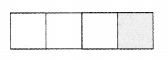
MCQ On Fractions For Class 6 Chapter 7 Question 1.
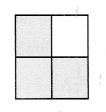
The fraction representing the shaded portion is
MCQ On Fractions For Class 6 Chapter 7
(a) \(\frac { 1 }{ 4 }\)
(b) \(\frac { 3 }{ 4 }\)
(c) \(\frac { 1 }{ 2 }\)
(d) \(\frac { 1 }{ 8 }\)

Answer

Answer: (a)


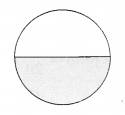
Class 6 Maths Chapter 7 MCQ Question 2.
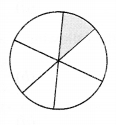
The fraction representing the shaded portion is
Class 6 Maths Chapter 7 MCQ
(a) \(\frac { 1 }{ 4 }\)
(b) \(\frac { 1 }{ 2 }\)
(c) \(\frac { 1 }{ 3 }\)
(d) \(\frac { 1 }{ 8 }\)

Answer

Answer: (b)


Fraction MCQ Class 6 Chapter 7 Question 3.
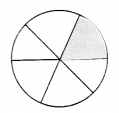
The fraction representing the shaded portion is
Fraction MCQ Class 6 Chapter 7
(a) \(\frac { 1 }{ 4 }\)
(b) \(\frac { 1 }{ 2 }\)
(c) \(\frac { 3 }{ 4 }\)
(d) none of these

Answer

Answer: (c)


MCQ Questions For Class 6 Maths Chapter 7 Question 4.
The fraction representing the shaded portion is
MCQ Questions For Class 6 Maths Chapter 7
(a) \(\frac { 1 }{ 4 }\)
(b) \(\frac { 1 }{ 2 }\)
(c) \(\frac { 1 }{ 8 }\)
(d) none of these

Answer

Answer: (c)


MCQ Questions On Fractions For Class 6 Chapter 7 Question 5.
The fraction representing the shaded portion is
MCQ Questions On Fractions For Class 6 Chapter 7
(a) \(\frac { 1 }{ 2 }\)
(b) \(\frac { 1 }{ 4 }\)
(c) \(\frac { 1 }{ 3 }\)
(d) \(\frac { 1 }{ 6 }\)

Answer

Answer: (d)


Fraction Class 6 MCQ Chapter 7 Question 6.
What fraction of ₹ 1 is 50 paise?
(a) \(\frac { 1 }{ 2 }\)
(b) \(\frac { 1 }{ 4 }\)
(c) \(\frac { 1 }{ 8 }\)
(d) \(\frac { 1 }{ 10 }\)

Answer

Answer: (a)


Fractions Class 6 MCQ Chapter 7 Question 7.
What fraction of ₹ 1 is 25 paise?
(a) \(\frac { 1 }{ 2 }\)
(b) \(\frac { 1 }{ 4 }\)
(c) \(\frac { 1 }{ 8 }\)
(d) \(\frac { 1 }{ 10 }\)

Answer

Answer: (b)


What fraction of ₹ 1 is 25 paise?

Fractions MCQ Class 6 Chapter 7 Question 8.
What fraction of an hour is 30 minutes?
(a) \(\frac { 1 }{ 4 }\)
(b) \(\frac { 1 }{ 2 }\)
(c) \(\frac { 1 }{ 3 }\)
(d) \(\frac { 1 }{ 5 }\)

Answer

Answer: (b)


MCQ Questions For Class 6 Maths Fractions Question 9.
What fraction of a day is 12 hours?
(a) \(\frac { 1 }{ 2 }\)
(b) \(\frac { 1 }{ 4 }\)
(c) \(\frac { 1 }{ 3 }\)
(d) \(\frac { 1 }{ 6 }\)

Answer

Answer: (a)


Class 6 Fraction MCQ Chapter 7 Question 10.
Which of the following is a proper fraction?
(a) \(\frac { 1 }{ 2 }\)
(b) \(\frac { 5 }{ 4 }\)
(c) \(\frac { 3 }{ 2 }\)
(d) \(\frac { 9 }{ 2 }\)

Answer

Answer: (a)


Class 6 Fractions MCQ Chapter 7 Question 11.
Which of the following is a proper fraction?
(a) \(\frac { 0 }{ 1 }\)
(b) \(\frac { 5 }{ 2 }\)
(c) \(\frac { 7 }{ 4 }\)
(d) \(\frac { 11 }{ 3 }\)

Answer

Answer: (a)


MCQ Of Fraction For Class 6 Chapter 7 Question 12.
Which of the following is a proper fraction whose numerator is 1 and denominator is 3?
(a) \(\frac { 1 }{ 3 }\)
(b) \(\frac { 1 }{ 6 }\)
(c) \(\frac { 1 }{ 9 }\)
(d) \(\frac { 1 }{ 12 }\)

Answer

Answer: (a)


Ncert Class 6 Maths Chapter 7 MCQ Question 13.
Which of the following is an improper fraction?
(a) \(\frac { 2 }{ 3 }\)
(b) \(\frac { 3 }{ 4 }\)
(c) \(\frac { 4 }{ 5 }\)
(d) \(\frac { 5 }{ 4 }\)

Answer

Answer: (d)


Class 6 Maths Chapter 7 MCQ Questions Question 14.
Which of the following is an improper fraction?
(a) \(\frac { 1 }{ 4 }\)
(b) \(\frac { 3 }{ 8 }\)
(c) \(\frac { 11 }{ 3 }\)
(d) \(\frac { 2 }{ 5 }\)

Answer

Answer: (c)


Class 6 Maths Fractions MCQ Chapter 7 Question 15.
Express \(\frac { 5 }{ 2 }\) as a mixed fraction.
(a) 1 \(\frac { 1 }{ 2 }\)
(b) 2 \(\frac { 1 }{ 2 }\)
(c) 3 \(\frac { 1 }{ 2 }\)
(d) 4 \(\frac { 1 }{ 2 }\)

Answer

Answer: (b)


Question 16.
Express \(\frac { 9 }{ 4 }\) as a mixed fraction.
(a) 2 \(\frac { 1 }{ 4 }\)
(b) 3 \(\frac { 1 }{ 4 }\)
(c) 4 \(\frac { 1 }{ 4 }\)
(d) 5 \(\frac { 1 }{ 4 }\)

Answer

Answer: (a)


Question 17.
Express the mixed fraction 1\(\frac { 1 }{ 2 }\) as an improper fraction.
(a) \(\frac { 2 }{ 3 }\)
(b) \(\frac { 3 }{ 2 }\)
(c) \(\frac { 3 }{ 4 }\)
(d) none of these

Answer

Answer: (b)


Question 18.
Express the mixed fraction 2 \(\frac { 3 }{ 4 }\) as an improper fraction.
(a) \(\frac { 11 }{ 4 }\)
(b) \(\frac { 4 }{ 11 }\)
(c) \(\frac { 9 }{ 11 }\)
(d) \(\frac { 7 }{ 11 }\)

Answer

Answer: (a)


Question 19.
The simplest form of \(\frac { 12 }{ 20 }\) is
(a) \(\frac { 1 }{ 5 }\)
(b) \(\frac { 2 }{ 5 }\)
(c) \(\frac { 3 }{ 5 }\)
(d) \(\frac { 4 }{ 5 }\)

Answer

Answer: (c)


Question 20.
The simplest form of \(\frac { 45 }{ 20 }\) is
(a) \(\frac { 9 }{ 4 }\)
(b) \(\frac { 4 }{ 9 }\)
(c) \(\frac { 9 }{ 8 }\)
(d) \(\frac { 2 }{ 9 }\)

Answer

Answer: (a)


Question 21.
Which of the following fractions is not equivalent to \(\frac { 1 }{ 3 }\) ?
(a) \(\frac { 5 }{ 15 }\)
(b) \(\frac { 6 }{ 18 }\)
(c) \(\frac { 4 }{ 12 }\)
(d) \(\frac { 7 }{ 20 }\)

Answer

Answer: (d)


Question 22.
Which of the following fractions is equivalent to \(\frac { 3 }{ 4 }\)?
(a) \(\frac { 6 }{ 11 }\)
(b) \(\frac { 9 }{ 10 }\)
(c) \(\frac { 15 }{ 20 }\)
(d) \(\frac { 21 }{ 25 }\)

Answer

Answer: (c)


Question 23.
The equivalent fraction of \(\frac { 2 }{ 5 }\) with numerator 4 is
(a) \(\frac { 4 }{ 10 }\)
(b) \(\frac { 4 }{ 12 }\)
(c) \(\frac { 4 }{ 16 }\)
(d) \(\frac { 4 }{ 20 }\)

Answer

Answer: (a)


Question 24.
The equivalent fraction of \(\frac { 20 }{ 36 }\) with denominator 9 is
(a) \(\frac { 4 }{ 9 }\)
(b) \(\frac { 5 }{ 9 }\)
(c) \(\frac { 7 }{ 9 }\)
(d) \(\frac { 8 }{ 9 }\)

Answer

Answer: (b)


Question 25.
Which of the following pairs of fractions are equivalent?
(a) \(\frac { 1 }{ 2 }\) , \(\frac { 2 }{ 4 }\)
(b) \(\frac { 1 }{ 3 }\) , \(\frac { 3 }{ 7 }\)
(c) \(\frac { 2 }{ 5 }\) , \(\frac { 4 }{ 9 }\)
(d) \(\frac { 4 }{ 7 }\) , \(\frac { 8 }{ 13 }\)

Answer

Answer: (a)


Question 26.
Which of the following pairs of fractions are not equivalent?
(a) \(\frac { 1 }{ 2 }\) , \(\frac { 2 }{ 3 }\)
(b) \(\frac { 4 }{ 5 }\) , \(\frac { 12 }{ 15 }\)
(c) \(\frac { 6 }{ 7 }\) , \(\frac { 12 }{ 14 }\)
(d) \(\frac { 4 }{ 9 }\) , \(\frac { 36 }{ 81 }\)

Answer

Answer: (a)


Question 27.
Which of the following pairs of fractions are like fractions?
(a) \(\frac { 1 }{ 5 }\) , \(\frac { 4 }{ 5 }\)
(b) \(\frac { 2 }{ 3 }\) , \(\frac { 3 }{ 4 }\)
(c) \(\frac { 4 }{ 5 }\) , \(\frac { 5 }{ 6 }\)
(d) \(\frac { 5 }{ 6 }\) , \(\frac { 6 }{ 7 }\)

Answer

Answer: (a)


Question 28.
Which of the following pairs of fractions are unlike fractions?
(a) \(\frac { 2 }{ 3 }\) , \(\frac { 3 }{ 5 }\)
(b) \(\frac { 1 }{ 7 }\) , \(\frac { 6 }{ 7 }\)
(c) \(\frac { 2 }{ 9 }\) , \(\frac { 5 }{ 9 }\)
(d) \(\frac { 4 }{ 13 }\) , \(\frac { 12 }{ 13 }\)

Answer

Answer: (a)


Question 29.
Apala typed 50 pages of a book containing 100 pages. Meenu typed 25 pages of the same book. Who typed more?
(a) Apala
(b) Meenu
(c) Both (a) and (b)
(d) none of these

Answer

Answer: (a)


Question 30.
\(\frac { 1 }{ 3 }\) + \(\frac { 2 }{ 3 }\) =
(a) 1
(b) 2
(c) 3
(d) none of these

Answer

Answer: (a)


Question 31.
\(\frac { 1 }{ 3 }\) + \(\frac { 1 }{ 3 }\) + \(\frac { 1 }{ 3 }\) =
(a) 1
(b) 2
(c) 3
(d) none of these

Answer

Answer: (a)


Question 32.
\(\frac { 1 }{ 4 }\) + \(\frac { 1 }{ 4 }\) + \(\frac { 1 }{ 4 }\) + \(\frac { 1 }{ 4 }\) =
(a) 1
(b) 2
(c) 4
(d) 8

Answer

Answer: (a)


Question 33.
\(\frac { 5 }{ 4 }\) – \(\frac { 1 }{ 4 }\) =
(a) 1
(b) 4
(c) 5
(d) none of these

Answer

Answer: (a)


Question 34.
\(\frac { 8 }{ 10 }\) – \(\frac { 3 }{ 10 }\) =
(a) \(\frac { 1 }{ 2 }\)
(b) \(\frac { 1 }{ 5 }\)
(c) \(\frac { 1 }{ 10 }\)
(d) none of these

Answer

Answer: (a)


Question 35.
1 – \(\frac { 1 }{ 2 }\) =
(a) \(\frac { 1 }{ 2 }\)
(b) 1
(c) – \(\frac { 1 }{ 2 }\)
(d) \(\frac { 1 }{ 4 }\)

Answer

Answer: (a)


Question 36.
\(\frac { 0 }{ 1 }\) + \(\frac { 0 }{ 1 }\) =
(a) 0
(b) 1
(c) -1
(d) 2

Answer

Answer: (a)


Question 37.
\(\frac { 8 }{ 15 }\) – ? = \(\frac { 7 }{ 15 }\)
(a) \(\frac { 1 }{ 15 }\)
(b) \(\frac { 2 }{ 15 }\)
(c) \(\frac { 4 }{ 15 }\)
(d) \(\frac { 7 }{ 15 }\)

Answer

Answer: (a)


Question 38.
? – \(\frac { 1 }{ 4 }\) = \(\frac { 1 }{ 4 }\)
(a) \(\frac { 1 }{ 4 }\)
(b) \(\frac { 1 }{ 2 }\)
(c) \(\frac { 3 }{ 4 }\)
(d) \(\frac { 5 }{ 4 }\)

Answer

Answer: (b)


Question 39.
? + \(\frac { 2 }{ 7 }\) = \(\frac { 5 }{ 7 }\)
(a) \(\frac { 1 }{ 7 }\)
(b) \(\frac { 2 }{ 7 }\)
(c) \(\frac { 3 }{ 7 }\)
(d) \(\frac { 4 }{ 7 }\)

Answer

Answer: (c)


Question 40.
\(\frac { 25 }{ 7 }\) – \(\frac { 15 }{ 5 }\) =
(a) 3/4
(b) 4/7
(c) 1/2
(d) 7/4

Answer

Answer: 4/7


Question 41.
\(\frac { 1 }{ 2 }\) – \(\frac { 1 }{ 4 }\) =
(a) \(\frac { 1 }{ 4 }\)
(b) \(\frac { 1 }{ 2 }\)
(c) \(\frac { 1 }{ 8 }\)
(d) \(\frac { 1 }{ 3 }\)

Answer

Answer: (a)


Question 42.
1 \(\frac { 1 }{ 2 }\) + 2 \(\frac { 1 }{ 2 }\) =
(a) 1
(b) 2
(c) 3
(d) 4

Answer

Answer: (d)


Question 43.
Apala bought 21/2 kg of potatoes whereas Meenu bought 11/2 kg of potatoes. Find the total amount of potatoes purchased by Apala and Meenu both.
(a) 1 kg
(b) 2 kg
(c) 3 kg
(d) 4 kg

Answer

Answer: (d)


Apala bought 21/2 kg of potatoes whereas Meenu bought 11/2 kg of potatoes. Find the total amount of potatoes purchased by Apala and Meenu both.

Question 44.
A teacher finished \(\frac { 3 }{ 4 }\) of his course. How much course is left?
(a) \(\frac { 1 }{ 2 }\)
(b) \(\frac { 1 }{ 4 }\)
(c) \(\frac { 1 }{ 6 }\)
(d) \(\frac { 1 }{ 3 }\)

Answer

Answer: (b)


Question 45.
Mamsh read \(\frac { 5 }{ 6 }\) part of a book. Preeti read \(\frac { 1 }{ 6 }\) part of that book. What more part was read by Manish?
(a) \(\frac { 2 }{ 3 }\)
(b) \(\frac { 1 }{ 6 }\)
(c) \(\frac { 5 }{ 6 }\)
(d) none of these

Answer

Answer: (a)


We hope the given NCERT MCQ Questions for Class 6 Maths Chapter 7 Fractions with Answers Pdf free download will help you. If you have any queries regarding Fractions CBSE Class 6 Maths MCQs Multiple Choice Questions with Answers, drop a comment below and we will get back to you soon.
MCQ Questions for Class 6 Maths Chapter 14 Practical Geometry with Answers

MCQ Questions for Class 6 Maths Chapter 14 Practical Geometry with Answers

Check the below NCERT MCQ Questions for Class 6 Maths Chapter 14 Practical Geometry with Answers Pdf free download. MCQ Questions for Class 6 Maths with Answers were prepared based on the latest exam pattern. We have provided Practical Geometry Class 6 Maths MCQs Questions with Answers to help students understand the concept very well.

Students can also refer to NCERT Solutions for Class 6 Maths Chapter 14 Practical Geometry for better exam preparation and score more marks.

Practical Geometry Class 6 MCQs Questions with Answers

Practical Geometry Class 6 MCQ Question 1.
A line segment \(\overrightarrow { TP } \) is bisected at I. What is the measure of \(\overrightarrow { TI }\)?
(a) \(\frac{1}{2}\)\(\overrightarrow { TP }\)
(b) \(\overrightarrow { IP }\)
(c) \(\overrightarrow { TP }\)
(d) \(\frac{1}{3}\) \(\overrightarrow { TP }\)

Answer

Answer: (b) \(\overrightarrow { IP }\)
Hint:
\(\overrightarrow { TI }\) = \(\frac{1}{3}\) \(\overrightarrow { TP }\) = IP


MCQ On Practical Geometry Class 6 Question 2.
Which of the following can be drawn on a piece of paper?
(a) A line
(b) A line segment
(c) A ray
(d) A plane

Answer

Answer: (b) A line segment


Which of the following can be drawn on a piece of paper?

MCQ Questions For Class 6 Maths Chapter 14 Question 3.
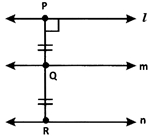
l || m. P and Q are points on land m respectively such that PQ ⊥ lR is a point on a line n in the same plane such that \(\overline { PQ }\) = \(\overline { QR }\). Which of the following is true?
(a) l || n
(b) m || n
(c) Both [a] and [b]
(d) Neither [a] nor [b]

Answer

Answer: (c) Both [a] and [b]
Hint:
Class 6 Maths Chapter 14 MCQ
Clearly, from the given data and the figure, l || n and m || n.


Class 6 Maths Chapter 14 MCQ Question 4.
At 7 a.m. the angle between the Sun’s ray and the ground at a point is 43°. What would be the angle at 10 a.m.?
(a) 40°
(b) 90°
(c) Between 43° and 90°
(d) Greater than 90°

Answer

Answer: (c) Between 43° and 90°
Hint:
MCQ On Practical Geometry For Class 6
Let QP be the sun’s ray and RP be the ground. The angle between QP and PR at P is 43° at 7 a.m. At 10 a.m., the sun’s ray is Q’P. We know that at 12 noon the sun is exactly above our head. So, the sun’s ray will be perpendicular to the ground. So, clearly at 10 am, the required angle will be between 43° and 90°.


MCQ On Practical Geometry For Class 6 Question 5.
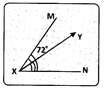
\(\overrightarrow { XY }\) divides ∠MXN = 72° in the ratio 1 : 2. What is the measure of ∠YXN?
Practical Geometry Class 6 MCQ Questions
(a) 48°
(b) 24°
(c) 72°
(d) 96°

Answer

Answer: (a) 48°
Hint:
MCQ Of Practical Geometry Class 6
Given ∠MXN = 72∘ and \(\overrightarrow { XY }\) divides ∠MXN in the ratio 1 : 2.
∠YXN = \(\frac{2}{3}\) ∠MXN = \(\frac{2}{3}\) × 72° = 48°


MCQ Of Practical Geometry Class 6 Question 6.
\(\overrightarrow { MN }\) is the perpendicular bisector of \(\overleftrightarrow { AB }\). Which of the given statements is correct?
(i) ∠ANM + ∠MNB = 90∘
(ii) \(\overline { AN }\) = \(\overline { NB }\)
(iii) \(\overline { AN }\) = 2 \(\overline { NB }\)
(iv) ∠MNB = \(\frac{1}{2}\) ∠ANM
(a) (i) and (iii) only
(b) (ii) and (iv) only
(c) (i) and (ii) only
(d) (ii) and (iii) only

Answer

Answer: (c) (i) and (ii) only
Hint:
\(\overrightarrow { NM }\) ⊥ \(\overleftrightarrow { AB }\) and \(\overrightarrow { NM }\) divides \(\overleftrightarrow { AB }\) into two congruent parts.
MCQ Of Practical Geometry Class 6
Clearly ∠ANM = ∠MNB = 90∘ is true. \(\overline { AN }\) = \(\overline { NB }\) is true since \(\overrightarrow { NM }\) ⊥ \(\overleftrightarrow { AB }\), \(\overline { AN }\) = 2\(\overline { NB }\) is false, and ∠MNB = \(\frac{1}{2}\) ∠ANM is false. Thus, only (i) and (ii) are correct.


Class 6 Maths Practical Geometry MCQ Question 7
Identify the uses of a ruler.
(a) To draw a line segment of a given length
(b) To draw a copy of a given segment.
(c) To draw a diameter of a circle.
(d) All the above.

Answer

Answer: (d) All the above.
Hint:
A ruler is used to draw a line segment of a given length, to draw the copy of a given segment, and to draw a diameter of a circle. Thus, all the given options are correct.


Practical Geometry MCQ Class 6 Question 8.
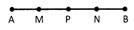
P is the midpoint of \(\overline { AB }\). M and N are midpoints of \(\overline { AP }\) respectively. What is the measure of \(\overline { MN }\)?
(a) \(\frac{1}{3}\) \(\overline { AB }\)
(b) \(\frac{1}{2}\) \(\overline { AB }\)
(c) \(\frac{1}{2}\) \(\overline { AP }\)
(d) \(\frac{3}{2}\) \(\overline { AB }\)

Answer

Answer: (b) \(\frac{1}{2}\) \(\overline { AB }\)
Hint:
Practical Geometry MCQ Class 6
P is the midpoint of \(\overline { AB }\) ⇒ AP = PB M and N are midpoints of \(\overline { AP }\) and \(\overline { PB }\) ⇒ \(\overline { AM }\) = \(\overline { MP }\) and \(\overline { PN }\) = \(\overline { NB }\)
∴ \(\overline { MN }\) = \(\overline { MP }\) + \(\overline { PN }\) = \(\frac{1}{2}\) \(\overline { AP }\) + \(\frac{1}{2}\) \(\overline { PB }\) = \(\frac{1}{2}\) (\(\overline { AP }\) + \(\overline { PB }\) ) = \(\frac{1}{2}\) (\(\overline { AB }\))


Class 6 Practical Geometry MCQ Question 9.
\(\overrightarrow { XY }\) bisects∠AXB. If ∠YXB = 37.5∘, what is the measure of ∠AXB?
(a) 37.5°
(b) 74°
(c) 64°
(d) 75°

Answer

Answer: (d) 75°


MCQ Practical Geometry Class 6 Question 10.
X and Y are two distinct points in a plane. How many lines can be drawn passing through both X and Y?
(a) 0
(b) 1
(c) Only 2
(d) Infinitely many

Answer

Answer: (b) 1


Ncert Class 6 Maths Chapter 14 MCQ Question 11.
Lines a, b, p, q, m, n and x have a point P common to all of them. What is the name of P?
(a) Point of concurrence
(b) Point of intersection
(c) Common point
(d) Distinct point

Answer

Answer: (a) Point of concurrence
Hint:
A point common to multiple lines is called a point of concurrence as the lines are concurrent lines.


Class 6 Maths Chapter 14 Extra Questions Question 12.
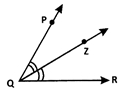
\(\overrightarrow { QZ }\) is the bisector of ∠PQZ = ∠PQR. Which of the following is true?
(a) ∠PQZ = ∠PQR
(b) ∠PQZ = ∠ZQR
(c) ∠PQZ = \(\frac{1}{2}\) ∠ZQR
(d) Both [b] and [c]

Answer

Answer: (d) Both [b] and [c]
Hint:
\(\overrightarrow { QZ }\) bisects ∠PQR (Given)
MCQ On Lines And Angles For Class 6
Thus. ∠PQZ = ∠ZQR = \(\frac{1}{2}\) ∠PQR


MCQ On Lines And Angles For Class 6 Question 13.
Identify the pair of parallel lines.
(i) Lines m and n have two points in common.
(ii) Lines p and q do not have any point in common
(iii) Lines p and q have a point X in common.
(a) (i) and (ii) only
(b) (ii) only
(c) (ii) and (iii) only
(d) (i), (ii) and (iii)

Answer

Answer: (b) (ii) only
Hint:
Parallel lines do not have any point in common.


Class 6 Maths Ch 14 MCQ Question 14.
Identify the one with no definite length.
(a) \(\overleftrightarrow { AB }\)
(b) \(\overline { PQ }\)
(c) -XYZ
(d) \(\overline { MN }\)

Answer

Answer: (a) \(\overleftrightarrow { AB }\)
Hint:
\(\overleftrightarrow { AB }\) has no definite length.


Question 15.
If two lines have only one point in common, what are they called?
(a) Parallel lines
(b) Intersecting lines
(c) Perpendicular lines
(d) Transversal

Answer

Answer: (b) Intersecting lines
Hint:
Intersecting lines have only one point in common.


Question 16.
Two lines are said to be perpendicular to each other when they meet at ____angle.
(a) 180°
(b) 90°
(c) 60°
(d) 360°

Answer

Answer: (b) 90°


Question 17.
A line segment \(\overline { IP }\) is bisected at T. Which of the following equals \(\overline { IT }\)?
(a) \(\overline { IP }\)
(b) \(\overline { TP }\)
(c) \(\overline { TC }\)
(d) \(\overline { IQ }\)

Answer

Answer: (b) \(\overline { TP }\)


Question 18.
How do you draw a 90° angle?
(a) By drawing a perpendicular to a line from a point lying on it.
(b) By bisecting a 120° angle.
(c) By bisecting a 60° angle.
(d) By drawing multiples of 45° angle.

Answer

Answer: (a) By drawing a perpendicular to a line from a point lying on it.


Question 19.
An angle of 15° is drawn using a pair of compasses and a ruler. How is it done?
(a) Bisecting 60° angle.
(b) Bisecting 60° and 120° angles.
(c) Bisecting 60° and then bisecting it again.
(d) Bisecting a 60° and 180° angles.

Answer

Answer: (c) Bisecting 60° and then bisecting it again.


An angle of 15° is drawn using a pair of compasses and a ruler. How is it done?

Question 20.
Identify the instruments used to bisect a given line segment.
(a) A scale and a protractor
(b) Scale and compasses
(c) Scale and setsquares
(d) A scale

Answer

Answer: (b) Scale and compasses


We hope the given NCERT MCQ Questions for Class 6 Maths Chapter 14 Practical Geometry with Answers Pdf free download will help you. If you have any queries regarding Practical Geometry CBSE Class 6 Maths MCQs Multiple Choice Questions with Answers, drop a comment below and we will get back to you soon.
The Comet 1 Class 8 MCQ Questions with Answers English Chapter 9

The Comet 1 Class 8 MCQ Questions with Answers English Chapter 9

Check the below NCERT MCQ Questions for Class 8 English It So Happened Chapter 9 The Comet 1 with Answers Pdf free download. MCQ Questions for Class 8 English with Answers were prepared based on the latest exam pattern. We have provided The Comet 1 Class 8 English MCQs Questions with Answers to help students understand the concept very well. https://ncertmcq.com/mcq-questions-for-class-8-english-with-answers/

Students can also visit the most accurate and elaborate NCERT Solutions for Class 8 English It So Happened (supplementary) Chapter Chapter 9 The Comet I Question Answer. Every question in the textbook has been answered here.

MCQ Questions for Class 8 English It So Happened Chapter 9 The Comet 1 with Answers

The Comet 1 MCQ Question 1.
Indrani had woken up because
(a) Duttada had gone
(b) She felt for the adjoining pillow and found no one there
(c) she did not know where Duttada was
(d) there was a burst of cool breeze

Answer

Answer: (d) there was a burst of cool breeze


Comet 1 Class 8 MCQ Question 2.
Dibya was a
(a) woman who was Dutta’s friend
(b) woman who was Indrani’s friend
(c) maid who worked for them
(d) telescope which Duttada had

Answer

Answer: (d) telescope which Duttada had


Comet 1 MCQ Question 3.
The telescope was for Duttada
(a) an instrument
(b) something to help him
(c) fulfilment of an ambition
(d) a good investment

Answer

Answer: (c) fulfilment of an ambition


The Comet 1 Class 8 MCQ Question 4.
Navin Babu was to Duttada
(a) a friend
(b) a doctor
(c) a son
(d) a brother

Answer

Answer: (b) a doctor


Navin Babu was to Duttada

Comet 1 MCQ Questions Question 5.
Duttada’s secret ambition was to
(a) discover a new comet
(b) go to London
(c) be famous and wealthy
(d) Just look into the sky and watch it

Answer

Answer: (a) discover a new comet


The Comet MCQ Question 6.
Comets are different from planets because they
(a) orbit round the sun
(b) are small in size
(c) can be new unlike the planets
(d) are generally close to the sun

Answer

Answer: (c) can be new unlike the planets


Question 7.
Professional astronomers
(a) generally discover comets
(b) generally look at faint stars
(c) discover planets
(d) are not interested in discoveries

Answer

Answer: (b) generally look at faint stars


Question 8.
“ Barring rare circumstances, the collision is inevitable.” What were those rare circumstances?
(a) Collision with an asteroid
(b) Splitting near the sun
(c) Evaporating
(d) All of the Above

Answer

Answer: (d) All of the Above


Question 9.
Who had James given the manuscript to?
(a) Nature
(b) IIA
(c) Sir John
(d) Taylor

Answer

Answer: (a) Nature


Question 10.
How would you describe Johnson?
(a) Quiet
(b) Efficient
(c) Both a and b
(d) None of the above

Answer

Answer: (c) Both a and b


Question 11.
Who was Johnson?
(a) Provost of King’s College
(b) Butler
(c) Security officer at Whitehall
(d) Defence Science Advisor, Her Majesty’s government

Answer

Answer: (c) Security officer at Whitehall


Question 12.
Where did the envelope tell him to come?
(a) London
(b) Canada
(c) New York
(d) India

Answer

Answer: (a) London


Question 13.
“ There is no __________ whatsoever with the arrival of a comet and the calamities of the earth.”
(a) Correlation
(b) Proof
(c) Finding
(d) None of the above

Answer

Answer: (a) Correlation


Question 14.
Duttada laughed. “I see that even an MA degree has not cured you of your __________!
(a) Dumbness
(b) Sarcasm
(c) Doubt
(d) Superstitions

Answer

Answer: (d) Superstitions


Question 15.
Did he like the publicity he was receiving?
(a) Yes
(b) No
(c) Maybe
(d) Not mentioned in the story

Answer

Answer: (b) No


Question 16.
Duttada was absent-minded about daily chores. How was he with his calculations?
(a) Absent-minded
(b) Oblivious
(c) Meticulous
(d) Forgetful

Answer

Answer: (c) Meticulous


Question 17.
Why could professionals not discover a comet?
(a) They are busy with pre-assigned programmes
(b) They are busy looking at faint stars
(c) They are busy looking at nebulous galaxies
(d) All of the Above

Answer

Answer: (d) All of the Above


Question 18.
What was Duttada’s secret ambition?
(a) To discover an asteroid
(b) To buy a telescope
(c) To spend nights star-gazing
(d) To discover a comet

Answer

Answer: (d) To discover a comet


Question 19.
What does his wife think of Dibya?
(a) A telescope
(b) A designing woman
(c) A man
(d) His husband’s friend

Answer

Answer: (b) A designing woman


Question 20.
What do you mean by ‘tete-a-tete’?
(a) Public meeting
(b) Public announcement
(c) Private meeting
(d) None of the above

Answer

Answer: (c) Private meeting


Question 21.
Who was he hobnobbing with?
(a) Dibya
(b) Indrani Debi
(c) Himself
(d) No one

Answer

Answer: (a) Dibya


Who was he hobnobbing with?

Question 22.
“IT was a moonless night in __________”
(a) September
(b) October
(c) November
(d) December

Answer

Answer: (d) December


Short Answer Type Questions

Question 1.
Where was Duttada when Indrani Debi felt his pillow ?

Answer

Answer: Duttada was on the roof looking at the stars through his telescope.


Question 2.
What did Duttada call his telescope ?

Answer

Answer: Duttada called his telescope Dibya Chakshu—the Divine Eye.


Question 3.
What were Duttada’s ambitions in life ?

Answer

Answer: First, he should have enough money to buy a good telescope. Secondly, he should have enough spare time to observe the stars.


Question 4.
What was Duttada’s secret ambition ?

Answer

Answer: Duttada’s secret ambition was to discover a new comet.


Question 5.
To whom does Duttada give the credit for his discovery ?

Answer

Answer: Duttada gives the credit for his discovery to his eight-inch telescope. He calls it ‘Dibya Chakshu’.


Question 6.
Why did Duttada feel disgusted with his discovery ?

Answer

Answer: Duttada was an introvert. So, he felt disgusted with the receptions and functions organised for him.


Question 7.
Why did Indrani Debi wish that Duttada should not have made this discovery ?

Answer

Answer: Indrani Debi believed that comets brought bad luck. She wished a good man like Duttada not to be associated with such a discovery.


Question 8.
What did Duttada say about comets ?

Answer

Answer: Duttada said that comets have nothing to do with calamities on the earth. There is nothing harmful about them. His comet will cause no anxiety to anybody.


Question 9.
How did Sir John get hold of James’ original manuscript ?

Answer

Answer: Sir John met one Mr. Taylor at lunch in a club. Taylor showed him a paper there. He asked for Sir John’s opinion about the manuscript. It was James’s original manuscript. Taylor wanted to consult Sir John before sending the manuscript to a professional referee. So Sir John got hold of James’s original manuscript.


Question 10.
What is the important point the paper makes ?

Answer

Answer: The paper makes the important point that Comet Dutta will collide with the earth.


We hope the given NCERT MCQ Questions for Class 8 English It So Happened Chapter 9 The Comet 1 with Answers Pdf free download will help you. If you have any queries regarding CBSE Class 8 English The Comet 1 MCQs Multiple Choice Questions with Answers, drop a comment below and we will get back to you soon.

MCQ Questions for Class 8 Hindi Chapter 18 टोपी with Answers

MCQ Questions for Class 8 Hindi Chapter 18 टोपी with Answers

Check the below NCERT MCQ Questions for Class 8 Hindi Vasant Chapter 18 टोपी with Answers Pdf free download. MCQ Questions for Class 8 Hindi with Answers were prepared based on the latest exam pattern. We have provided टोपी Class 8 Hindi MCQs Questions with Answers to help students understand the concept very well.

Students can also read NCERT Solutions for Class 8 Hindi Chapter 18 Questions and Answers at LearnInsta. Here all questions are solved with a detailed explanation, It will help to score more marks in your examinations.

टोपी Class 8 MCQs Questions with Answers

Topi Class 8 MCQ Question 1.
पाठ का नाम और इसके लेखक हैं
(a) गवरा और गवरइया – संजय
(b) टोपी -संजय
(c) राजा की टोपी – संजय
(d) गवरइया की टोपी – संजय

Answer

Answer: (b) टोपी -संजय


Class 8 Hindi Chapter 18 MCQ Question 2.
गवरा, गवरइया के शरीर को कैसा बता रहा है?
(a) मोटा ताजा
(b) दुबला पतला
(c) अनगढ़
(d) सुगढ़

Answer

Answer: (d) सुगढ़


Topi Class 8 Extra Questions Question 3.
टोपी कौन पहनता है?
(a) मनुष्य
(b) सेनापति
(c) राजा का मंत्री
(d) राजा

Answer

Answer: (d) राजा


Topi MCQ Class 8 Question 4.
गवरइया धुनिए के पास क्यों गई?
(a) टोपी बनवाने
(b) रुई धुनवाने
(c) राजा का घर देखने
(d) उससे मित्रता करने

Answer

Answer: (b) रुई धुनवाने


Class 8 Hindi Ch 18 MCQ Question 5.
कितनी टोपियाँ सिली गईं ?
(a) दो
(b) तीन
(c) चार
(d) पाँच

Answer

Answer: (a) दो


Ncert Class 8 Hindi Chapter 18 MCQ Question 6.
दरजी ने टोपी पर कितने फुदने लगाए ?
(a) पाँच फूंदने
(b) चार फूंदने
(c) तीन फूंदने
(d) दो फंदने

Answer

Answer: (a) पाँच फूंदने


Class 8 Hindi Chapter 18 Extra Questions Question 7.
गवरइया ने राजा को कैसा बताया?
(a) अच्छा
(b) बुरा
(c) डरपोक
(d) सच्चा

Answer

Answer: (c) डरपोक


MCQ Questions For Class 8 Hindi Chapter 18 Question 8.
राजा ने गवरइया को कैसा बताया?
(a) अच्छा
(b) बुरा
(c) मुँहफट
(d) ठीक

Answer

Answer: (c) मुँहफट


(1)

साथ हँसते, साथ ही रोते, एक साथ खाते-पीते, एक साथ सोते। भिनसार होते ही खोते से निकल पड़ते दाना चुगने और झुटपुटा होते ही खोंते में आ घुसते। थकान मिटाते और सारे दिन के देखे-सुने में हिस्सेदारी बटाते। एक शाम गवरइया बोली, “आदमी को देखते हो? कैसे रंग-बिरंगे कपड़े पहनते हैं ! कितना फबता है उन पर कपड़ा!”
“खक फबता है!” गवरा तपाक से बोला, “कपड़ा पहन लेने के बाद तो आदमी और बदसूरत लगने लगता है।”
“लगता है आज लटजीरा चुग गए हो?” गवरइया बोल पड़ी।
“कपड़े पहन लेने के बाद आदमी की कुदरती खूबसूरती ढंक जो जाती है।” गवरा बोला, “अब तू ही सोच! अभी तो तेरी सुघड़ काया का एक-एक कटाव मेरे सामने हैं, रोंवे-रोंवे की रंगत मेरी आँखों में चमक रही है।

Class 8 Topi MCQ Question 1.
वे अपने घोंसले में कब आते थे?
(a) प्रातः के समय
(b) दोपहर के समय
(c) शाम के समय
(d) रात के समय

Answer

Answer: (c) शाम के समय


Question 2.
घोंसले में आने के बाद गवरा और गवरइया किस विषय पर बातें कर रहे थे?
(a) आदमी के व्यवहार पर
(b) आदमी के कपड़े पर
(c) आदमी के खान-पान पर
(d) आदमी की सुंदरता पर

Answer

Answer: (c) आदमी के खान-पान पर


घोंसले में आने के बाद गवरा और गवरइया किस विषय पर बातें कर रहे थे?

Question 3.
“भिनसार शब्द का अर्थ है-
(a) मनाया हुआ
(b) प्रातः काल
(c) सायंकाल
(d) सूर का चमकना

Answer

Answer: (b) प्रातः काल


Question 4.
कपड़े पहन लेने से क्या होता है?
(a) शरीर ढक जाता है
(b) कुदरती सुंदरता ढक जाती है
(c) आदमी सुंदर दिखता है

Answer

Answer: (b) कुदरती सुंदरता ढक जाती है


Question 5.
‘सुघड़ काया’ में सुघड़ शब्द क्या है?
(a) संज्ञा
(b) सर्वनाम
(c) क्रिया
(d) विशेषण

Answer

Answer: (d) विशेषण


(2)

“उनके सिर पर टोपी कितनी अच्छी लगती है।” गवरइया बोली, “मेरा भी मन टोपी पहनने का करता है।”
“टोपी तू पाएगी कहाँ से?” गवरा बोला, “टोपी तो आदमियों का राजा पहनता है। जानती है, एक टोपी के लिए कितनों का टाट उलट जाता है। जरा-सी चूक हुई नहीं कि टोपी उछलते देर नहीं लगती। अपनी टोपी सलामत रहे, इसी फिकर में कितनों को टोपी पहनानी पड़ती है। … मेरी मान तो तू इस चक्कर में पड़ ही मत।”
गवरा था तनिक समझदार, इसलिए शक्की। जबकि गवरइया थी जिद्दी और धुन की पक्की। ठान लिया सो ठान लिया, उसको ही जीवन का लक्ष्य मान लिया। कहा गया है-जहाँ चाह, वहीं राह। मामूल के मुताबिक अगले दिन दानों घूरे पर चुगने निकले। चुगतेचुगते उसे रुई का एक फाहा मिला।

Question 1.
गवरइए ने गँवरे से कौन सी इच्छा प्रकट की?
(a) उड़ने की
(b) साथ-साथ खाने की
(c) साथ-साथ उड़ने की
(d) टोपी पहनने की

Answer

Answer: (d) टोपी पहनने की


Question 2.
टोपी कौन पहनता है?
(a) आदमी
(b) आदमियों का राजा
(c) गवरइया
(d) दरजी

Answer

Answer: (b) आदमियों का राजा


Question 3.
‘गवरइया’ कैसी थी?
(a) समझदार
(b) जिद्दी
(c) धुन की पक्की
(d) जिद्दी और धुन की पक्की

Answer

Answer: (d) जिद्दी और धुन की पक्की


Question 4.
चुगते-चुगते गवरइया को क्या मिला?
(a) एक फुदना
(b) रुई का फाहा
(c) एक टोपी
(d) एक कपड़ा

Answer

Answer: (b) रुई का फाहा


Question 5.
‘जीवन’ का विलोम शब्द है-
(a) अमर
(b) जिंदगी
(c) मरण
(d) मृतक

Answer

Answer: (c) मरण


(3)

धुनिए को अपनी जिंदगी में आज तक खरी मजूरी कभी न मिली थी। सोलह आने में आठ आने मजूरी तो इसके लिए सपना थी। वह झट तैयार हो गया। ‘घर-चों, घर्र-चों’ उसकी ताँती बज उठी। उसने बड़े मन से रुई धुनी, “लो इसे …।” उसमें से आधा धुनिए ने ले लिया और आधा गवरइया ने।
इससे उत्साहित गवरा-गवरइया एक कोरी के यहाँ गए और कहने लगे, “कौरी भाइया-कोरी भइया, इस धुनी रुई से सूत कात दो।

Question 1.
धुनिए को पहली बार इतनी मज़दूरी किसने दी?
(a) राजा ने
(b) बनिए ने
(c) गवरा और गवरइए ने
(d) इनमें से कोई नहीं

Answer

Answer: (c) गवरा और गवरइए ने


Question 2.
‘सोलह आने में आठ आने मजूरी’ का क्या अभिप्राय है?
(a) आधा मजदूरी
(b) आठ आना मजदूरी
(c) उम्मीद से ज्यादा पारिश्रमिक
(d) उपर्युक्त सभी

Answer

Answer: (c) उम्मीद से ज्यादा पारिश्रमिक


Question 3.
‘ताँती’ किसे कहते हैं?
(a) एक वाद्य यंत्र
(b) तौलने की मशीन
(c) रुई साफ़ करने का देशी उपकरण
(d) इनमें से कोई नहीं

Answer

Answer: (c) रुई साफ़ करने का देशी उपकरण


Question 4.
गवरा, गवरइया कोरी के यहाँ क्यों गए?
(a) रुई खरीदने
(b) रुई धुनवाने
(c) रुई से सूत कतवाने
(d) उपर्युक्त सभी

Answer

Answer: (c) रुई से सूत कतवाने


Question 5.
‘उत्साहित’ शब्द में लगा प्रत्यय है
(a) हित
(b) इत
(c) हत
(d) अहित

Answer

Answer: (b) इत


(4)

एक सिपाही ने गुलेल मारकर गवरइया की टोपी नीचे गिरा दी, तो दूसरे सिपाही ने झट वह टोपी लपक ली और राजा के सामने पेश कर दिया। राजा टोपी को पैरों से मसलने ही जा रहा था कि उसकी खूबसूरती देखकर दंग रह गया। कारीगरी के इस नायब नमूने को देखकर वह जड़ हो गया-“मेरे राज में मेसिवा इतनी खूबसूरत टोपी दूसरे के पास कैसे पहुँची!” सोचते हुए राजा उसे उलटपुलटकर देखने लगा।

Question 1.
सिपाही ने गवरइया की टोपी क्यों गिराई ?
(a) कुरूप होने के कारण
(b) गवरइया के अनुरोध के कारण
(c) सिपाई के मना करने के कारण
(d) क्योंकि वह टोपी पहनकर राजा को चिढ़ा रही थी।

Answer

Answer: (d) क्योंकि वह टोपी पहनकर राजा को चिढ़ा रही थी।


Question 2.
पहले सिपाही ने क्या किया?
(a) गवरइया की टोपी गिरा दी
(b) गुलेल मारी
(c) दोनों काम किए
(d) टोपी लपक ली

Answer

Answer: (c) दोनों काम किए


Question 3.
गवरइया की वह टोपी थी?
(a) बहुत महँगी
(b) बहुत बड़ी
(c) अद्वितीय नमूना
(d) साधारण नमूना

Answer

Answer: (c) अद्वितीय नमूना


गवरइया की वह टोपी थी?

Question 4.
खूबसूरत टोपी’ में रेखांकित शब्द क्या है?
(a) संज्ञा
(b) सर्वनाम
(c) विशेषण
(d) क्रिया

Answer

Answer: (c) विशेषण


We hope the given NCERT MCQ Questions for Class 8 Hindi Vasant Chapter 18 टोपी with Answers Pdf free download will help you. If you have any queries regarding CBSE Class 8 Hindi टोपी MCQs Multiple Choice Questions with Answers, drop a comment below and we will get back to you soon.
MCQ Questions for Class 6 Maths Chapter 3 Playing with Numbers with Answers

MCQ Questions for Class 6 Maths Chapter 3 Playing with Numbers with Answers

Check the below NCERT MCQ Questions for Class 6 Maths Chapter 3 Playing with Numbers with Answers Pdf free download. MCQ Questions for Class 6 Maths with Answers were prepared based on the latest exam pattern. We have provided Playing with Numbers Class 6 Maths MCQs Questions with Answers to help students understand the concept very well.

Students can also refer to NCERT Solutions for Class 6 Maths Chapter 3 Playing with Numbers for better exam preparation and score more marks.

Playing with Numbers Class 6 MCQs Questions with Answers

Playing With Numbers Class 6 MCQ Question 1.
Which of the following numbers is not a factor of 68?
(a) 2
(b) 4
(c) 17
(d) 6.

Answer

Answer: (d)


Class 6 Maths Chapter 3 MCQ Question 2.
Which of tfie following numbers is not a factor of 36?
(a) 2
(b) 4
(c) 18
(d) 8.

Answer

Answer: (d)


MCQ Questions For Class 6 Maths Chapter 3 Question 3.
Which of the following numbers is not a factor of 24?
(a) 2
(b) 3
(c) 4
(d) 5.

Answer

Answer: (d)


MCQ On Playing With Numbers For Class 6 Question 4.
Which of the following numbers is not a factor of 15?
(a) 1
(b) 3
(c) 4
(d) 5.

Answer

Answer: (c)


MCQ Class 6 Maths Chapter 3 Question 5.
Which of the following number is not a factor of 21?
(a) 1
(b) 3
(c) 6
(d) 7.

Answer

Answer: (c)


Playing With Numbers MCQ Class 6 Question 6.
Which of the following number is not a multiple of 27?
(a) 1
(b) 3
(c) 9
(d) 6

Answer

Answer: (d)


Class 6 Playing With Numbers MCQ Question 7.
Which of the following numbers is not a factor of 12?
(a) 4
(b) 2
(c) 3
(d) 8.

Answer

Answer: (d)


MCQ On Playing With Numbers Question 8.
Which of the following numbers is not a factor of 20?
(a) 2
(b) 4
(c) 5
(d) 6.

Answer

Answer: (d)


MCQ Playing With Numbers Class 6 Question 9.
Which of the following number is not a factor of 18?
(a) 2
(b) 3
(c) 6
(d) 8.

Answer

Answer: (d)


Playing With Numbers MCQ Question 10.
Which of the following number is not a multiple of 6?
(a) 12
(b) 21
(c) 24
(d) 36.

Answer

Answer: (b)


Class 6 Maths MCQ Chapter 3 Question 11.
Which of the following number is not a multiple of 5?
(a) 15
(b) 20
(c) 30
(d) 33.

Answer

Answer: (d)


MCQ For Class 6 Maths Chapter 3 Question 12.
Which of the following number is not a multiple of 9?
(a) 18
(b) 36
(c) 81
(d) 75

Answer

Answer: (d)


Which of the following number is not a multiple of 9?

MCQ Questions On Playing With Numbers For Class 6 Question 13.
The smallest prime number is
(a) 1
(b) 2
(c) 3
(d) 4.

Answer

Answer: (b)


MCQ Of Playing With Numbers Class 6 Question 14.
The smallest composite number is
(a) 1
(b) 2
(c) 3
(d) 4.

Answer

Answer: (d)


Class 6 Math Chapter 3 MCQ Question 15.
The prime number which is even, is
(a) 2
(b) 3,
(c) 5
(d) 13.

Answer

Answer: (a)


Question 16.
1 is
(a) a prime number
(b) a composite number
(c) neither prime nor composite
(d) an even number.

Answer

Answer: (c)


Question 17.
The smallest odd number is
(a) 1
(b) 2
(c) 3
(d) 4.

Answer

Answer: (a)


Question 18.
The smallest even number is
(a) 1
(b) 2
(c) 3
(d) 4.

Answer

Answer: (b)


Question 19.
The least prime number between 1 and 10 is
(a) 2
(b) 5
(c) 3
(d) 7.

Answer

Answer: (a)


Question 20.
The greatest prime number between 1 and 10 is
(a) 7
(b) 5
(c) 3
(d) 2.

Answer

Answer: (a)


Question 21.
Which of the following numbers is prime?
(a) 21
(b) 12
(c) 17
(d) 39.

Answer

Answer: (c)


Question 22.
Which of the following numbers is composite?
(a) 19
(b) 23
(c) 6
(d) 29.

Answer

Answer: (c)


Question 23.
Which of the following statements is true?
(a) The product of two even numbers is always even.
(b) The sum of three odd numbers is even.
(c) All prime numbers are odd.
(d) Prime numbers do not have any factors.

Answer

Answer: (a)


Question 24.
Which of the following statements is false?
(a) All even numbers are composite numbers.
(b) If an even number is divided by 2, the quotient may be odd or even.
(c) The sum of two odd numbers and one even number is even.
(d) Sum of two prime numbers is not always even.

Answer

Answer: (a)


Question 25.
128 is divisible by
(a) 2
(b) 3
(c) 5
(d) 10.

Answer

Answer: (a)


Question 26.
275 is divisible by
(a) 5
(b) 3
(c) 6
(d) 8.

Answer

Answer: (a)


Question 27.
116 is divisible by
(a) 2
(b) 3
(c) 6
(d) 8.

Answer

Answer: (a)


Question 28.
200 is divisible by
(a) 8
(b) 3
(c) 6
(d) 11.

Answer

Answer: (a)


Question 29.
1331 is divisible by
(a) 11
(b) 2
(c) 3
(d) 5.

Answer

Answer: (a)


Question 30.
1000 is divisible by
(a) 10
(b) 6
(c) 3
(d) 11.

Answer

Answer: (a)


Question 31.
The greatest common factor of 8 and 20 is
(a) 2
(b) 1
(c) 4
(d) 8.

Answer

Answer: (c)


Question 32.
The common factor of 9 and 15 is
(a) 3
(b) 6
(c) 9
(d) 15.

Answer

Answer: (a)


Question 33.
The common factor of 4 and 15 is
(a) 1
(b) 2
(c) 3
(d) 5.

Answer

Answer: (a)


Question 34.
Which of the following pairs of number are not co-prime?
(a) 7,15
(b) 12,49
(c) 18,23
(d) 12,21.

Answer

Answer: (d)


Question 35.
Which of the following pairs of number are co-prime?
(a) 30,415
(b) 17, 68
(c) 16, 81
(d) 15, 100.

Answer

Answer: (c)


Question 36.
The greatest common factor of 4, 8 and 12 is
(a) 2
(b) 1
(c) 4
(d) 8

Answer

Answer: (c)


Question 37.
The greatest common factor of 5, 15 and 25 is
(a) 1
(b) 5
(c) 10
(d) 15.

Answer

Answer: (b)


Question 38.
The common factor of 3, 4 and 9 is
(a) 1
(b) 3
(c) 4
(d) 2.

Answer

Answer: (a)


Question 39.
The greatest common factor of 75,60 and 210 is
(a) 1
(b) 3
(c) 5
(d) 15.

Answer

Answer: (d)


Question 40.
The smallest common factor of 4, 12 and 16 is
(a) 1
(b) 2
(c) 4
(d) 8.

Answer

Answer: (a)


Question 41.
The HCF of 8 and 12 is
(a) 1
(b) 2
(c) 3
(d) 4.

Answer

Answer: (d)


Question 42.
The HCF of 24 and 36 is
(a) 3
(b) 6
(c) 12
(d) 24.

Answer

Answer: (c)


Question 43.
The HCF of 27 and 63 is
(a) 3
(b) 6
(c) 9
(d) 18.

Answer

Answer: (c)


Question 44.
The HCF of 36 and 84 is
(a) 3
(b) 4
(c) 6
(d) 12.

Answer

Answer: (d)


Question 45.
The HCF of 30 and 42 is
(a) 2
(b) 3
(c) 5
(d) 6.

Answer

Answer: (d)


The HCF of 30 and 42 is

Question 46.
The LCM of 5 and 20 is
(a) 5
(b) 10
(c) 15
(d) 20.

Answer

Answer: (d)


Question 47.
The LCM of 6 and 18 is
(a) 6
(b) 12
(c) 18
(d) 36.

Answer

Answer: (c)


Question 48.
The LCM of 12 and 48 is
(a) 6
(b) 12
(c) 24
(d) 48.

Answer

Answer: (d)


Question 49.
The LCM of 9 and 45 is
(a) 3
(b) 9
(c) 5
(d) 45.

Answer

Answer: (d)


Question 50.
The LCM of 5 and 6 is
(a) 10
(b) 20
(c) 30
(d) 60.

Answer

Answer: (c)


We hope the given NCERT MCQ Questions for Class 6 Maths Chapter 3 Playing with Numbers with Answers Pdf free download will help you. If you have any queries regarding Playing with Numbers CBSE Class 6 Maths MCQs Multiple Choice Questions with Answers, drop a comment below and we will get back to you soon.
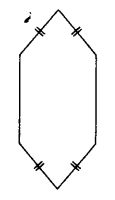
MCQ Questions for Class 6 Maths Chapter 5 Understanding Elementary Shapes with Answers

MCQ Questions for Class 6 Maths Chapter 5 Understanding Elementary Shapes with Answers

Check the below Online Education NCERT MCQ Questions for Class 6 Maths Chapter 5 Understanding Elementary Shapes with Answers Pdf free download. MCQ Questions for Class 6 Maths with Answers were prepared based on the latest exam pattern. We have provided Understanding Elementary Shapes Class 6 Maths MCQs Questions with Answers to help students understand the concept very well.
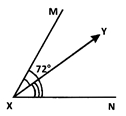
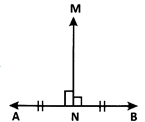
Students can also refer to NCERT Solutions for Class 6 Maths Chapter 5 Understanding Elementary Shapes for better exam preparation and score more marks.

Understanding Elementary Shapes Class 6 MCQs Questions with Answers

Understanding Elementary Shapes Class 6 MCQ Question 1.
The angle measure for one complete revolution is
(a) 180°
(b) 360°
(c) 90°
(d) none of these.

Answer

Answer: (b)


Class 6 Maths Chapter 5 MCQ Question 2.
The angle measure for half a revolution is
(a) 90°
(b) 180°
(c) 360°
(d) none of these.

Answer

Answer: (b)


MCQ Questions For Class 6 Maths Chapter 5 Question 3.
The angle measure for one-fourth revolution is
(a) 90°
(b) 360°
(c) 180°
(d) none of these.

Answer

Answer: (a)


Understanding Elementary Shapes Class 6 MCQ With Answers Question 4.
Through what angle measure does the hour hand of a clock turn through, when it goes from 3 to 9?
(a) 90°
(b) 360°
(c) 180°
(d) none of these.

Answer

Answer: (c)


MCQ On Angles For Class 6 Question 5.
Through what angle measure does the hour hand of a clock turn through, when it goes from 5 to 8?
(a) 90°
(b) 180°
(c) 360°
(d) none of these.

Answer

Answer: (a)


MCQ On Understanding Elementary Shapes For Class 6 Question 6.
Through what angle measure does the hour hand of a clock turn through, when it goes from 12 to 9?
(a) 270°
(b) 180°
(c) 360°
(d) 90°.

Answer

Answer: (a)


Understanding Elementary Shapes MCQ Question 7.
Through what angle does the hour hand of a clock turn through, when it goes from 2 to 11?
(a) 270°
(b) 90°
(c) 360°
(d) 180°.

Answer

Answer: (a)


Class 6 Maths Ch 5 MCQ Question 8.
Through what angle does the hour hand of a clock turn through, when it goes from 6 to 3?
(a) 90°
(b) 180°
(c) 270°
(d) 360°.

Answer

Answer: (c)


Ncert Class 6 Maths Chapter 5 MCQ Question 9.
What part of a revolution have you turned through if you stand facing north and turn clockwise to face west?
(a) \(\frac { 1 }{ 4 }\)
(b) \(\frac { 1 }{ 2 }\)
(c) \(\frac { 3 }{ 4 }\)
(d) none of these.

Answer

Answer: (c)


MCQ Class 6 Maths Chapter 5 Question 10.
What part of a revolution have you turned through if you stand facing east and turn clockwise to face west?
(a) \(\frac { 1 }{ 4 }\)
(b) \(\frac { 1 }{ 2 }\)
(c) \(\frac { 3 }{ 4 }\)
(d) none of these.

Answer

Answer: (b)


Class 6 Understanding Elementary Shapes MCQ Question 11.
What part of a revolution have you turned through, if you stand facing north and turn clockwise to face east?
(a) \(\frac { 1 }{ 4 }\)
(b) \(\frac { 1 }{ 2 }\)
(c) \(\frac { 3 }{ 4 }\)
(d) none of these

Answer

Answer: (a)


MCQ On Understanding Elementary Shapes Question 12.
Find the number of right angles turned through by the hour hand of a clock when it goes from 12 to 3.
(a) 1
(b) 2
(c) 3
(d) 4.

Answer

Answer: (a)


Class 6 Math Chapter 5 MCQ Question 13.
Find the number of right angles turned through by the hour hand of a clock when it goes from 4 to 10.
(a) 1
(b) 2
(c) 3
(d) 4.

Answer

Answer: (b)


Class 6 Maths Chapter 5 Extra Questions Question 14.
Find the number of right angles turned through by the hour hand of a clock when it goes from 3 to 12.
(a) 1
(b) 2
(c) 3
(d) 4.

Answer

Answer: (c)


Class 6 Maths Chapter 5 MCQ Questions Question 15.
How many right angles do you make if you start facing north and turn clockwise to south?
(a) 1
(b) 2
(c) 3
(d) 4.

Answer

Answer: (b)


How many right angles do you make if you start facing north and turn clockwise to south?

Question 16.
How many right angles do you make if you start facing east and turn clockwise to south?
(a) 1
(b) 2
(c) 3
(d) 4.

Answer

Answer: (a)


Question 17.
How many right angles do you make if you start facing south and turn clockwise to east?
(a) 1
(b) 2
(c) 3
(d) 4.

Answer

Answer: (c)


Question 18.
How many right angles do you make if you start facing east and turn clockwise to east?
(a) 1
(b) 2
(c) 3
(d) 4.

Answer

Answer: (d)


Question 19.
The measure of a right angle is
(a) 45°
(b) 90°
(c) 60°
(d) 180°.

Answer

Answer: (b)


Question 20.
The measure of a straight angle is
(a) 90°
(b) 45°
(c) 180°
(d) 60°.

Answer

Answer: (c)


Question 21.
The measure of an acute angle is
(a) < 90°
(b) > 90°
(c) = 90°
(d) none of these.

Answer

Answer: (a)


Question 22.
The measure of an obtuse angle is
(a) < 90°
(b) > 90° and < 180°
(c) = 90°
(d) none of these.

Answer

Answer: (b)


Question 23.
The measure of a reflex angle is
(a) 180°
(b) < 180°
(c) > 180°
(d) < 90°.

Answer

Answer: (c)


Question 24.
Which of the following angles is the measure of an acute angle?
(a) 30°
(b) 90°
(c) 120°
(d) 210°.

Answer

Answer: (a)


Question 25.
Which of the following angles is the measure of an obtuse angle?
(a) 120°
(b) 90°
(c) 60°
(d) 240°.

Answer

Answer: (a)


Question 26.
Which of the following angles is the measure of a reflex angle?
(a) 90°
(b) 180°
(c) 120°
(d) 270°.

Answer

Answer: (d)


Question 27.
A triangle having three unequal sides is called a
(a) scalene triangle
(b) isosceles triangle
(c) equilateral triangle
(d) right triangle.

Answer

Answer: (a)


Question 28.
A triangle having two equal sides is called
(a) a scalene triangle
(b) an isosceles triangle
(c) an equilateral triangle
(d) a right angled triangle.

Answer

Answer: (b)


Question 29.
A triangle having three equal sides is called
(а) a scalene triangle
(b) an isosceles triangle
(c) an equilateral triangle
(d) a right triangle.

Answer

Answer: (c)


Question 30.
Which of the following statement is true?
(a) The opposite sides of a trapezium are par-allel.
(b) All the sides of a parallelogram are of equal in length.
(c) The diagonals of a square are perpendicular to each other.
(d) All the angles of a rectangle are not equal.

Answer

Answer: (c)


Question 31.
The following shape is of a
MCQ Questions for Class 6 Maths Chapter 5 Understanding Elementary Shapes with Answers 1
(a) cone
(b) cylinder
(c) sphere
(d) pyramid.

Answer

Answer: (d)


Question 32.
The shape is of
MCQ Questions for Class 6 Maths Chapter 5 Understanding Elementary Shapes with Answers 2
(a) cylinder
(b) cone
(c) sphere
(d) cuboid.

Answer

Answer: (b)


Question 33.
MCQ Questions for Class 6 Maths Chapter 5 Understanding Elementary Shapes with Answers 3
The shape is of
(a) cone
(b) cylinder
(c) cuboid
(d) sphere

Answer

Answer: (b)


Question 34.
The shape is of
MCQ Questions for Class 6 Maths Chapter 5 Understanding Elementary Shapes with Answers 4
(a) cuboid
(b) cylinder
(c) cone
(d) sphere

Answer

Answer: (a)


Question 35.
The shape is of
MCQ Questions for Class 6 Maths Chapter 5 Understanding Elementary Shapes with Answers 5
(a) cone
(b) cylinder
(c) sphere
(d) Pyramid

Answer

Answer: (c)


Question 36.
The shape is of
MCQ Questions for Class 6 Maths Chapter 5 Understanding Elementary Shapes with Answers 6
(a) triangular prism
(b) pyramid
(c) cuboid
(d) cylinder.

Answer

Answer: (a)


Question 37.
The number of faces of the shape is
MCQ Questions for Class 6 Maths Chapter 5 Understanding Elementary Shapes with Answers 7
(a) 2
(b) 4
(c) 5
(d) 3

Answer

Answer: (c)


Question 38.
The number of edges of the shape is
MCQ Questions for Class 6 Maths Chapter 5 Understanding Elementary Shapes with Answers 8
(a) 4
(b) 8
(c) 10
(d) 12

Answer

Answer: (b)


Question 39.
The number of corners of the shape is
MCQ Questions for Class 6 Maths Chapter 5 Understanding Elementary Shapes with Answers 9
(a) 8
(b) 6
(c) 5
(d) 3

Answer

Answer: (c)


Question 40.
The number of faces of the shape is
MCQ Questions for Class 6 Maths Chapter 5 Understanding Elementary Shapes with Answers 10
(a) 2
(b) 3
(c) 4
(d) 5

Answer

Answer: (d)


Question 41.
The number of edges of the shape is
MCQ Questions for Class 6 Maths Chapter 5 Understanding Elementary Shapes with Answers 11
(a) 6
(b) 8
(c) 9
(d) 4

Answer

Answer: (c)


Question 42.
The number of comers of the shape is
MCQ Questions for Class 6 Maths Chapter 5 Understanding Elementary Shapes with Answers 12
(a) 1
(b) 2
(c) 4
(d) 6

Answer

Answer: (d)


Question 43.
The number of faces of the shape is
MCQ Questions for Class 6 Maths Chapter 5 Understanding Elementary Shapes with Answers 13
(a) 1
(b) 2
(c) 3
(d) 4

Answer

Answer: (d)


Question 44.
The number of edges of the shape is
MCQ Questions for Class 6 Maths Chapter 5 Understanding Elementary Shapes with Answers 14
(a) 3
(b) 6
(c) 4
(d) 15

Answer

Answer: (b)


Question 45.
The number of vertices of the shape is
MCQ Questions for Class 6 Maths Chapter 5 Understanding Elementary Shapes with Answers 15
(a) 1
(b) 2
(c) 3
(d) 4

Answer

Answer: (d)


Question 46.
The number of faces of the shape is
MCQ Questions for Class 6 Maths Chapter 5 Understanding Elementary Shapes with Answers 16
(a) 2
(b) 4
(c) 3
(d) 6

Answer

Answer: (d)


The number of faces of the shape is

Question 47.
The number of edges of the shape is
MCQ Questions for Class 6 Maths Chapter 5 Understanding Elementary Shapes with Answers 17
(a) 12
(b) 6
(c) 9
(d) 8

Answer

Answer: (a)


Question 48.
The number of vertices of the shape is
MCQ Questions for Class 6 Maths Chapter 5 Understanding Elementary Shapes with Answers 18
(a) 4
(b) 6
(c) 5
(d) 8

Answer

Answer: (d)


Question 49.
The number of vertices of a sphere is
(a) 0
(b) 1
(c) 2
(d) none of these.

Answer

Answer: (a)


Question 50.
The number of comers of a cylinder is
(a) 0
(b) 1
(c) 2
(d) none of these.

Answer

Answer: (a)


We hope the given NCERT MCQ Questions for Class 6 Maths Chapter 5 Understanding Elementary Shapes with Answers Pdf free download will help you. If you have any queries regarding Understanding Elementary Shapes CBSE Class 6 Maths MCQs Multiple Choice Questions with Answers, drop a comment below and we will get back to you soon.